


A competency and values framework is not what most organisations build when they set out to make one. What usually gets produced is a competency framework with a values page bolted onto the front, read as aspiration rather than obligation, and never actually assessed against anyone. A genuine competency and values framework does something more specific: it puts a levelled, role-based competency structure and a fixed, unlevelled set of organisational values inside one governed system, and assesses each on entirely different logic.
What Is a Competency and Values Framework?
A competency and values framework is a workforce structure that combines a competency framework with a defined set of organisational values, governs both, but keeps them on separate assessment tracks. The competency side works the way any competency framework does: it groups behaviours into domains, sets proficiency levels, and writes behavioural indicators that describe what performance looks like at each level. The values side does not scale. A value is a threshold a person meets or breaches, not a skill they develop over time.
This distinction is not stylistic. A paper on competency mapping in the journal Knowledge defines organisational values as the guiding principles that shape an organisation’s culture, behaviours and decisions, while defining competencies as the abilities and knowledge that let people perform tasks effectively (Competency Mapping as a Knowledge Driver in Modern Organisations). One describes what the organisation stands for. The other describes what a person can do. Treating them as the same category, and scoring both on a one-to-five proficiency scale, is the single most common error in building this kind of framework.
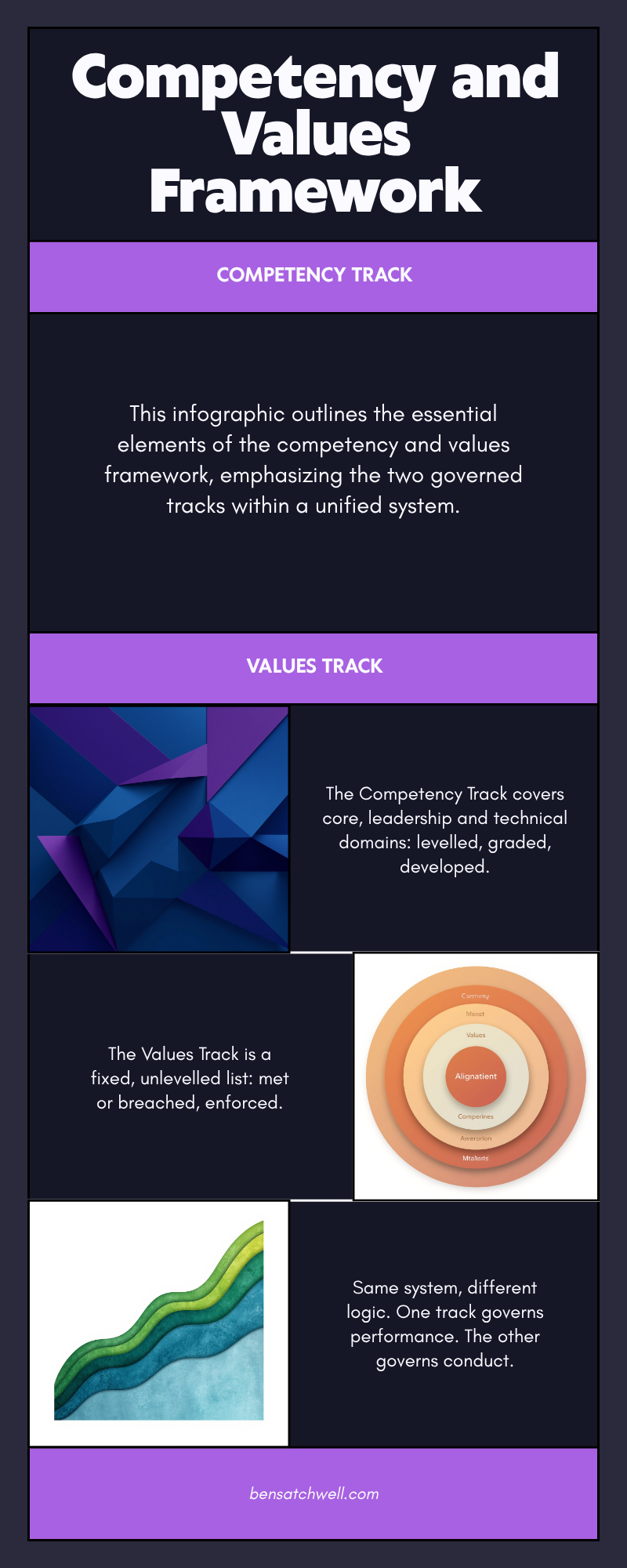
A competency and values framework runs two tracks inside one governance system: one levelled, one fixed.
Why Does a Competency and Values Framework Exist?
A competency framework answers one question: can this person do the work to the standard the role requires? It says nothing about whether they will do it honestly, fairly or consistently when nobody is checking. For most roles that gap is manageable. For roles carrying real discretion, handling money, safety, sensitive data or vulnerable people, the gap is the risk that matters most.
A values track exists to close that gap, and to make it enforceable independent of technical performance. Regulated industries make the case clearly. Under the UK's Senior Managers and Certification Regime, financial services firms must assess staff in certified roles against a Fit and Proper test that sits alongside, not inside, their technical competency assessment, and individuals can be found unfit on conduct grounds regardless of how strong their technical performance looks on paper. Australia's Financial Accountability Regime works on the same logic: accountable persons must meet defined accountability obligations that are evaluated independently of role competency. Neither regime lets a strong technical score offset a conduct failure, because the two are deliberately assessed on different bases.
This is the same logic behind why I built the People Capability System as a set of governed layers rather than one flat list: constructs that behave differently under assessment need to be modelled differently, not folded together because they both describe "how someone shows up" in loose conversation.
How Does a Competency and Values Framework Work in Practice?
Building one starts with the values, not the competencies, and it rarely starts from a blank page. Most organisations already have stated values somewhere, in a strategy document, an induction pack or a wall poster. The real work is converting each value from an adjective into an observable threshold: not "integrity" as a word, but a specific description of what a breach of integrity looks like in this organisation, in this sector, in this kind of decision.
- Each value is written once, applies to every person regardless of level, and is assessed as met or breached. No proficiency levels, no domains, no partial credit.
- Each competency sits inside the existing competency framework architecture: core, leadership and technical domains, three to six proficiency levels, and behavioural indicators written for each level.
- Governance splits along the same line. A learning and development or HR function typically owns the competency track and its assessment cycle. An ethics, integrity, professional standards or legal function owns the values track, because a breach is a conduct matter first and a people-development matter a distant second.
The two tracks meet at the point of decision: recruitment, performance review or promotion. Both get assessed in the same conversation on different logic: a competency gap gets a development plan, a values breach gets escalated. This is the same design principle behind what makes the People Capability System different from a single undifferentiated skills list: distinct constructs need distinct rules, not a shared rubric because it is administratively simpler.

Competencies progress through defined proficiency levels. Values do not. They apply identically at every level.
What Is a Competency and Values Framework Not?
- It is not a competency framework with a values statement in the introduction. If the values are never assessed against anyone, the document is a competency framework with decoration, not a competency and values framework.
- It is not a document where values are scored on the same proficiency scale as competencies. A value rated "3 out of 5" implies a person can be partially dishonest and still pass, which defeats the purpose of naming it a value in the first place.
- It is not the same as a plain competency framework, which defines and levels behaviours but has no mechanism for enforcing a fixed, non-negotiable standard of conduct.
- It is not a capability framework. A capability framework describes broad, transferable ability a person carries across roles and time. A competency and values framework pairs role-specific, levelled competencies with organisation-wide conduct thresholds, which is a narrower and more specific pairing.
- It is not culture. Culture describes what people actually do without anyone enforcing it. A values track describes what the organisation has committed to enforce, and a framework can exist inside a culture that does not yet match it. This mirrors what the People Capability System is not: a description of current behaviour rather than a governed standard for expected behaviour.
Named Frameworks and Standards to Know
The Australian Public Service Values are the clearest statutory example of a values track applied without reference to role. They sit above any agency-level competency framework and apply uniformly to every APS employee, in every agency, at every classification, regardless of which competency structure an individual agency runs underneath them. A strong competency score has no bearing on whether a values breach is upheld.
CIPD's Profession Map takes a related approach for the HR profession, built on purpose and values sitting alongside core knowledge and behaviours rather than a single competency list, a professional body's own acknowledgement that values need architectural treatment separate from technical competence.
Frameworks such as SFIA, Korn Ferry and DDI's competency libraries generally do not build in a values track. They assume conduct is governed separately through a code of conduct, which matters when comparing a values-inclusive framework against a purely technical one.
The most fully documented named example of this structure sitting inside a single branded framework is the UK's Competency and Values Framework for policing, maintained by the College of Policing. It is a specific enough model, and specific enough to one sector, that it warrants its own treatment: see Competencies and Values Framework: The UK Policing CVF Explained for a full breakdown of how it pairs six competencies with four fixed values.
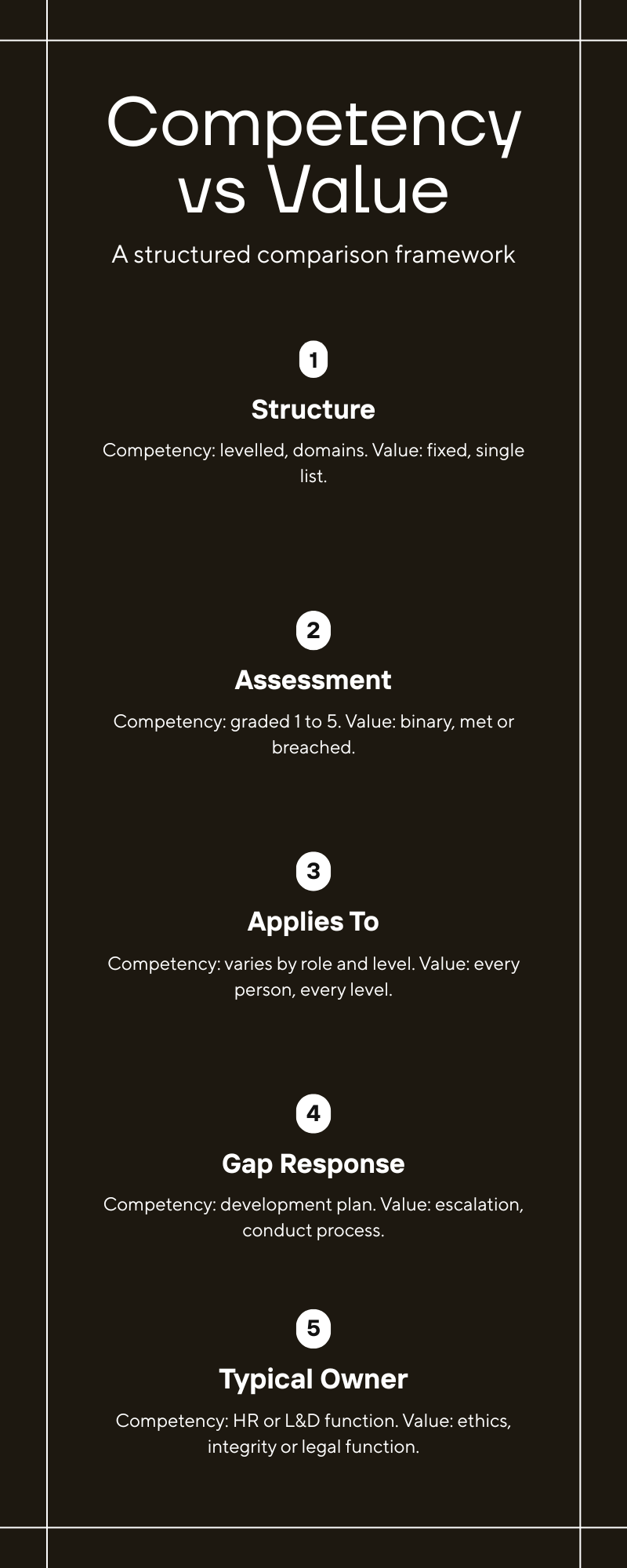
Competency and value differ across every governance dimension in a competency and values framework, not only in name.
Common Failure Modes in a Competency and Values Framework
- Writing values as aspirational adjectives, such as "we value excellence," produces a statement that cannot be observed or breached, because it describes an outcome rather than a conduct threshold.
- Scoring values on the same scale as competencies is the fastest way to collapse the entire design rationale for keeping them separate.
- Leaving the values track without a named owner distinct from HR means a breach becomes nobody's job to catch, since HR's mandate is typically development, not conduct enforcement.
- Importing a values track wholesale from another organisation or sector without recalibrating it locally is a genuine risk. Research assessing a culture instrument built on a related values framework found that dimensions validated with one employee population did not hold for another (Assessing an organizational culture instrument based on the Competing Values Framework). A values track written for one workforce rarely survives unedited contact with a different one.
- Building the framework without willingness to act on a breach independent of competency turns the whole document into a promise the organisation has already shown it will not keep.
Trade-Offs and Constraints
This structure earns its complexity where discretion under pressure creates genuine risk: regulated professions, safety-critical roles, financial services, and any function handling sensitive information or vulnerable people. In those settings, competence and conduct are both non-negotiable, and separate tracks are what make both enforceable.
It is usually the wrong tool for low-discretion roles with limited risk exposure. A standard competency framework covers the ground adequately, and adding a values track creates assessment overhead, a second governance owner and an escalation pathway without a matching rise in the risk being managed. The other real constraint is enforceability. A values track is only credible if the organisation will remove someone who is technically strong but breaches a value. Without that willingness, the framework becomes a document nobody trusts.
FAQ
What is the difference between a competency and a value in this kind of framework?
A competency is levelled and behavioural, describing graded performance from foundational through to expert. A value is a fixed threshold with no levels, describing conduct that is either met or breached regardless of role or seniority.
Is a competency and values framework the same as a capability framework?
No. A capability framework describes broad, transferable ability a person carries across roles and contexts. A competency and values framework pairs role-specific, levelled competencies with organisation-wide conduct thresholds, which is a different and more specific construct.
Do values have proficiency levels like competencies do?
No. Values are assessed as met or breached. Adding proficiency levels to a value implies partial compliance is acceptable, which defeats the purpose of stating it as a value rather than a competency.
Who should own the values track in a competency and values framework?
An ethics, integrity, professional standards or legal function is the usual owner, separate from whoever owns the competency track through HR or learning and development, because a values breach is a conduct matter rather than a development gap.
Can a small organisation build a competency and values framework?
Yes, but the complexity only pays off where genuine discretion and risk exist. A small organisation with low-risk, low-discretion roles is usually better served by a standard competency framework and a separate code of conduct, rather than the governance overhead of a combined structure.
Does every competency framework need a values track?
No. Frameworks such as SFIA and most technical competency libraries do not include one, and assume conduct is governed through a separate code of conduct. A values track is added deliberately, not by default, and only where the organisation is prepared to enforce it independently of competency.