
Most organisations can describe their CFO's responsibilities clearly enough. What they struggle to articulate is what competent performance in the role actually looks like. A list of accountabilities is not a CFO competency framework. Knowing the difference matters, and building one that does real work requires more precision than most organisations apply.
What Is a CFO Competency Framework?
A CFO competency framework is an organisation-specific system that defines the competencies the CFO must demonstrate to perform effectively in that role. It specifies what good looks like at this level of seniority, across the domains of performance the role requires, and at the proficiency level appropriate for someone operating at the top of the finance function.
Unlike a job description, which lists responsibilities, a competency framework defines observable behaviours. It tells you not just what the CFO is accountable for, but how a high-performing CFO actually operates when executing against those accountabilities.
A note on terminology. A competency framework is also called a competency model, especially in the United States. I use competency profile for the competencies and required levels for one role, and competency matrix for the grid of required against current proficiency. Usage varies by region, and I explain the differences in this competency model definition.
Why CFOs Need Their Own Competency Framework
The CFO role has changed substantially over the past two decades. Where once the position was anchored in technical financial management and reporting compliance, it now spans strategic planning, enterprise risk, capital allocation, investor relations, and board-level advisory. A generic senior leadership framework cannot capture that range with the specificity the role demands.
Research published in BMC Health Services Research examining CFO competency requirements across hospital finance leaders identified multiple distinct competency areas, with significant divergence between technical financial competencies and the strategic and relational competencies that distinguished higher performers. Generic frameworks missed this distinction entirely.
The case for a dedicated framework is practical. When the CFO role becomes vacant, the organisation needs criteria that reflect the actual demands of the position, not a leadership template lifted from a generic model. When an incumbent CFO needs development, the framework must be specific enough to identify where the gaps are and at what proficiency level they exist.
How a CFO Competency Framework Works in Practice
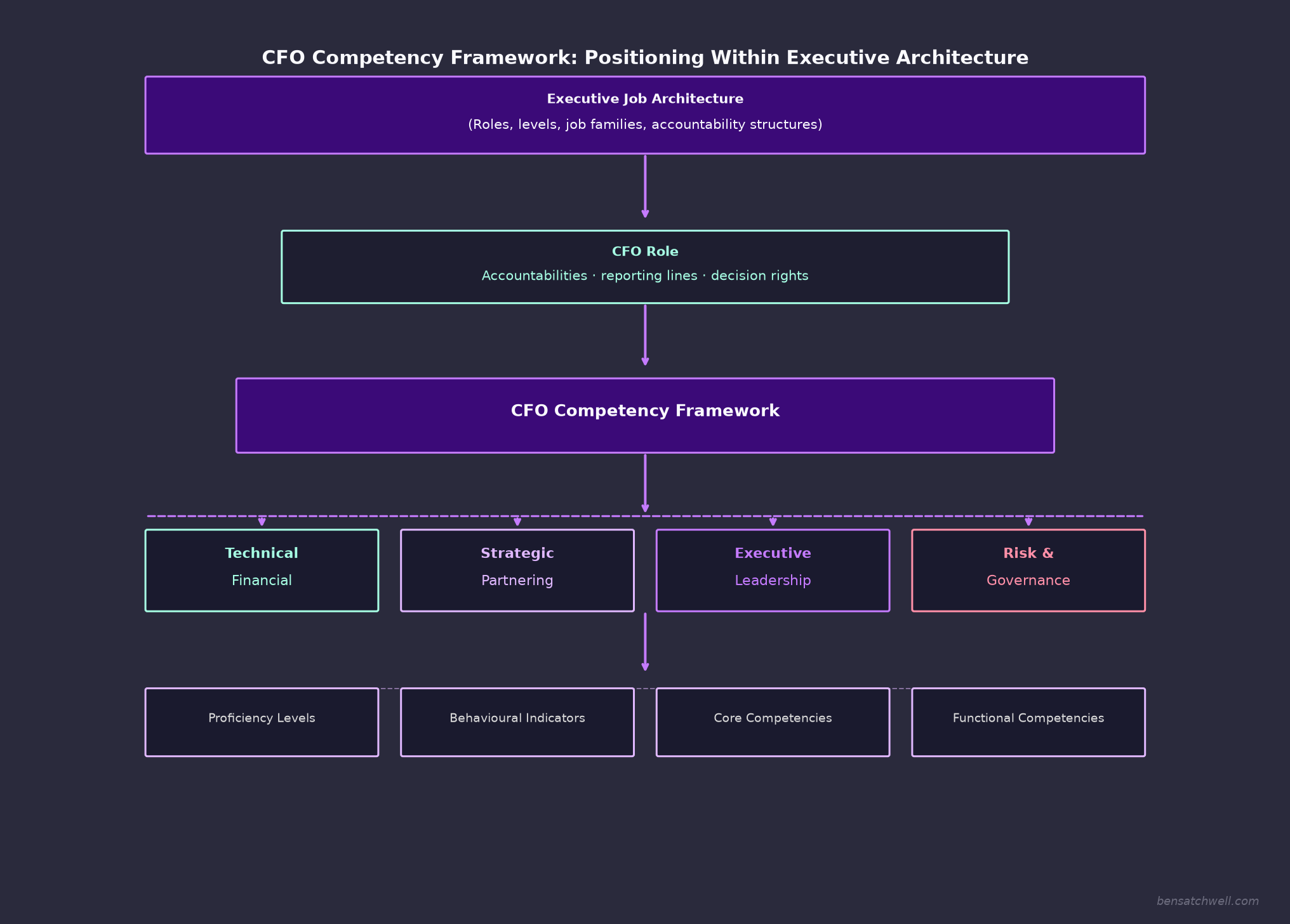
Most well-designed CFO competency frameworks organise competencies across four domains. The first is Technical Financial: financial reporting, capital management, treasury, and statutory compliance. The second is Strategic Partnering: working alongside the CEO and executive team to shape strategy, translating financial insight into commercial decision-making, and influencing at board level. The third is Executive Leadership: leading the finance function, building capability within it, and operating as part of the senior leadership team. The fourth is Risk and Governance: enterprise risk oversight, audit and compliance accountability, and regulatory positioning.
Within each domain, the framework defines competencies, and each competency is described through behavioural indicators at the relevant proficiency level. For a CFO, that level is typically defined by scope, autonomy, complexity, and scale of impact rather than by seniority alone.
The Institute of Management Accountants (IMA) Management Accounting Competency Framework identifies key competency areas for senior finance professionals, including strategy, reporting, risk, and technology. A CFO-specific framework typically extends these into the executive and governance layer where a CFO operates, adding dimensions the IMA framework does not fully address at that level.
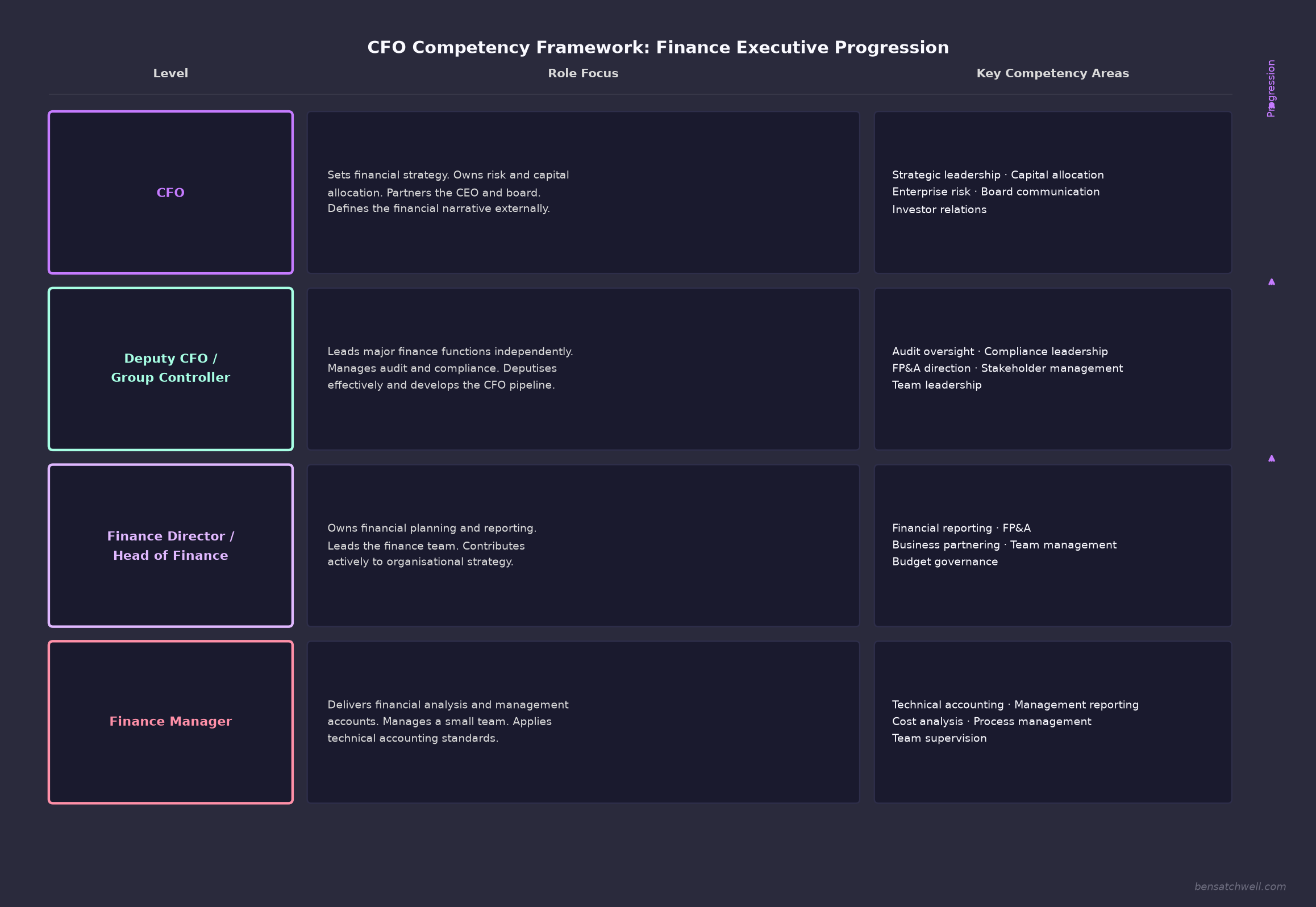
In practice, organisations use CFO competency frameworks in three ways: selection, using the framework as assessment criteria when hiring or appointing into the CFO role; development, working with an incumbent CFO to identify where their current capability profile diverges from what the role requires; and succession planning, using the framework to assess readiness among candidates in the finance leadership pipeline. See how this applies more broadly in creating a competency framework for any role or function.
What a CFO Competency Framework Is Not
This is where most frameworks get built wrong.
A CFO competency framework is not a job description with competency-sounding language applied to it. If the framework reads like a list of tasks or responsibilities, it has not been designed properly. Competencies describe how someone performs, not what they are responsible for.
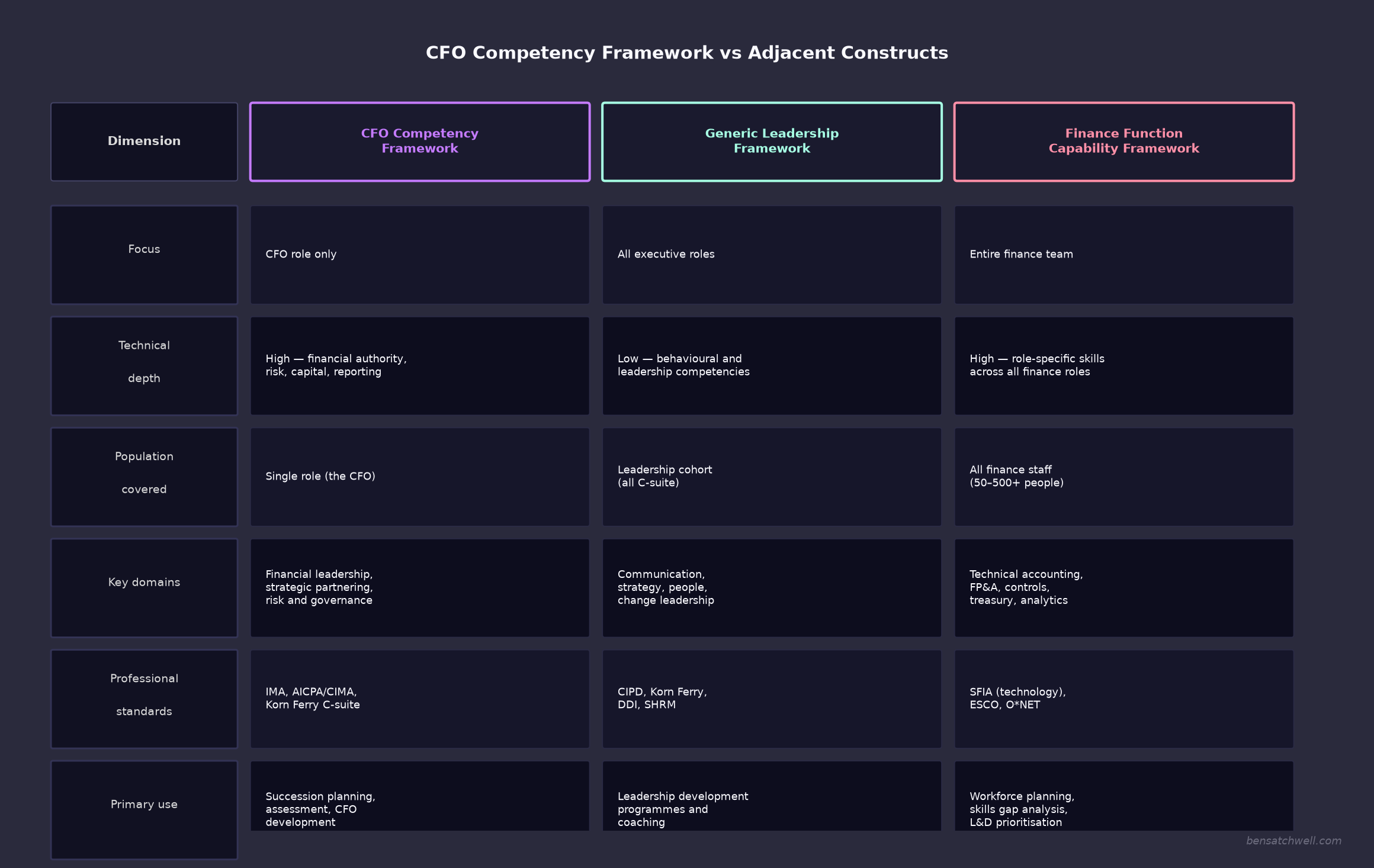
It is not a generic leadership framework with a finance label. Senior leadership frameworks typically describe competencies like strategic thinking, influencing, and building organisational capability. These may be relevant to a CFO, but they are not sufficient. A CFO-specific framework must address the technical financial domain with genuine precision, alongside the executive and governance dimensions that distinguish the role. For a broader understanding of what a competency framework is and is not, that distinction holds at every level.
It is not a finance function capability framework. A capability framework for the finance function defines what the finance team as a whole needs to be able to do. A CFO competency framework is about one specific role. These serve different purposes and should be designed separately. Conflating the two produces something that is too broad to be useful for either purpose.
Named Frameworks and Standards for CFO Competency
Several established frameworks inform CFO competency design, though none were built exclusively for the CFO role.
The CGMA Competency Framework, developed jointly by AICPA and CIMA, outlines competencies across technical, business, people, leadership, and digital domains for management accounting professionals. At the senior level, it provides a useful structure for the technical and strategic dimensions of CFO competency, though organisations typically need to extend it for governance and executive leadership specifics.
Korn Ferry's research on C-suite competency profiles identifies distinct capability signatures for CFO roles compared to CEOs and other executive positions. Their findings consistently show that CFOs who transition into broader executive leadership typically demonstrate stronger strategic and relational capabilities than their technically proficient but operationally focused counterparts. This reinforces the case for a multi-domain framework that does not over-index on technical finance.
For organisations in sectors with defined professional standards, frameworks from bodies like CPA Australia or Chartered Accountants ANZ may set the technical floor, but they will not provide the full range of competencies a CFO in a complex organisation requires. See what this looks like across different applications in competency model examples across functions and roles.
Why CFO Competency Frameworks Fail
The most common failure is building the framework around the person currently in the role. When framework design starts with an assessment of the incumbent and works backwards, it tends to produce a profile that reflects that individual's strengths rather than the genuine requirements of the position. The framework then becomes a description of one CFO rather than a definition of the role.
The second failure is operating at the wrong level of abstraction. Some CFO frameworks are so broad that they could apply to any executive. Others are so granular that they describe tasks rather than competencies. The framework must sit at the level where behavioural observation is possible and meaningful, which typically means four to six domains with a manageable number of competencies within each, described through observable indicators.
The third failure is disconnecting the framework from people processes. A CFO competency framework that is not used in selection, development, or succession is not a framework. It is a document. The value is in the application, and that requires deliberate integration into how the organisation makes decisions about the CFO role.
When a CFO Competency Framework Is Appropriate
A CFO competency framework makes sense when the organisation is preparing for CFO succession and needs defined criteria to assess internal candidates. It makes sense when an incoming or incumbent CFO needs a structured basis for development conversations. It makes sense when the CFO role is evolving, as it frequently is in organisations scaling quickly or navigating significant change, and the organisation needs to redefine what the role requires.
It is not appropriate as a standalone document that exists outside of any organisational process. Building a CFO competency framework without a clear use case and without the intention to use it in actual talent decisions produces effort without return. The same principle applies to any role-specific framework. For a comparison, see how this plays out in a sales manager competency framework, where the use case drives the design in the same way.
Frequently Asked Questions
What competencies should be in a CFO competency framework?
A CFO competency framework typically covers four domains: technical financial (reporting, capital management, treasury), strategic partnering (influencing strategy, board-level advisory), executive leadership (leading the finance function, operating in the senior team), and risk and governance (enterprise risk, audit, regulatory compliance). The specific competencies within each domain depend on the organisation's context, industry, and the scale at which the CFO operates.
How is a CFO competency framework different from a finance competency framework?
A CFO competency framework defines competencies for one executive role. A finance competency framework defines what the entire finance function needs to be able to do. They serve different purposes and are designed at different levels of specificity. The CFO framework focuses on the behaviours of an individual in one senior role; the finance framework addresses the collective capability of a team or function.
What established frameworks can inform CFO competency design?
The CGMA Competency Framework (AICPA/CIMA) provides a useful structure for the technical and strategic dimensions. The IMA Management Accounting Competency Framework covers strategy, reporting, risk, and technology for senior finance professionals. Korn Ferry's C-suite research identifies distinct competency profiles for CFO roles versus other executive positions. These can inform design, but most organisations will need to adapt them to reflect the specific context and requirements of their CFO role.
How long does it take to build a CFO competency framework?
A well-scoped project, with clear inputs from the board, CEO, and current or recent CFOs, typically takes six to ten weeks to produce a framework specific enough to use in selection and development decisions. The timeline depends on the complexity of the role, the number of stakeholders involved, and how much existing data is available from role analysis or prior assessments.
Can you use a generic leadership framework for a CFO?
A generic leadership framework captures some dimensions of the CFO role, particularly those related to executive presence, stakeholder influence, and team leadership. It does not capture the technical financial, risk and governance, and strategic finance dimensions with the specificity required. Using a generic framework for CFO selection or development will produce assessments that are too broad to be actionable and may miss the most important performance distinctions.
Should a CFO competency framework include proficiency levels?
Yes. Proficiency levels are what make a framework usable for assessment and development. Without them, the framework describes competencies but cannot distinguish between someone who is developing in an area and someone operating at the level the role requires. For a CFO, proficiency is typically defined by scope of influence, the complexity of decisions involved, and the degree of autonomy at which the person operates.