
Most organisations use the phrase "capability framework" and mean something different each time. It gets applied to competency frameworks, skills matrices, role profiles, values statements, and sometimes all of them bundled together under one name. That conflation is not harmless. When the term does not mean anything precise, the document it labels does not function as a governing structure. It becomes a reference artefact nobody updates and nobody uses.
A capability framework is something specific. Here is what it actually is, why it exists, how it works in practice, and where it most commonly breaks down.
What Is a Capability Framework?
A capability framework is an organisation-wide structure that defines and organises the human capabilities people need to deliver the strategy, built to evolve as technology and strategy shift.
That definition has three load-bearing parts. First, it is organisation-wide: a capability framework spans the whole workforce, not a single team or function. Second, it defines and organises capabilities, not competencies or skills, which are distinct constructs. Third, it is built to evolve: it is not a static document but a live governing structure.
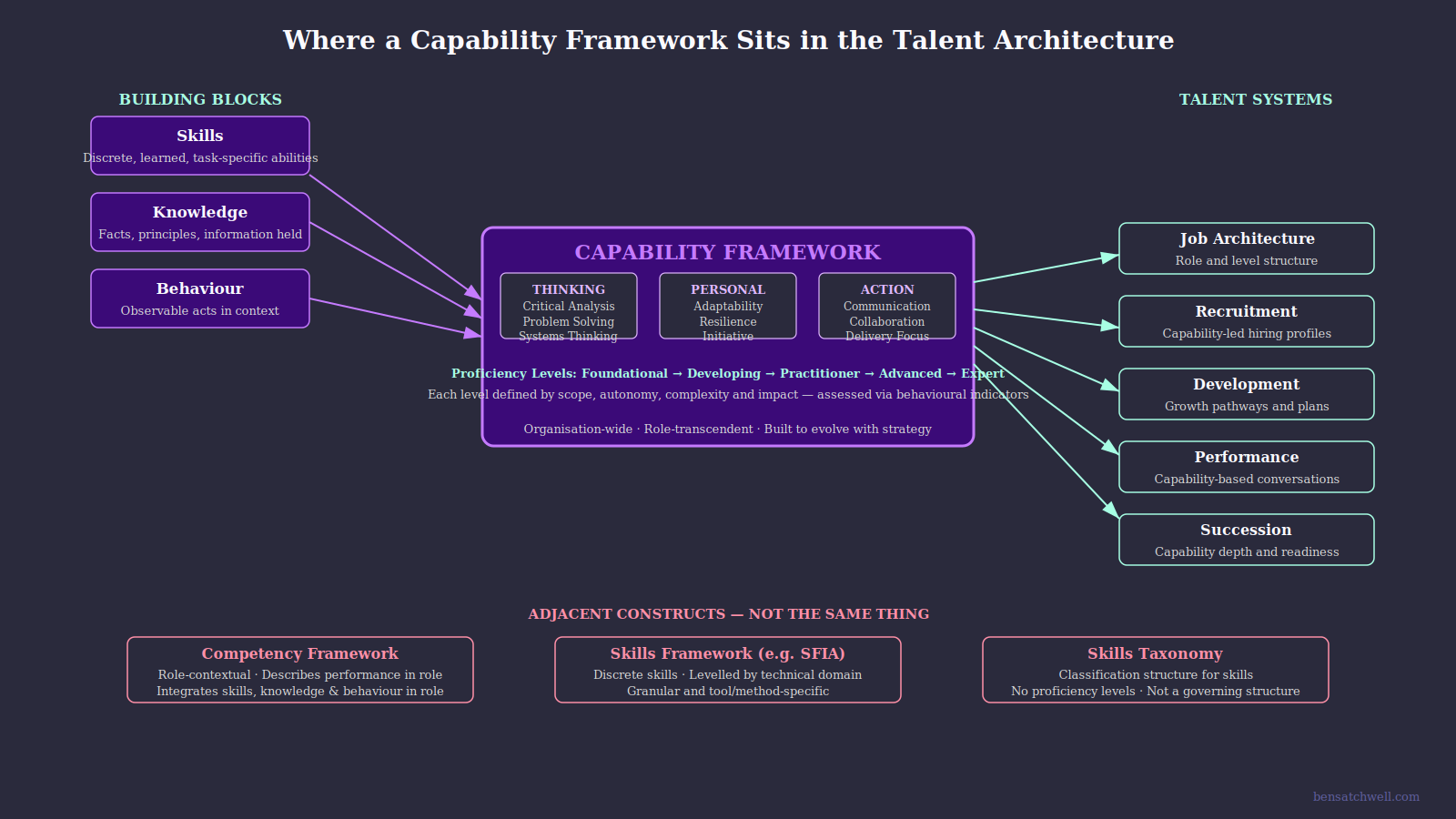
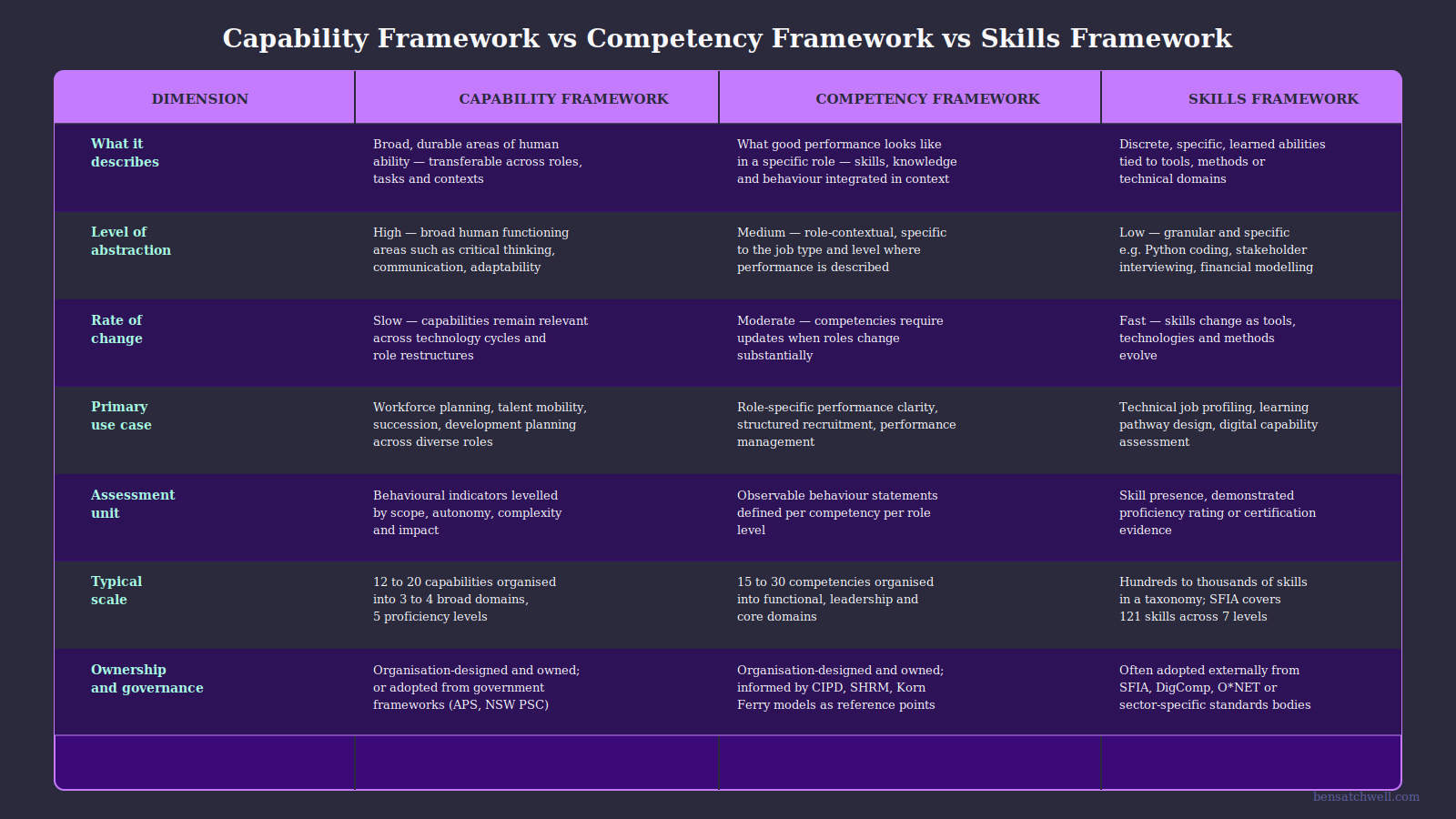
A capability, in this context, is a broad, durable area of ability that a person owns and develops across roles, tasks and contexts. It integrates knowledge, skills and personal attributes into something transferable and lasting. Capabilities are what people bring with them when they move into new and emerging roles. They are different from competencies (which describe performance in a specific role context) and from skills (which are discrete, learned abilities tied to particular tools or methods).
A note on terminology. A competency framework is also called a competency model, especially in the United States. I use competency profile for the competencies and required levels for one role, and competency matrix for the grid of required against current proficiency. Usage varies by region, and I explain the differences in this competency model definition.
Why Does a Capability Framework Exist?
The problem a capability framework is designed to solve is workforce planning under conditions of rapid change. When technology reshapes roles and organisations restructure frequently, role-specific competency profiles become obsolete before they can be fully implemented. A framework built around discrete role requirements struggles to answer the question most workforce planners are actually asking: do we have the underlying human capability to take on new work?
Capabilities are more stable than competencies. They persist across role changes, tool changes and technology shifts. Building a framework around them gives the organisation a layer of description that remains meaningful even when the work itself changes significantly.
This is also why government jurisdictions favour the capability framework. The NSW Public Sector Capability Framework is designed to help attract, develop and retain a responsive public sector workforce, precisely because governments need a stable, portable way to describe what their people can do across hundreds of different roles, policy environments and service delivery contexts.
How Does a Capability Framework Work in Practice?
A capability framework has three core structural components: capability domains, capabilities with definitions, and proficiency levels with behavioural indicators.
Capability domains are groupings of related capabilities organised by the area of human functioning they draw on, not by job function. Common domain structures include Thinking (cognitive capabilities such as critical analysis, problem-solving and systems thinking), Personal (self-regulatory and dispositional capabilities such as adaptability, resilience and initiative), and Action (interpersonal and execution capabilities such as communication, collaboration and delivery focus). Because capabilities are broad and transferable, domains avoid the role-specific technical categories you find in competency frameworks.
Capabilities are defined within each domain. Each definition names what the capability is in terms a person holds and develops. A capability definition should describe the breadth of what this area covers and make clear how it is distinct from adjacent capabilities. Well-written capability definitions are durable: they should remain valid even as the specific skills beneath them shift.
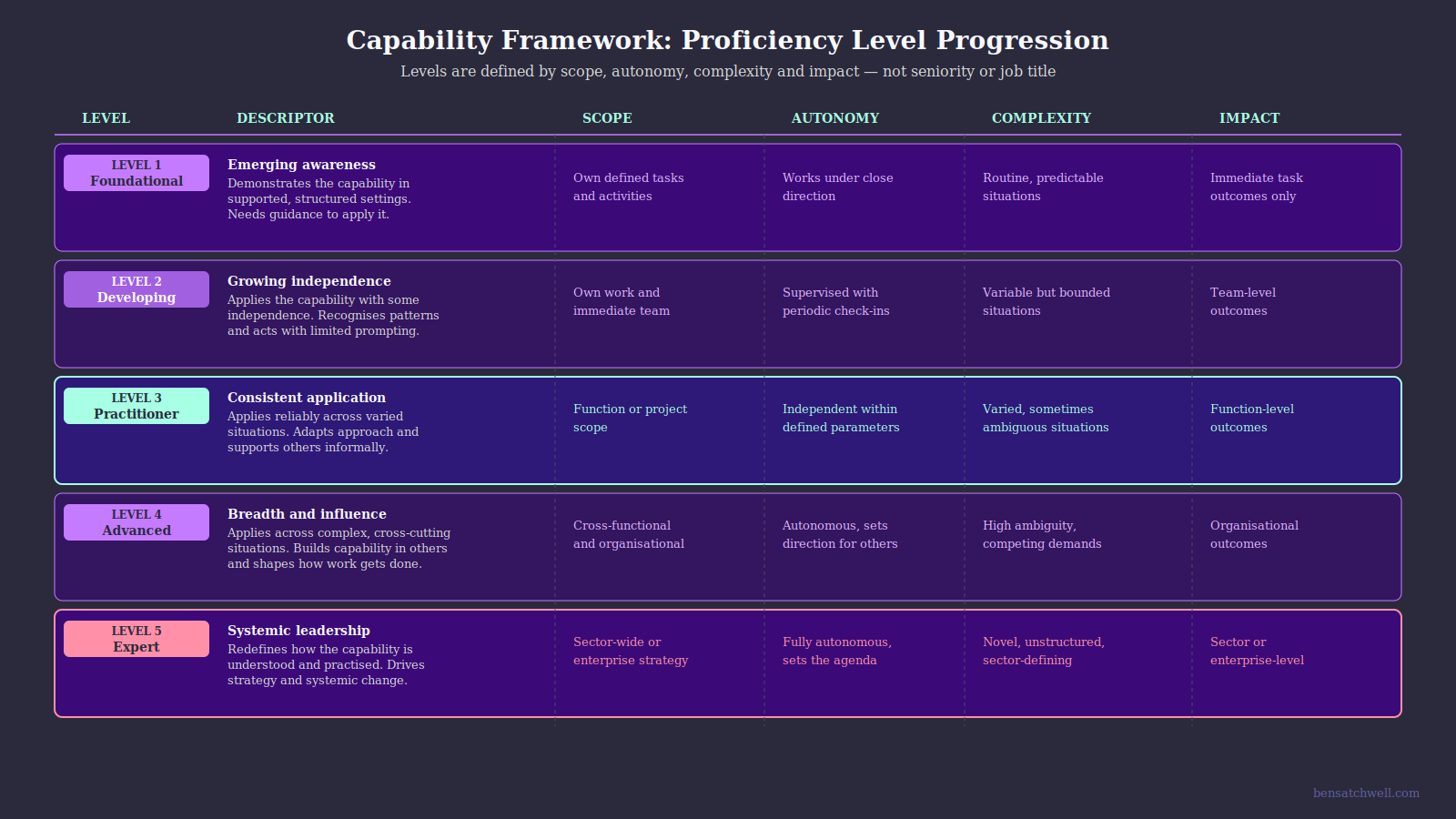
Proficiency levels describe how each capability scales across the organisation. Levels are typically set by four parameters: scope of work, autonomy, complexity and impact. A workable framework uses four to six levels. Each level carries behavioural indicators, which are the observable, written statements describing what the capability looks like in action at that stage. Indicators are what make a framework assessable: they give managers and individuals something concrete to evaluate against.
In practice, the framework feeds other talent systems. It informs job architectures (how roles are constructed and organised), recruitment (what capability profiles are needed), development programmes (what to build and at what level), performance conversations (how to describe growth rather than just task completion), and succession planning (who has the capability depth to take on expanded scope).
For an application of this structure in one specific function, HR capability frameworks show how this plays out in a professional context where the same broad capabilities need to be held across very different HR roles.
What Is a Capability Framework NOT?
This matters because the term gets misused in ways that undermine implementation.
A capability framework is not a competency framework. A competency framework defines what good performance looks like in role-specific terms: the integration of skills, knowledge, judgement and behaviour required at each level of a given job. Competencies are role-contextual. Capabilities are role-transcendent. The structural difference is significant. Using the terms interchangeably produces frameworks that do neither job well.
A capability framework is not a skills taxonomy or skills ontology. Skills are discrete, specific and often tied to particular tools or methods. A capability sits above skills: it is the broader area of ability within which specific skills are exercised. Critical thinking is a capability. Using a particular analysis tool is a skill. A capability framework does not replace a skills taxonomy; it operates at a different level of abstraction.
A capability framework is not a values or behaviour statement. Values statements describe what the organisation believes. Behaviours are observable acts. A capability framework uses behavioural indicators as evidence, but the framework itself defines durable human abilities, not cultural expectations or conduct standards.
A capability framework is also not the same thing as a collection of capability frameworks. One framework governs the organisation. A collection of frameworks covering different functions or divisions, each with its own structure, is a fragmented design with significant maintenance and comparability problems.
Which Named Frameworks Take a Capability Approach?
Several well-known frameworks take a capability approach in distinct contexts.
The SFIA Framework (Skills Framework for the Information Age) applies a proficiency-level structure to technology roles, mapping digital skills and capabilities across seven levels of responsibility. It is widely used in government and large technology functions and operates as a shared external reference rather than an organisation-specific design.
The CIPD Profession Map defines the purpose, values, knowledge and behaviours expected of HR, L&D and OD professionals. It organises across core knowledge, core behaviours and specialist knowledge domains, giving a structure that the CIPD describes as increasing clarity around performance expectations and linking individual performance to professional standards.
At the government level, jurisdictions including NSW, Victoria and the Australian Public Service have each built capability frameworks as central workforce management infrastructure. These public-sector frameworks typically emphasise transferability across roles and agencies, because public sector careers are long and roles shift frequently.
For leadership-specific application, leadership capability frameworks draw on the same underlying structure but concentrate the capability set on the areas most critical for people who lead and govern.
What Are the Common Failure Modes of a Capability Framework?
The majority of capability framework implementations fail in one of four ways.
Conflation with competency frameworks. The framework ends up describing role-level performance expectations rather than transferable human capabilities. This is usually because the designers worked from existing competency frameworks rather than from a capability-first architecture. The output looks like a framework but functions as a consolidated competency library.
Too many capabilities. Frameworks with 40 or 50 defined capabilities are not frameworks; they are inventories. A usable framework holds somewhere between 12 and 20 capabilities at most. Beyond that, no one uses it because no assessment process can cover it meaningfully.
Levels defined by seniority, not scope. When proficiency levels are labelled Coordinator, Manager, Director, Executive, they encode hierarchy rather than describing growth. A graduate can demonstrate high-level critical thinking. A senior leader can demonstrate entry-level data literacy. Levels should describe what performing at that standard looks like, not what title usually holds it.
No governance. A framework without a named owner, review cycle and change management process becomes obsolete. Without governance, the framework dates, usage drops, and confidence erodes. The OECD's work on skills-first workforce approaches is a useful wider reference for organisations building capability-led workforce systems.
When Is a Capability Framework the Right Tool?
A capability framework is the right tool when the organisation needs a stable, portable description of human ability that persists across role changes and can underpin multiple talent systems simultaneously. It is the better choice over a competency framework when work is changing fast, roles are highly varied, or the organisation has significant mobility expectations across functions.
It is not the right starting point when the organisation needs immediate, role-specific performance clarity. If the problem is that there is no consistent way to describe what good looks like in a specific job, a competency profile solves that faster. The capability framework is a longer investment that pays off at the system level, not the role level.
The capability framework also requires genuine design rigour. A poorly designed capability framework is harder to fix than a poorly designed competency profile because the framework touches more systems and more people. Get the domain structure, capability definitions and level logic right before building anything on top of it.
Frequently Asked Questions About Capability Frameworks
What is a capability framework?
A capability framework is an organisation-wide structure that defines and organises the human capabilities people need to deliver the strategy. It describes broad, durable areas of ability that persist across role changes and can be levelled and assessed against behavioural indicators.
What is the difference between a capability framework and a competency framework?
A competency framework describes what good role-level performance looks like: the integration of skills, knowledge, judgement and behaviour required at a given level of a specific job. A capability framework describes the broader, transferable abilities people carry across jobs. Competencies are role-contextual; capabilities are role-transcendent.
How many capabilities should a capability framework have?
Most workable frameworks hold between 12 and 20 capabilities. More than that makes assessment impractical and usage drops. Fewer than eight and the framework is not providing enough differentiation to be useful.
How are proficiency levels set in a capability framework?
Proficiency levels are defined by scope of work, autonomy, complexity and impact, not by seniority, job title or years of service. A framework typically uses four to six levels, each with written behavioural indicators describing what the capability looks like in action at that stage.
Can a capability framework be used for recruitment?
Yes. Capability frameworks give hiring managers a stable, role-transcendent vocabulary for describing what they are looking for. Rather than specifying role history, they can assess whether a candidate holds the underlying capability to perform and grow in the context.
What is the difference between a capability framework and a skills framework?
A skills framework such as SFIA defines discrete, specific abilities and how they level up across a defined spectrum, often tied to particular technical domains. A capability framework operates at a higher level of abstraction, describing broader areas of durable human ability within which specific skills sit. The two can coexist: a skills framework governs specific technical domains; a capability framework governs the broader workforce.