

Competency Framework for Administrative Staff
Administrative staff are the group most competency frameworks handle badly. Either they are left out entirely because the framework was built with leadership and technical specialists in mind, or they are handed a generic "support" competency lifted wholesale from a model that was never designed for their work. Neither approach holds up, and the confusion starts with a mislabel: what most organisations call a competency framework for administrative staff is usually a competency model, and the distinction matters more than it sounds.
What Is a Competency Framework for Administrative Staff
Strictly, an organisation does not need a separate competency framework for administrative staff. A competency framework is the single organisation-wide system that defines, groups and levels competencies so they can be reused consistently across every role. What administrative work actually needs is a competency model, an applied selection of competencies drawn from that one framework and tailored to the administrative job family, with target proficiency levels set for the scope, autonomy and complexity of the work.
Read more on the base structure in my article on the competency framework itself. In practice, when people search for "competency framework for administrative staff" they mean a defined set of core, technical and behavioural competencies, at levels appropriate to roles ranging from administrative assistant through to office manager or executive assistant, built from the organisation's existing framework rather than invented separately.
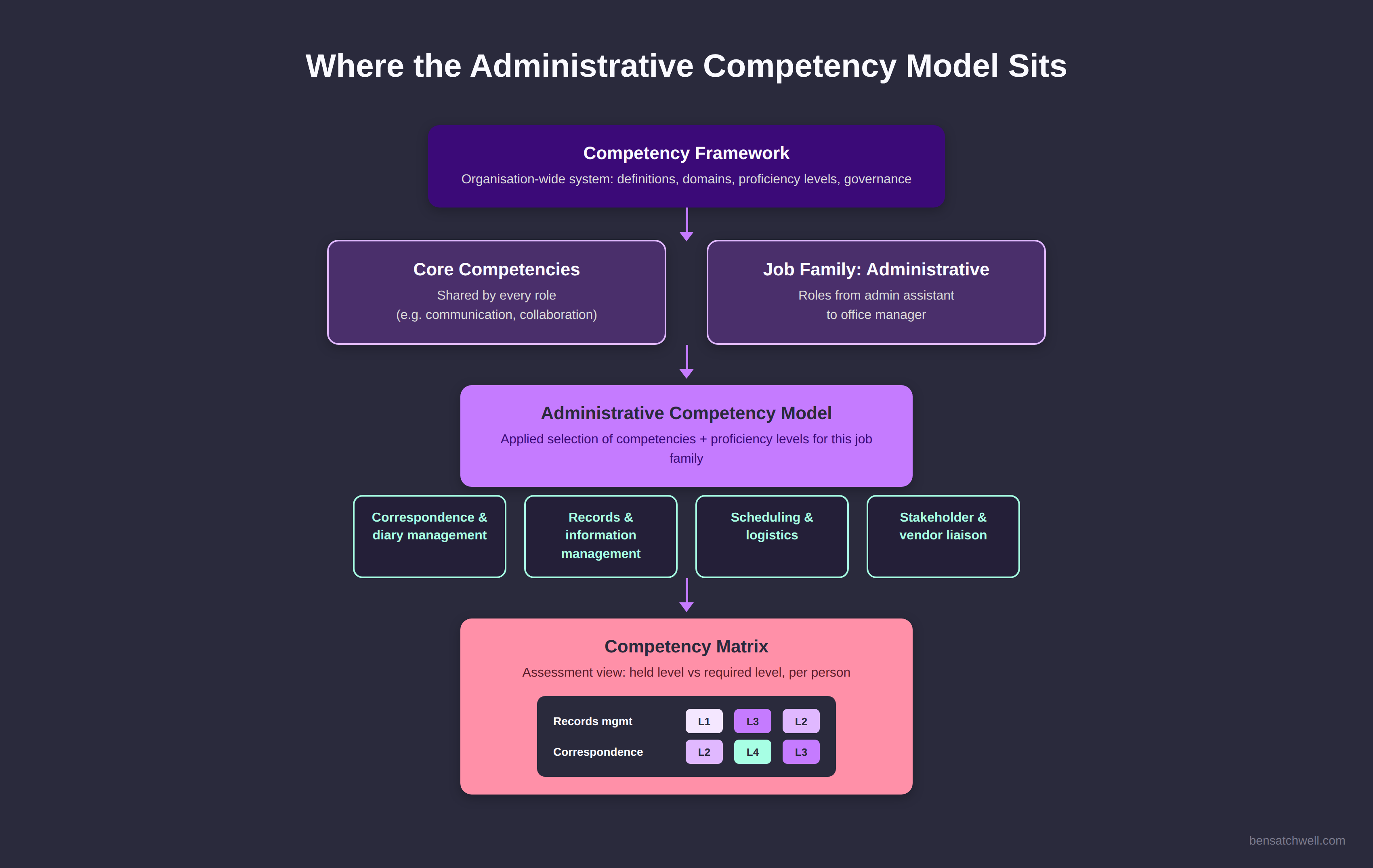
Where the administrative competency model sits between the organisation-wide competency framework and the resulting competency matrix.
Why a Dedicated Administrative Competency Model Exists
Administrative roles sit at an odd intersection. The work is highly operational, correspondence, scheduling, records, stakeholder liaison, but it also carries judgement, discretion and, at senior levels, genuine influence over how an executive or a whole office functions. Generic leadership competencies do not describe this work. Generic technical skill lists do not capture the judgement in it either.
Without a proper model, two failure patterns emerge. Administrative staff are assessed against competencies written for managers, which they are marked down against by design because the indicators describe a different job. Or they are assessed against nothing structured at all, and progression, hiring and performance conversations default to informal impressions of who seems capable, which is exactly the inconsistency a HR competency framework is meant to remove.
How It Works in Practice
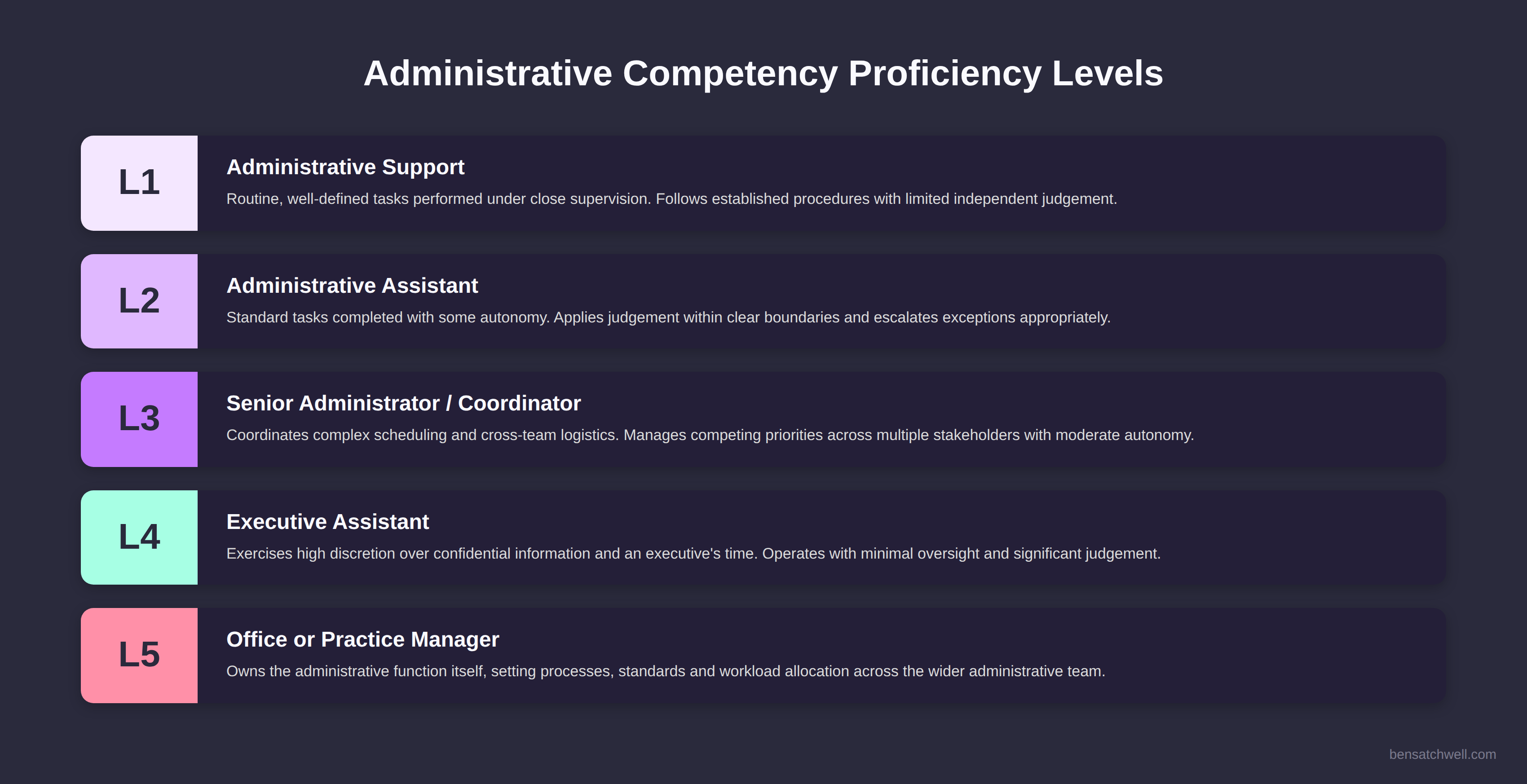
Proficiency levels for a competency framework for administrative staff, from routine administrative support through to office manager.
Each competency is written as a behavioural indicator at each level, an observable statement of what the work looks like at that stage, not a personality trait or a duty statement. "Manages competing calendar demands across multiple stakeholders with minimal escalation" is a behavioural indicator. "Good at multitasking" is not.
Applied against real people, this model becomes a competency matrix, showing who holds which competency at what level against what the role requires. Research on public sector administration backs this structured approach: a study on competency models in the public sector found that models built around operational, social, cognitive and meta-competency domains gave administrators a clearer basis for assessment than generic role descriptions.
What It Is Not
A competency framework for administrative staff is not a job description. A job description states what a role is accountable for. The competency model states what the person needs to demonstrate to do that role well, at what level.
It is also not a skills checklist. Software proficiency, typing speed or knowledge of a specific booking system are technical skills, discrete and teachable, that feed into a technical competency once they are integrated with judgement and applied consistently at a defined level. Listing "proficient in Outlook" is not the same as defining the competency of correspondence management.
Nor is it the same instrument as a job competency matrix for other job families layered straight on top without adjustment. Sales, engineering and administrative work draw on the same core competency layer but need entirely different technical domains and, often, different numbers of proficiency levels, because the scope and complexity gradient in administrative work does not map cleanly onto a technical career ladder.
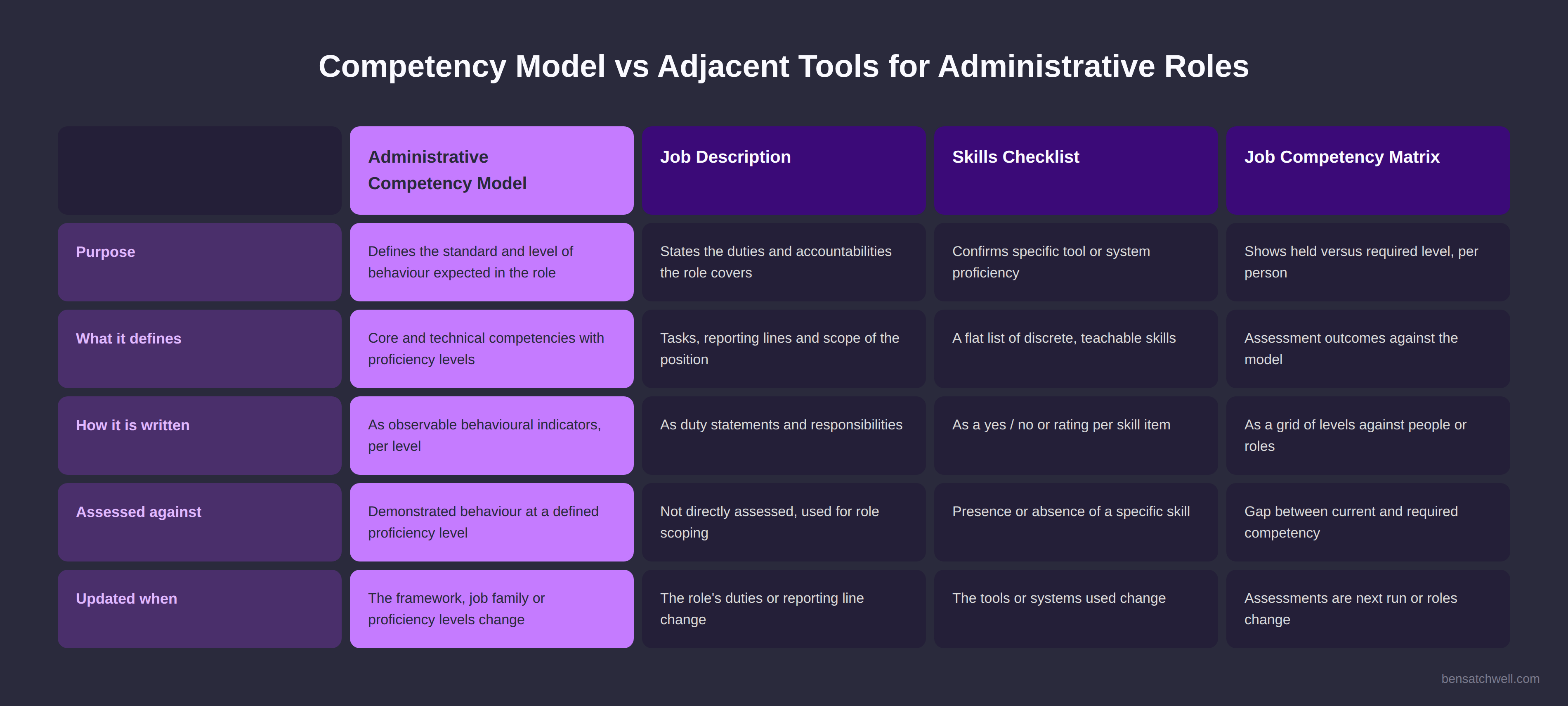
How a competency framework for administrative staff differs from a job description, a skills checklist and a job competency matrix.
Named Frameworks and Standards Worth Knowing
There is no single dominant named standard for administrative competency, unlike SFIA in the technology space. The closest reference point in HR practice is the CIPD's competence and competency factsheet, which sets out the distinction between competence, the standard of performance, and competency, the behaviour that produces it, a distinction that applies directly to administrative role design.
In government settings, integrated capability frameworks covering administrative and corporate roles are common. The University of Essex's research into public service competency frameworks found that clearly defined, levelled competencies improved consistency in how administrative and corporate service roles were assessed across departments. Most organisations, though, are better served building a bespoke administrative model off their own existing competency framework than adopting an external one wholesale, since the technical domain has to reflect their specific systems, stakeholders and governance requirements.
Common Failure Modes
The most frequent mistake is treating administrative competency as an afterthought bolted onto a leadership framework, rather than a properly scoped technical domain in its own right. This produces indicators that read as junior versions of management behaviours instead of descriptions of the actual work.
A second failure is flattening proficiency into a single level. Administrative work spans an enormous range, from data entry support to running an executive office, and a model with only one level for "administration" cannot distinguish between them, which makes it useless for hiring, progression or pay banding.
A third is writing indicators as traits rather than behaviours. "Organised" and "detail-oriented" are not assessable. "Maintains error-free records across [defined volume] with no more than [defined tolerance] correction rate" is.
Trade-offs and Constraints
Building a fully levelled, bespoke administrative competency model is worthwhile once an organisation has enough administrative roles, and enough variation in seniority within them, that consistency actually matters for hiring, progression or pay decisions. In a small organisation with two or three administrative staff at similar levels, the overhead of a full model rarely pays off. A lighter approach, applying the existing core competencies plus a short technical checklist, is usually sufficient until the administrative job family grows.
The constraint that catches most organisations out is governance. A competency model without a maintenance cycle goes stale as systems, tools and stakeholder expectations change, and administrative work changes faster than most job families because it absorbs whatever process gaps exist elsewhere in the organisation.
Frequently Asked Questions
Is a competency framework for administrative staff different from other competency frameworks?
Not structurally. It draws on the same organisation-wide competency framework as every other role. What differs is the competency model, the specific selection of core and technical competencies and the proficiency levels set for administrative work.
What competencies should administrative staff have?
Typically a mix of core competencies shared across the organisation, such as communication and collaboration, plus technical competencies specific to administrative work, including correspondence and diary management, records management, scheduling and logistics, and stakeholder liaison.
Is administrative ability a skill or a competency?
Both, at different levels. Typing accurately or using a specific booking system is a discrete, teachable skill. Managing correspondence and competing priorities across multiple stakeholders with sound judgement is a competency, the integration of several skills applied consistently at a defined standard.
How many proficiency levels should an administrative competency model use?
Four to six is workable for most organisations, distinguishing routine, closely supervised work from senior roles carrying discretion, confidentiality and minimal oversight.
Can administrative staff be assessed on the same competencies as managers?
Core competencies, yes, since these apply organisation-wide. Technical competencies, no. Management competencies describe accountability for people and strategy, which is not the scope of most administrative roles, and applying them directly produces indicators that do not fit the actual work.
What is the difference between a competency framework and a job description for an administrative role?
A job description lists the duties and accountabilities of the role. A competency framework, and the model drawn from it, defines the standard and level of behaviour required to perform those duties well.