
Competency model examples are easy to find and easy to misread, because the label gets applied to things that are structurally very different. Korn Ferry's Leadership Architect has 38 competencies arranged across four factors. The 2026 SHRM BASK has eight behavioural competencies and one technical competency. The NHS Leadership and Management Framework, launched in July 2026, sets nine standards across five stages. All of them are competency frameworks, and in the United States they are all called competency models, but they are built differently, serve different purposes and are not interchangeable.
This article works through eight named examples, the four main types, how each handles proficiency levels and how to decide whether to adopt, adapt or build your own. Several were revised in 2025 and 2026, so I have checked each against its publisher's current documentation.
What Is a Competency Model?
A competency model is a defined set of competencies, each described as observable behaviour at a level of proficiency, that sets out what effective performance looks like for a role, level, job family or profession. SHRM defines one as a set of competencies that together define the requirements for effective performance in a specific job, profession or organisation. For the system view of the same structure, see the competency model guide.
Whatever the label, a usable model contains three things: a defined set of competencies, proficiency levels for each, and the behavioural indicators that describe performance at each level. It is the instrument people use for hiring, performance conversations and development planning.
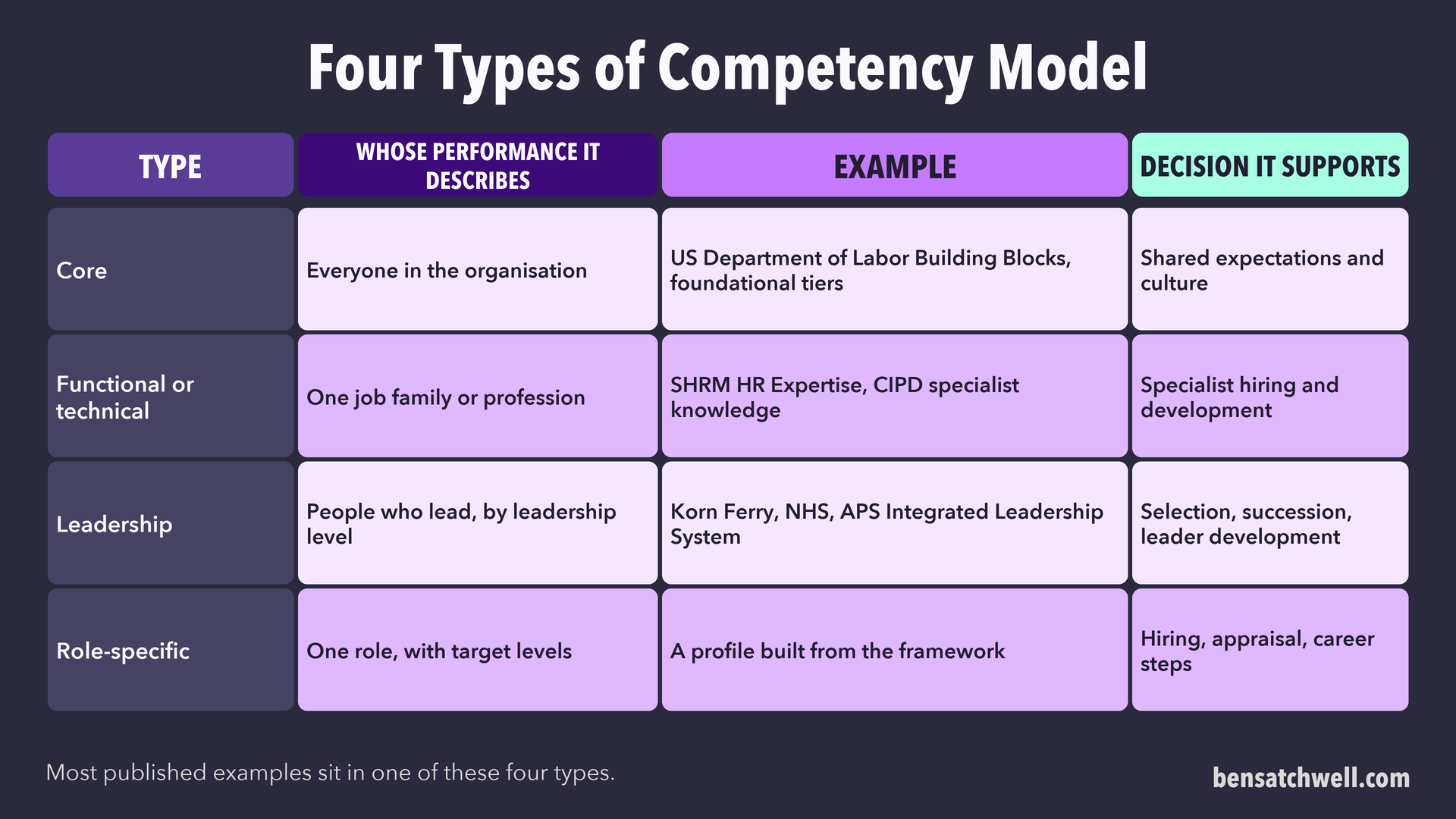
Most published examples sit in one of four types.
A note on terminology. A competency framework is also called a competency model, especially in the United States. I use competency profile for the competencies and required levels for one role, and competency matrix for the grid of required against current proficiency. Usage varies by region, and I explain the differences in this competency model definition.
The Four Main Types of Competency Model
The type tells you whose performance the model describes and which decisions it can support.
- Core. The competencies everyone in the organisation is expected to show, regardless of role. The foundational tiers of the US Department of Labor's Building Blocks Model are a public example. This is not the strategy term core competence, which describes an organisation's distinctive collective advantage.
- Functional or technical. The specialist knowledge and skills a job family needs. SHRM's HR Expertise competency and the CIPD's specialist knowledge areas are both functional models for the people profession.
- Leadership. What effective leadership looks like, usually by leadership level. Korn Ferry, the NHS framework and the Australian Public Service's Integrated Leadership System are leadership models. I compare more in these leadership competency model examples.
- Role-specific. The core, functional and leadership competencies one role needs, with a target level for each, which is what I call a competency profile. A 2023 study in BMC Health Services Research shows how one is built from scratch, combining job analysis, a literature review and a survey of more than 300 hospital management professionals.
Most published examples are also a fifth thing: professional or occupational models written by external bodies. SHRM, the CIPD and O*NET describe a profession or occupation, not your organisation, which is both their strength as a reference and their limit as an off-the-shelf tool.
Eight Named Competency Model Examples
1. SHRM Body of Applied Skills and Knowledge
The SHRM BASK underpins the SHRM-CP and SHRM-SCP certifications. The 2026 edition has eight behavioural competencies in three clusters, Leadership, Interpersonal and Business, plus one technical competency, HR Expertise, organised into three knowledge domains and 14 functional areas. It merged Inclusion & Diversity and Global Mindset into Inclusive Mindset, which is why older articles list nine. Proficiency uses two sets of indicators, one for all HR professionals and one for advanced professionals. The full breakdown is in the SHRM competency model guide.
2. CIPD Profession Map
The CIPD Profession Map is the international standard for people professionals across HR, L&D and organisation development, last refreshed in November 2025. A core purpose supported by three values, principles-led, evidence-based and outcomes-driven, sits at the centre, with core knowledge, eight core behaviours and optional specialist knowledge around it. Every standard is described at four levels, Foundation, Associate, Chartered Member and Chartered Fellow, aligned to membership grades.
3. Korn Ferry Leadership Architect
The current version has 38 competencies in 12 clusters under four factors: Thought, Results, People and Self. Each is described through staged behaviours. The older Lominger library has 67 competencies plus 19 career stallers and stoppers, so 67 attributed to Korn Ferry is the legacy version. Organisations using either typically select a focused subset, often 8 to 12.
4. DDI Success Profile
DDI treats competencies as one of four dimensions of job success: knowledge, experience, competencies and personal attributes. The lesson for design is the separation. Knowledge and experience requirements belong in the role profile but are not competencies, and mixing them in is a common error.
5. NHS Leadership and Management Framework (2026)
The NHS Leadership and Management Framework applies to clinical and non-clinical leaders and managers. Its standards are the competency model: nine standards in three focus areas, each with descriptions for five stages from Fundamentals through to board level. Older articles still cite the 2011 NHS Leadership Framework or the 2013 Healthcare Leadership Model.
6. Australian Public Service Integrated Leadership System
The APS Integrated Leadership System has five core clusters, described in behavioural terms at every classification level from APS 1 to SES Band 3. It is cumulative: behaviours at one level become the floor for the next. The APS calls these capabilities, but because each cluster is written as observable behaviour at a classification level, it works as a levelled competency framework.
7. US Department of Labor Building Blocks Model
On the Competency Model Clearinghouse, six tiers stack from foundational personal, academic and workplace competencies, through industry-wide and sector-specific technical competencies, to occupation-specific ones. The industry models are built on this structure. See the building blocks competency model page for the tiers.
8. O*NET Content Model
The O*NET Content Model is a database of more than 900 occupation profiles, not a single competency model. It is best used by analysts and workforce planners for job analysis and benchmarking, and it still needs translating into behavioural indicators before it works for your roles.
Where Competency Models Came From
Most modern models trace back to David McClelland's 1973 paper "Testing for competence rather than for intelligence", which argued that intelligence tests were poor predictors of job performance and organisations should assess the characteristics that distinguish effective performers. Richard Boyatzis applied it in The Competent Manager (1982), drawing on research with more than 2,000 managers, and distinguished threshold competencies, which a role needs but which do not separate strong from adequate performers, from those that differentiate superior performance. Lyle and Signe Spencer extended the work in Competence at Work (1993) with generic models for several occupations and popularised the iceberg model: knowledge and skills above the waterline, self-concept, traits and motives below it. The Boyatzis competency model page covers that work.
How Multi-Level Systems Work
A multi-level system uses two design ideas, and stronger examples use both.
Tiers organise competencies by how widely they apply: a core layer for every role, a functional layer for each job family and a leadership layer for people leaders. Proficiency levels describe how one competency scales.
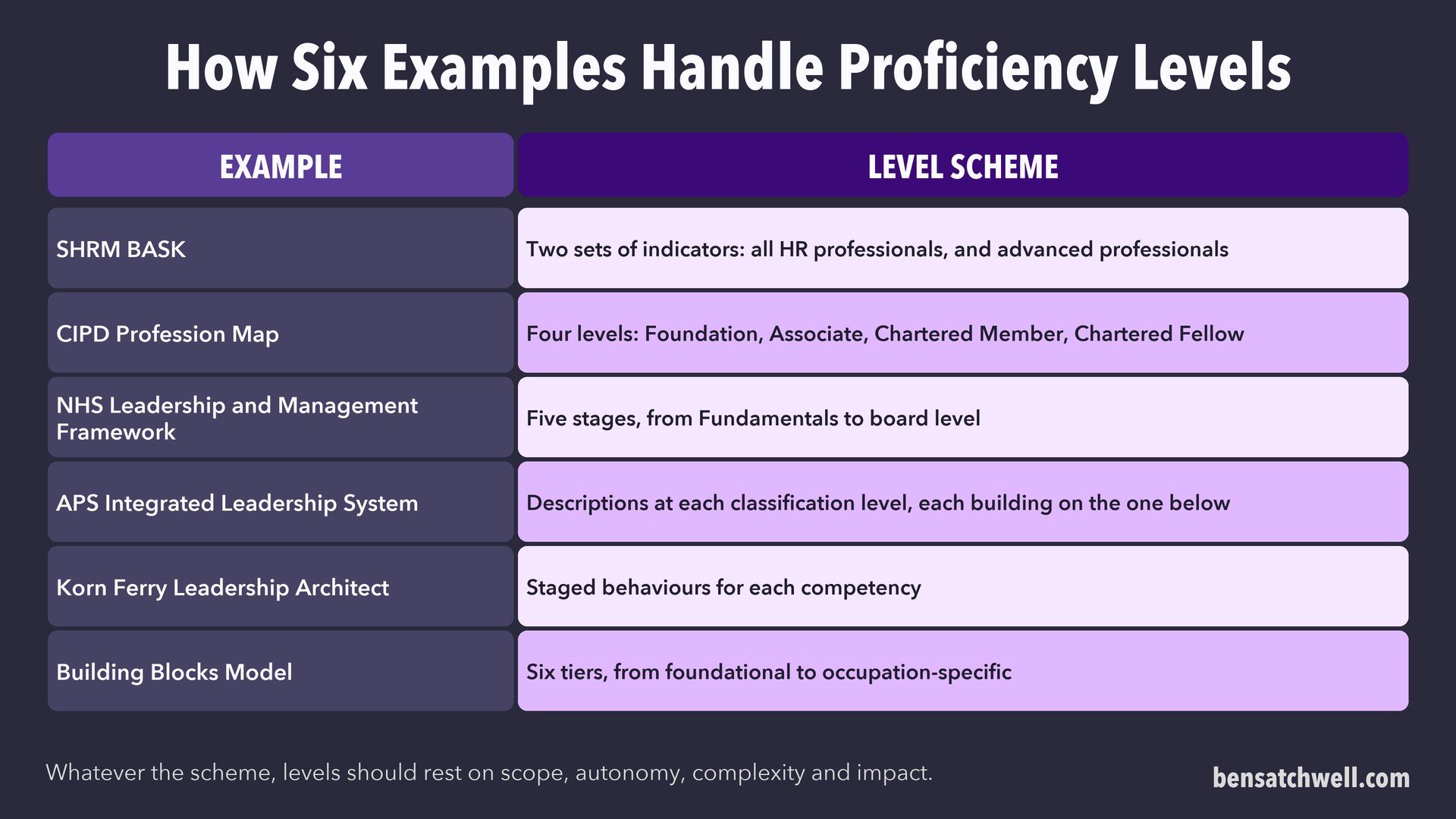
Whatever the scheme, levels should rest on scope, autonomy, complexity and impact.
In my experience four to six levels is the workable range. Fewer and the steps are too coarse to guide development. More and assessors cannot reliably tell adjacent levels apart.
Competency Model Examples and Competency Framework Examples
The two phrases name the same structures, and publishers rarely follow one convention. This page reads the examples as applied models and structural patterns. For the governing systems from the same organisations, see the competency framework examples guide.
What a Competency Model Is Not
- Not a job description. A job description lists tasks and responsibilities.
- Not a skills framework. A skill is a discrete learned ability. SFIA is a skills framework. Korn Ferry Leadership Architect is a competency framework.
- Not a capability framework. A capability is a broad, durable ability a person carries across roles. The two answer different questions.
How to Choose: Adopt, Adapt or Build
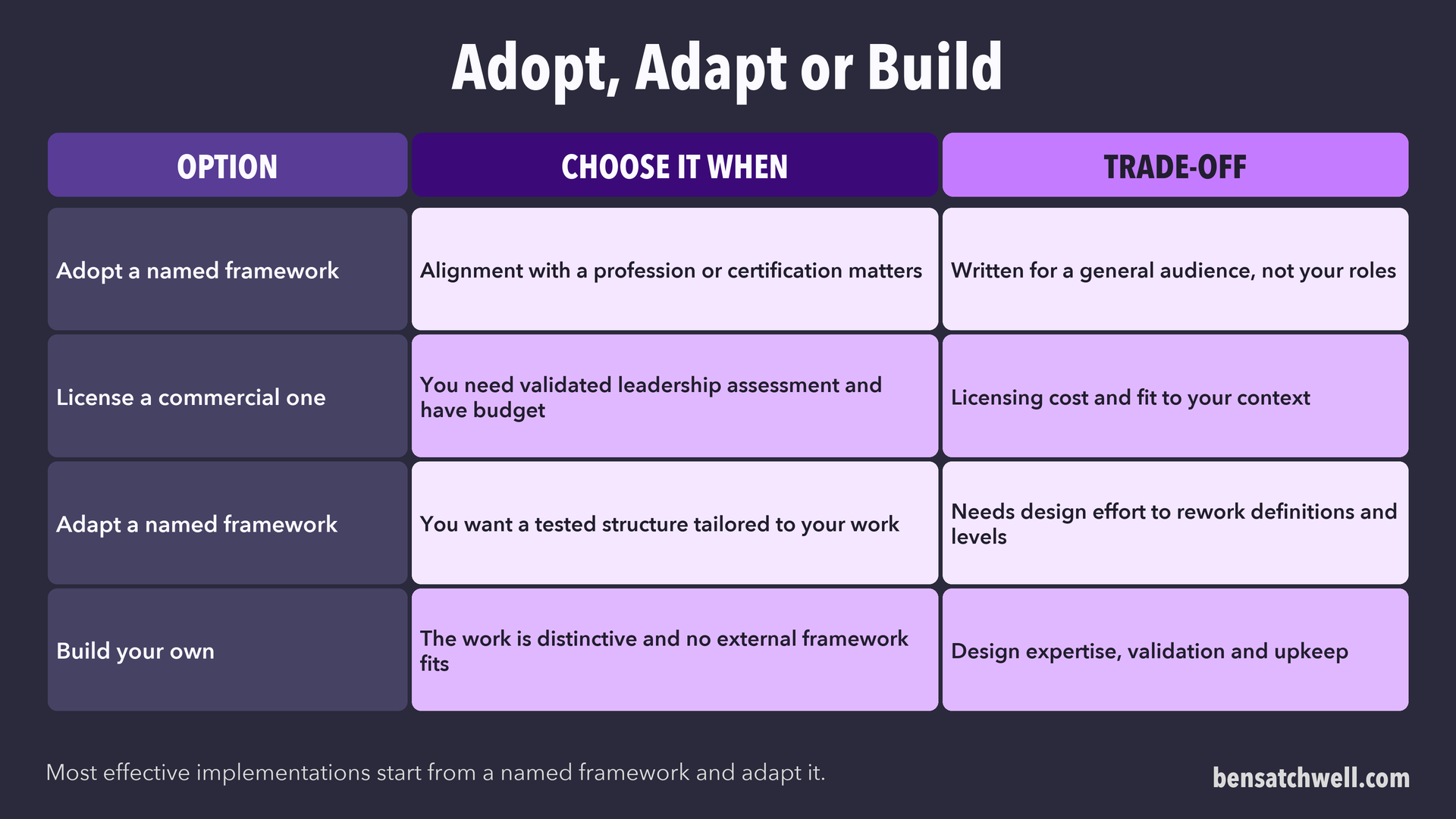
Most effective implementations start from a named framework and adapt it.
Adopt SHRM or the CIPD map for professional development of HR practitioners. License Korn Ferry or DDI for validated leadership assessment if the budget allows. Borrow the structure of the NHS or APS models for a levelled leadership model across a large workforce. Use O*NET and the Building Blocks Model as inputs to job analysis, not finished models. Build your own only when the work is distinctive enough that nothing external describes it, and validate it against performance data. A tight set of eight competencies you can consistently assess is worth more than a thirty-competency document reviewed every three years.
Common Failure Modes
- Too many competencies. Past 25 or so, assessors cannot reliably tell candidates apart.
- No proficiency levels. Without levels a competency becomes a checkbox.
- Generic language. "Works effectively with others" is a wish, not a definition.
- Competencies written as tasks. "Completes reviews on time" is a task.
- Adoption without tailoring. Professional standards were written for a broad community, not for differentiating roles in your organisation.
- An outdated version. SHRM moved to eight behavioural competencies in 2026, the CIPD refreshed in 2025 and the NHS launched a national framework in 2026. Check the current documentation.
FAQ
What is an example of a competency model?
The SHRM BASK is a clear one. It defines eight behavioural competencies plus one technical competency, HR Expertise, with proficiency indicators from early career to executive level. Others are the CIPD Profession Map, Korn Ferry Leadership Architect, DDI's Success Profile, the NHS Leadership and Management Framework and the APS Integrated Leadership System.
What are the four main types?
Core, functional or technical, leadership and role-specific. Professional models such as SHRM and the CIPD map are often treated as a fifth category.
What is the difference between a competency model and a competency framework?
There is no difference in structure. Competency model is the usual US name and competency framework is more common in the UK and Australia. A competency profile is the narrower selection for one role.
How many competencies should a competency model have?
For selection, six to twelve is the practical ceiling. Development models can carry a few more, but more than twenty is rarely used consistently.
What was McClelland's contribution?
His 1973 paper argued that tests of intelligence and aptitude predict job performance poorly and that organisations should assess the competencies that distinguish effective performers. Boyatzis and the Spencers built on it.
What is the difference between competence and competency?
Competence is the overall condition of being able to perform to the required standard. A competency is one defined unit, the integration of skills, knowledge, judgement and behaviour applied in a role. The CIPD's factsheet covers how the two terms are used in UK practice.