
In my work with organisations trying to modernise performance, learning, and workforce planning, capability is the term people reach for when they sense something is missing, but can’t quite name it. They know skills alone aren’t enough. They know competencies feel backward-looking. Capability becomes the catch-all.
What I consistently see, though, is capability being described without discipline. Used well, it’s one of the most powerful constructs in workforce design. Used loosely, it becomes a vague synonym for “being good at things”.
This article clarifies what capability actually is, why it’s so often conflated with competency, and the specific problems capability frameworks were designed to solve.
How Capability Is Commonly Defined
Unlike skills or knowledge, capability has strong roots in organisational theory.
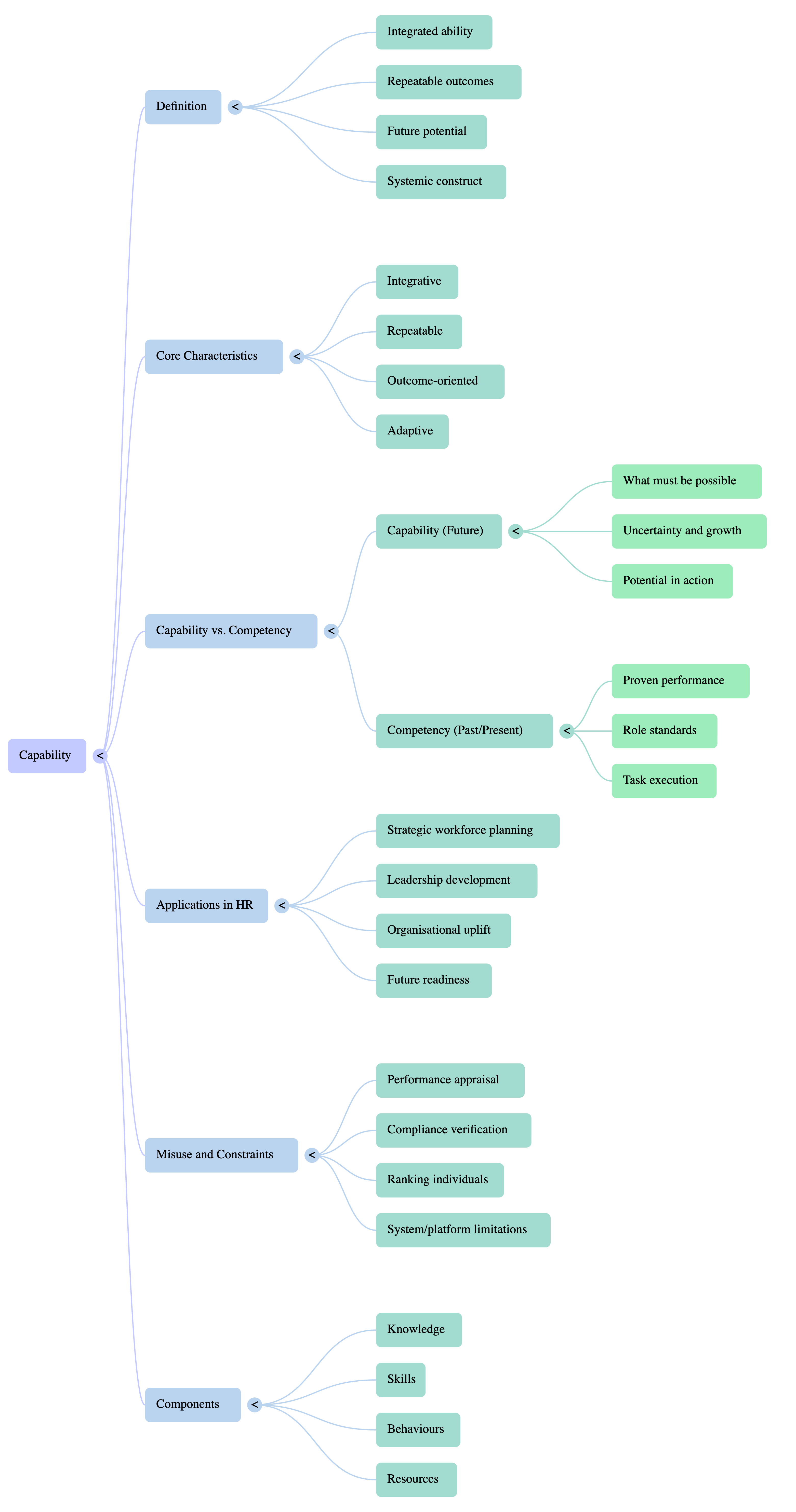
The most influential definition comes from Robert M. Grant’s work on organisational capability, where capability is described as the integration of specialised knowledge to perform productive tasks repeatedly. More recent public-sector research, including work from UCL Institute for Innovation and Public Purpose, extends this to emphasise adaptability, systems, and future readiness.
Across these sources, capability is not a single attribute. It is:
- integrative,
- repeatable,
- and oriented toward outcomes over time.
From what I see, capability is fundamentally about what must be possible, not what has already been proven.
What the Dictionary Gets Right and What It Misses
Dictionaries typically define capability as the power or ability to do something. That’s directionally correct, but dangerously broad.
What it gets right:
- Capability implies potential.
- It suggests capacity beyond a single task.
What it misses:
- Capability is not individual skill writ large.
- It is not momentary performance.
- It does not exist without systems, context, and integration.
In organisational settings, the confusion begins when capability is treated as belonging to the system rather than to the person. Capability is fundamentally personal: it is owned and developed by an individual, and carried by them across roles and contexts. Organisations also need a capability of their own, usually called organisational capability, but that is a separate construct from the human capability described here.
Why Capability Gets So Heavily Conflated in HR
From experience, capability is most often confused with competency, and not accidentally.
Several forces drive this:
- Shared language, different intent
Both use proficiency levels and behavioural language, which masks their different purposes. - Framework fatigue
Organisations want one model to do everything, so capability is pulled into performance assessment. - System constraints
Many HR platforms were built for evaluating individuals, not developing organisational capacity. - Loose everyday usage
Saying someone is “capable” in plain English collapses potential and proof.
The result is capability frameworks being written, and then immediately used, like competency frameworks.
The Problem Capability Was Originally Designed to Solve
Capability exists to solve future readiness.
In my work, capability frameworks are most effective when organisations need to:
- adapt to changing conditions,
- operate across uncertainty,
- integrate skills and judgement,
- build capacity beyond current roles.
Capability answers the question:
What must this organisation, system, or role be able to do, repeatedly, to deliver future outcomes?
It does not answer:
- who performed best last quarter,
- whether someone meets today’s role standard,
- or whether a task was executed correctly in the past.
Those are competency questions.
How Capability and Capability Frameworks Are Used in HR Today
Across organisations I work with, capability frameworks are increasingly used for:
- strategic workforce planning,
- leadership and management development,
- organisation-wide uplift programs,
- aligning learning to future priorities.
This works when capability frameworks are:
- future-focused,
- outcome-oriented,
- written at role, system, or organisational level.
It breaks down when they’re repurposed for performance ratings, promotion decisions, or compliance checks. In those cases, capability loses its developmental power and becomes just another assessment form.
A Clear, Practical Definition of Capability (My Position)
From both the research and applied work, this is the definition I use:
Capability is a broad, durable area of ability that a person holds and develops over time. It integrates knowledge, skills, behaviours and personal attributes into something transferable, carried across roles and contexts, and signalling that person's potential for new or emerging work. Organisations need a version of this too: organisational capability is what the business as a whole must be able to do to deliver its strategy, separate from what any one person holds.
Capability describes potential in action, not isolated performance.
It answers “what must be possible?”
It does not answer “has this been demonstrated yet?”
What This Definition Supports and What It Doesn’t
Used properly, capability supports:
- development and growth,
- workforce and succession planning,
- leadership uplift,
- organisational adaptability.
It is poorly suited for:
- performance appraisal,
- certification or assurance,
- compliance verification,
- ranking individuals against each other.
When capability is forced into those roles, it loses what makes it valuable.
Why Getting This Right Actually Matters
From what I see, organisations struggling with transformation often don’t have a performance problem. They have a capability problem. They’re excellent at measuring what exists, and poor at building what’s needed next.
Capability frameworks provide direction, not judgement. They describe where to invest, not who to reward.
Used alongside competency frameworks, not instead of them, capability becomes the missing link between learning, performance, and strategy.