

Most competency models in organizations fail for the same reason: they are built as standalone documents instead of as applied instances of something larger. I see a list of ten behaviours stapled to a position description and called a model. It is not a model. It is a list, and it will contradict the next list written by the next team.
What Are Competency Models in Organizations?
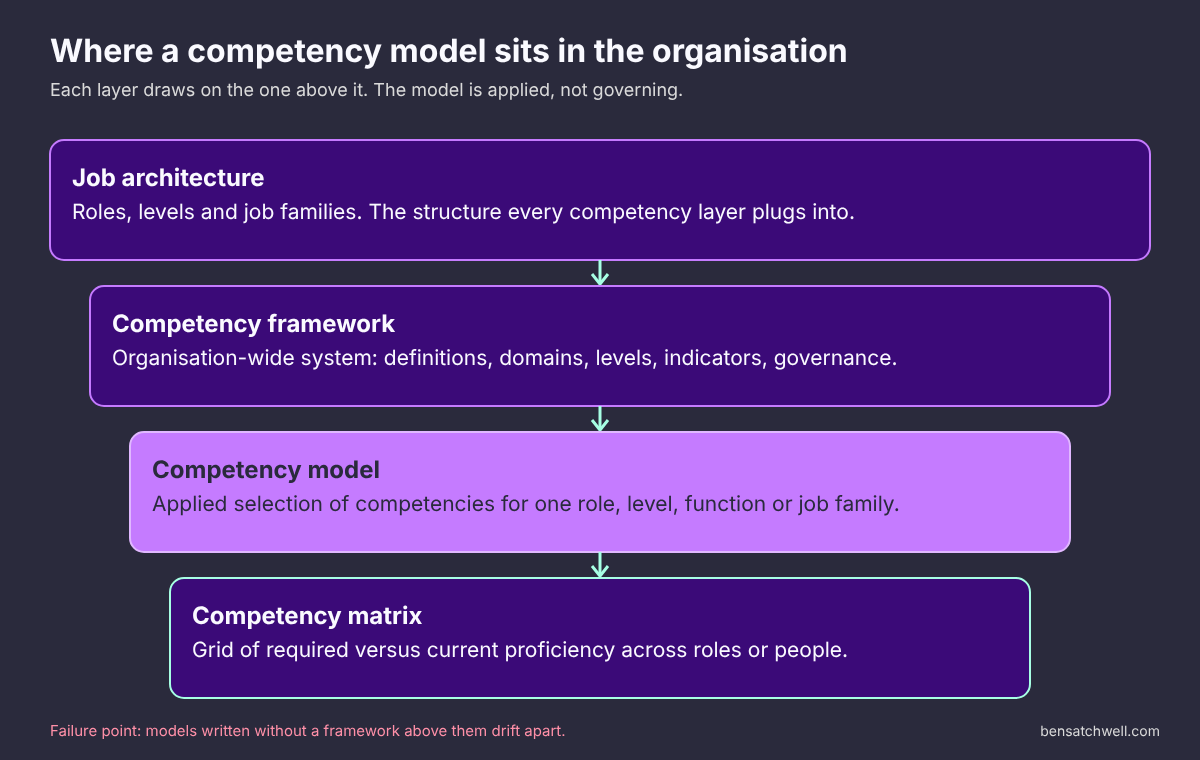
A competency model is an applied selection of competencies, drawn from a competency framework, and tailored to a specific role, level, function or job family.
A competency is the integration of skills, knowledge, judgement and behaviour applied effectively in the context of a role. It describes what good performance looks like as observable behaviour at a defined proficiency level. It is not a task and it is not a single skill.
If the competency framework is the system, the model is an instance of it. The framework holds the definitions, domains, proficiency levels and behavioural indicators for the whole organisation. The model picks from that library what one role needs and sets a target level for each competency. For a deeper treatment of the governing layer, see my article on the competency framework.
Why Do Organisations Use Competency Models?
Organisations use competency models because role expectations written in prose cannot be compared, assessed or developed at scale. A model converts "a strong communicator" into a stated competency, a target proficiency level and behavioural indicators a manager can actually observe.
That conversion solves three specific problems.
- Inconsistent expectations. Two managers hiring for the same role describe different people.
- Unfair decisions. Without shared indicators, promotion and selection rest on impression.
- Invisible gaps. Leaders cannot see where workforce proficiency falls short of what the work requires.
The approach has deep public sector roots. The United States Office of Personnel Management describes competency modeling as the foundation for selection, career development and performance management tools, built from job analysis data. The Australian Public Service Commission took a similar position with its Integrated Leadership System, which gives a common language and behavioural indicators for increasing role complexity.
How Do Competency Models Work in Practice?
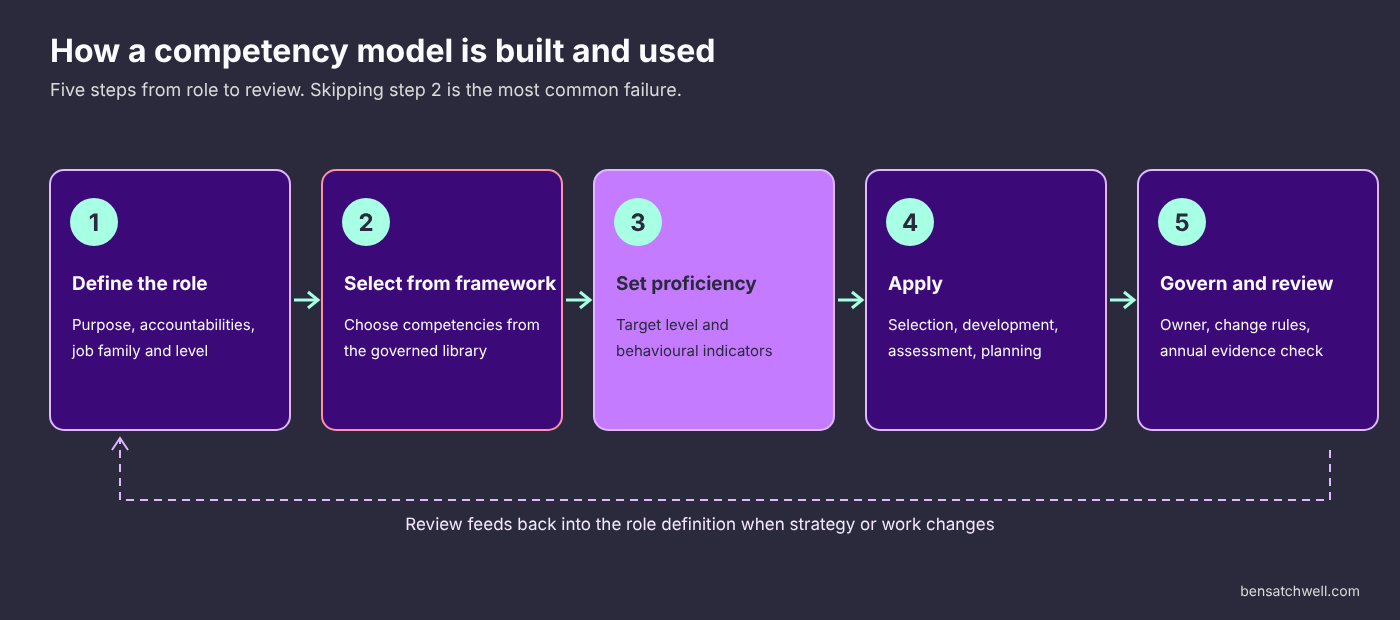
A competency model works by moving through five steps, from the role to a governed review. The order matters, and step two is where most organisations cut a corner.
Define the role
Start with purpose, accountabilities, job family and level. A role is the set of responsibilities a person is accountable for. Competencies describe what they need to do it well. If the role is unclear, the model will be too.
Select from the framework
Choose competencies from the governed library. Do not write new ones unless the framework has a genuine gap, and then add the new competency to the framework, not only to the model. Typically a model combines core competencies that everyone holds with technical competencies specific to the discipline.
Set proficiency and indicators
Assign a target proficiency level to each selected competency. Levels are set by scope, autonomy, complexity and impact, not by seniority or years of service. My article on competency framework levels covers how to build them. Four to six levels is workable.
Apply and govern
Use the model for selection, development, assessment and workforce planning, and give it an owner. A model without an owner decays within a year.
The CIPD Profession Map is a useful reference point here. It separates core knowledge, core behaviours and specialist knowledge, which is the same logic as separating common competencies from technical ones. You can see this in the CIPD Profession Map. For worked role-level illustrations, see these competency model examples.
Where named frameworks fit
Named frameworks are best treated as source libraries for the selection step, not as models in their own right. The Korn Ferry Leadership Architect, which grew out of the Lominger work, offers a ready library of leadership competencies. SFIA gives a skills framework with defined levels of responsibility for technology roles. Neither is a model for your organisation until someone has chosen from it, set target levels and attached it to a role.
The same applies to the matrix. Once models exist for a job family, a competency matrix can lay them against current proficiency across a team. That grid is useful for seeing gaps, but it only works when every model beneath it uses the same definitions and levels.
What Is a Competency Model Not?
A competency model is not any of the adjacent constructs it is regularly confused with. Precision here prevents most implementation failures.
- Not a competency framework. The framework governs the whole organisation. The model is one applied instance of it.
- Not a competency matrix. A matrix is a grid showing required versus current proficiency. It is a display and assessment artefact built from models.
- Not a capability model. A capability is a broad, durable area of ability a person carries across roles. A competency is tied to performance in a role. The two sit in separate structures and should not be blended into one list.
- Not a skills list. Skills are discrete and transient. A competency integrates skills with knowledge, judgement and behaviour.
- Not a job description. The description defines accountabilities. The model defines what good performance looks like in meeting them.
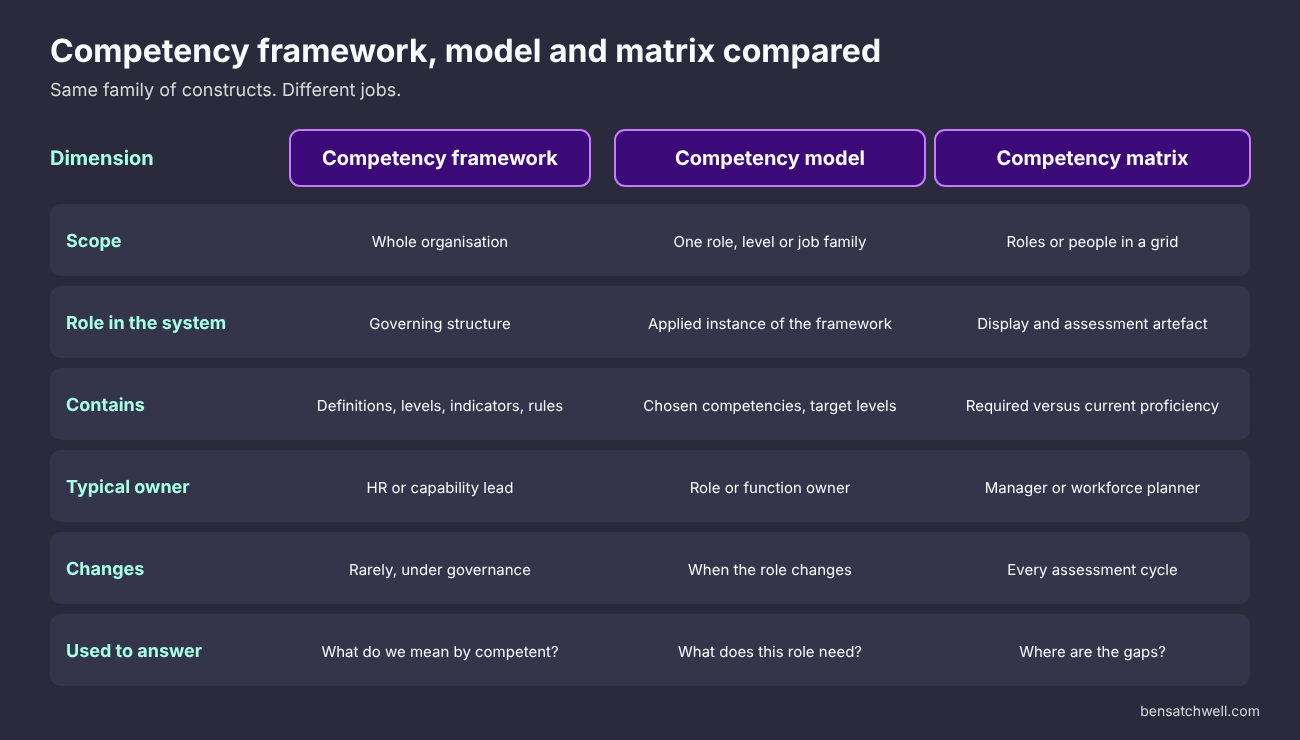
A note on terminology. Many North American sources use "competency model" as the broadest, primary term. I use framework, model and matrix as three distinct layers because the distinction makes governance clearer. It is a convention, not a universal rule, so check which sense a source is using before comparing definitions.
Why Do Competency Models Fail?
Competency models fail when they are disconnected from the structure above and the decisions below. The common failure modes are consistent.
- No framework above them. Each function writes its own model, and the same competency appears under five names with five meanings.
- Too many competencies. A model with 25 competencies cannot be assessed. Most roles need between six and twelve.
- Vague indicators. "Demonstrates leadership" is not observable. Behavioural indicators must describe what a person does at a specific level.
- Seniority standing in for proficiency. Levels get mapped to grades rather than to scope and complexity.
- No owner and no review. Strategy changes and the model stays frozen.
- Never used. The model is published, and no selection, assessment or planning decision references it.
The structural version of this problem is the subject of why capability frameworks fail. The causes overlap: parts get built without being assembled into a system.
What Are the Trade-Offs of Using Competency Models?
Competency models trade flexibility for consistency. They are the right tool in some conditions and the wrong one in others.
Use a competency model when roles are stable enough to describe, decisions need to be comparable across teams, and there is a framework and an owner to hold it together.
Do not rely on one when roles change faster than a model can be reviewed, when the real need is to understand transferable human capabilities for emerging roles, or when the organisation has no framework and is tempted to build models first.
There is also an assessment constraint. Competencies are assessed against observable behaviour, so the model is only as good as the evidence a manager can realistically gather. Over-specified models produce box-ticking, not insight.
Frequently Asked Questions
What is a competency model in simple terms?
A competency model is a defined set of competencies, each with a target proficiency level, that describes what good performance looks like in a particular role or job family. It is selected from a wider competency framework.
What is the difference between a competency model and a competency framework?
A competency framework is the organisation-wide system that defines and governs all competencies, levels and indicators. A competency model is an applied selection from that framework for one role, level or cohort.
How many competencies should a competency model include?
Most role-level models work with six to twelve competencies. Beyond that, assessment becomes unreliable and managers stop using the model. Combine a small set of core competencies with the technical competencies the role requires.
What are competency models used for in organisations?
They are used for selection, performance conversations, development planning, promotion decisions, and workforce planning. Each use draws on the same defined competencies and indicators, which keeps decisions consistent.
Is a competency model the same as a capability model?
No. A competency model describes performance in a role. A capability model selects broad, durable human capabilities, such as those a person carries across roles, and sets target levels for a role or cohort. They sit in separate structures.
How often should a competency model be reviewed?
Review it at least annually and whenever the role or strategy changes materially. Review needs an owner, and changes should flow back into the framework so models stay aligned.