
Most capability frameworks get the capabilities right and the levels wrong. The capabilities are thought through carefully: what people need to do the work, what good looks like, how skills and behaviour intersect. But the levels are often a rough stab at a scale. A handful of descriptors blur together, differentiate nothing, and leave every assessor falling back on gut feel. The levels are where the framework earns its value or forfeits it, and they are where design attention tends to be shortest.
What Are Capability Framework Levels?
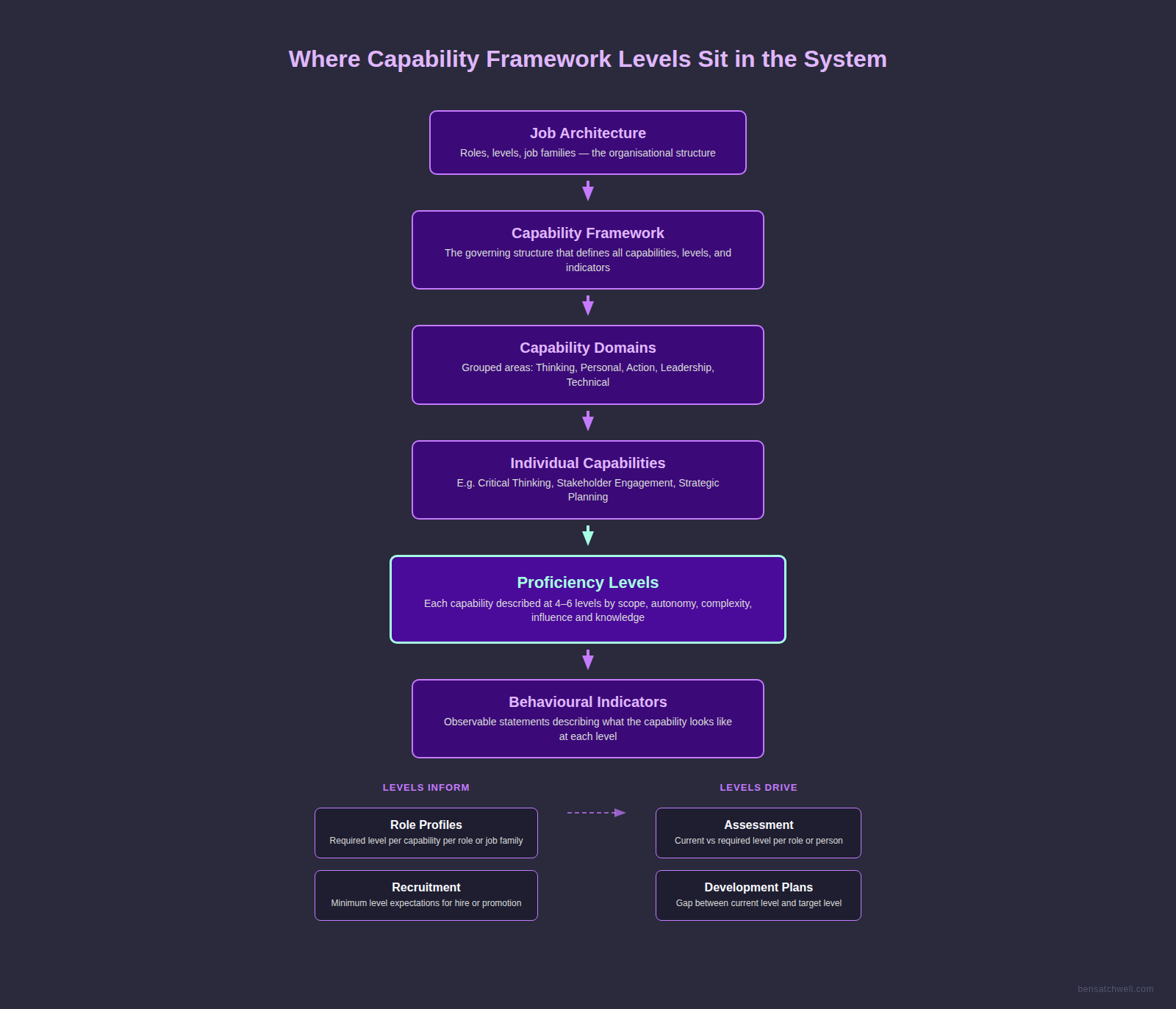
A capability framework level is the defined stage at which a given capability framework expects a capability to be held or demonstrated. Levels divide a single capability into a sequence of observable stages, from basic application under supervision through to autonomous, strategic influence across an enterprise.
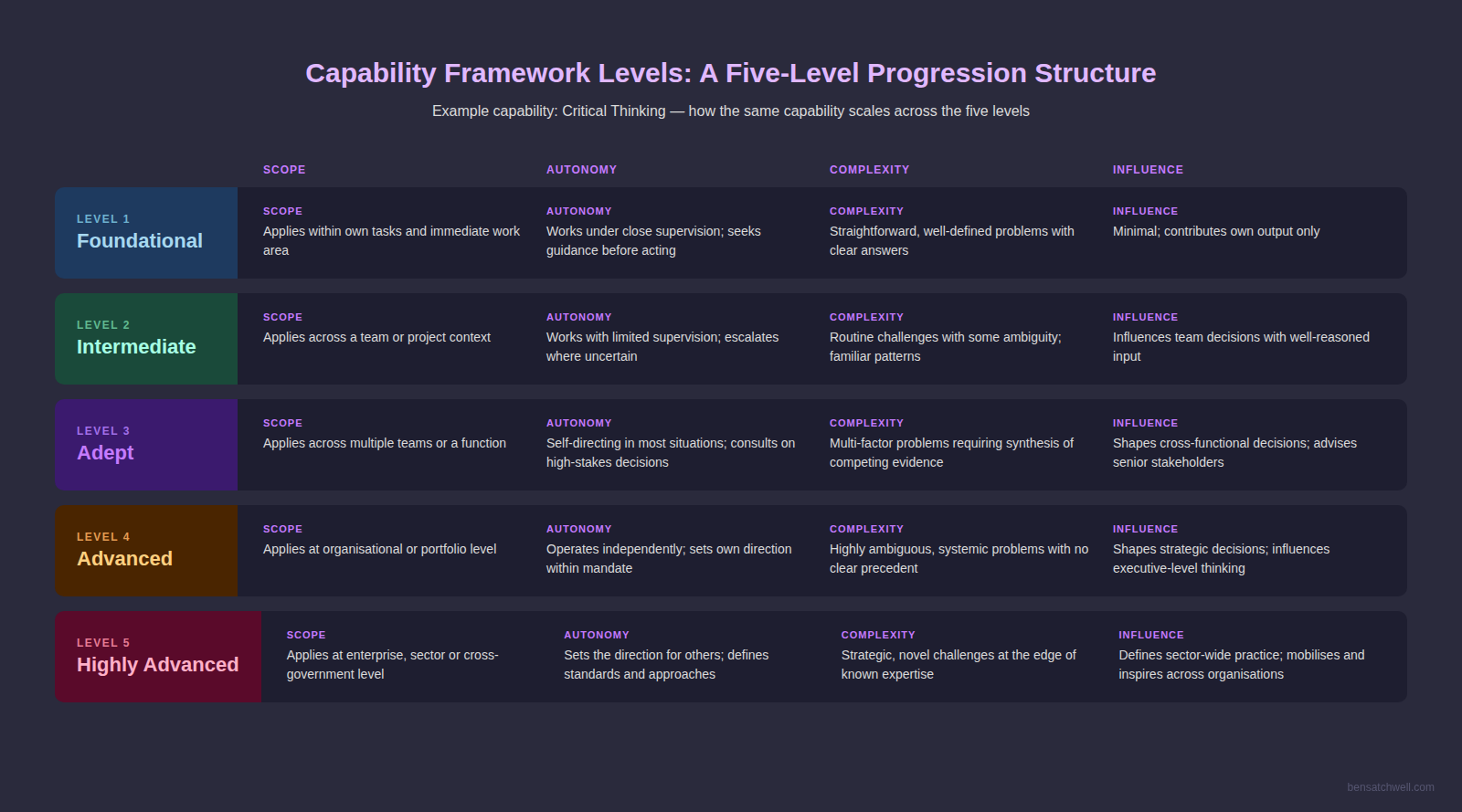
Each level is not a different capability. It is the same capability operating at greater scope, autonomy, complexity, and impact. A person demonstrating critical thinking at Level 1 applies it within their own tasks. A person demonstrating it at Level 4 applies it at organisational scale, without supervision, on genuinely ambiguous problems with no clear precedent.
The precise term from capability framework practice is proficiency level: the defined stage of growth at which a competency or capability is held or required. Levels are set by scope, autonomy, complexity and impact, not by seniority, years of service or personality.
Why Do Capability Framework Levels Exist?
Without levels, a capability framework can name what people need but cannot say how much of it they need. "Stakeholder Engagement" appears on a role profile. But at what depth? The analyst in a project team and the director presenting to ministers both need stakeholder engagement, but not at the same standard. Without levels, the framework cannot articulate that difference, and the role profile becomes decorative.
Levels make capability frameworks useful for real decisions. They enable:
- Role profiling: specifying the minimum level required for each capability in a given role
- Recruitment: setting a consistent standard for hiring and promotion decisions
- Assessment: comparing a person's current demonstrated level against what their role requires
- Development planning: identifying the gap between current level and target level, so effort is directed purposefully
Without levels, the framework is a taxonomy. With levels, it becomes an assessment and development system.
How Capability Framework Levels Work in Practice
The most reliable frameworks differentiate levels using four primary dimensions:
- Scope: the breadth of context in which the capability is applied, from own tasks through to team, function, organisation, or sector
- Autonomy: the degree to which the person operates independently versus under supervision or direction
- Complexity: the nature of the problems engaged with, from routine and well-defined through to ambiguous, novel, and systemic
- Influence: the extent to which the person shapes outcomes, decisions, or practice beyond themselves
A fifth dimension, knowledge depth, is used in some frameworks, particularly technical or specialist ones. Together, these dimensions allow a framework to write a behavioural indicator that genuinely distinguishes Level 2 from Level 3, not just by degree of effort but by observable difference in what the person does. ACSF performance levels show how support and context can define a level, which is the same logic as autonomy and scope under different names.
Each level also needs a label. Labels serve two functions: they communicate meaning to the reader of the framework, and they anchor assessors against a shared reference point. Vague or interchangeable labels (Basic, Intermediate, Advanced, Expert) are the most common source of assessor drift. When two assessors look at the same person and arrive at different ratings, the label is usually the problem.
How Many Levels Should a Capability Framework Have?
Four to six levels is the practical range for most frameworks. Fewer than four tends to collapse meaningful distinctions. There is often a genuine difference between someone who applies a capability only under close direction and someone who applies it with limited supervision, and a three-level framework cannot hold both without conflating them. More than six creates differentiation so fine-grained that most assessors cannot reliably distinguish adjacent levels in practice, and the framework becomes unworkable.
The number of levels should reflect the genuine range of role complexity within the workforce the framework covers. A framework spanning entry-level analysts through to executives across a large government department needs at least five levels. A framework for a narrow specialist function might manage well with four.
How Named Frameworks Handle Capability Levels
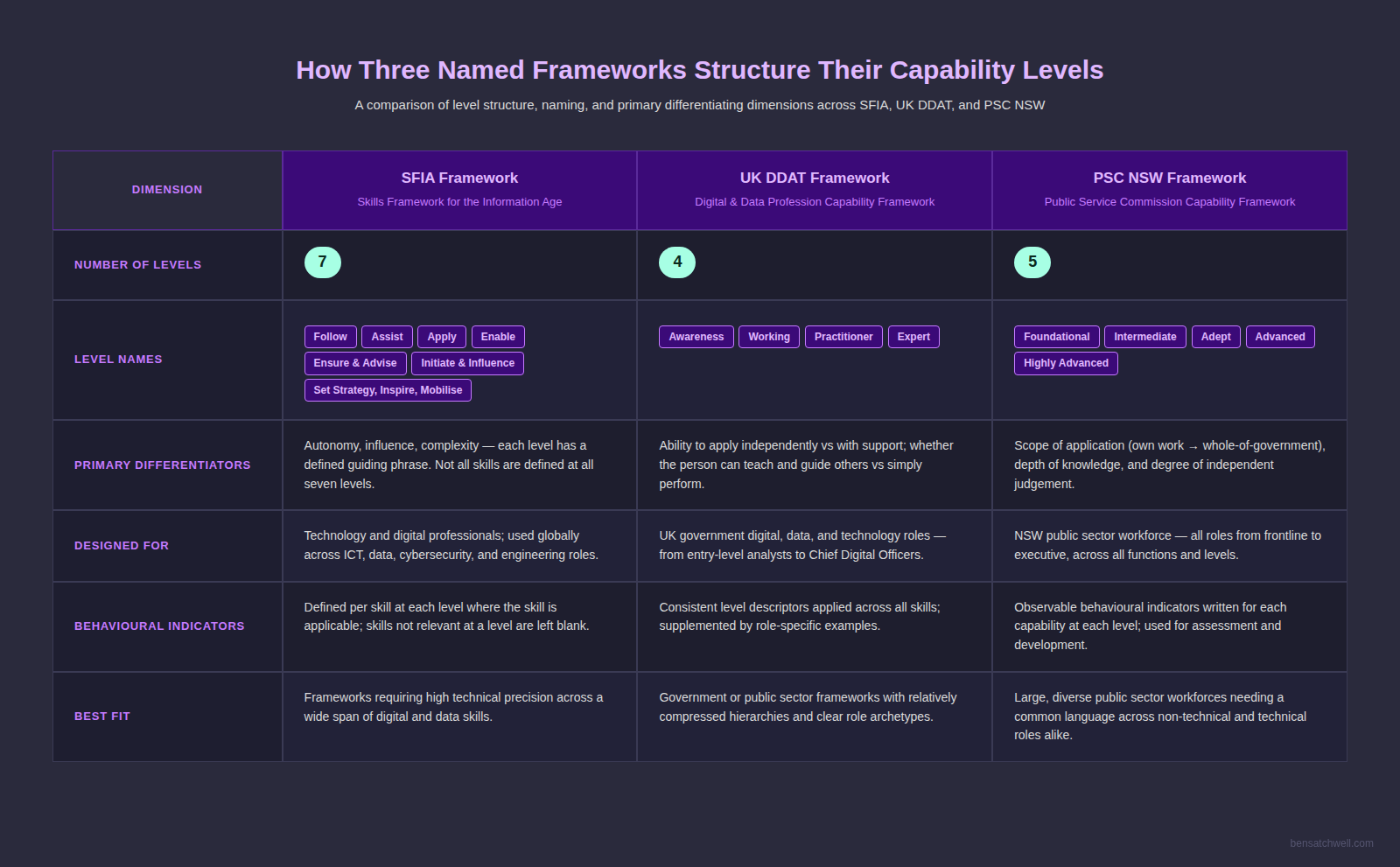
Three of the most widely referenced frameworks illustrate different approaches to level structure and naming.
The SFIA framework uses seven levels, each defined by a guiding phrase: Follow, Assist, Apply, Enable, Ensure and Advise, Initiate and Influence, Set Strategy Inspire Mobilise. SFIA levels are defined by responsibility, not by job title, and not all skills are defined at all seven levels. A skill that does not meaningfully apply at a given level is left blank. This is one of the more rigorous level architectures in any published skills framework.
The UK DDAT Capability Framework uses four levels: Awareness, Working, Practitioner, Expert. The compressed hierarchy suits a government digital and technology workforce with well-defined role archetypes. The primary differentiator is whether the person can apply the capability independently versus with support, and whether they can coach others.
The NSW Public Service Commission Capability Framework uses five levels: Foundational, Intermediate, Adept, Advanced, Highly Advanced. The NSW framework spans the full public sector workforce, so its levels need to hold across both technical and non-technical roles. Scope of application is the primary differentiator, moving from the person's own work through to whole-of-government influence. A detailed look at how the PSC framework applies this structure is in our article on the PSC Capability Framework.
What Capability Framework Levels Are Not
Levels are not grades. A job grade is a pay and classification band, an HR and remuneration construct. A capability level is a description of how a capability is demonstrated. The two may correlate (a more senior grade typically requires higher capability levels), but they are not the same thing. Conflating them causes frameworks to be designed around pay structures rather than around what people actually need to do the work well.
Levels are not performance ratings. A performance rating describes how well someone is doing their job overall. A capability level describes how a specific capability is held. A person can perform well in their role while holding some capabilities below what the role formally requires. That is a development gap, not a performance problem.
Levels are not seniority proxies. Years of experience does not determine level. A person five years into a role may hold a capability at the same level as someone two years in, or lower, depending on the breadth and depth of their exposure and how they have applied it. A framework that equates level with tenure quickly loses credibility and produces assessments that tell people nothing useful.
Capability levels are also distinct from what a capability framework in HR means as a whole. The framework is the governing system. The levels are the mechanism that gives it analytical precision.
Common Failure Modes in Capability Level Design
The most common failure is level descriptors that are not genuinely differentiated. Levels that differ only in degree ("sometimes", "regularly", "consistently") give assessors nothing to anchor their judgements. The result is high variability in assessment outcomes across assessors and a rapid loss of confidence in the framework.
The second failure is designing levels around job titles rather than around the observable dimensions of scope, autonomy, complexity, and influence. When a Level 3 is defined as "for managers" and a Level 4 as "for directors", the framework collapses into a grade structure. Assessors stop reading the behavioural indicators and simply map people to their title.
The third failure is an inappropriate number of levels. Too few and the framework cannot serve development: there is nowhere meaningful to go. Too many and assessors cannot distinguish adjacent levels reliably. The framework then produces inconsistent results and is quietly abandoned.
When Level Design Matters Most
Level design matters most in three situations. First, when the framework is used for formal assessment: if a person's actual level is being measured and recorded, the levels need to be rigorous enough to produce consistent results across different assessors. Second, when the framework spans a wide range of roles: the broader the workforce, the more carefully levels need to be calibrated to hold at both ends. Third, when the framework is connected to significant decisions such as promotion, selection, or pay banding: the stakes of inconsistent assessment are higher, and the level design needs to be correspondingly tighter.
A framework used only informally for development conversations can tolerate less rigour. A framework used for promotion panels cannot.
Frequently Asked Questions About Capability Framework Levels
How many levels should a capability framework have?
Four to six levels is the practical range for most frameworks. Fewer than four collapses meaningful distinctions. More than six produces levels that most assessors cannot reliably distinguish in a real assessment context.
What is the difference between a capability level and a job grade?
A capability level describes how a specific capability is demonstrated. A job grade is a pay and classification band. They may correlate, but they are different constructs. Conflating them causes frameworks to be designed around salary structures rather than around the work itself.
Do all capabilities need to be defined at all levels?
No. Some capabilities are not relevant at certain levels. The SFIA framework leaves a capability blank at levels where it does not meaningfully apply. Forcing a definition at every level when the capability is not relevant produces descriptors that are artificial and not useful for assessment.
What dimensions should define the difference between levels?
Scope, autonomy, complexity, and influence are the four primary dimensions. Some frameworks add knowledge depth, particularly for technical capabilities. The dimensions should produce observable, distinguishable differences in what the person does, not just incremental improvements in the same behaviour.
Can a person hold different capabilities at different levels?
Yes, and this is expected. A person may hold some capabilities well above what their role requires and others below. A capability framework is designed to surface exactly this kind of granular picture, which is what makes it more useful for development than a broad performance rating.
What happens when level labels are not clear?
Assessor drift. When labels are vague or interchangeable, different assessors apply different standards to the same behaviour. The assessment results then vary based on who conducted the assessment rather than on what was demonstrated. Reliable assessment requires labels that carry genuine definitional weight, backed by specific behavioural indicators at each level.