
Most organisations deploy HR business partners without an HR business partner competency framework, so nobody is clear about what good looks like at this level. They take people from generalist HR roles, give them a new title, and assume proximity to the business will close the capability gap. It rarely does.
An HR business partner competency framework makes the expectation explicit. It defines what effective HRBPs need to know, do and demonstrate across a range of proficiency levels, from early-career advisory support through to strategic business influence. Without it, "business partner" remains a job title, not a standard of performance.
This article sets out the framework itself: the eight core HR business partner competencies, the proficiency levels under them, how to assess HRBPs, and how the Ulrich, CIPD, SHRM and APSC frameworks compare. Applying it to one specific role, by selecting and weighting competencies and setting target levels, is the job of an HRBP competency profile, which I cover separately.
What Is an HR Business Partner Competency Framework?
An HR business partner competency framework is an organisation-wide structure that defines the competencies HR business partners need, groups them into domains, and describes the observable behaviour expected at each proficiency level. It sets the standard for strategic advisory performance, not for managing HR processes closer to the business.
A competency here is not a checklist item or a personality trait. It is the integration of skills, knowledge, judgement and behaviour, applied effectively in the context of the HRBP role and visible in what the person actually does.
The HRBP framework is itself a specific application of a broader HR competency framework, tailored to the scope and strategic expectations of the business partner role.
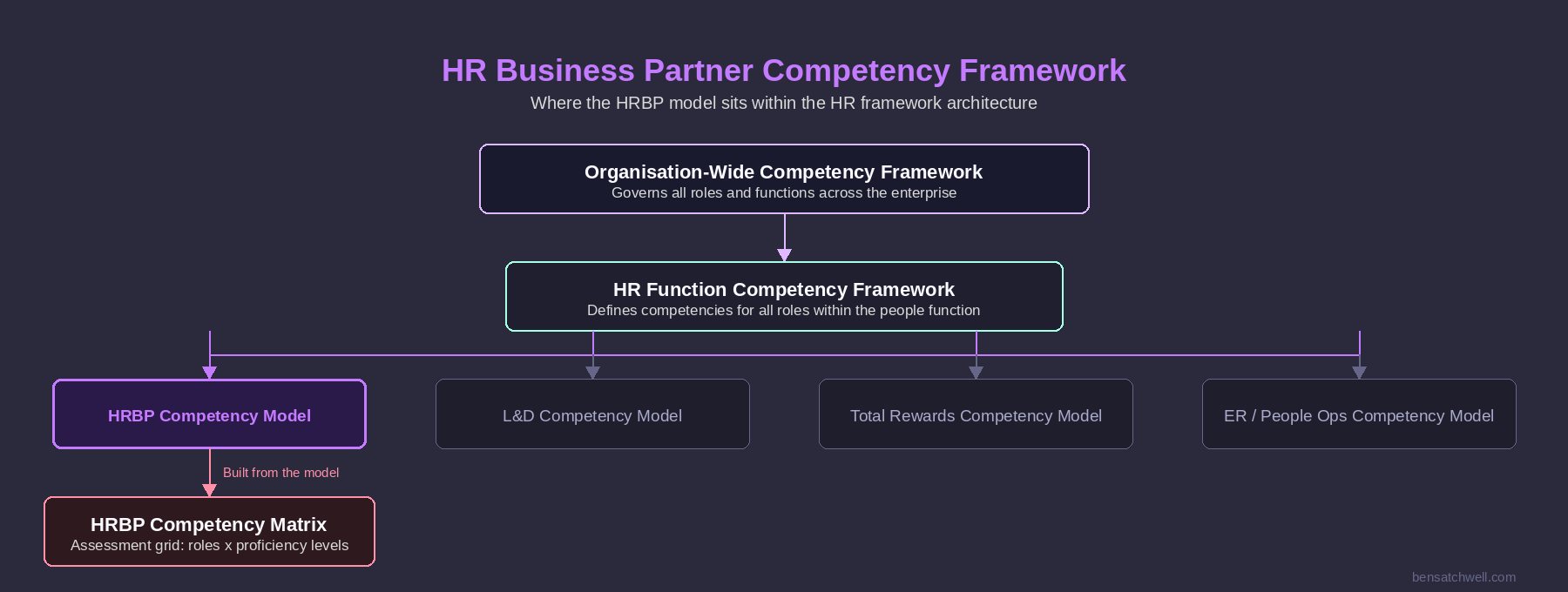
A note on terminology. A competency framework is also called a competency model, especially in the United States. I use competency profile for the competencies and required levels for one role, and competency matrix for the grid of required against current proficiency. Usage varies by region, and I explain the differences in this competency model definition.
Why HR Business Partners Need Their Own Framework
The business partner role has specific demands that a generic HR framework cannot address adequately. HRBPs operate at the boundary between the HR function and the business line. They are expected to translate business strategy into workforce decisions, influence senior leaders without line authority, and work with ambiguity that frontline generalists rarely face.
The CIPD's business partnering factsheet describes the essence of business partnering as the people function working effectively alongside the rest of the organisation to deliver people solutions. That implies a specific set of competencies: commercial understanding, stakeholder influence, data literacy, and the ability to diagnose complex organisational problems. A general competency framework does not account for those elevated expectations. A dedicated framework closes that gap.
How an HR Business Partner Competency Framework Works in Practice
An HRBP competency framework has three layers. Competency domains group related competencies, each competency has a precise definition, and behavioural indicators describe what it looks like at each proficiency level. The indicators are what make the framework usable for assessment, not just aspiration.
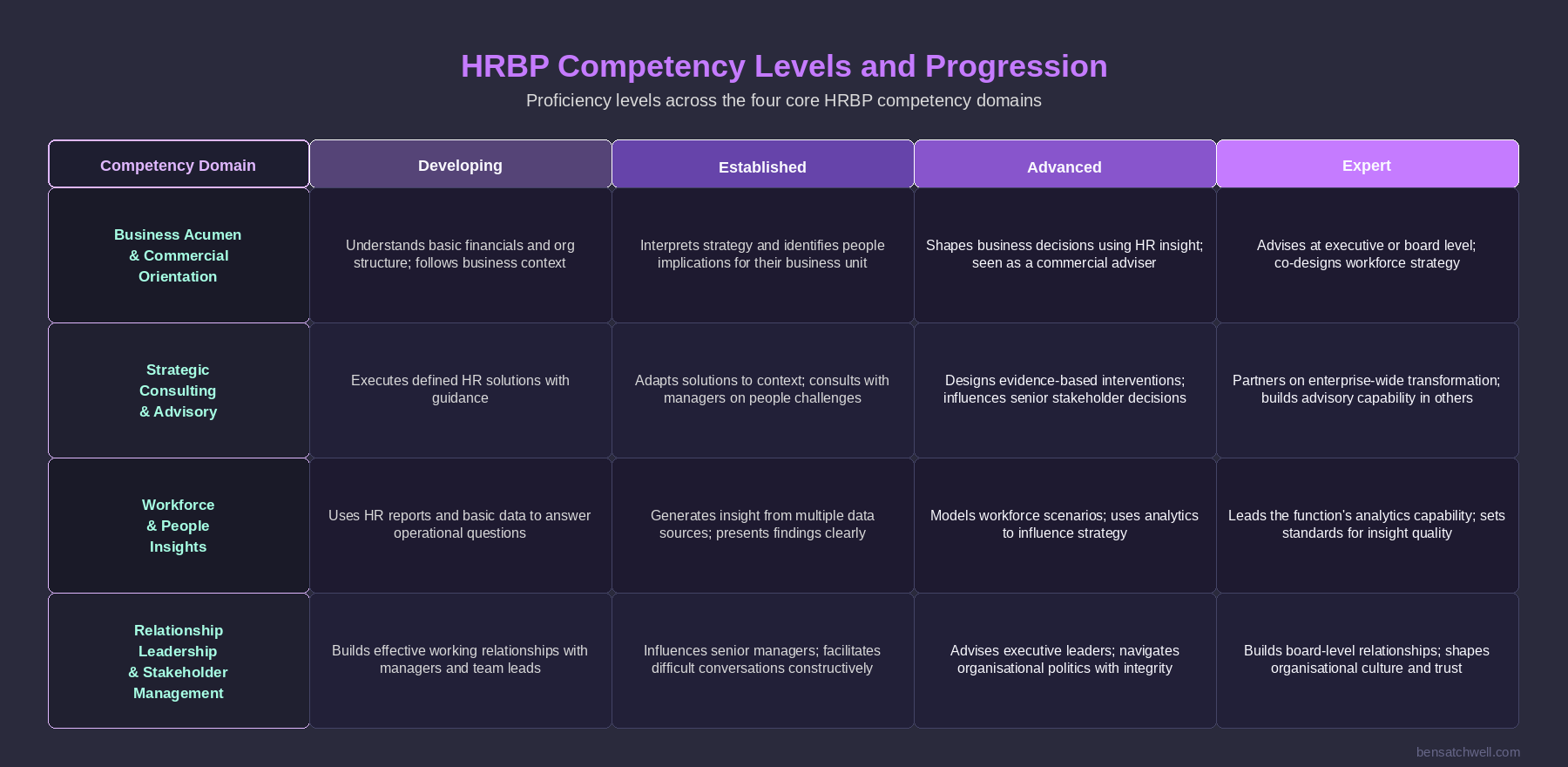
I use four proficiency levels for HRBPs. Levels are defined by scope, autonomy, complexity and impact, not job title, but each tends to line up with a familiar role:
- Developing: works within defined boundaries with guidance. Typical of associate HRBPs and generalists moving into partnering.
- Established: partners independently with a business unit leadership team. Typical of an HRBP.
- Advanced: shapes senior leaders' decisions across complex or high-risk portfolios. Typical of a senior HRBP.
- Expert: shapes enterprise people strategy with the executive and builds partnering capability in others. Typical of a lead or strategic HRBP.
The titles are shorthand only. A senior HRBP with a narrow, stable portfolio may genuinely operate at Established.
What Are the Core HR Business Partner Competencies?
These are the eight core HR business partner competencies I build into an HRBP framework, grouped into the four domains shown above. HR technical expertise is the entry ticket for the role, so I treat it as a threshold requirement rather than a differentiating competency. People often search for HR business partner skills, but a skill is a discrete ability, such as running a consultation process. Each competency below integrates skills with knowledge, judgement and behaviour.
1. Business Acumen
Business acumen is understanding how the organisation creates value, through revenue, margin or public service outcomes, and connecting people decisions to it.
- Developing: Explains the unit's strategy, key metrics and cost drivers, and how an HR issue affects them.
- Established: Frames recommendations in business terms such as productivity, service or risk, and quantifies the cost of inaction.
- Advanced: Contributes to business planning and challenges plans that underestimate the people implications.
- Expert: Shapes enterprise strategy and is consulted on commercial decisions that are not framed as HR issues.
2. Consulting and Influencing
Consulting and influencing is diagnosing the real problem behind a request, agreeing the outcome with the leader, and persuading leaders to act without line authority. It most clearly separates a business partner from a service provider.
- Developing: Clarifies requests before acting and presents options drawn from policy and precedent.
- Established: Separates symptoms from causes and recommends a preferred option with a clear rationale.
- Advanced: Reframes a senior leader's request when the diagnosis points elsewhere, and holds that position under pressure.
- Expert: Influences executive decisions on contested issues and builds consulting capability across the HRBP team.
3. Change and Organisation Development
Change and organisation development is designing and leading the people side of change, including restructures, organisation design and culture shifts, so that change shows up in behaviour, not just on an org chart.
- Developing: Delivers defined change activities, such as consultation plans and impact assessments, to an agreed plan.
- Established: Designs the people plan for a business unit change and adjusts it when resistance emerges.
- Advanced: Advises on organisation design options and sequencing for multi-team change, weighing capability, cost and risk.
- Expert: Leads organisation development at enterprise scale, linking structure, culture and capability to strategy.
4. Employee Relations Judgement
Employee relations judgement is applying employment law, policy and precedent to complex people issues, balancing legal risk, fairness and the business outcome. It is where HR technical expertise meets advisory judgement.
- Developing: Advises managers on routine conduct and performance matters, and escalates anything outside precedent.
- Established: Manages investigations and grievances, and advises leaders on risk, process and likely outcomes.
- Advanced: Advises senior leaders on high-risk matters such as restructures, anticipating industrial and reputational consequences.
- Expert: Shapes employee relations strategy and risk appetite, and resolves precedent-setting matters.
5. Data and People Analytics
Data and people analytics is using workforce data and other evidence to diagnose problems, test assumptions and measure the impact of people decisions. An HRBP does not need to be an analyst, but they must know when the data does not support a conclusion.
- Developing: Uses standard reports such as turnover and absence, and explains accurately what they show.
- Established: Combines several data sources to answer a business question, and states the limits of the evidence.
- Advanced: Builds the evidence case for major decisions and challenges conclusions the data does not support.
- Expert: Sets the standard for how evidence is used in people decisions across the organisation.
6. Strategic Workforce Planning
Strategic workforce planning is translating business plans into the size, shape and skills of the workforce needed, and deciding whether to build, buy, borrow or redesign work to close the gap.
- Developing: Maintains headcount and vacancy data, and explains how it connects to the business plan.
- Established: Runs the workforce plan for a business unit, covering supply, demand and critical role risk.
- Advanced: Models workforce scenarios for options such as growth, automation or restructure, and quantifies the trade-offs.
- Expert: Builds workforce planning into enterprise strategy and sets long-term capability priorities.
7. Stakeholder Relationship Leadership
Stakeholder relationship leadership is building trusted, candid relationships with leaders so the HRBP is involved before decisions are made rather than after.
- Developing: Builds effective working relationships with managers and team leads, and follows through on commitments.
- Established: Is a regular voice in the leadership team's people discussions and handles difficult conversations constructively.
- Advanced: Is brought in early by senior leaders and navigates organisational politics with integrity.
- Expert: Holds trusted relationships with executives and the board, and shapes how leaders make people decisions.
8. Ethical Practice and Professional Courage
Ethical practice and professional courage is acting with integrity and speaking up when a decision is unfair, unlawful or poorly evidenced, even when the message is unwelcome. The HRBP role tests it harder than most.
- Developing: Handles confidential information appropriately and raises fairness or compliance concerns with their manager.
- Established: Challenges line managers directly when a proposed action conflicts with policy, law or stated values.
- Advanced: Challenges senior leaders on risky decisions and offers a workable alternative.
- Expert: Sets the ethical standard for people decisions across the organisation and protects others who speak up.
Weight these for the role. Business acumen, consulting and influencing, and stakeholder relationship leadership usually matter most. Employee relations judgement carries more weight in unionised environments, and workforce planning more during structural change.
How Do You Assess an HR Business Partner?
You assess an HR business partner by collecting evidence of behaviour against the indicators for their target level, from more than one source, then calibrating ratings across the HRBP team. Self-assessment opens a development conversation, but it is not evidence on its own. The methods I rely on are:
- Structured behavioural interviews asking for specific past examples at the level being assessed.
- Case exercises, such as a business unit data pack that needs a diagnosis and recommendation. One good case tests business acumen, analytics and consulting at once.
- Stakeholder feedback from the leaders the HRBP partners with, framed around specific indicators.
- Calibration panels that compare ratings across HRBPs, so Advanced means the same thing in every business unit.
Context matters more than most frameworks admit. Raymond Caldwell's research on HR business partner competencies (Human Resource Management Journal, 2008) found the effectiveness of competency-based approaches disappointing and their ability to predict business partner performance particularly weak, with results varying by how consistently partnering had been implemented and how far transactional HR work had been reduced. If HRBPs are buried in transactional work, low scores may reflect the role design, not the person.
The gap between assessed and target level becomes each HRBP's development plan. For rating scales and decision rules, see my guide to building a competency assessment framework.
What an HR Business Partner Competency Framework Is Not
It is not a job description. A job description states what someone is accountable for. A competency framework describes how they need to perform to meet those accountabilities well.
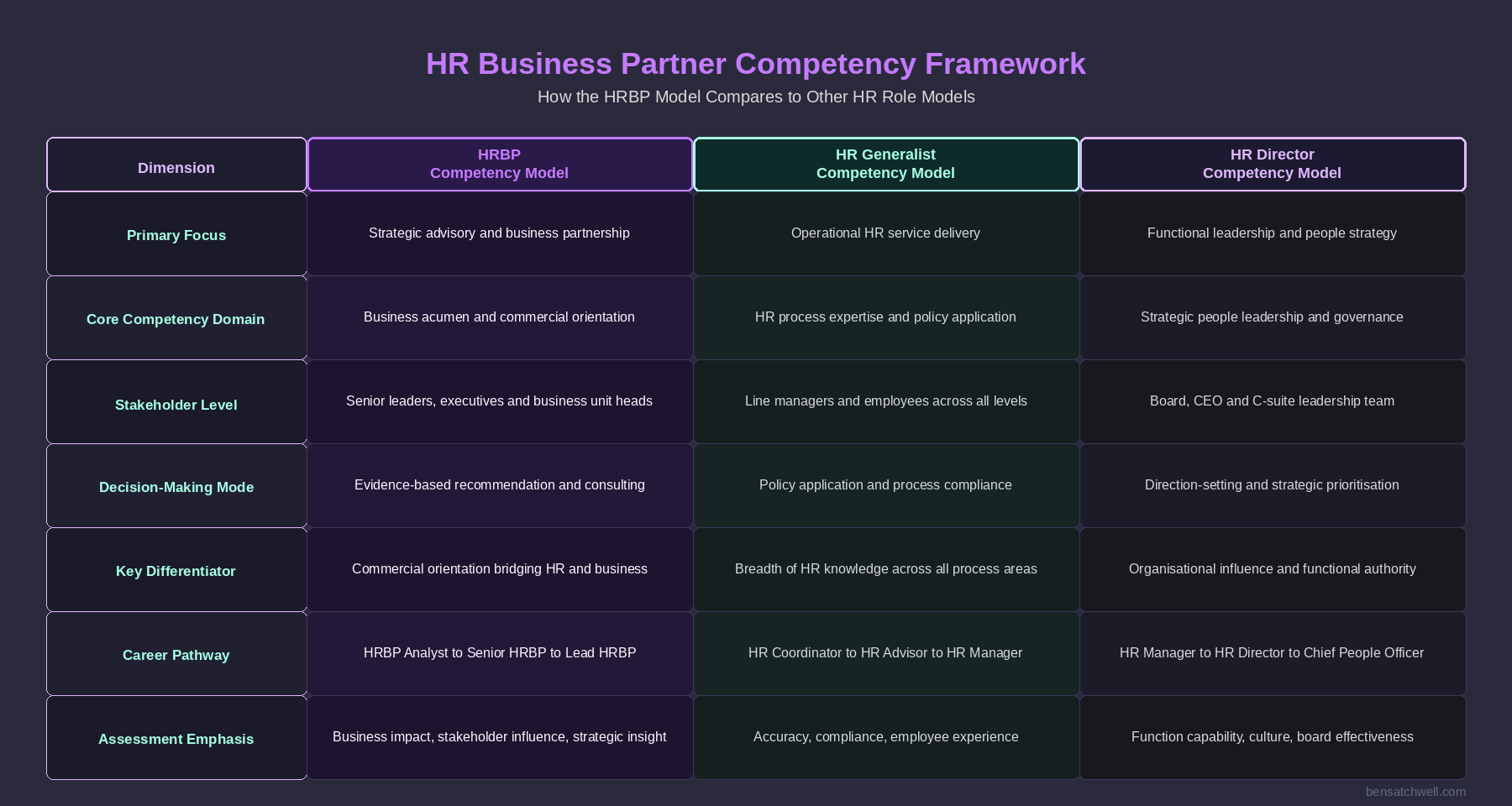
It is not a list of HR technical skills. Employment law knowledge, HRIS proficiency or benefits administration matter, but they are not the defining competency of an HRBP. What distinguishes a business partner from a generalist is the capacity to translate that expertise into commercial and strategic impact, as the comparison above shows.
It is not a personality profile. Frameworks that describe HRBPs as "strategic thinkers" or "trusted advisers" without specifying the observable behaviours that demonstrate those qualities are not competency frameworks. They are aspiration documents. A proper framework anchors every descriptor to observable behaviour at a defined proficiency level.
HRBP Competency Frameworks and Standards: Ulrich, CIPD, SHRM and APSC
Several frameworks shape how HR business partner competencies are defined. None is a ready-made HRBP competency framework on its own.
The Ulrich HR Business Partner Model
The business partner role traces back to Dave Ulrich. In A New Mandate for Human Resources (Harvard Business Review, 1998), he argued that HR should be defined by what it delivers rather than what it does, and set out four roles: partner in strategy execution, expert in how work is organised and executed, champion for employees, and agent of continuous transformation. The structural version, the three-legged stool of shared services, centres of excellence and business partners, is the most commonly implemented model according to the CIPD.
Ulrich's later HR Competency Study research reported six competency domains for HR professionals: strategic positioner, credible activist, capability builder, change champion, HR innovator and integrator, and technology proponent (Ulrich, Younger, Brockbank and Ulrich, 2013). Ulrich describes roles and domains, not levelled indicators for an HRBP role. Your framework has to supply those.
The CIPD Profession Map
The CIPD Profession Map sets out six core knowledge areas (people practice, culture and behaviour, business acumen, evidence-based practice, technology and people, and change), eight core behaviours and a set of specialist knowledge areas, described at four levels: Foundation, Associate, Chartered Member and Chartered Fellow. The CIPD reviews it annually, and the 2025 review added workforce planning as a specialist knowledge area.
For business partnering, the most relevant core behaviours are commercial drive, professional courage and influence, insights focused, and situational decision-making.
The SHRM Competency Model
The SHRM Body of Applied Skills and Knowledge (BASK) is the current form of the SHRM Competency Model. The 2026 edition has eight behavioural competencies in three clusters, plus one technical competency, HR Expertise, spanning 14 functional areas:
- Leadership: Leadership & Navigation, Ethical Practice, Inclusive Mindset.
- Interpersonal: Relationship Management, Communication.
- Business: Business Acumen, Consultation, Analytical Aptitude.
The Business cluster is the core of HRBP performance. The 2026 update merged Inclusion & Diversity with Global Mindset to form Inclusive Mindset, so sources listing nine behavioural competencies are out of date. I explain each competency in my guide to the SHRM competency model.
The APSC HR Capability Framework
The Australian Public Service Commission's Pathways to Professionalisation framework (2021) is the HR capability framework for APS HR professionals. It describes four personas, the emerging, developing, advanced and expert HR professional, which map neatly onto the four HRBP levels above, alongside APS HR Leader Attributes such as business acumen and influential leader.
Note the terminology. It describes broad, transferable capabilities for the whole HR profession rather than role-specific competencies, so it needs translating before it works as an HRBP framework. Australian organisations outside the public sector will also want to calibrate against the AHRI competency framework.
Common Failure Modes
Conflating seniority with proficiency. Many frameworks describe what a "senior HRBP" does differently from a "junior HRBP" based on years of experience or job grade. Proficiency levels should be defined by the scope, complexity and autonomy of the work, not by how long someone has been in the role.
Treating all competency domains as equally weighted. Business acumen and stakeholder influence typically matter more than technical HR process expertise in an HRBP role. Frameworks that assign equal weight to all domains misrepresent what the role actually requires.
Writing indicators that cannot be observed. Statements like "demonstrates strategic mindset" are not behavioural indicators. They cannot be assessed. Effective indicators describe what a person actually does in a specific type of situation at a specific level of complexity.
Using the framework only for recruitment. HRBP competency frameworks are most valuable when they inform development, performance conversations and succession decisions, not just hiring. Organisations that build the framework and then file it have wasted the investment.
Neglecting the transition from generalist. The move from HR generalist to business partner is one of the more significant transitions in an HR career. Frameworks that do not explicitly address this transition, including what needs to be built and what needs to change, fail the people making it.
Trade-offs and Constraints
Specificity versus portability. The more precisely a framework is designed for a specific organisation's business context and HRBP operating model, the less transferable it is as a benchmark against the market. There is a genuine trade-off between fit and comparability.
Depth versus usability. Eight competencies across four proficiency levels produce 32 sets of behavioural indicators. That detail is valuable for structured assessment but impractical as a day-to-day reference. Most organisations use a summarised version for performance conversations and the full version for formal review.
Framework versus capability. A framework does not build capability. It defines what is required. The gap between having a framework and actually developing HRBP capability across the organisation is where most organisations underinvest.
Frequently Asked Questions
What competencies does an HR business partner need?
An HR business partner needs eight core competencies: business acumen, consulting and influencing, change and organisation development, employee relations judgement, data and people analytics, strategic workforce planning, stakeholder relationship leadership, and ethical practice and professional courage. HR technical expertise is a threshold requirement rather than a differentiator.
What is an HR business partner competency framework?
An HR business partner competency framework is an organisation-wide structure that defines the competencies effective HRBPs need, groups them into domains, and describes the observable behaviour expected at each proficiency level. It goes beyond a job description to define what distinguishes strong from adequate HRBP performance.
How do you assess an HR business partner?
Assess an HR business partner against the behavioural indicators for their target proficiency level, using evidence from structured behavioural interviews, a case exercise and feedback from the leaders they partner with. Then calibrate ratings across the HRBP team so each level means the same thing in every business unit.
What is the difference between an HRBP competency framework and an HRBP competency profile?
The framework is the governing system: the full set of HRBP competencies, definitions, proficiency levels and indicators. An HRBP competency profile applies that framework to a specific role, selecting the competencies that matter most, weighting them and setting required levels.
How many proficiency levels should an HRBP competency framework have?
Four levels work well for most HRBP frameworks: developing, established, advanced and expert. Levels should be defined by scope, complexity, autonomy and impact, not by job title or years of experience. More than five adds assessment complexity without adding precision.
Can the CIPD Profession Map or the SHRM competency model be used as an HRBP competency framework?
Not on their own. The CIPD Profession Map and the SHRM BASK are professional standards for the whole people profession. They provide useful benchmarks, but they need translating into role-specific, levelled HRBP competencies with behavioural indicators before they work in a specific organisation.