

Competency Framework for HR Professionals
Every HR function I work with eventually has to answer an uncomfortable question: what actually makes someone good at HR? Not personable, not organised, not "strategic" in the vague way that word gets used. Competent, in a way that can be defined and observed. A competency framework for HR professionals is the tool that answers that question in writing, and most HR functions either skip building one entirely or borrow a generic leadership model and relabel it, which produces a document nobody in the function actually recognises as describing their own work.
What Is a Competency Framework for HR Professionals?
A competency framework for HR professionals is a structure that defines the competencies HR practitioners themselves need to perform effectively, at every level from HR administrator through to Chief People Officer. It is not a framework HR builds for other functions. It is the standard HR holds itself to.
A competency framework for HR professionals defines what good HR performance looks like, as observable behaviour, at defined proficiency levels, across both the technical domain of HR practice and the core behavioural domain expected of every practitioner regardless of specialism.
That splits into two layers. The technical or functional layer covers the specialist knowledge and skills tied to a particular HR discipline, reward, employee relations, talent acquisition, organisational design. The core or behavioural layer covers what every HR professional is expected to demonstrate regardless of specialism: ethical practice, consultation, business acumen. If you want the fuller mechanics of how human resources competencies are defined and grouped into domains, that groundwork sits underneath everything in this article.
Why a Competency Framework for HR Professionals Exists
HR spends a significant amount of its time building competency and capability frameworks for everyone else in the organisation, engineers, salespeople, managers, and it is a persistent irony that the function doing this work has often gone without a defined standard of competence for itself. A competency framework for HR professionals exists to close that gap. It gives the function a shared, defensible answer to what "good" looks like at each level, which then underpins hiring criteria, promotion decisions, and individual development plans within HR.
The CIPD Profession Map is explicit about this rationale: it exists to set out the purpose, values, core knowledge and behaviours expected of the people profession internationally, precisely because that standard did not previously exist in a form practitioners could apply consistently across career stage and specialism.
How a Competency Framework for HR Professionals Works in Practice
In practice, the framework is built around two structural components working together. Proficiency levels, usually four to six, define scope, autonomy and impact rather than years of service or job title. Behavioural indicators then describe what each competency looks like when it is demonstrated at each of those levels, written as observable statements rather than personality descriptors.
A functional competency such as employee relations might carry indicators that move from "resolves straightforward grievances following policy" at an early level, to "designs the ER strategy that prevents systemic disputes" at a senior level. That progression is what makes the framework usable for assessment rather than just aspirational language. For the full structural breakdown of how these pieces fit together, including how domains and indicators are organised, see the HR competency framework structure in more detail.
The SHRM Body of Applied Skills and Knowledge illustrates one widely used version of this structure. It defines nine behavioural competencies, including leadership and navigation, ethical practice and business acumen, alongside a single technical competency labelled HR expertise, and uses that structure to define the content of its certification exams. The behavioural and technical split is not incidental. It reflects the same distinction between core and functional competency that underpins most well-built frameworks in this space.
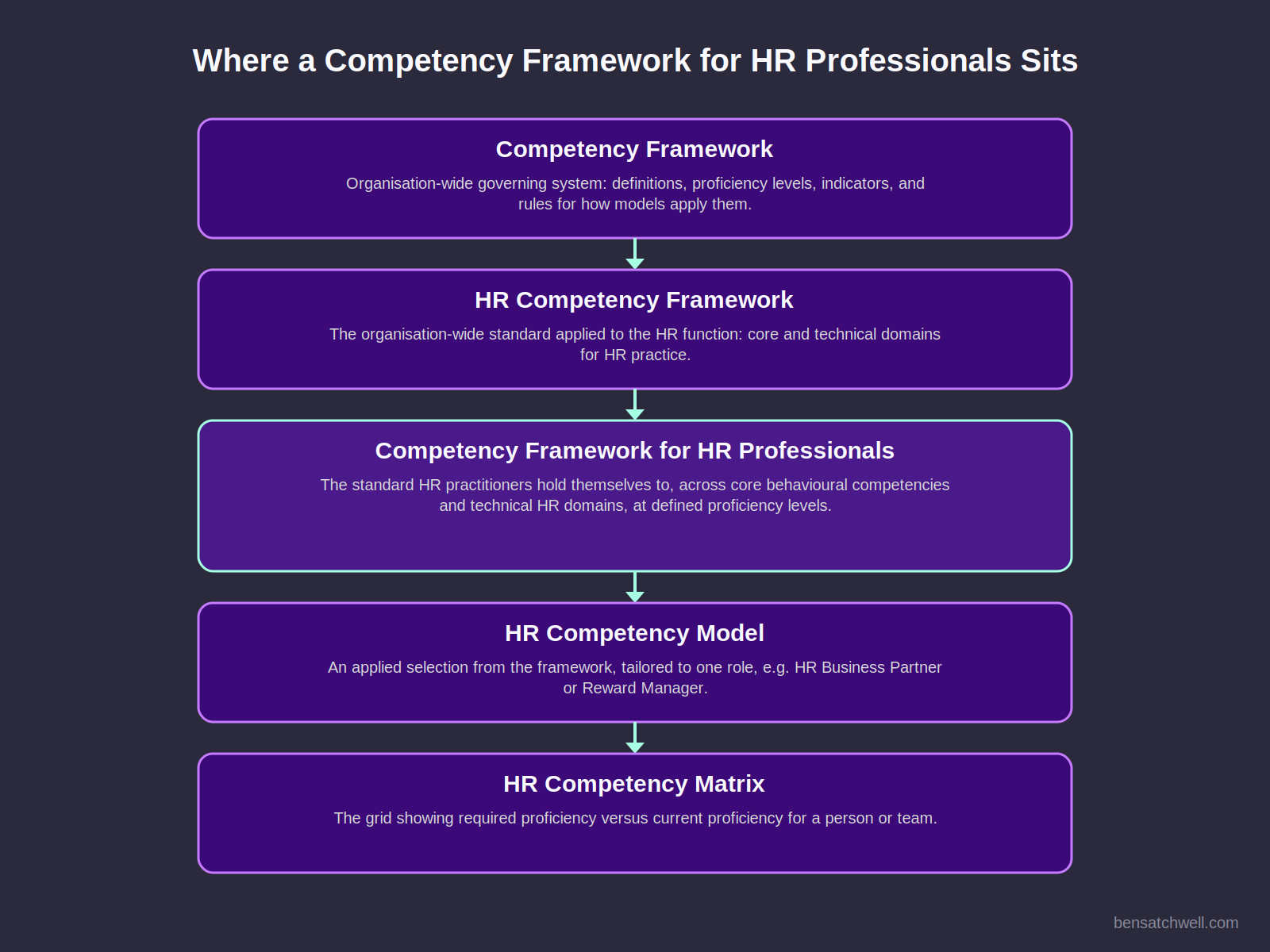
Where a competency framework for HR professionals sits between the broader competency framework and the individual competency model.
Named Frameworks and Standards HR Professionals Reference
Three named references dominate this space, and each answers a slightly different question. The competency framework concept generally traces its governance logic from generic frameworks like these, applied to the HR profession specifically.
The CIPD Profession Map structures its standard around core knowledge, core behaviours and specialist knowledge, applicable across career level and specialism, and is the reference most commonly used across the UK, Ireland, the Middle East and much of the Commonwealth. The SHRM BASK, described above, is the dominant US reference and underpins the SHRM-CP and SHRM-SCP certifications. The Ulrich and Brockbank HR Competency Study, run in successive rounds since the late 1980s, takes a different approach again: rather than defining a standard prescriptively, it empirically measures which competencies correlate with HR professional effectiveness and business performance. A peer-reviewed account of that research documents how the competency set has shifted across rounds as the demands placed on HR practitioners have changed, which is a useful corrective against treating any single competency list as fixed.
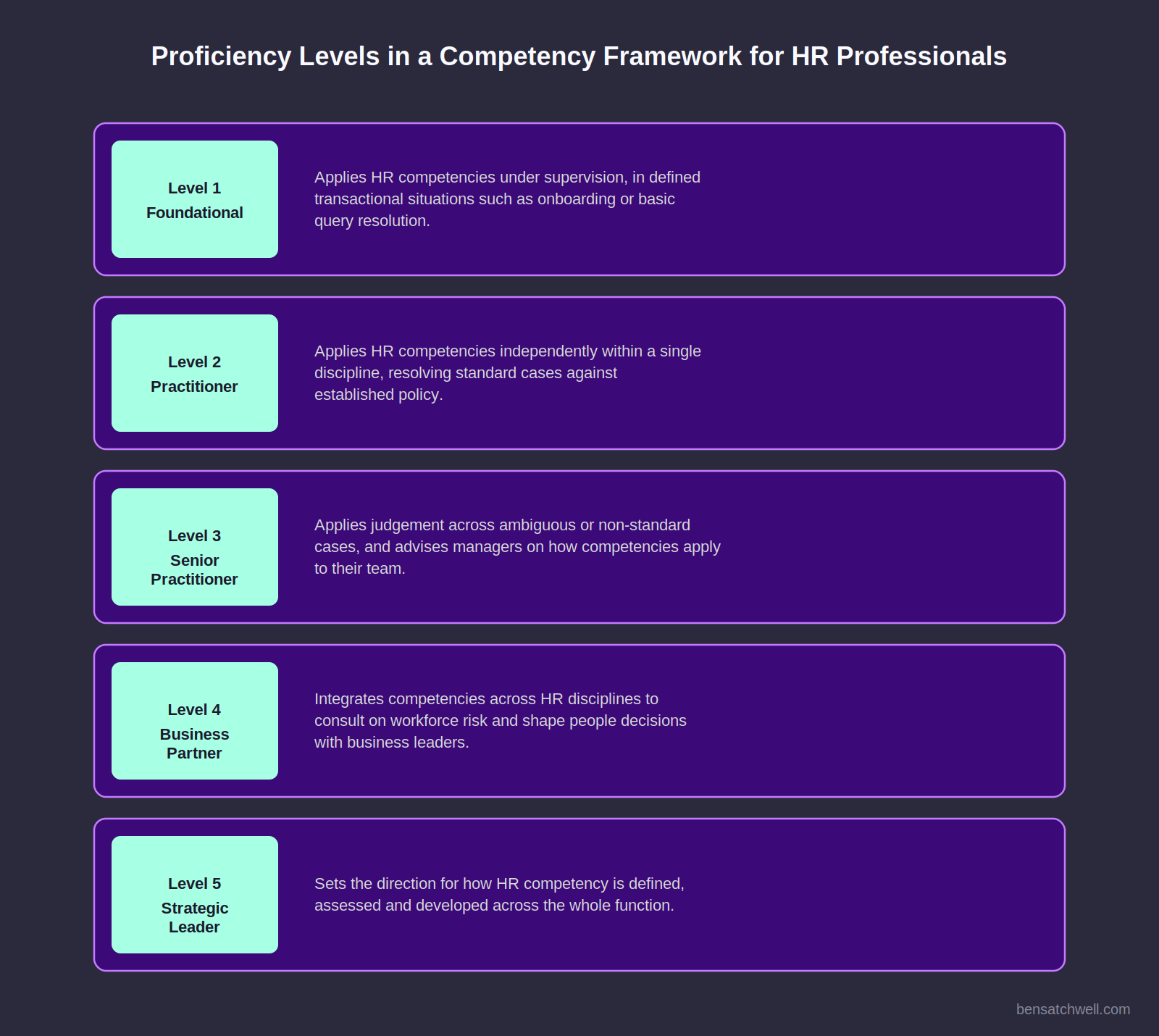
How proficiency in a competency framework for HR professionals progresses from foundational to strategic scope.
Common Failure Modes
The most common failure is adopting a generic leadership competency framework and inserting "HR" into a handful of competency titles without changing the underlying indicators. The result reads as if it was written for any function, because it was.
A second failure is writing indicators as evaluative statements rather than observable behaviour, "demonstrates strategic thinking" rather than "identifies workforce risks two to three years ahead of the business plan and adjusts the people strategy accordingly." The first cannot be assessed consistently between two different raters. The second can.
A third is building the framework and never connecting it to anything. If it does not inform hiring panels, promotion criteria or development plans, it becomes a document that sits in a shared drive and is never opened again.
A fourth is proficiency levels defined by job title or years in the function rather than by scope, autonomy, complexity and impact, which quietly reintroduces seniority bias into what is meant to be a competence-based system.
Trade-offs and Constraints
A dedicated competency framework for HR professionals earns its cost in HR functions large enough to span multiple specialisms and career levels, where consistency in hiring, assessment and development decisions genuinely matters. In a very small HR team, often a single generalist or two, the overhead of maintaining a full framework with defined proficiency levels and behavioural indicators rarely pays for itself, and a lighter competency model borrowed from a published standard is usually sufficient.
The other constraint is maintenance. Published standards such as SHRM BASK are periodically revised as the demands on the profession shift, most visibly with the growing weight placed on data literacy and technology fluency in recent revisions. A framework built once and never revisited will drift out of step with what the role actually requires within a few years.
Frequently Asked Questions
What is the difference between a competency framework for HR professionals and a general HR competency framework?
They usually describe the same thing. "General HR competency framework" sometimes refers instead to the technical competencies HR designs for other functions, so check which the source means before assuming they are identical.
Should HR professionals use CIPD or SHRM as their reference standard?
Geography usually decides it. CIPD dominates the UK, Ireland and much of the Commonwealth, while SHRM is the standard reference across the United States. Neither is more "correct"; they reflect different professional bodies and different certification pathways.
How many competencies should a competency framework for HR professionals include?
Most workable frameworks land between eight and twelve competencies split across core and technical domains. Beyond that, the framework becomes too unwieldy to assess consistently.
Do HR competency frameworks need proficiency levels?
Yes. Without levels, a competency framework can only say a behaviour matters, not how much of it is expected at a given career stage, which makes it unusable for hiring or promotion decisions.
Is a competency framework the same as a career framework for HR?
No. A career framework maps roles, levels and progression paths. A competency framework defines the behaviour expected within those roles. Career frameworks are usually built using the competency framework as an input, not the other way around.
How is a competency framework for HR professionals assessed?
Most functions combine self-assessment against the behavioural indicators with manager or peer review, and some layer in 360-degree feedback for senior levels where impact is harder to observe directly.
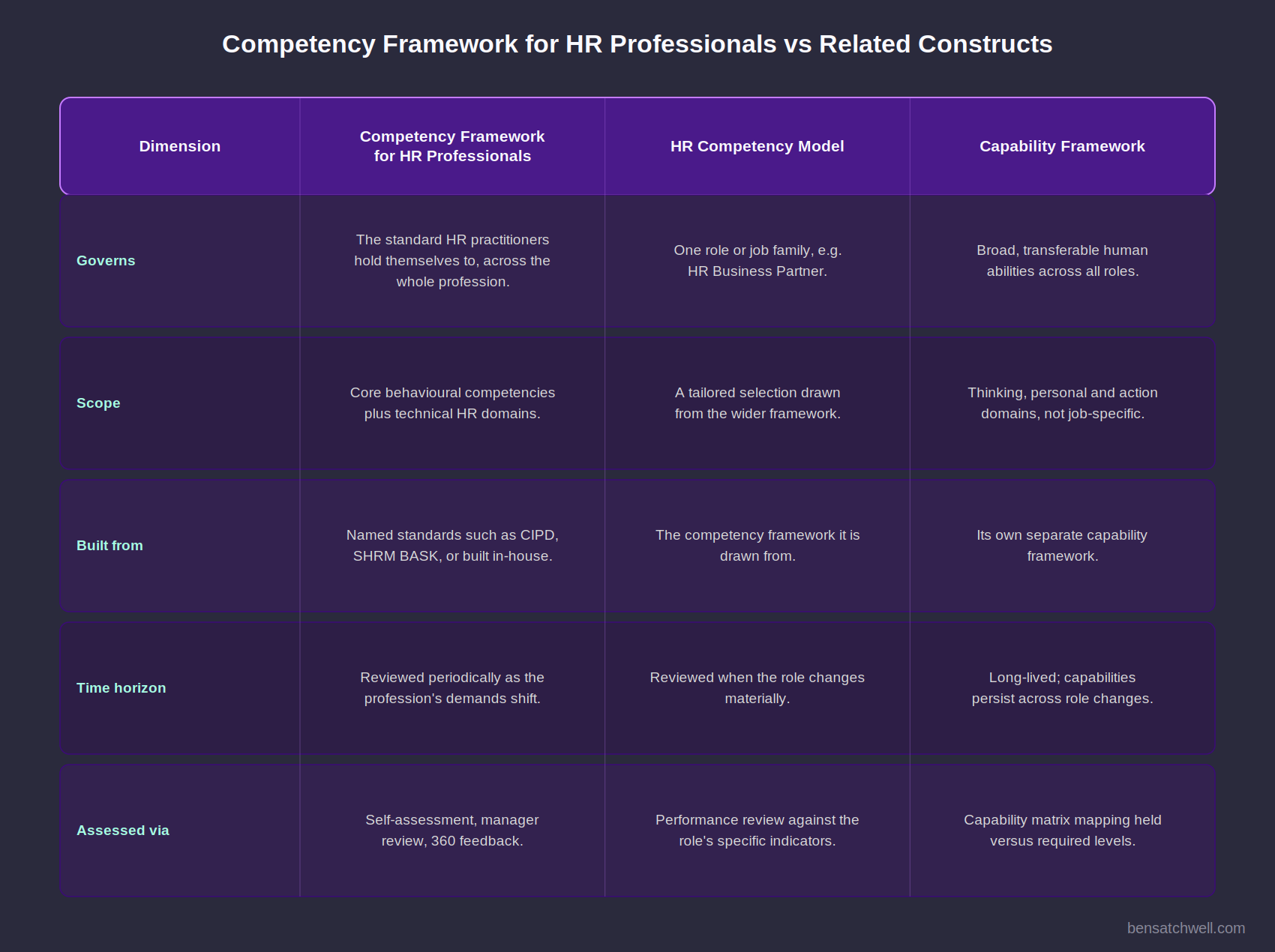
Comparing a competency framework for HR professionals against the related constructs it gets confused with.