

Competency Framework HR
Search "competency framework HR" and you get two different things bolted together under one query: frameworks HR builds for the rest of the organisation, and the framework that defines competence inside HR itself. Most people teams do the first constantly and the second almost never. That is not a minor gap. A function that designs competency frameworks for finance, engineering and customer service but has never turned the same rigour on its own roles is asking other functions to accept a standard it has not applied to itself.
This article is about the second thing: the competency framework HR uses to define what good performance looks like for people working inside the HR function, across HR business partnering, talent acquisition, employee relations, reward, learning and development, and people analytics.
What Is Competency Framework HR
A competency framework is an organisation-wide system that defines, groups and standardises competencies so they can be applied consistently across roles and levels. A competency framework scoped to HR is the applied instance of that system, built specifically for the roles, disciplines and career pathways that sit inside the HR function.
A competency framework for HR defines the core competencies every HR practitioner is expected to hold, plus the technical competencies specific to each HR discipline, levelled against defined proficiency stages. It is not a description of what HR does for the business. It is a description of what HR itself needs to be good at.
That distinction matters because a competency is the integration of skills, knowledge, judgement and behaviour applied effectively in the context of a role, not a task and not a single skill. An HR competency framework states what that integration looks like at each level, for each part of the HR function, as observable behaviour rather than a list of duties.
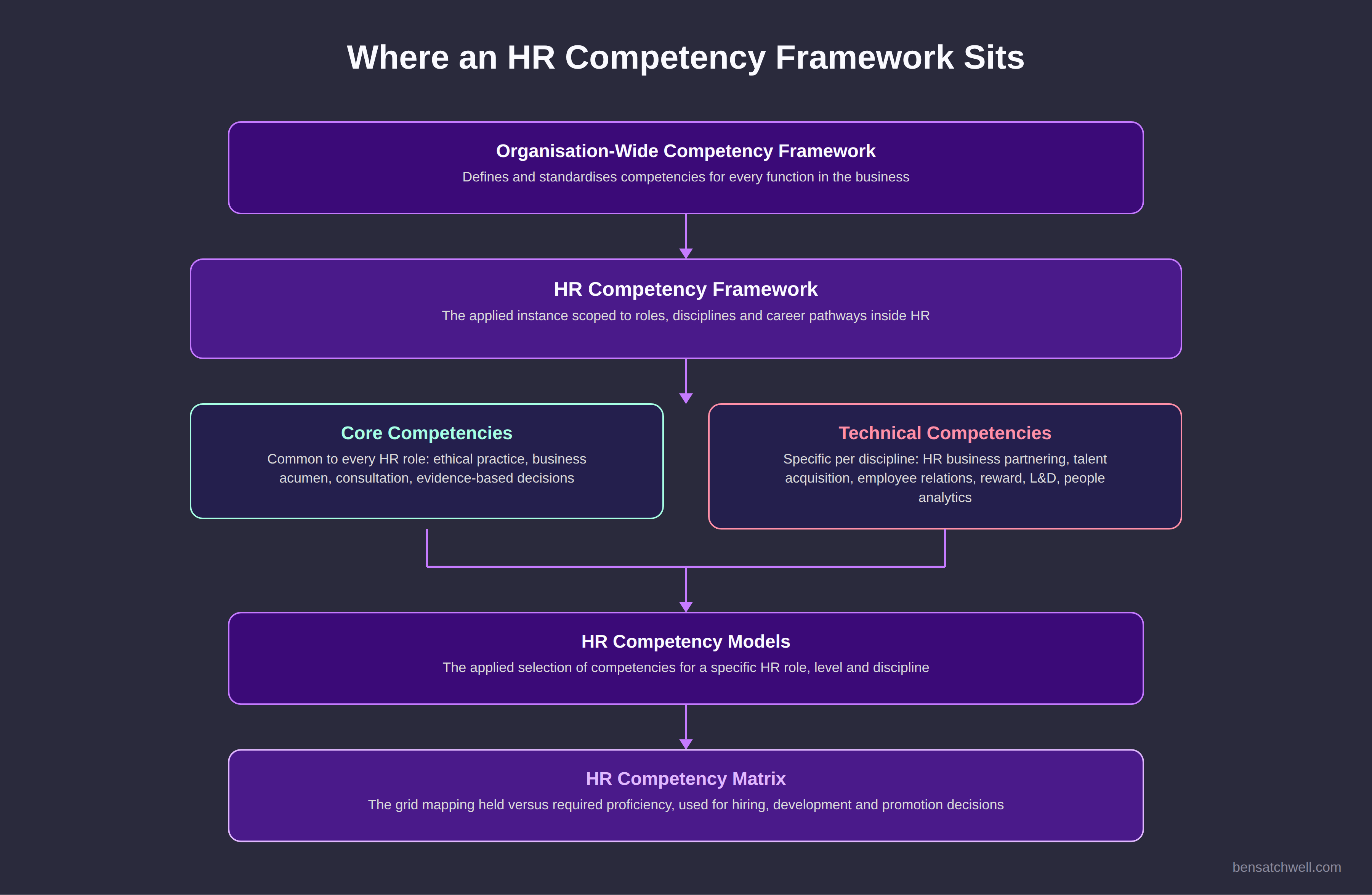
How an HR competency framework sits between the organisation-wide competency framework above it and the models and matrices applied beneath it.
Why It Exists
HR functions routinely build frameworks that assume everyone else's competence is inconsistent and needs governing, while treating their own function's competence as a given. It rarely is. HR business partnering, employee relations, reward and people analytics require genuinely different technical competencies, and conflating them into one generic "HR skills" list produces career pathways, hiring criteria and development plans that fit no one well.
A competency framework for HR exists to fix that. It gives the function a shared, levelled language for what a graduate HR coordinator needs versus a senior HR business partner, what is common across every HR role and what is specific to a discipline, and a defensible basis for hiring, promotion and development decisions inside the function itself. Without it, the same problems HR is meant to solve for the rest of the business simply relocate into HR's own backyard.
How It Works in Practice
A working HR competency framework has three layers.
Core competencies sit at the top and apply to every HR role regardless of discipline or level: ethical practice, evidence-based decision making, stakeholder consultation and business acumen are the ones that recur most consistently across published models. These are the competencies every person in HR is expected to demonstrate, carrying shared expectations across the function.
Technical competencies sit underneath, specific to each HR discipline: employee relations casework and industrial instrument interpretation for ER, sourcing strategy and applicant tracking configuration for talent acquisition, job evaluation methodology for reward, learning needs analysis for L&D, and data modelling and dashboarding for people analytics. These vary by role in the way core competencies do not.
Proficiency levels run across both layers, typically three to five stages moving from foundational practice through to strategic leadership of the discipline. Levels are set by scope, autonomy, complexity and impact of the work, not by tenure or job title, and each level carries behavioural indicators that assessors can actually observe.
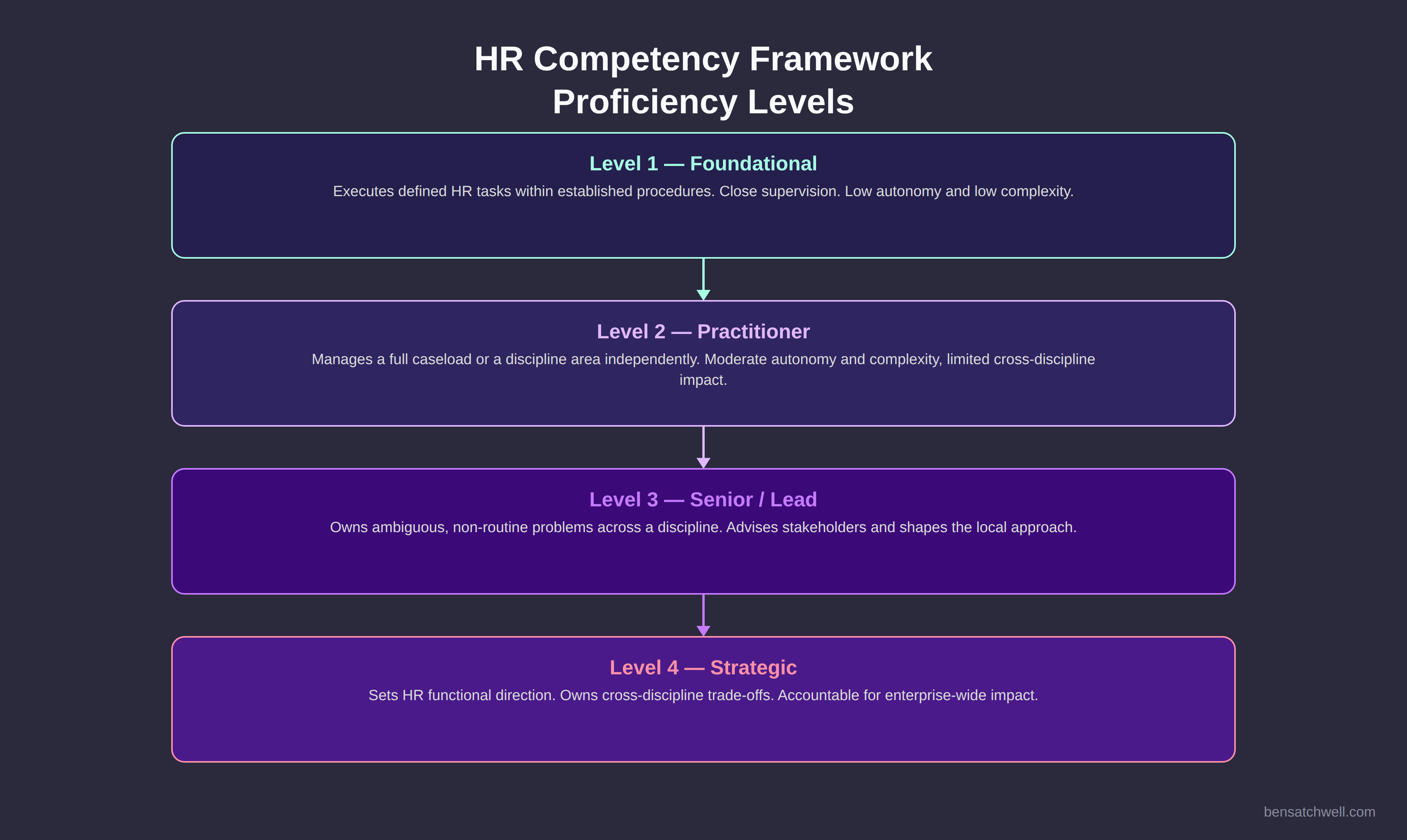
The four proficiency levels a competency framework HR uses to separate scope, autonomy, complexity and impact from tenure or title.
How this layered structure holds together in practice is the part most frameworks get wrong: they build the competency list without building the levelling logic underneath it, which leaves the framework unusable for anything beyond a wall poster.
What Competency Framework HR Is Not
It is not a capability framework. A capability is a broad, durable area of ability a person carries across roles and contexts, such as stakeholder influence or systems thinking, whereas a competency is scoped tightly to a role and integrates specific skills, knowledge and behaviour for that context. HR needs both, but they answer different questions and belong in different structures.
It is not a job description. A job description states accountabilities and reporting lines. A competency framework states the standard of performance expected once someone is in the role.
It is not a competency matrix. The matrix is the grid that shows who holds what against what is required. It is an assessment and reporting artefact built from the framework, not the governing structure itself.
And it is not the framework HR designs for the rest of the organisation. Plenty of HR teams have a well-developed leadership or sales competency framework and nothing equivalent for their own function. Building competence for everyone except the people building the frameworks is a structural gap, not an oversight.
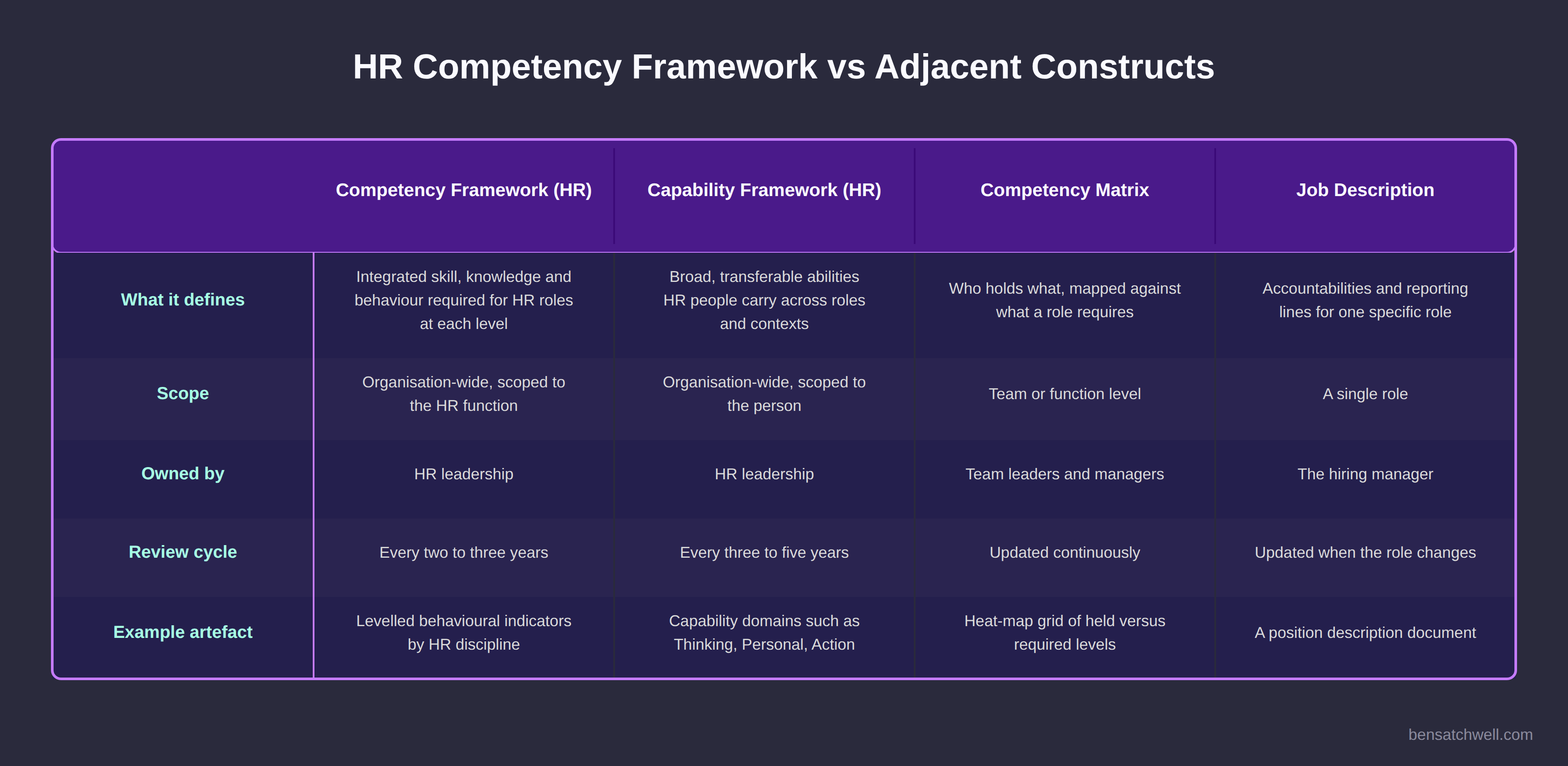
How a competency framework HR compares with the capability framework, competency matrix and job description it is most often confused with.
Named Models: CIPD, SHRM and Public Sector Approaches
Three bodies have published models worth knowing before building one internally.
The CIPD's Profession Map sets an international standard for the people profession, defining core knowledge and core behaviours that apply across HR, learning and development, and organisation design, mapped across career bands from early practice through to leading the profession. It is a genuinely cross-specialism model rather than an HR-only one.
SHRM's competency model, now folded into its Body of Applied Skills and Knowledge, defines nine competencies split between behavioural (leadership and navigation, ethical practice, business acumen, consultation, critical evaluation, communication, global and cultural effectiveness, relationship management) and technical (HR expertise). It was built from research across thousands of practising HR professionals rather than derived theoretically, which is a meaningful point of difference from vendor-authored models.
In the Australian public sector, agencies typically don't adopt a single national HR competency model outright. The NSW Government's HR capability set sits inside the broader public sector capability framework and defines occupation-specific expectations for HR roles within that jurisdiction's own levelling structure, which is the more common public sector pattern: a shared capability framework at the top, with HR-specific technical detail added underneath.
Common Failure Modes
The most common failure is treating the framework as a documentation exercise rather than an assessment tool. A framework nobody uses to assess, hire or promote against is a document, not a working system.
The second is copying a vendor template wholesale without adapting the technical competency layer to the organisation's actual HR structure. A framework built for a large corporate HR function with dedicated specialists does not transfer cleanly to a generalist team of three.
The third is conflating proficiency level with seniority or years of service. Level should track scope, autonomy, complexity and impact of the work a person actually does, and a senior title with narrow accountability does not automatically sit at a higher level than a broader generalist role at a lower grade.
The fourth is building the framework once and never revisiting it as HR's own technical work shifts, particularly as people analytics and HR technology change what "technical competency" actually means inside the function.
Trade-offs and Constraints
A dedicated HR competency framework earns its cost in HR functions of meaningful size and disciplinary spread, where business partnering, employee relations, reward, talent acquisition and analytics are distinct enough to need different technical definitions and different career pathways.
In a small generalist HR team of two or three people covering everything, a full framework with separate technical domains is disproportionate. A shorter core competency list, pulled from an existing standard such as CIPD's or SHRM's rather than built from scratch, does the same job with a fraction of the governance overhead.
The constraint that catches most functions out is maintenance. A framework requires periodic review as the discipline changes, and an HR team that builds one and never revisits it ends up governing other functions against a currency it does not hold itself.
Frequently Asked Questions
What is the difference between a competency framework for HR and a general HR competency framework?
They usually describe the same thing. Both refer to the framework that defines competence for people working inside the HR function, as distinct from a framework HR designs for other parts of the business.
Does HR need its own competency framework if the organisation already has one?
Yes, if HR has genuinely distinct disciplines within it. A single organisation-wide framework rarely has the technical depth to differentiate an employee relations specialist from a people analytics analyst, which is what a discipline-specific layer is for.
What competencies are common across every HR role?
Ethical practice, business acumen, stakeholder consultation and evidence-based decision making recur across most published models, including CIPD's Profession Map and SHRM's competency model.
How does an HR competency framework differ from a capability framework for HR?
A competency framework defines role-specific, integrated performance for HR roles at defined levels. A capability framework defines the broader, transferable abilities HR people carry across roles, such as influence or analytical thinking. Most mature HR functions need both, used for different purposes.
Should HR build its own model or adopt CIPD or SHRM?
Adopting an established model for the core competency layer and building the technical layer internally is usually more defensible than building both from scratch, since the core layer benefits from external validation and the technical layer needs to reflect the organisation's actual HR structure.
How often should an HR competency framework be reviewed?
Most functions review the technical competency layer every two to three years, or sooner where HR technology or ways of working have materially changed what the discipline requires. The core competency layer, being more stable, needs review less frequently.