

A competency based assessment framework gets used interchangeably with a competency framework, and the two are not the same thing. A competency framework defines what good looks like. A competency based assessment framework is a specific assessment methodology built to judge a person against that standard directly, not against how other people performed. Confuse the two and you end up ranking candidates on a curve when the entire point of the exercise was to stop doing exactly that.
What Is a Competency Based Assessment Framework
A competency based assessment framework is a structured, criterion-referenced system for judging whether a person can perform to a defined standard of competence, using direct evidence of their performance, and producing a binary decision: competent, or not yet competent.
The defining feature is what the judgement is made against. A norm-referenced assessment compares a candidate to other candidates and produces a rank or a score on a curve. A competency based assessment framework compares a candidate to a fixed standard, stated as a behavioural indicator or a unit of competency, and asks one question only: does the evidence show this person can do this, to this standard, unsupported. Everyone who meets the standard passes. Everyone who does not, does not, regardless of how the rest of the cohort performed.
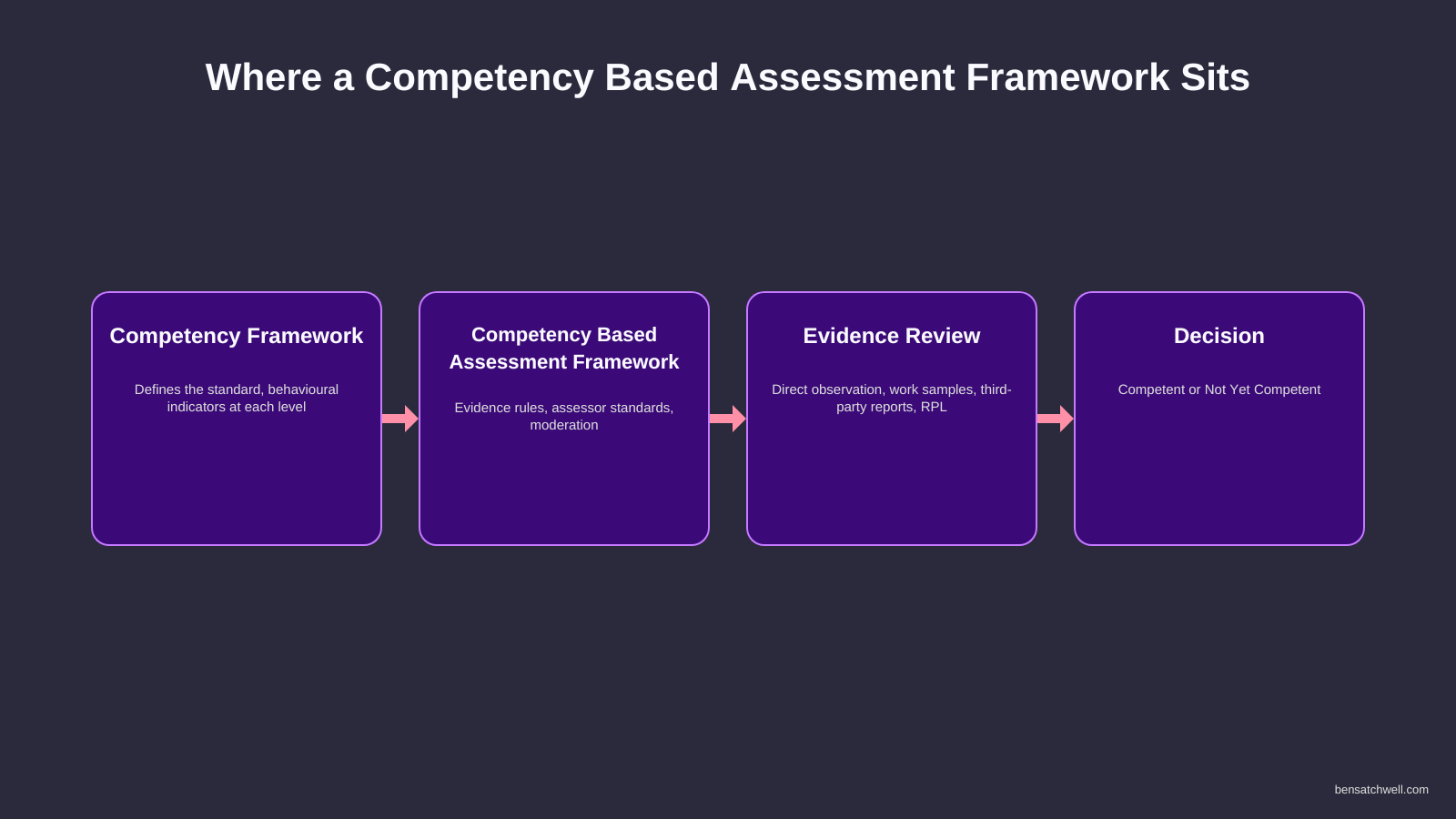
Where a competency based assessment framework sits between the standard being assessed and the decision it produces.
Why a Competency Based Assessment Framework Exists
Traditional graded assessment answers a different question to the one most workforce decisions actually need answered. An exam mark or an interview score tells you how a candidate compares to a cohort. It does not tell you, on its own, whether that person can perform a specific task to a required standard, unsupervised, in a real setting. For roles where the consequence of getting that wrong is a safety incident, a compliance breach or a client left exposed, a comparative score is not good enough.
A competency based assessment framework exists to close that gap. It replaces comparative judgement with criterion-referenced judgement: evidence is gathered against a defined standard, and the standard does not move depending on who else was assessed that year. This is the same logic that sits underneath the people capability system more broadly, where the goal is a defensible, evidence-based read of what a person can actually do rather than an impression formed in a single conversation.
There is also a portability argument. A competency based assessment result should mean the same thing wherever it travels, between employers, between sites, between assessors. That only holds if the standard and the evidence rules are fixed in advance, which is the entire function of the framework.
How a Competency Based Assessment Framework Works in Practice
Evidence Requirements
A workable framework specifies, before anyone is assessed, what counts as evidence and how much of it is required. Common sources include direct observation of the task being performed, work samples or products, structured questioning, third-party reports from a supervisor or client, and recognition of prior learning where a person can demonstrate the competency was already gained elsewhere. Vocational assessment practice typically applies four rules to that evidence: it must be valid, sufficient, authentic and current. Weak frameworks skip this step and accept whatever evidence happens to be available.
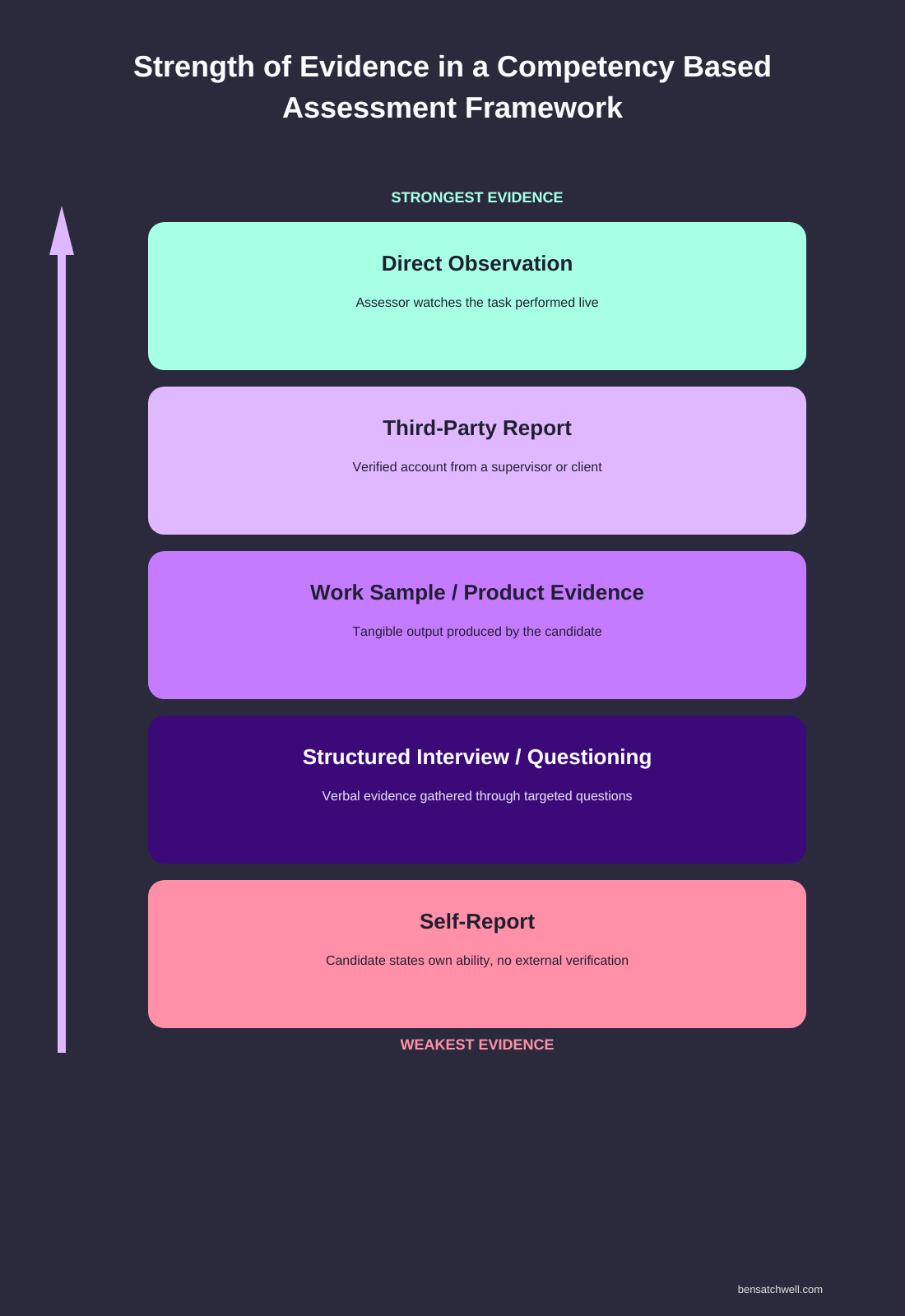
Evidence sources used in a competency based assessment framework, ranked from weakest to strongest.
The Competent, Not Yet Competent Decision
The outcome is binary by design. There is no partial credit and no ranking against peers. A person is judged competent when the evidence meets the standard, and not yet competent when it does not, with a defined pathway to gather further evidence and be reassessed. This is a deliberate departure from graded proficiency scales, which are useful for development conversations but poorly suited to a pass or fail decision with real consequences attached.
Assessor Standards
Assessors are not simply subject matter experts. A defensible framework requires assessors to be trained and validated in the assessment method itself, and it builds in moderation, a process where multiple assessors compare judgements against the same evidence to check they are applying the standard consistently. Without moderation, "competent" ends up meaning something different depending on which assessor happened to be rostered on.
What a Competency Based Assessment Framework Is Not
It is not a competency framework. The competency framework defines the standard and the behavioural indicators. The assessment framework is the separate machinery that decides whether a specific person meets that standard, and the discipline of naming what a system is not is usually where the real clarity comes from, not from another definition of what it is.
It is not a performance review. A performance review is ongoing, forward-looking and mixes competency evidence with objectives, targets and manager opinion formed over a period. A competency based assessment produces a single, evidence-backed judgement against a fixed standard at a point in time.
It is not a psychometric or aptitude test. Psychometric tools infer latent traits or potential. A competency based assessment framework only judges demonstrated performance against a stated standard, not what a person might be capable of under different conditions.
It is not norm-referenced grading. Ranking, forced distributions and bell curves belong to comparative assessment. A competency based assessment framework rejects comparison entirely in favour of a fixed criterion.
Named Frameworks and Standards
SFIA builds competency assessment directly into its skills and responsibility levels, treating competency as something demonstrated in real work rather than asserted through a credential alone. The CIPD's guidance on competence and competency frameworks makes a similar point, distinguishing the framework that defines expected behaviour from the separate assessment methods, such as structured interviews and assessment centres, used to establish whether that behaviour is actually present. The Australian Public Service Commission's work level standards operate on the same logic in the public sector, pairing defined behavioural indicators at each classification level with self-assessment and panel assessment tools that measure a person against the standard rather than against other applicants.
Where Competency Based Assessment Frameworks Fail
The most common failure is assessor drift. Without moderation, two assessors looking at similar evidence reach different competent or not yet competent decisions, and the framework's central promise, that the outcome means the same thing regardless of who assessed it, quietly breaks. This is a version of what I call the assembly problem: the individual pieces, the standards, the evidence rules, the assessor guides, all exist, but nobody has assembled them into a system that produces a consistent result.
A second failure is insufficient evidence. A single conversation or a single work sample gets treated as proof of competence when the framework itself specifies multiple, triangulated sources. Under time pressure, assessment collapses into a checklist tick rather than a genuine evidence review.
A third failure is borrowing proficiency levels from a graded competency framework and trying to force them into a binary decision. A framework built for developmental conversations, with five or six levels of "developing" through to "expert", does not translate cleanly into a pass or fail certification decision without real rework.
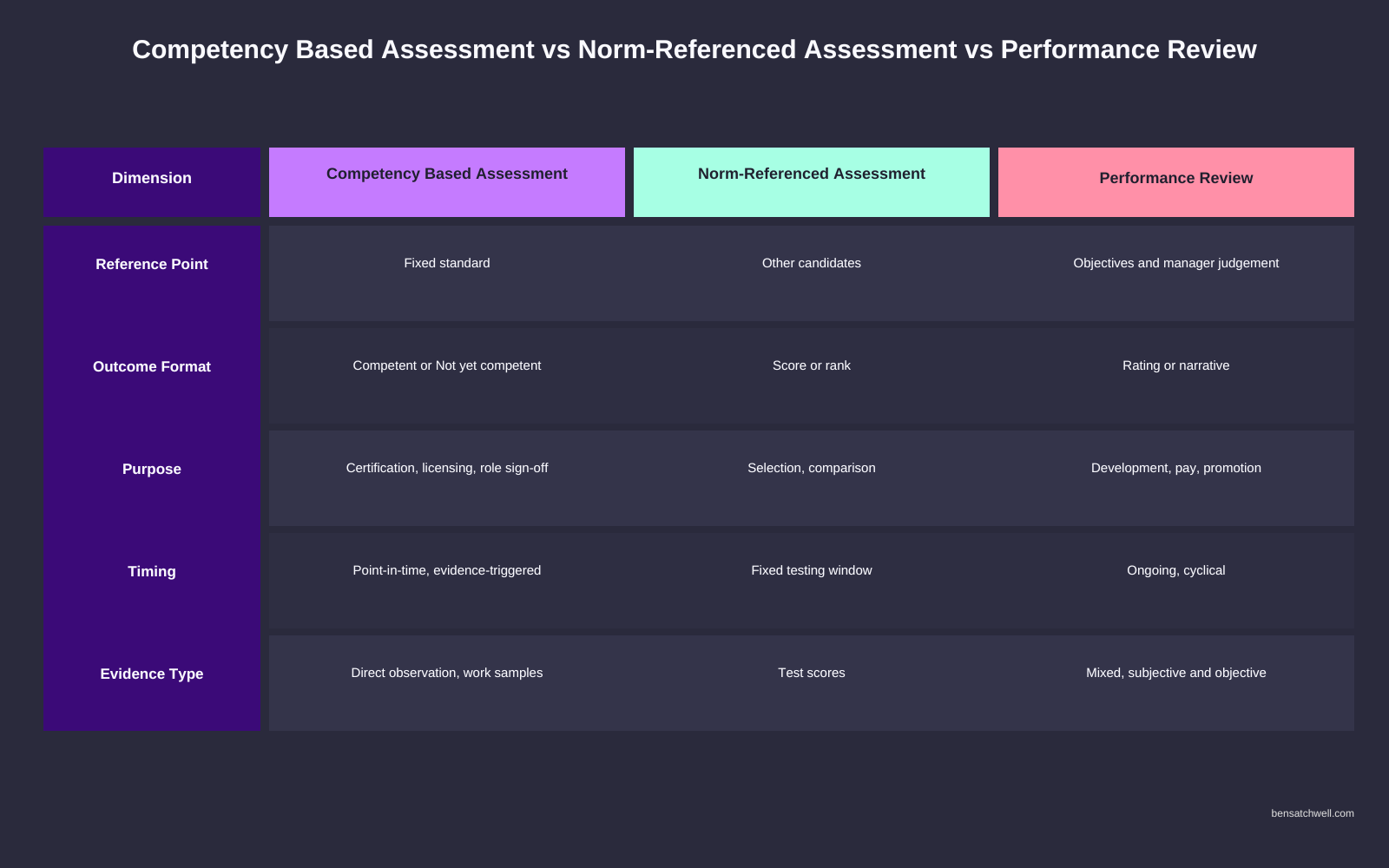
How a competency based assessment framework differs from norm-referenced assessment and a standard performance review.
Trade-offs and Constraints
Competency based assessment is resource intensive. Gathering sufficient, valid, authentic and current evidence takes longer than issuing a test, and it requires assessors who are themselves trained and periodically revalidated. That cost is justified for regulated occupations, safety-critical tasks, and licensing or certification decisions, where a wrong "competent" call has real consequences.
It is a poorer fit for broad behavioural or leadership capabilities, where a binary judgement is less useful than a graded, developmental read of where someone sits and what would move them forward. That is closer to what separates a genuinely working capability system from one that is just documented on paper, a distinction I go into in what makes the people capability system different. Choosing between a graded assessment and a competency based assessment framework is a design decision, not a default, and it should be made deliberately for each competency or role, not applied uniformly across the whole organisation.
Frequently Asked Questions
What is the difference between a competency based assessment framework and a competency framework?
A competency framework defines the competencies and the standard expected at each level. A competency based assessment framework is the separate system used to gather evidence and judge whether a specific person meets that standard.
Is competency based assessment the same as competency based training?
No. Competency based training is the delivery method used to build a skill or competency. Competency based assessment is the separate process used afterwards to judge whether the competency has actually been demonstrated.
What counts as evidence in a competency based assessment framework?
Direct observation, work samples, structured questioning, third-party reports and recognition of prior learning are the most common sources, provided each piece of evidence is valid, sufficient, authentic and current.
Why is competency based assessment binary rather than graded?
Because the decision it supports, usually certification, licensing or role sign-off, requires a defensible yes or no answer rather than a comparative score, and a graded scale does not remove the ambiguity that binary criterion-referenced judgement is designed to eliminate.
Can competency based assessment be used for leadership capabilities?
It can, but it is often a poor fit. Leadership capabilities are usually better served by graded, developmental assessment that shows where a person sits on a spectrum, rather than a binary competent or not yet competent call.
How is a competency based assessment framework validated?
Through assessor training and moderation, where multiple assessors review the same evidence against the same standard to confirm they reach the same judgement, and through periodic review of the standard itself to keep it current.