

Competency Framework Communication
Most competency frameworks do not fail because the levels are wrong or the indicators are badly written. They fail because nobody explained them properly to the people who are meant to use them. Competency framework communication is the part of the project that gets a line item in the plan and then quietly disappears once the framework itself is signed off, and in my experience it is the single biggest predictor of whether the thing ever gets used at all.
There is also a naming confusion worth clearing up before I go further, because it trips people constantly. Competency framework communication is not a communication competency framework. One is an activity: how you introduce, explain and embed a competency framework across an organisation. The other is a structure: a set of competencies that define what good communication looks like as a skill, the kind SHRM builds into its nine core behavioural competencies. They share three words in a different order and almost nothing else in common.
What Is Competency Framework Communication
Competency framework communication is the deliberate, sequenced process of explaining a competency framework, its purpose, its structure and what it means for each audience, so that leaders, managers and employees understand it well enough to actually apply it in hiring, development and performance decisions.
It is not a single announcement. It is a set of tailored messages that has to land before, during and after a framework goes live, and it has to keep happening as the framework gets applied against real roles and real people. If a competency framework document sits unread in a shared drive while managers keep making judgement calls the old way, the framework has been designed but never actually communicated, and the two are not the same achievement.
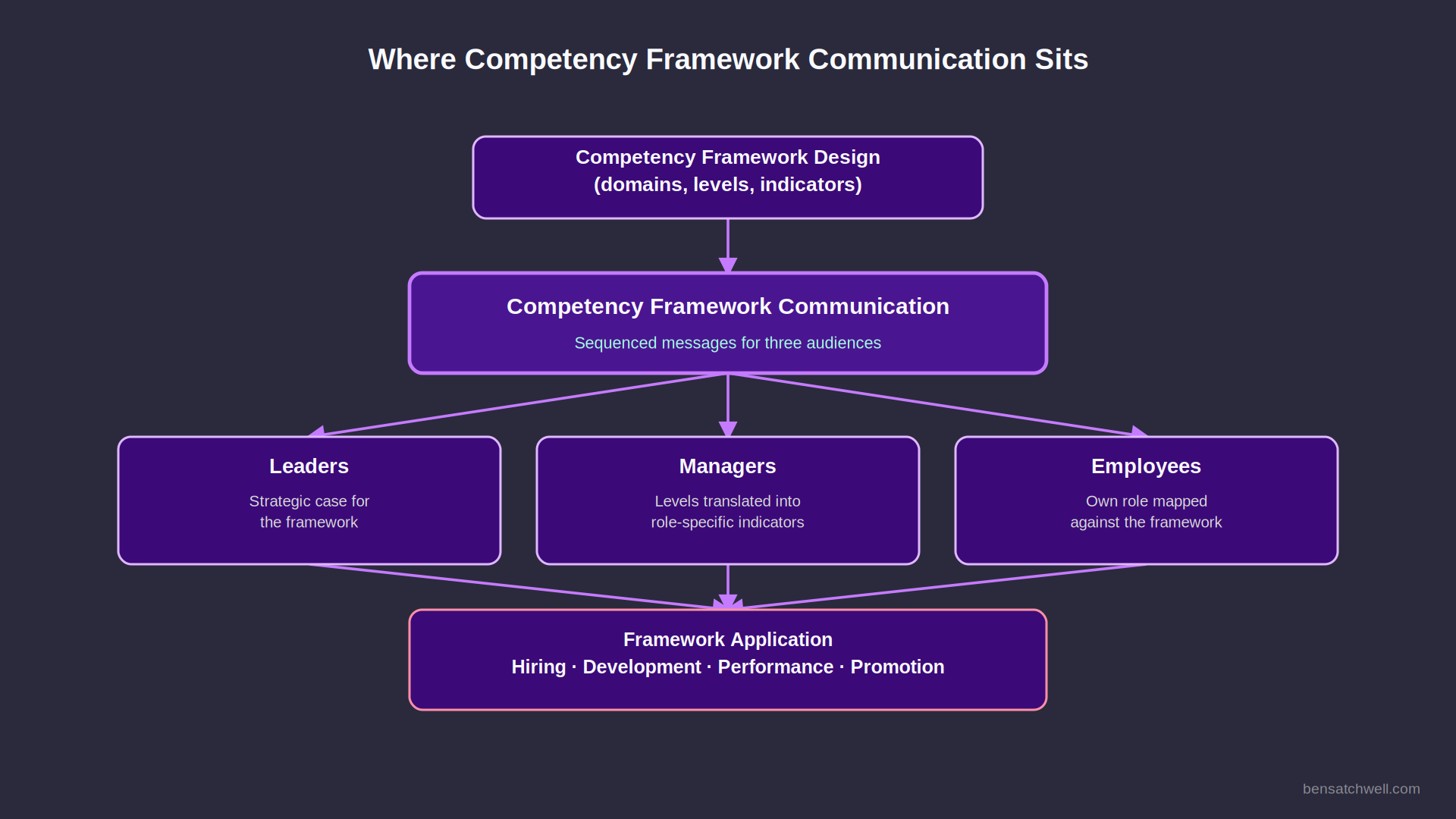
Competency framework communication sits between framework design and framework application, translated for leaders, managers and employees.
Why It Exists
A competency framework only works if the people applying it interpret the competencies, proficiency levels and behavioural indicators consistently. That consistency does not come from the document itself. It comes from a shared understanding that has to be built, deliberately, through repeated and targeted communication.
Without it, three things happen in a fairly predictable order. Managers interpret levels against their own private benchmark instead of the framework's definitions, because nobody walked them through what "level 3" looks like in behaviour. Employees read the framework as a compliance artefact rather than a development tool, because the only communication they received was a policy-style email. Within twelve months the framework quietly stops being referenced in performance conversations. I have seen well-designed frameworks die this way more often than badly designed ones.
Framework design and framework communication are two different disciplines, and most organisations invest heavily in the first while treating the second as an afterthought.
How It Works in Practice
Competency framework communication has to be built around three separate audiences, because they need different things from the same framework.
Sequencing the Rollout
Sequencing matters as much as content. A sensible order is: brief leaders on the rationale, equip managers with translated, role-specific examples before anything goes wider, then communicate to employees with their own role already mapped against the framework. Communication then has to repeat at the moments the framework is actually used, in performance conversations, promotion decisions and development planning.
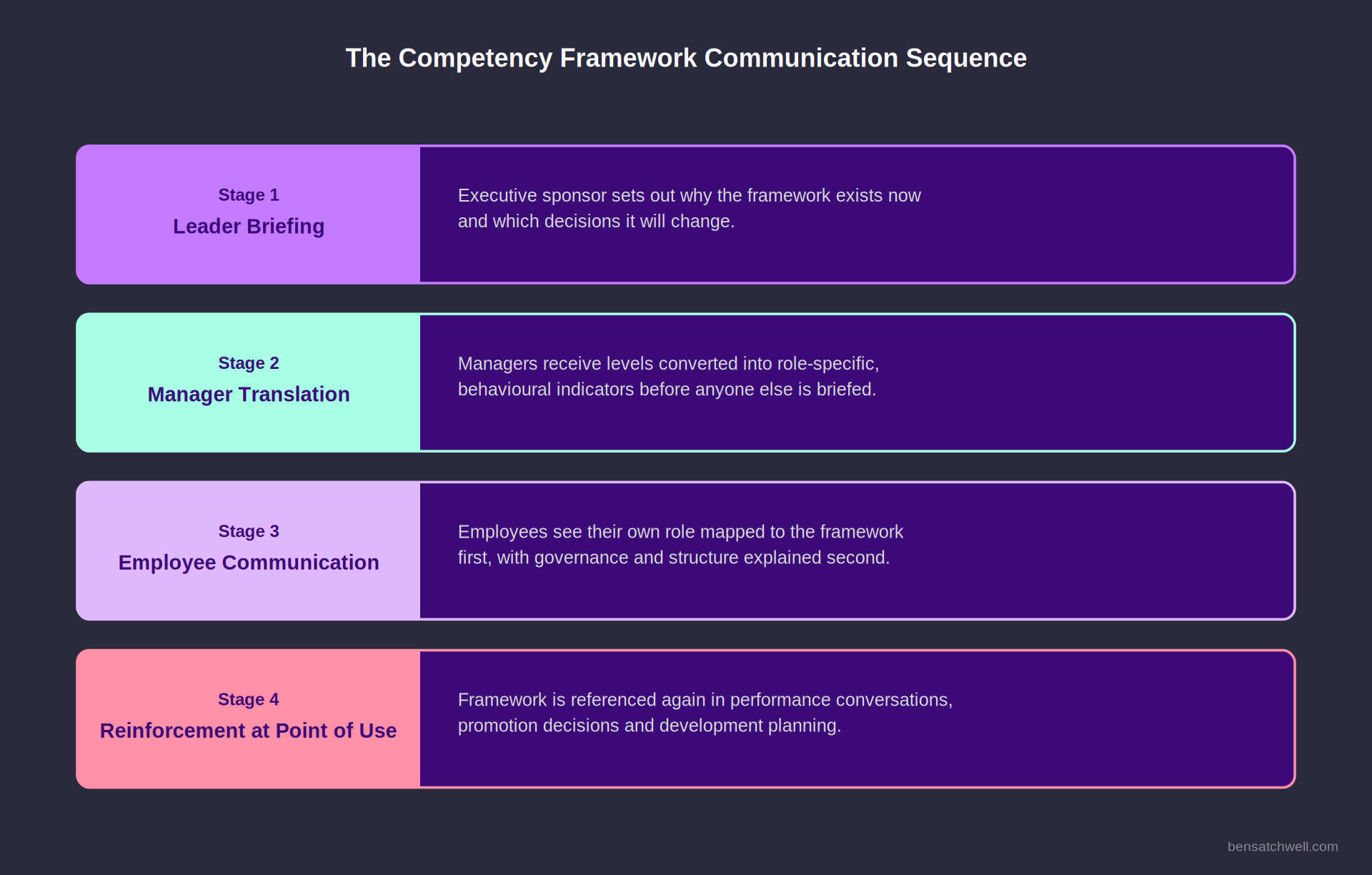
Competency framework communication is a sequence, not a launch event, reinforced at the point the framework is actually used.
The Skills Framework for the Information Age (SFIA) is a useful reference point here, because it was built around exactly this problem. SFIA uses deliberately plain language rather than technical jargon so it functions as a shared reference across very different audiences, including line managers, HR and the employees being assessed against it, which is precisely what competency framework communication is trying to achieve for any framework, not just a skills-specific one.
What Competency Framework Communication Is Not
It is not a communication competency framework. A communication competency framework, or a communication competency inside a broader model such as SHRM's, defines communication as a skill area to be assessed and developed, covering things like verbal clarity, active listening and stakeholder influence. Competency framework communication is the activity of explaining a framework to people. By the distinctions I use in my own work, most of what gets called a "communication competency" in these models is actually closer to a capability: a broad, durable, transferable ability that a person carries across roles, rather than a narrow, role-specific skill. That distinction matters for design, but it is a separate question from the one this article is answering.
It is not change management in general. Change management covers the full set of activities needed to move an organisation from one state to another, including stakeholder management, resistance planning and adoption measurement. Competency framework communication is one input into a change management plan for a framework rollout, not a replacement for it.
It is not a capability-building programme. Building manager confidence in applying a framework consistently is separate, later work. Communication has to happen first, so people understand what the framework is and why it exists, before anyone tries to build proficiency in applying it.
It is not the competency framework document itself. A framework document sets out the competency domains, proficiency levels and indicators. Communication is what turns that document into something people actually reference, and a framework that is perfectly designed but poorly communicated will still fail in practice.
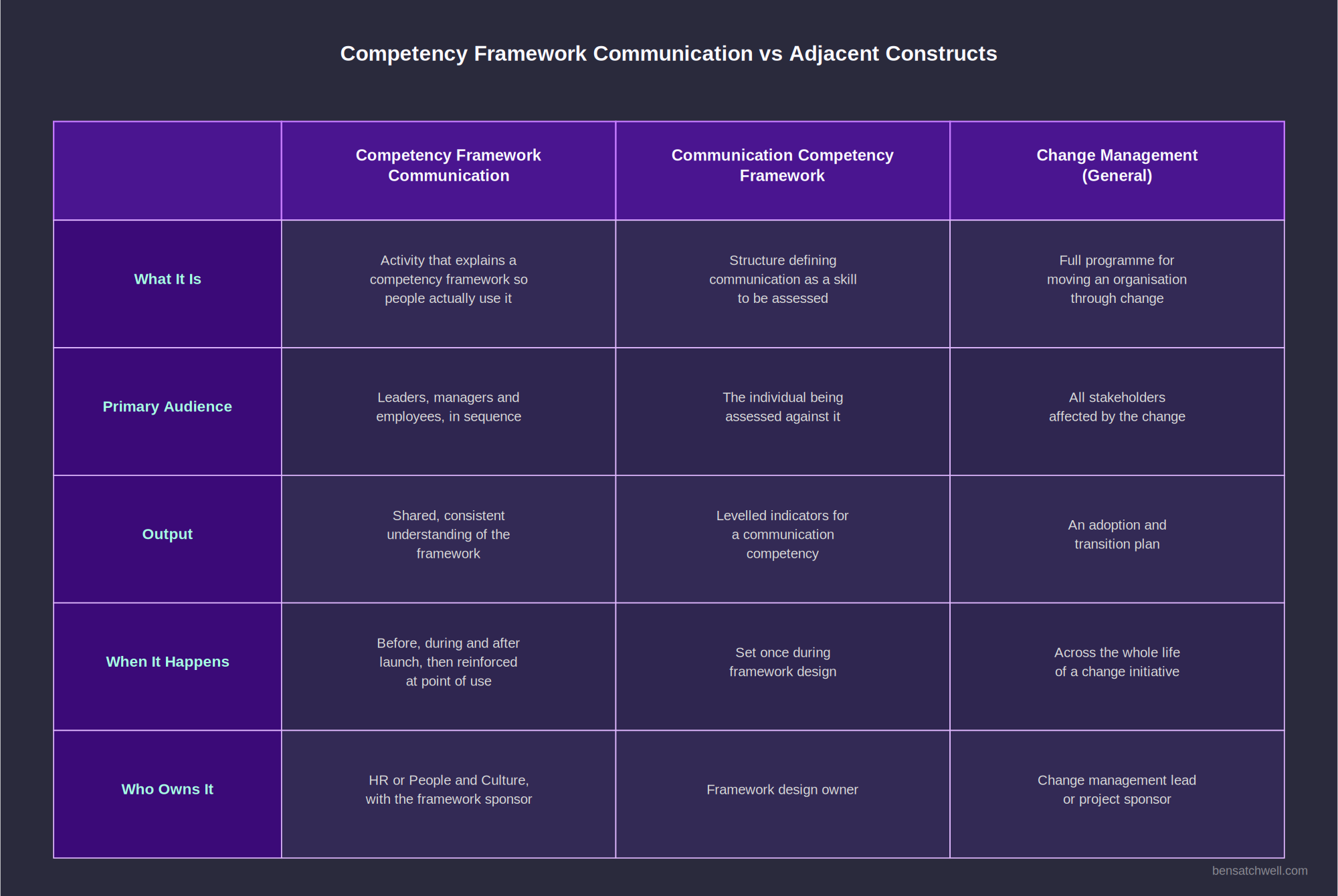
Competency framework communication, a communication competency framework and change management are three distinct constructs, easily confused by their overlapping vocabulary.
Common Failure Modes
The most common failure is treating launch as the finish line. A single all-staff email or intranet post at go-live, with no reinforcement afterward, guarantees the framework fades from use within a year.
A second is skipping the manager translation step and going straight from framework document to employee communication. Managers end up learning the framework from their own team's questions, the worst way to build confidence in applying it consistently.
A third is leaving indicators in their original technical wording. Behavioural indicators are meant to be observable and specific, but if written for a framework governance audience rather than a manager in a real conversation, they will not survive contact with an actual performance discussion.
A fourth, and one I would flag as under-appreciated, is a general absence of planned communication guidance at all. The OECD's Report on Public Communication, based on a survey of centre-of-government bodies across 46 countries, found that only 38 percent of respondents had developed formal guidance on communication topics, which points to a structural gap in how prepared organisations actually are to communicate anything complex and standardised, competency frameworks included. CIPD's guidance on competency and competency frameworks makes a related point from the design side: frameworks need to balance enough detail to be useful with enough flexibility to avoid becoming overly prescriptive, and an over-engineered framework is harder to communicate simply, which compounds the rollout problem before communication even starts.
Trade-offs and Constraints
Formal, staged competency framework communication is worth the investment in larger or more complex organisations, where a competency framework will span multiple job families, business units or geographies, and where inconsistent interpretation carries real cost in pay equity, promotion decisions and workforce planning.
It is proportionally less critical in a small organisation running a lightweight competency framework development process for a single job family, where a founder or a handful of managers can walk the whole team through the model directly without a staged communication plan.
The constraint that catches most projects out is timing. Communication planned after the framework is finalised is reactive by definition. Building the communication plan alongside the framework, so translated manager-facing materials exist before launch day rather than being drafted afterward under pressure, produces a materially better result than treating communication as the last item before go-live.