
Most organisations that attempt to build a capability and competency framework end up with two separate systems that were never designed to work together. A capability framework gets developed by the learning team, a competency framework gets commissioned by HR, and within eighteen months both are gathering dust because the proficiency scales clash, the definitions overlap, and no line manager can explain the difference between the two. This is not a design problem. It is a conceptual one. A capability and competency framework works only when the architecture is clearly understood from the start.
What Is a Capability and Competency Framework?
A capability and competency framework is an integrated workforce architecture that defines, within a single coherent system, both the broad human capabilities people need to develop across their working lives and the specific performance expectations that apply within roles.
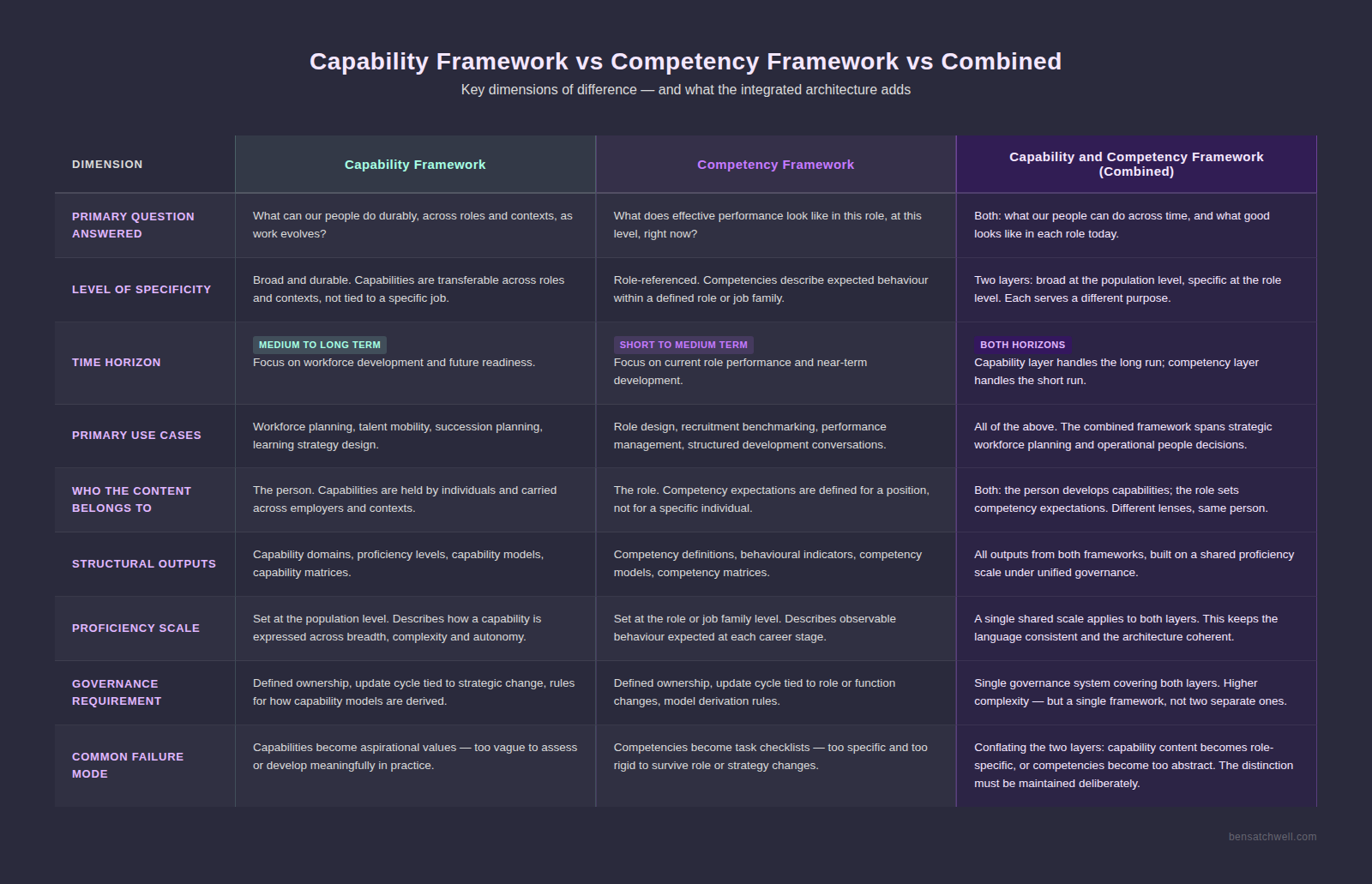
The two constructs are distinct but complementary. A capability framework defines what people can do broadly and durably across roles and contexts. Capabilities are held by individuals. They transfer across employers and roles. A capability like analytical thinking or stakeholder engagement belongs to the person, not to any single position, and it compounds in value as a person's career develops.
A competency framework defines what effective performance looks like in a specific role, at a specific level, right now. Competencies describe observable behaviour within a defined scope of work. They belong to the role, not to the person holding it. When a role changes, its competency expectations change with it.
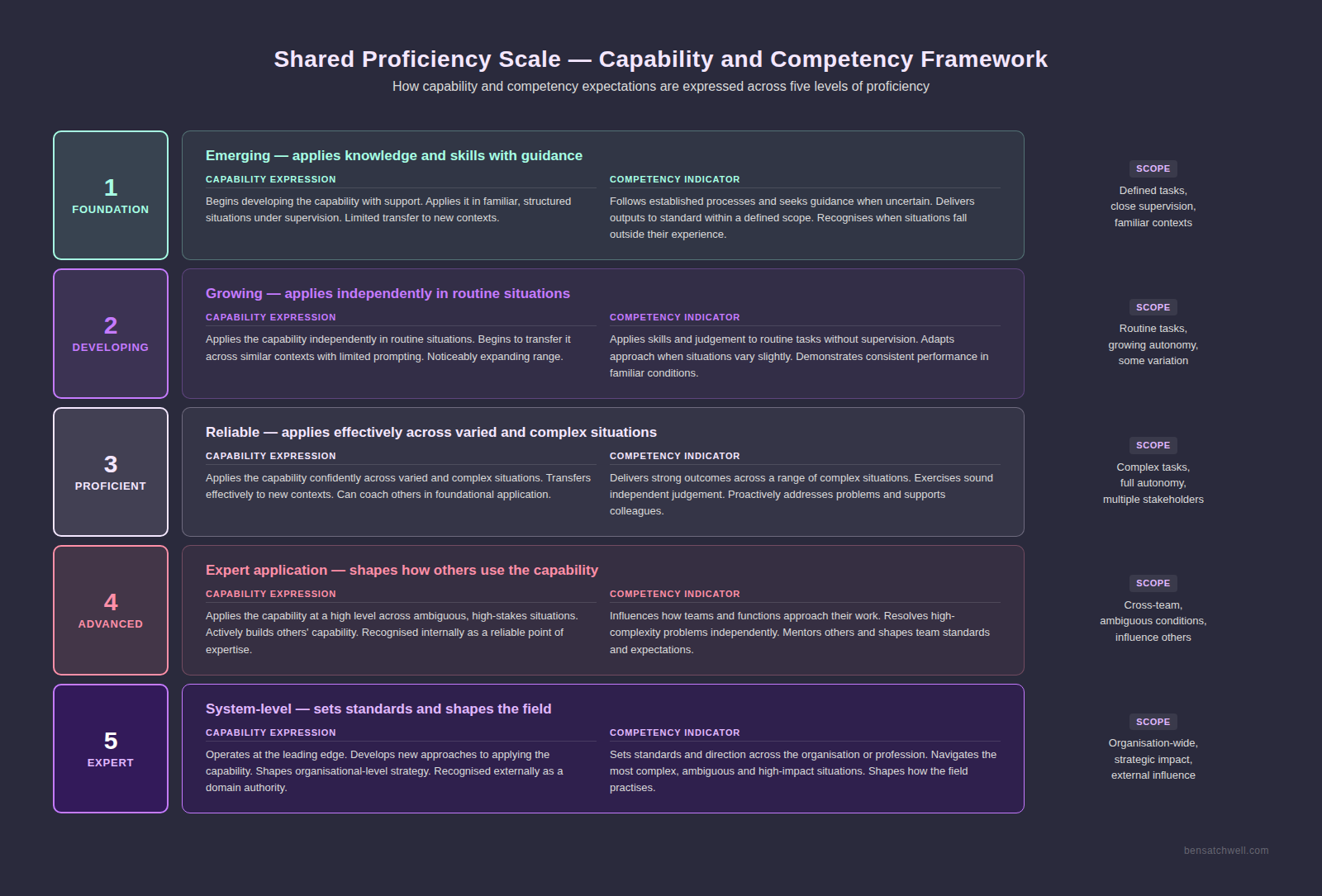
Both layers sit on a shared proficiency scale that describes how either a capability or a competency is held, from early development through to recognised expertise. That shared scale is what makes the architecture function as a single integrated system rather than two parallel and incompatible ones.
A note on terminology. A competency framework is also called a competency model, especially in the United States. I use competency profile for the competencies and required levels for one role, and competency matrix for the grid of required against current proficiency. Usage varies by region, and I explain the differences in this competency model definition.
Why the Two Frameworks Need Each Other
Neither framework is sufficient on its own.
A capability framework without a competency layer can describe what your people can do in general terms, but it gives managers nothing concrete to assess performance against in their specific roles. The framework becomes a set of aspirational qualities that everyone endorses and nobody uses for anything operational. Capability content needs to be anchored in role-level expectations to drive behaviour change.
A competency framework without a capability layer anchors performance management to current roles in current conditions. When those roles change, the competency framework needs to be redesigned from scratch. There is no transferable infrastructure underneath it to preserve the investment. Organisations that have built only a competency framework typically find themselves rebuilding it every five years as the business changes.
The combined architecture solves both problems. The capability layer handles the long run: workforce planning, talent mobility, succession, and learning strategy. The competency layer handles the short run: role design, performance conversations, recruitment benchmarking, and structured development. Both layers draw from the same proficiency scale, use consistent language, and sit under unified governance.
How an Integrated Capability and Competency Framework Works in Practice
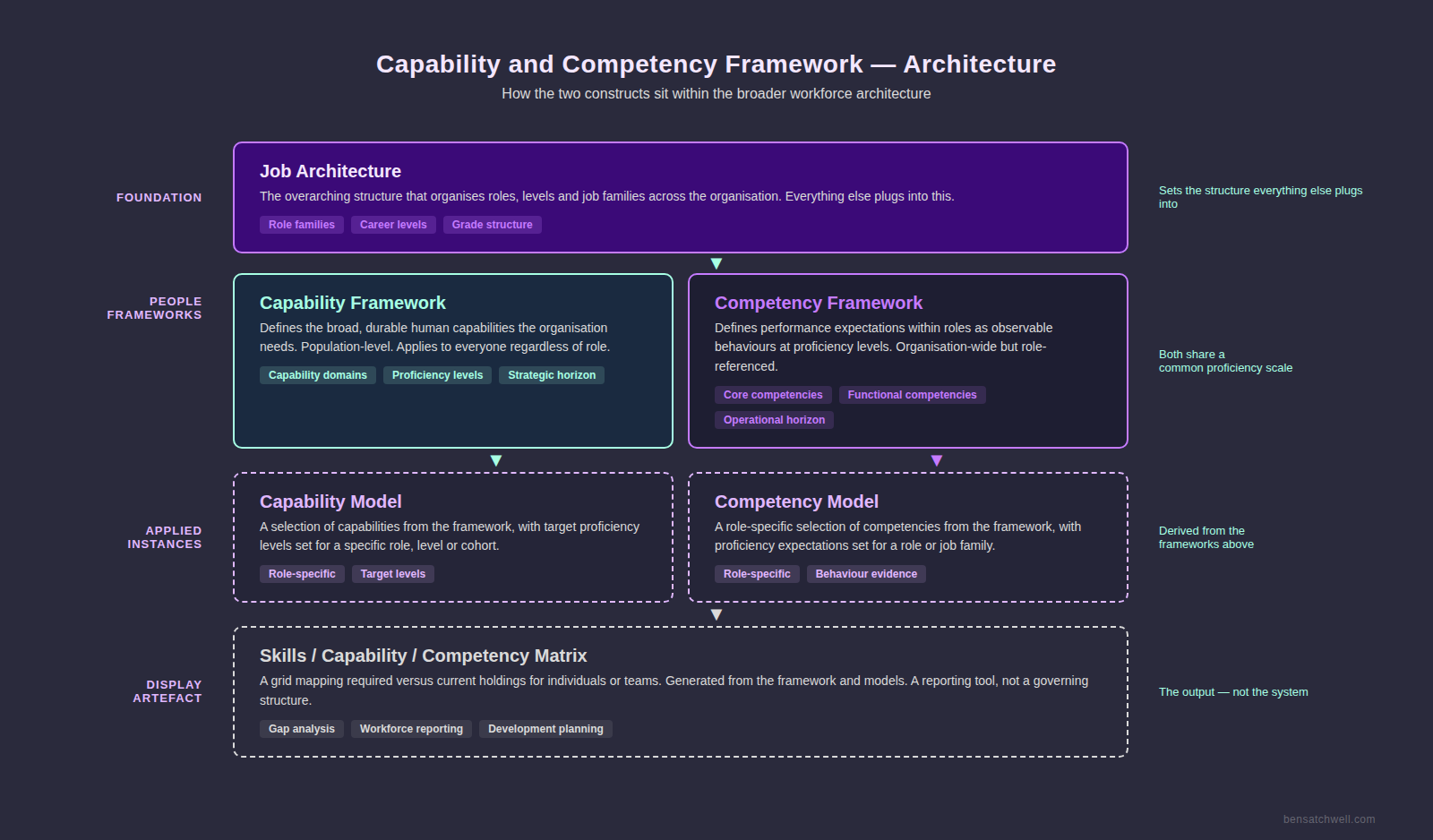
The architecture has four levels that stack from the broadest structure down to the most specific application.
Job architecture sits at the base. This is the structure that organises roles, levels, and job families across the organisation. Job architecture is what everything else plugs into. Without a clear job architecture, neither framework can be applied consistently because there is no agreed definition of what roles exist, how they relate to each other, or what levels of work they represent.
The capability framework operates at the population level. It defines the broad capabilities the organisation needs its people to hold, regardless of role. A capability domain like systems thinking or commercial acumen applies to both a finance analyst and a senior project manager, though the proficiency expectation for each role will differ.
The competency framework operates at the role and job family level. It defines the specific observable behaviours the organisation expects in a role, at each career level. Core competencies apply across all roles. Functional or technical competencies apply within job families or specific positions.
Capability profiles and competency profiles are selections drawn from the frameworks. A competency profile for a senior analyst draws from both the competency framework and the capability framework, translated into the specific requirements of that role at that level. The profile is what the line manager and employee work with day to day. The framework is the source it draws from.
What a Capability and Competency Framework Is Not
It is not a skills framework. A skills framework such as SFIA classifies discrete, technical, and job-specific skills with defined levels of proficiency. Skills are granular and transient, shifting as tools and methods change. Capabilities are broader and more durable. The two architectures can coexist and reference each other, but they are not the same construct and should not be merged into one system.
It is not two separate frameworks running in parallel. The integration is the point. If the capability framework uses a different proficiency scale from the competency framework, or if they are governed by different teams with incompatible definitions, you do not have one integrated framework. You have two frameworks with the same problem as before, and twice as many documents nobody reads.
It is not a matrix. A capability matrix or competency matrix is a reporting artefact built from the frameworks. It maps required proficiency against current holdings for individuals or roles and is useful for gap analysis and development planning, but it is not the governing structure itself.
Named Standards and Reference Points
Several professional bodies publish guidance that informs the design of an integrated capability and competency architecture.
The CIPD publishes a competency framework factsheet covering design principles, the relationship between competencies and performance management, and common implementation pitfalls. It is a practical starting point for practitioners building from scratch. CIPD's competency framework guidance is freely accessible and regularly updated to reflect contemporary practice.
SFIA (Skills Framework for the Information Age) provides a detailed skills and competency reference specifically for technology and digital roles, built on seven levels of responsibility and a common proficiency language. It is widely adopted in government and ICT job families and offers a ready-made reference for technical competency design within a broader capability and competency architecture.
State and territory governments in Australia offer sector-specific capability architectures worth examining. The Victorian Public Sector Commission's workforce capability framework defines the expected capabilities and behaviours for public sector employees across defined proficiency levels. The Victorian Public Sector Capability Framework illustrates how population-level capability definitions can be integrated with role-specific performance expectations at scale.
Common Failure Modes
The most common failure is conflating the two layers. When capability content becomes role-specific, it stops being a capability and becomes a competency. When competencies become too broad and abstract, they become indistinguishable from capability statements. Once the conceptual distinction collapses, the architecture collapses with it, and the organisation is left with a single muddled framework that cannot serve either purpose well.
The second failure is building without shared governance. A capability and competency framework requires a single governance function that owns the definitions, manages the proficiency scale, sets the rules for how profiles are derived, and controls the update cycle. Without this, different teams customise the framework independently until it is no longer coherent. The most common signal of this failure is when two business units present different definitions of the same capability to the same employee.
The third failure is treating the framework as a one-time project. Capability expectations shift as strategy changes. Competency expectations shift as roles evolve. A framework built in 2020 and not reviewed since will already be out of alignment with the current business in ways that are difficult to see but very concrete in their effect on hiring decisions, learning investment, and the quality of performance conversations.
Trade-offs and When This Architecture Is Appropriate
A combined capability and competency framework adds governance complexity. Maintaining two layers of content, a shared proficiency scale, and the rules that connect them requires sustained investment. This is appropriate for organisations large enough to need both strategic workforce planning and operational people systems that work together. It is not appropriate for a fifty-person business that needs a simple set of role expectations and a performance conversation template.
The investment pays off when the organisation is large enough that multiple job families need consistent comparison across roles, when talent mobility and succession are genuine strategic priorities, when the business is changing rapidly enough that role-specific frameworks alone cannot keep up, or when learning investment needs to be directed at the population level rather than driven entirely by individual performance reviews.
Frequently Asked Questions
What is the difference between a capability framework and a competency framework?
A capability framework defines the broad, durable abilities a person holds across roles and contexts, owned by the individual and transferable over time. A competency framework defines the specific observable behaviours expected in a particular role at each proficiency level, owned by the role. The capability framework is person-centred; the competency framework is role-referenced.
Can you have a capability framework without a competency framework?
Yes, but you lose the operational layer. A capability framework handles workforce planning and long-term development well but gives managers nothing concrete to use in performance conversations or recruitment. Most organisations of meaningful size benefit from having both, integrated under a shared proficiency scale.
What is a shared proficiency scale in a capability and competency framework?
A shared proficiency scale is a set of defined levels, typically four to six, that describe how a capability or competency is held across a spectrum from early development to recognised expertise. Using the same scale across both frameworks keeps the language consistent and the architecture coherent.
Does a capability and competency framework replace a skills framework?
No. A skills framework such as SFIA classifies discrete, often technical skills at defined levels. It is a separate structure that sits alongside a capability and competency architecture. The two serve different purposes: a skills framework classifies what someone can do technically; a capability framework describes who someone is becoming as a practitioner over time.
How often should a capability and competency framework be reviewed?
At minimum, the capability layer should be reviewed when the organisation's strategy changes significantly. The competency layer should be reviewed when roles or job families change materially. In practice, an annual light-touch review with a more substantial refresh every three to four years is workable for most organisations.
Who owns a capability and competency framework?
Ownership should sit with a single governance function, typically People and Culture or Organisational Development, with input from business leaders and subject matter experts for the functional competency layer. Split ownership between different teams is the most common cause of framework inconsistency and content drift over time.