
Most organisations that think they have a business competency framework have a list. They have a spreadsheet with behavioural descriptors, or a values poster with five aspirational words, or a job description archive with KPIs buried at the bottom. None of these is a framework. A business competency framework is a system, and the difference matters more than most people realise.
What is a business competency framework?
A business competency framework is an organisation-wide system that defines, groups and standardises the competencies expected across roles and levels. It specifies what good performance looks like, how it is expressed as observable behaviour, and how those expectations scale with seniority and scope. It includes competency definitions, proficiency levels with behavioural indicators, and the governance rules that determine which competencies apply to which roles.
The terminology matters here. A competency framework is the governing system. A competency profile is the selection of competencies and required levels for a specific role or job family. A competency matrix is the grid that shows who holds what and at what level. These three artefacts form a hierarchy: the framework generates the profiles, and the profiles feed the matrices. Most organisations have the matrices without the framework, which is why assessments are inconsistent and career conversations go nowhere.
A business competency framework typically organises competencies into three domains: core competencies that every person holds regardless of role; leadership competencies that apply to those managing people or shaping strategy; and functional or technical competencies that vary by discipline or job family. Together, these three domains cover the full range of what the organisation needs from its people.
A note on terminology. A competency framework is also called a competency model, especially in the United States. I use competency profile for the competencies and required levels for one role, and competency matrix for the grid of required against current proficiency. Usage varies by region, and I explain the differences in this competency model definition.
Why do organisations build a business competency framework?
The problem a business competency framework solves is inconsistency. Without one, every hiring manager has a different idea of what good judgement looks like. Every performance review uses different language. Every development conversation is driven by the manager's instincts rather than a defined standard. The framework creates a shared language for performance that works across the organisation, not just within a single team or one manager's interpretation.
The CIPD factsheet on competency frameworks makes the case that clearly defined expectations give performance conversations and succession decisions a common reference. Clarity about expectations is a performance driver in its own right: people perform better when they know what good looks like at the level they are working toward, not just at the level they currently hold.
OECD work on public sector workforce management treats centralised competency frameworks as a way to improve the reliability and fairness of workforce planning across large, distributed organisations. The principle applies equally in the private sector: consistent language produces comparable data, and comparable data produces better decisions.
How does a business competency framework work in practice?
The framework sits at the centre of the talent system. Job architecture anchors the competency expectations within a defined level and role family. The framework then drives the talent processes that depend on defined performance standards: performance reviews, development planning, hiring and succession. The skills taxonomy, which catalogues discrete granular skills, feeds into the functional and technical domain.
In practice, every role has a competency profile drawn from the framework. That profile specifies which competencies apply and at what proficiency level. A customer service officer at Level 2 and a commercial director at Level 5 are both assessed within the same framework, against different competencies, from different domains, at different levels. That coherence is the point.
Proficiency levels are the mechanism that makes this work. Most frameworks use four to six levels. Levels are defined by scope, autonomy, complexity and impact, not by years of experience or seniority. A person who joined six months ago and works independently on complex cross-functional problems may sit at a higher proficiency level than a ten-year veteran who still requires close direction. The distinction describes performance, not tenure.
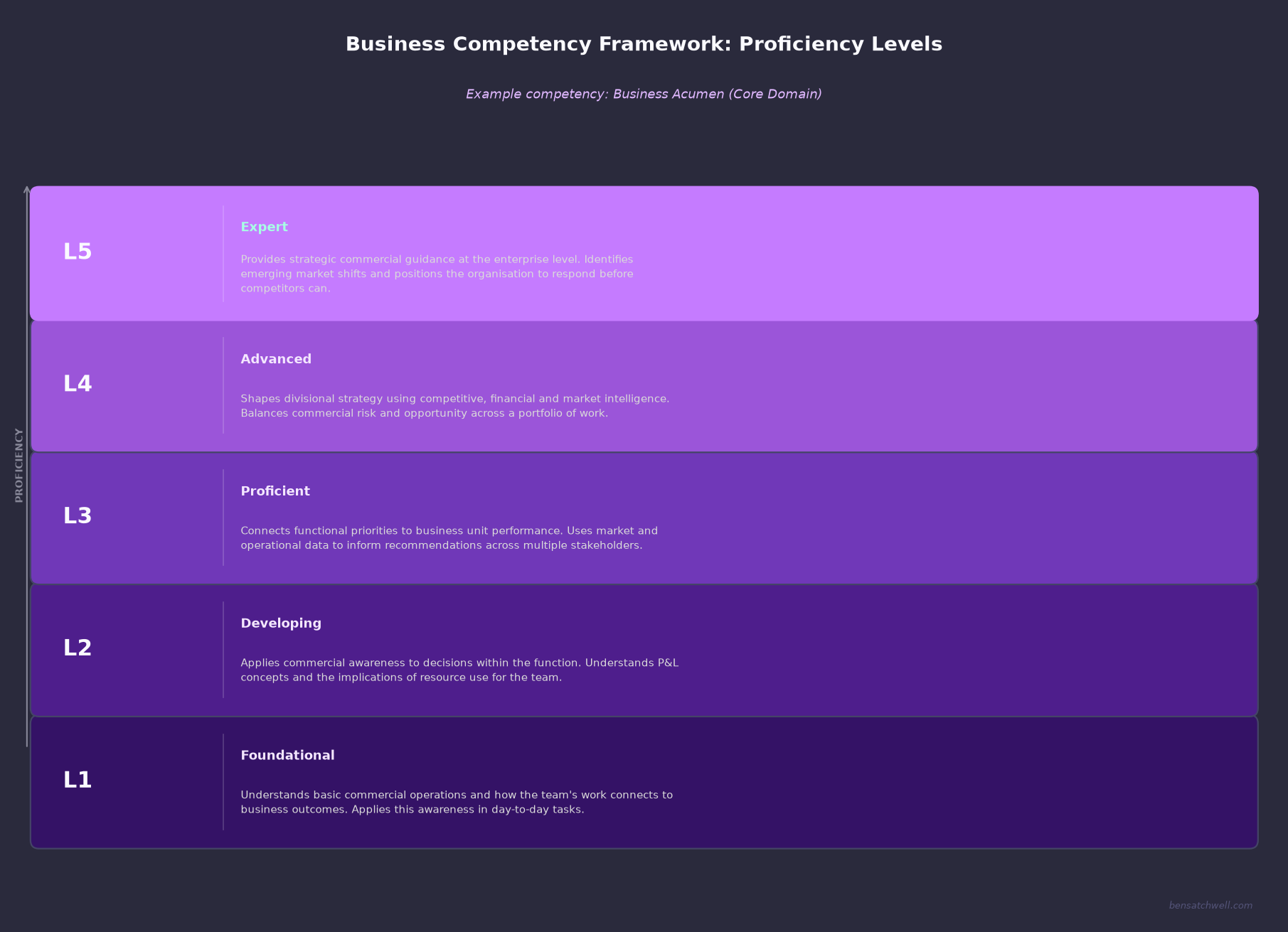
Behavioural indicators sit at the intersection of a competency and a proficiency level. They are written as observable descriptions of what the behaviour looks like in practice. Not "communicates well" but "presents complex financial scenarios to senior leaders in a way that drives informed decisions, anticipating objections and adjusting framing based on audience." That specificity is the difference between a useful assessment standard and a box-ticking exercise.
What a business competency framework is not
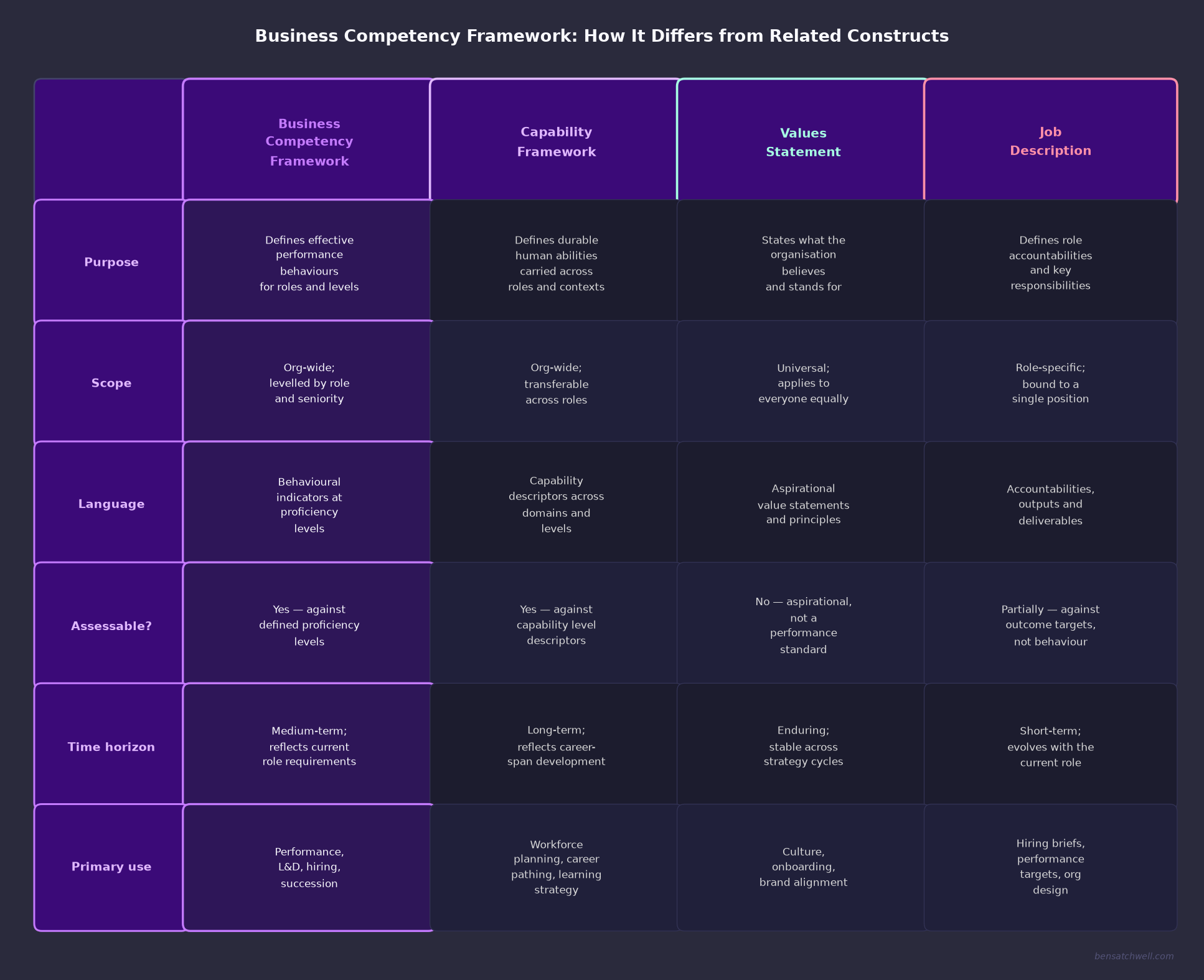
A business competency framework is frequently conflated with three related constructs, each of which does a different job.
It is not a capability framework. A capability framework describes broad, durable human abilities that a person carries across roles and contexts. Capabilities are future-oriented: they tell you what a person can develop into, not only what they can do in a specific role today. Competencies describe what good performance looks like now, in a defined role, at a defined level. Both constructs have value, but they answer different questions. Treating them as interchangeable produces a framework that is unclear about what it is measuring or why.
It is not a values statement. Values describe what an organisation believes and stands for. They are aspirational, universal and deliberately resistant to being measured. A competency framework is assessable. It specifies proficiency levels and observable indicators precisely because it is used to make judgements about performance, development and selection. A values statement pressed into service as a performance tool will frustrate everyone because it was never designed to carry that weight.
It is not a job description. A job description defines the accountabilities and key responsibilities of a specific role. It describes what the role is. A business competency framework describes what good performance in any role looks like, expressed as observable behaviour. The two documents complement each other, but they operate at different levels of abstraction. Job descriptions are role-specific and narrow. Competency frameworks are organisation-wide and enduring.
Which frameworks and standards inform a business competency framework?
Several widely used frameworks provide useful structural reference points. The Korn Ferry Leadership Architect organises competencies into four factors: Thought, Results, People and Self. The Lominger library it grew from remains a useful catalogue for designing functional domains. Both are proprietary and licensed, not open.
SHRM's Body of Applied Skills and Knowledge (BASK) defines eight competency domains for HR professionals, including Business Acumen, a competency present in most business competency frameworks regardless of sector. BASK is a useful example of how a competency domain can be levelled and expressed as assessable behaviour, even if its scope is limited to the HR profession.
For technical roles, the SFIA framework provides a detailed, levelled skills catalogue that feeds cleanly into the functional and technical domain of a business competency framework. SFIA defines skills, not competencies, but its level descriptors align well with standard proficiency level design.
What goes wrong when organisations design a business competency framework
The most common failure is scope inflation. Organisations try to capture every possible performance expectation in a single framework and end up with 40 competencies per role, which no one can hold in mind during a real conversation. An effective business competency framework defines 6 to 10 competencies per role, drawn from a total library of 20 to 30. Everything else belongs in job descriptions, skills taxonomies or development resources, not in the framework itself.
The second failure is governance debt. A framework with no owner, no review cycle and no mechanism for updating competency definitions will drift out of alignment with the business within two to three years. Frameworks require ongoing governance: a defined owner, a review cadence tied to the strategy cycle, and a clear process for adding, retiring or revising competencies as roles evolve.
The third failure is deployment without infrastructure. A framework deposited in a shared folder and announced via an internal email is not a deployed framework. It is a document. Deployment requires integration with performance review templates, learning catalogues, job profiles and hiring criteria. Without that integration, the framework sits unused because there is no moment in the year when anyone is required to engage with it.
When a business competency framework is and is not the right tool
A business competency framework pays off in organisations of more than 100 to 150 people, where role consistency and performance comparability start to matter. Below that size, informal standards usually hold. A small team that works closely together develops shared norms without a formal system.
A framework also requires stability of strategy and structure. If the business model is changing rapidly, a framework built for the current structure risks obsolescence before it is fully deployed. In that context, it is worth considering a leaner capability framework, or a more targeted sales competency framework for the functions where performance standards matter most urgently.
The investment to build and maintain a business competency framework is not small. It requires analysis of role requirements, behavioural indicator writing, validation with subject-matter experts, system configuration and ongoing governance. Organisations that treat it as a one-time project consistently underestimate what it takes to make it work.
Frequently asked questions about a business competency framework
What is the difference between a competency and a skill in a business competency framework?
A competency integrates knowledge, skills, judgement and behaviour applied effectively in a role context. A skill is discrete: a specific, learned ability to do something, such as building a financial model or writing a SQL query. Skills are granular building blocks. Competencies are the integrated expression of those skills in a role context. Most business competency frameworks include a functional or technical domain that draws on a skills taxonomy, but the competency itself is broader than any individual skill.
How many competencies should a business competency framework include?
Most organisations have too many. An effective business competency framework defines 6 to 10 competencies per role, drawn from a total library of 20 to 30. The three domains, core, leadership and functional or technical, typically contribute between 3 and 5 competencies each to any given role profile. More than 10 per role makes the framework unusable in practice.
How do proficiency levels work in a business competency framework?
Proficiency levels describe how a competency is expressed at different degrees of complexity, scope and autonomy. A typical framework uses four to six levels. Level 1 represents foundational application under guidance. Level 5 or 6 represents enterprise-wide strategic influence. Levels are defined by what the performance looks like, not by years of experience or job grade. A person can hold a competency at Level 3 in their first year and at Level 2 after ten years if the complexity of their work has narrowed.
What is the difference between a business competency framework and a capability framework?
A competency framework defines what good performance looks like in a specific role at a specific level. A capability framework defines the broad, durable human abilities that a person owns and carries across roles. Competencies are role-bound and assessable against defined proficiency standards. Capabilities are person-held, future-oriented and designed to remain relevant as roles change. Both have a place in a mature talent system. They answer different questions, and conflating them creates a system that is unclear about what it is trying to measure.