
Sales competency frameworks are often built quickly and used poorly.
In many organisations, “sales competencies” become a loose mix of quotas, behaviours, personality traits, and aspirational attributes. The result is predictable: inconsistent role expectations, subjective assessment, and development plans that don’t map cleanly to performance.
This article treats sales competency as a competency construct, not a capability, values, or potential construct.
It explains:
- what a sales competency framework actually is
- what it is not
- how a sales competency framework should be structured
- how it differs from sales competency profiles
- the most common mistakes that undermine sales frameworks
If sales performance needs to be assessed, compared, or governed, precision matters.
And I bring these musings to you from experience being a former employee at CEB (now Gartner) where we provided the Challenger Sale as a solution to the market. Many moons ago I also read and (tried to) implement Neil Rackham's work and am also familiar with Keenan's Gap Selling.
What is a sales competency framework?
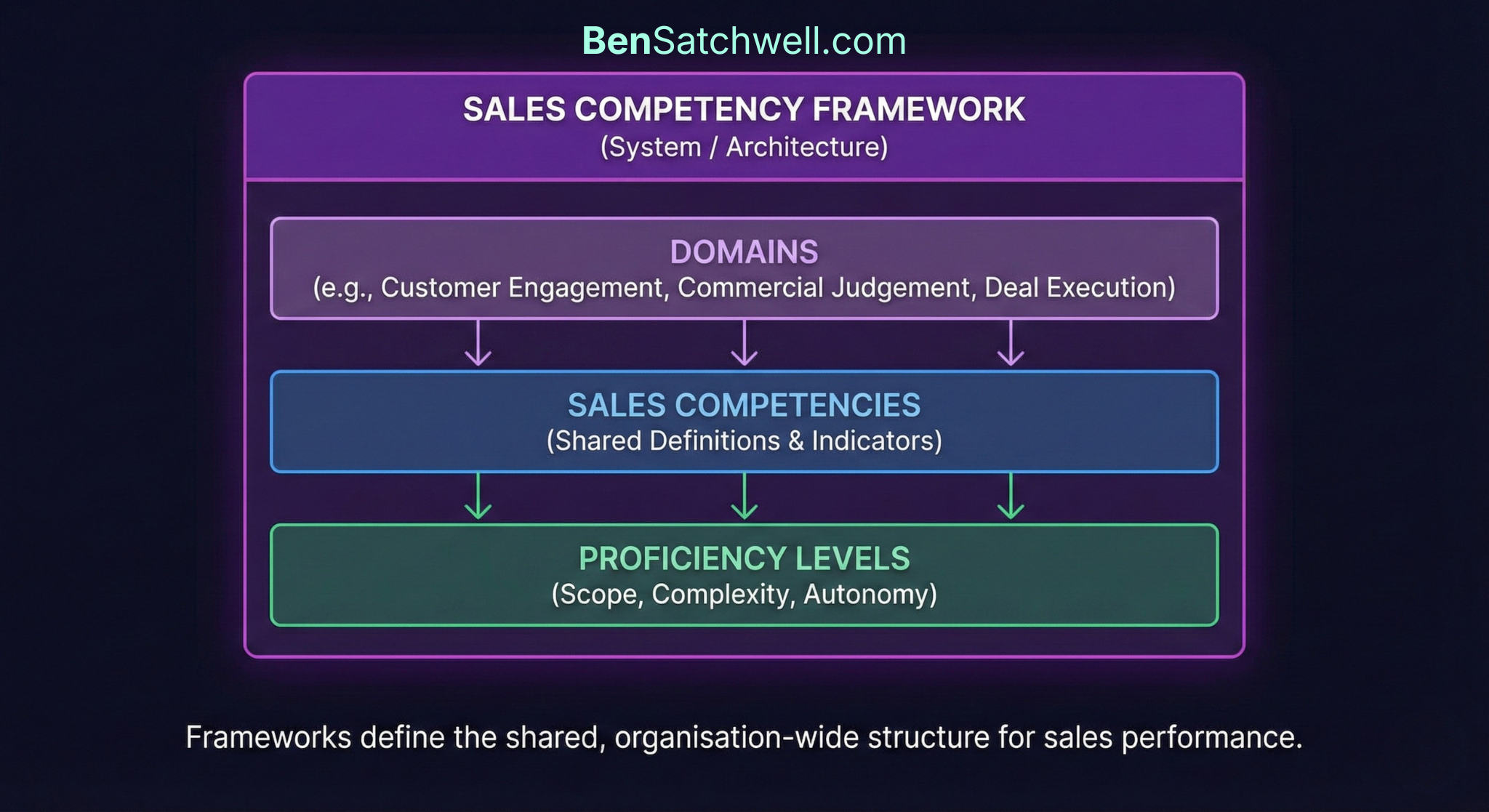
A sales competency framework is an organisation-wide structure that defines how sales work must be performed, to an agreed standard, across sales roles and levels.
It provides:
- standardised sales competency definitions
- consistent expectations across sales roles
- proficiency levels that distinguish scope and complexity
- observable indicators that support assessment
- rules for how sales roles apply the framework
In short, it answers this question:
How must sales work be performed, to an acceptable standard, in this organisation today?
A sales competency framework is about present-state performance, not future sales potential.
A sales competency framework is an organisation-wide system that defines sales competencies, including clear definitions, proficiency levels, and observable indicators. It standardises how sales performance is described and assessed across roles and levels, enabling consistent expectations, fair comparison, and governed role design.
A note on terminology. A competency framework is also called a competency model, especially in the United States. I use competency profile for the competencies and required levels for one role, and competency matrix for the grid of required against current proficiency. Usage varies by region, and I explain the differences in this competency model definition.
Why sales competency frameworks exist
Sales work varies widely across roles, markets, and deal types. Without shared standards, expectations quickly become inconsistent.
Organisations use sales competency frameworks to:
- define consistent sales performance expectations
- distinguish sales roles beyond job titles
- support defensible assessment and calibration
- reduce reliance on manager preference
- enable repeatable sales role design
A sales competency framework does not exist to describe what salespeople could become.
It exists to define what salespeople must demonstrate now to be competent in role.
Sales competency framework vs sales capability framework
This distinction is often ignored in sales contexts.
Sales competency framework
- defines how sales work is performed
- role-bound and assessable
- grounded in observable behaviour and judgement
- used for role design, assessment, and performance conversations
Sales capability framework
- describes future potential to adapt to new markets, products, or models
- forward-looking and strategic
- not role-locked
- used for workforce planning and transformation
Using a competency framework to describe future sales capability quietly invalidates assessment.
This article deals only with sales competency.
Sales competency framework vs sales competency profile
These constructs are related but distinct.
Sales competency framework
- organisation-wide
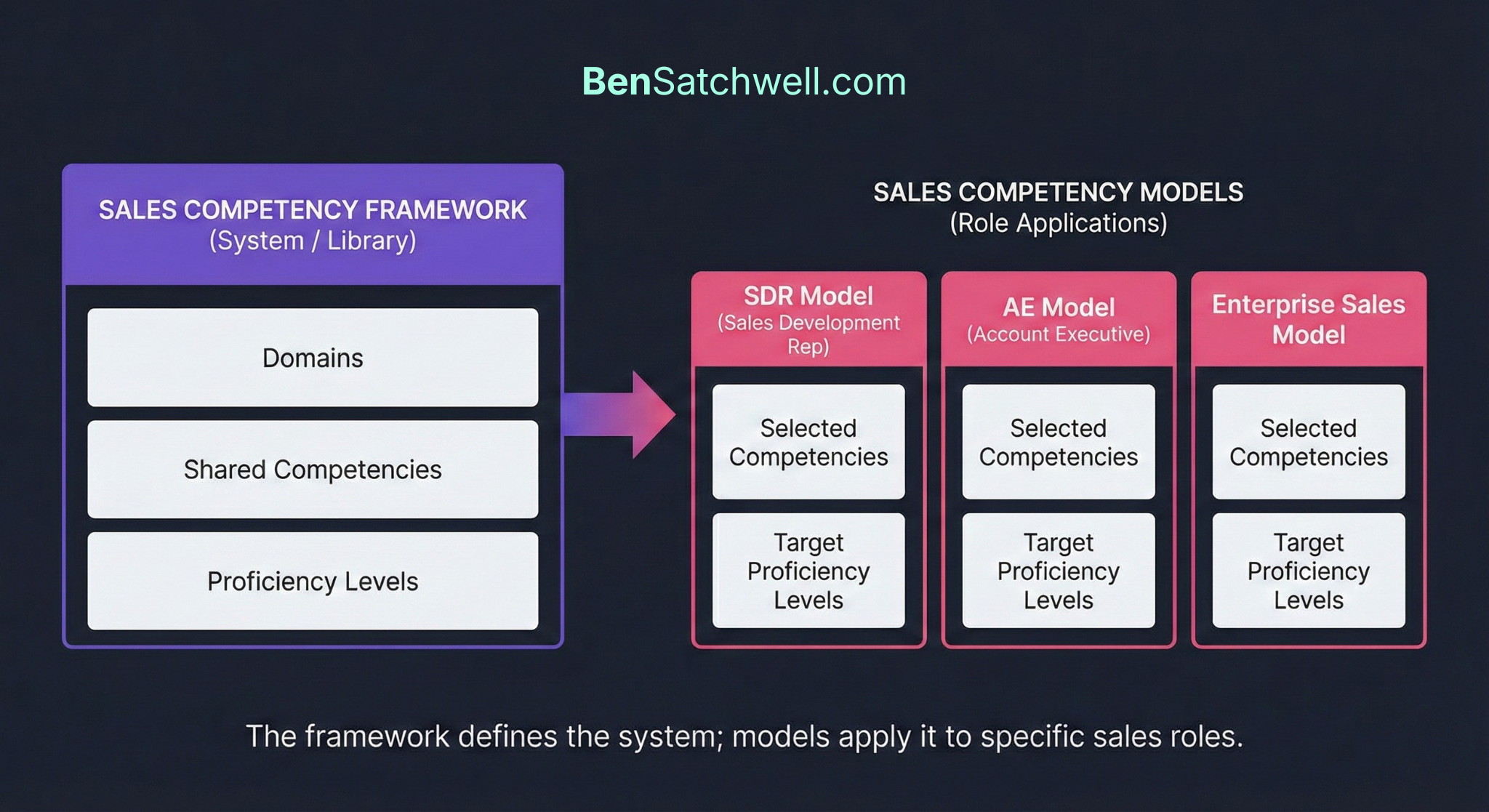
- defines shared sales competency architecture
- includes domains, definitions, proficiency levels, and governance
- relatively stable over time
Sales competency profile
- role- or level-specific (e.g. SDR, AE, Enterprise Sales)
- selects competencies from the framework
- sets target proficiency levels for a specific sales role
- changes as sales roles evolve
Put simply:
The framework defines sales competencies.
The profile applies them to specific sales roles.
If every sales role defines competencies differently, the framework is already broken
How a sales competency framework should be structured
Effective sales competency frameworks share a clear internal logic.
1. Sales competency domains
Domains group sales work into coherent areas and prevent duplication.
Common sales domains include:
- Customer engagement
- Opportunity qualification
- Value articulation
- Deal execution
- Commercial judgement
- Pipeline and territory management
The labels matter less than clarity and coverage.
2. Sales competency definitions
Each sales competency must be:
- clearly defined
- role-agnostic
- bounded (what it includes and excludes)
- free of quotas or KPIs
Weak definitions describe outcomes (“closes deals”).
Strong definitions describe performance (“structures and progresses opportunities through defined stages”).
3. Proficiency levels
Proficiency levels distinguish scope and complexity, not revenue numbers.
Effective progression reflects:
- size and complexity of deals
- autonomy in decision-making
- level of stakeholder influence
- commercial risk managed
Sales proficiency is not:
- tenure
- personality
- charisma
- potential
4. Observable indicators
Indicators describe how sales competency shows up in practice.
Good indicators are:
- observable
- contextual
- behaviourally specific
- non-judgemental
Avoid vague language such as strong, excellent, or natural salesperson.
5. Governance rules
Sales competency frameworks degrade quickly without ownership.
Governance defines:
- how competencies are updated
- how sales profiles must reference the framework
- who approves changes
- how exceptions are handled
Without governance, sales language fragments across teams and regions.
A worked example: sales competency framework in use
To illustrate structure, consider a simplified sales competency framework with four competencies used across all sales roles.
Sales competencies
- Customer engagement
- Value articulation
- Opportunity management
- Commercial judgement
Each competency includes:
- a clear definition
- four proficiency levels
- observable indicators per level
Sales roles then apply this framework via sales competency profiles.
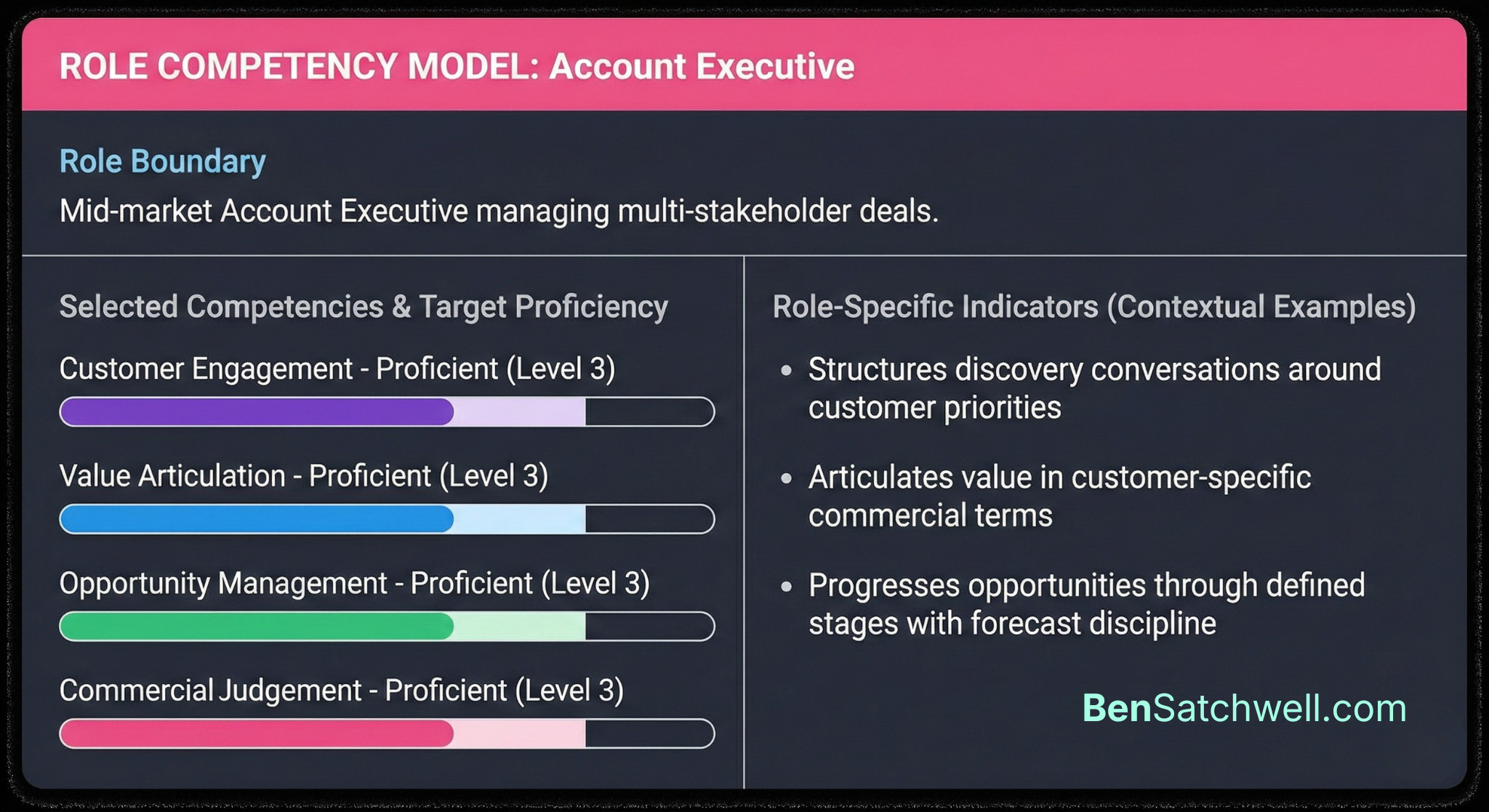
Example: Account Executive sales competency profile (applied)
Role boundary
Mid-market Account Executive managing multi-stakeholder deals.
Selected sales competencies
- Customer engagement
- Value articulation
- Opportunity management
- Commercial judgement
Target proficiency levels
- Customer engagement – Proficient
- Value articulation – Proficient
- Opportunity management – Proficient
- Commercial judgement – Proficient
Role-specific indicators (excerpt)
- Structures discovery conversations around customer priorities
- Articulates value in customer-specific commercial terms
- Progresses opportunities through defined stages with forecast discipline
The framework remains stable.
The profile applies it to role context.
What sales competency frameworks are not
Sales frameworks are often overloaded.
A sales competency framework is not:
- a quota model
- a compensation plan
- a sales methodology
- a values statement
- a personality profile
It may inform these, but it must remain structurally separate to remain valid.
Sales competency framework vs role description vs skills
Sales constructs are often collapsed into a single artefact.
| Construct | Primary purpose | What it defines |
|---|---|---|
| Sales competency framework | Performance standard | How sales work is performed |
| Sales role description | Accountability | What the salesperson is responsible for |
| Skills profile | Task execution | Discrete sales skills a person may use |
Competency frameworks sit between accountability and task-level skills.
Sales competency frameworks and assessment
Assessment only works when standards are stable.
A defensible approach:
- separate role requirements from individual performance
- assess evidence against defined indicators
- calibrate salespeople at the same level using the same framework
When sales frameworks drift into capability or aspiration, assessment becomes subjective.
Common mistakes in sales competency frameworks
Mistake 1: Conflating competency with outcomes
Revenue is an outcome, not a competency.
Mistake 2: Treating sales methodology as competency
Methodologies guide process. Competencies define performance.
Mistake 3: No real progression logic
If levels are indistinguishable, the framework adds no value.
Mistake 4: Over-indexing on personality
Sales performance is behavioural and judgement-based, not trait-based.
Mistake 5: No governance
Without ownership, sales frameworks fragment rapidly.
When a sales competency framework makes sense
A sales competency framework is appropriate when:
- sales roles are defined and stable
- sales performance must be assessed fairly
- expectations must be consistent across teams
- development planning needs a clear reference standard
In highly experimental sales environments, lighter constructs may be more appropriate.
Sales managers need their own standard. A sales manager competency framework covers coaching, pipeline and forecast management, and the other competencies of managing sellers.
Final takeaway
A sales competency framework is not about quotas, charisma, or future potential.
It is a present-state performance construct that defines how sales work must be performed, to a consistent standard, across roles and levels.
When sales competency frameworks are designed with precision and governance, they enable clarity, comparability, and defensible assessment. When they are vague or overloaded, they become decorative documents with little operational value.
FAQ
What is a sales competency framework?
A sales competency framework defines sales competencies, proficiency levels, and indicators to standardise sales performance expectations across an organisation.
How is this different from a sales competency profile?
The framework defines shared competencies; profiles select from them for specific sales roles.
Should sales frameworks include behaviours?
Yes, as observable indicators tied to defined competencies, not personality traits.
How often should sales competency frameworks be updated?
Infrequently and deliberately, typically on an annual review cycle with governance.