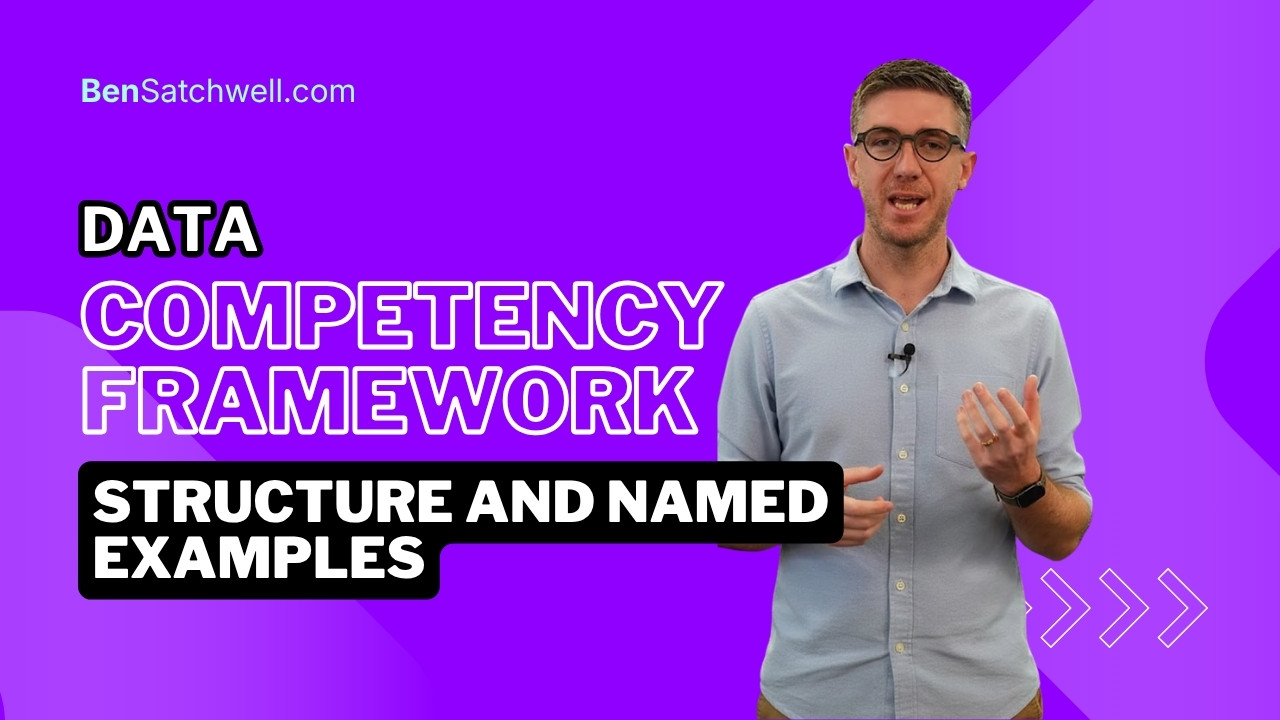

A data analytics competency framework is a structured framework that defines the behaviours, skills and knowledge required to perform analytics work to an agreed standard across roles and levels in an organisation.
It answers a specific question: what does good look like for someone working in or with data analytics, and how does that expectation vary depending on the role and level of the person holding it?
The framework does not prescribe a single job description. It defines a set of competencies, combining technical capability, analytical reasoning, communication, and judgement, and describes what each competency looks like at different proficiency levels. A graduate analyst working in a marketing team operates to a different standard than a principal data scientist in a product organisation. A competency framework makes those distinctions explicit and usable.
Why Organisations Build Data Analytics Competency Frameworks
Data analytics functions have grown quickly. In many organisations, the title "data analyst" means very different things depending on the team, the tool stack, and who originally hired for the role. That inconsistency creates practical problems: it becomes difficult to assess capability honestly, calibrate pay equitably, identify development needs, or make defensible promotion decisions.
A data analytics competency framework creates shared language and shared expectations. It allows a head of data to say, with confidence, what level of SQL fluency is expected of a mid-level analyst, what stakeholder communication looks like at a senior level, or what separates an analyst who identifies patterns from one who generates insight.
Without it, those judgements remain informal and inconsistent, which disadvantages both the individuals being assessed and the organisation trying to build capability systematically.
A note on terminology. A competency framework is also called a competency model, especially in the United States. I use competency profile for the competencies and required levels for one role, and competency matrix for the grid of required against current proficiency. Usage varies by region, and I explain the differences in this competency model definition.
How a Data Analytics Competency Framework Is Structured
Most frameworks are built across three dimensions: competency domains, proficiency levels, and role families.
Competency domains group related capabilities together. Common domains in analytics frameworks include data analysis and interpretation, data management and quality, statistical and quantitative methods, data visualisation and communication, tools and technology, business acumen and stakeholder engagement, and ethics, governance and privacy. Not all domains carry equal weight for every role. A data engineer and a business intelligence analyst may share some domains but diverge significantly on others. A well-designed framework reflects that variation rather than flattening it.
Proficiency levels define what each competency looks like at increasing levels of sophistication, typically across four to five bands. At the entry level, an analyst may be able to clean and query structured data. At a senior level, they are expected to design measurement frameworks, lead analytical projects, and challenge business assumptions with data. At principal or leadership level, the emphasis shifts to strategic direction, governance, and building analytical capability in others.
Role families organise the competency domains by function, so that expectations can be applied to specific jobs without requiring every role to demonstrate every competency at the same level.
Named Standards and Reference Frameworks
Several established frameworks provide a useful starting point for organisations building analytics competency frameworks from scratch.
The SFIA framework (Skills Framework for the Information Age) includes a defined skill for data analytics across six proficiency levels, sitting within a broader structure that covers data management, data science, and information strategy. SFIA is widely used in technology-intensive sectors and public sector organisations, and provides a rigorous foundation for analytics roles.
The Institute of Analytics Analyst Competency Framework organises analytics competencies into domains covering technical skill, critical thinking, communication, and professional practice. It is designed specifically for analytics practitioners and is useful for organisations building frameworks that emphasise professional standards.
Research on data analytics competencies and business value consistently finds that technical skill alone does not predict analytics effectiveness. Communication, domain knowledge, and the ability to translate findings into decisions emerge as differentiating competencies at senior levels.
For organisations that already operate with a broader capability or competency framework, the analytics framework needs to connect to it. The article on capability framework design covers how to approach that integration. The article on the HR competency profile is also relevant when deciding how to position the analytics framework within a wider people architecture.
What a Data Analytics Competency Framework Is Not
It is not a job description. A job description captures responsibilities and reporting lines. A competency framework captures what capability is required to perform those responsibilities at a defined standard.
It is not a skills inventory or a learning plan. A competency framework defines expectations. It does not catalogue what people currently know or map those gaps to specific programmes.
It is not a performance appraisal template. Some organisations mistake the framework for a rating sheet. The framework defines the standard; how an individual is assessed against that standard is a separate design decision.
And it is not a static document. Analytics tooling, methods and business expectations evolve. A framework built in 2020 will need revisiting in 2025, particularly around generative AI, LLM-assisted analysis, and the growing overlap between data analytics and data science roles. The article on the semantic crisis in work design explores how rapidly shifting terminology creates particular challenges in technical domains like analytics.
Where Analytics Competency Frameworks Fail
The most common failure is building a framework that covers everything and therefore applies to nothing. Organisations try to capture every possible analytics skill across every possible tool and end up with a document so large that practitioners cannot use it and managers do not reference it.
A second failure mode is separating the framework from the work that made it necessary. If a framework is built in isolation by HR without meaningful input from analytics leaders and practitioners, it will not reflect how analytics work actually operates. The competency descriptions will be abstract, the proficiency levels will not map to real jobs, and it will be abandoned within twelve months.
A third failure is treating the framework as the end goal. A framework is useful only when it is connected to something: hiring criteria, career pathways, development conversations, promotion calibration. A data analytics competency framework that sits in a folder and is never referenced has no effect.
Trade-offs in Framework Design
The central trade-off is breadth versus depth. A broad framework covers many competency domains and applies to a wide range of roles, but it risks being generic. A narrow framework is more precise and more usable, but it may not scale across a diverse analytics function.
A second trade-off is between building from scratch and adapting an existing standard. Frameworks like SFIA or the IoA framework provide a rigorous base and an externally recognised reference point. Adapting them is faster than building from scratch. The trade-off is that adaptation requires judgement about what fits the organisation's context.
The article on knowledge management and capability design explores how organisations can approach this trade-off across multiple domains.
Frequently Asked Questions
What competencies should a data analytics competency framework include?
At minimum: data analysis and interpretation, data quality and management, communication of findings, statistical reasoning, and business or domain knowledge. At senior levels, add stakeholder influence, governance and ethics, and strategic use of data. Tool-specific competencies such as SQL, Python, or Power BI are often included but should be distinguished from the underlying analytical capability they support.
How is a data analytics competency framework different from a skills framework?
A skills framework catalogues discrete technical skills, often tied to tools or tasks. A competency framework describes behaviours, knowledge and skills together, and defines what good performance looks like across levels. The distinction matters for assessment: skills can be verified; competencies require judgement about how someone applies what they know in context.
How many proficiency levels should a data analytics competency framework have?
Four or five levels works well for most analytics functions. Fewer than four flattens meaningful distinctions; more than five creates calibration problems. SFIA uses six levels, which is appropriate for large organisations with deep specialist tracks. Most corporate analytics functions will find four or five sufficient.
Should a data analytics competency framework cover data science and data engineering?
Not necessarily. Data science, data engineering, and data analytics are related but distinct disciplines. A single framework that tries to cover all three will either be too generic to be useful or too complex to be usable. Separate frameworks, or a shared foundation with distinct streams, is a more defensible design.
How often should a data analytics competency framework be reviewed?
At minimum, every two years. More frequently if the analytics function is growing rapidly or if the tooling and methods landscape is changing significantly, which from 2025 onwards means reviewing the treatment of AI-assisted analysis at least annually.
Who should own a data analytics competency framework?
Joint ownership between the head of data or analytics and the HR or L&D function is the most effective arrangement. Analytics leaders own the technical content; HR owns the structural consistency and connects it to talent processes. Neither should own it alone.