


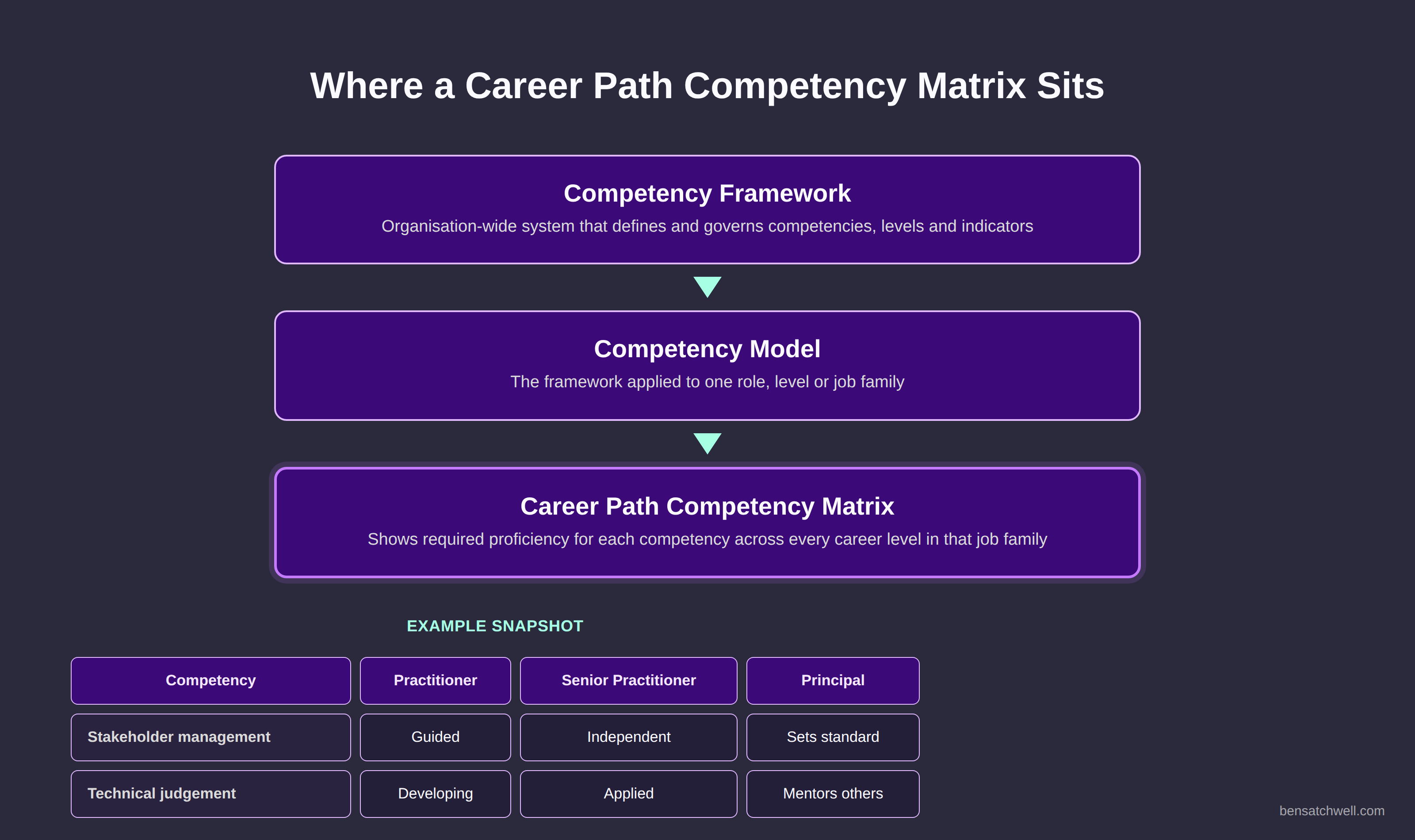
People use "career path competency matrix," "competency framework," and "career ladder" as if they are interchangeable. They are not. A competency framework is the governing system. A competency model is that framework applied to one role. A career path competency matrix is neither of those. It is the grid that shows, level by level, which competencies a person needs to hold and at what proficiency before they can move up, sideways, or into a different job family. Conflate the three and you end up with a spreadsheet nobody trusts, because it is trying to do a framework's job with a matrix's structure.
What Is a Career Path Competency Matrix?
A career path competency matrix maps the competencies required for a job family against the career levels within it, and shows the proficiency expected at each level.
A career path competency matrix is a display artefact, not a governing structure. It sits downstream of a competency framework and one or more competency models, and its job is to show holdings against requirements across a defined progression, not to define competencies from scratch.
Rows are typically the competencies relevant to that job family, both core competencies everyone in the organisation holds and technical competencies specific to the discipline. Columns are the career levels, for example associate, practitioner, senior practitioner and principal, or whatever ladder the organisation uses. Each cell states the proficiency level expected of someone at that level for that competency, and, where the matrix is used for individual assessment, what the person currently demonstrates against it.
Why Does a Career Path Competency Matrix Exist?
Without one, career progression decisions default to tenure, manager preference, or vague performance ratings. Two people at the "same level" in a technical job family can have wildly different actual proficiency, and promotion conversations become arguments about perception rather than evidence.
A career path competency matrix exists to make the criteria for advancement explicit and consistent. It answers a specific question an employee will ask sooner or later: what do I actually need to be able to do, at what standard, to move from where I am to the next level? SHRM's own guidance on career paths notes that nearly a quarter of employed adults cite a lack of career opportunities as their top reason for seeking a role elsewhere, which points to a retention problem a matrix is partly built to solve by making the path to progression visible rather than assumed.
How Does a Career Path Competency Matrix Work in Practice?
Building the matrix starts upstream, with the framework, not the matrix itself. An organisation first needs a career competency framework that defines the competencies relevant to a job family and the levels those competencies span. Only once that exists does the matrix become possible, because the matrix is a visualisation of the framework applied across levels, not a substitute for doing that definitional work.
In practice the build has three steps.
- Confirm the levels. Most working matrices use four to six levels, set by scope, autonomy, complexity and impact of the work, not by years of service.
- Select the competencies. A mix of core competencies, common across the organisation, and technical competencies, specific to the discipline, sit down the rows.
- Write the proficiency indicators. Each cell needs a specific, observable description of what "meets this level" looks like for that competency, not a generic label such as "advanced."
This is where a career path competency matrix differs from a narrower job competency matrix, which maps competencies against a single role rather than a full progression. A career path version has to hold together across every level in the job family at once, which is a harder design problem, because the difference between one level and the next has to be real and demonstrable, not just a different adjective attached to the same phrase.
O*NET's Job Zone system is a useful comparison here. It groups occupations by the level of preparation, education and experience they require, and O*NET's own resource centre notes it recently consolidated from five zones to four because the number of low-preparation roles in the economy had fallen so far that the old bottom tier had stopped being meaningful. The same discipline applies inside a career path competency matrix: if two adjacent levels cannot be told apart by what a person actually does, one of them probably should not exist.

What a Career Path Competency Matrix Is Not
It is not a competency framework. The framework defines and governs the competencies across the whole organisation. The matrix is one output built from it, scoped to a single job family's progression.
It is not a competency model. A model is the applied selection of competencies for one role or level. A career path competency matrix stacks several models together and lays them out across levels so the progression between them is visible in a single view.
It is not a career ladder on its own. A career ladder describes the sequence of job titles and reporting lines a person can move through. A career path competency matrix adds the detail underneath that ladder, the specific proficiency someone needs to demonstrate to justify each rung. SHRM's own material distinguishes the traditional ladder, ranked purely by level of responsibility and pay, from the more common modern career lattice, which allows lateral movement between job families as well as upward movement. A matrix works with either shape, but it has to be built against whichever one the organisation actually uses, not the one shown on an org chart from five years ago.
It is not a skills and competency matrix in the sense that term is often used, a single flat skills inventory. That version usually maps individuals against a skills list at one point in time, without the level-by-level progression structure a career path version needs.
It is not a capability matrix. A team capability matrix maps the broad, durable capabilities a person carries across roles and time, not the role-specific competencies expected at a defined level. Capability belongs to the person and travels with them between roles. The competency requirements in a career path matrix are set by the level and the job family, and a person's holdings are measured against that fixed target, not against what they carry with them regardless of role.

Where Named Frameworks and Standards Fit In
Skills frameworks with formal proficiency levels, such as SFIA, are the closest analogue in the technical skills space. They define skills and level them from foundational through to expert, and organisations frequently adapt that level logic when building a career path competency matrix for technical job families.
CIPD's guidance on competency frameworks is blunt about the risk running through all of this: care needs to be taken to balance detail with flexibility and avoid an overly prescriptive, non-inclusive approach. That caution applies directly to a career path competency matrix, because a matrix with too many narrow cells becomes exactly the rigid, box-ticking artefact CIPD is warning against, and one that assessors quietly stop using honestly.
Common Failure Modes in a Career Path Competency Matrix
The most common failure is writing proficiency indicators that describe seniority rather than behaviour. "Strategic thinking" at the senior level and "some strategic thinking" at the level below is not a real distinction. It is the same phrase with a qualifier attached, and assessors cannot apply it consistently because there is nothing observable to assess against.
The second failure is letting the matrix drift from the framework it was built from. Frameworks get updated as the organisation's competency requirements change. If nobody maintains that link, the matrix becomes a historical artefact that quietly stops matching how the organisation actually defines competency.
The third is scope creep, trying to make one matrix cover every job family in the organisation. A matrix that tries to be universal ends up too generic to use for promotion decisions in any single discipline, and too broad to keep accurate.
When a Career Path Competency Matrix Is (and Is Not) the Right Tool
A career path competency matrix earns its keep in job families with real internal progression and enough headcount to make consistency worth building. Technical and functional disciplines with clear seniority tiers are the classic case. It is worth less in very small organisations, where there are not enough people at each level to make the distinctions meaningful, and in roles that change faster than any documented level structure can track.
It is also the wrong tool if the organisation has not done the framework work first. A matrix built without an underlying competency framework or competency model is a table of adjectives with a promotion process attached to it, and it will not survive contact with the first genuinely borderline promotion case.
Frequently Asked Questions
What is the difference between a career path competency matrix and a career ladder?
A career ladder defines the sequence of roles and titles a person can progress through. A career path competency matrix defines the specific competencies and proficiency levels a person must demonstrate to justify moving between those roles. The ladder is the structure. The matrix is the evidence base underneath it.
Is a career path competency matrix the same as a competency framework?
No. A competency framework is the organisation-wide governing system that defines and standardises competencies. A career path competency matrix is a downstream artefact built from that framework, scoped to show progression within a specific job family.
How many levels should a career path competency matrix have?
Most working matrices use four to six levels. Levels should be set by genuine differences in scope, autonomy, complexity and impact, not by tenure or job title inflation. If two levels cannot be told apart by observable behaviour, they should be merged.
Who is responsible for building a career path competency matrix?
Typically HR or people and capability functions build the matrix, but it should be validated with people who actually do the work at each level. A matrix built entirely without practitioner input tends to produce indicators that sound right and assess badly.
Can a career path competency matrix be used for hiring as well as promotion?
Yes, provided the proficiency indicators are written for external assessment as well as internal review. Many organisations build the matrix for internal progression first and only extend it to hiring once the indicators have been tested against real promotion decisions.
Does a career path competency matrix replace performance reviews?
No. Performance reviews assess how someone is doing against current role expectations. A career path competency matrix assesses whether someone is ready for the next level. The two use related evidence but answer different questions.