
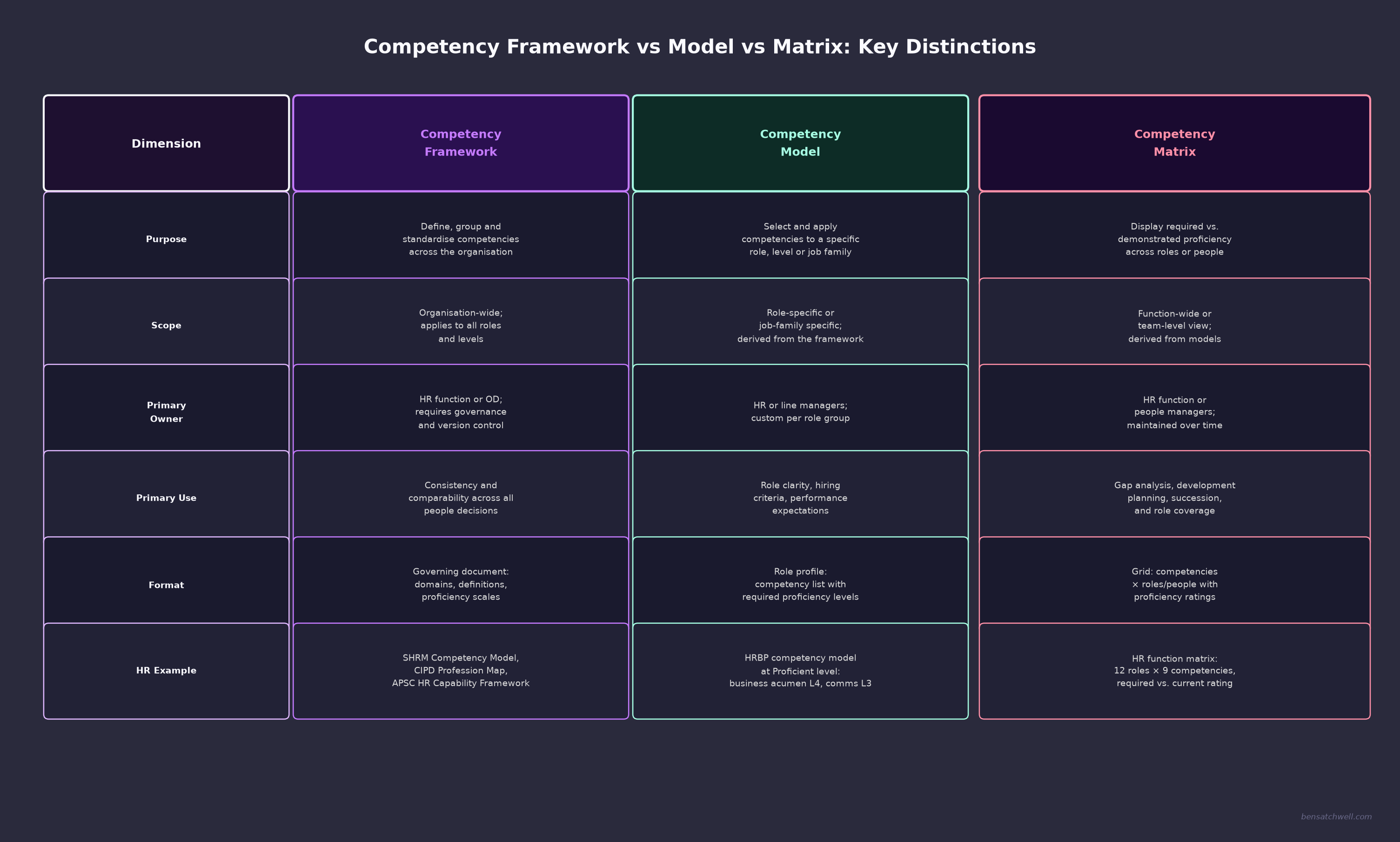
Most HR teams I work with confuse three separate artefacts under one name. Some use "HR competency matrix" to mean the list of competencies HR people are expected to hold. Others use it to describe the role profiles that define what each HR role requires. Others mean the grid that maps competencies against people to show where capability gaps sit. These three things are related, but they are not the same, and building a matrix without understanding which one you are building produces a document that answers no question well.
An HR competency matrix is the grid. It displays a defined set of HR competencies against roles or people, shows the proficiency level required at each intersection, and makes it possible to compare requirements with current capability across the function at a glance.
What Is an HR Competency Matrix?
An HR competency matrix is a structured display tool. Rows carry the competencies. Columns carry the roles, teams, or individual people being mapped. The cells carry proficiency ratings, typically required proficiency in one reading and demonstrated proficiency in another, so gaps become visible.
The matrix does not define the competencies. That is the job of the competency framework, which sets the governing definitions, domains, and proficiency scales the whole function uses. The matrix does not select which competencies apply to a specific role. That is the job of the competency profile, which is the role-specific selection drawn from the framework. The matrix takes those profiles and lays them side by side in a grid so that patterns across roles and people are visible.
When it works, a well-constructed HR competency matrix shows four things at once: what the function expects at each proficiency level, what a given role requires, what an individual currently demonstrates, and where the gaps are.
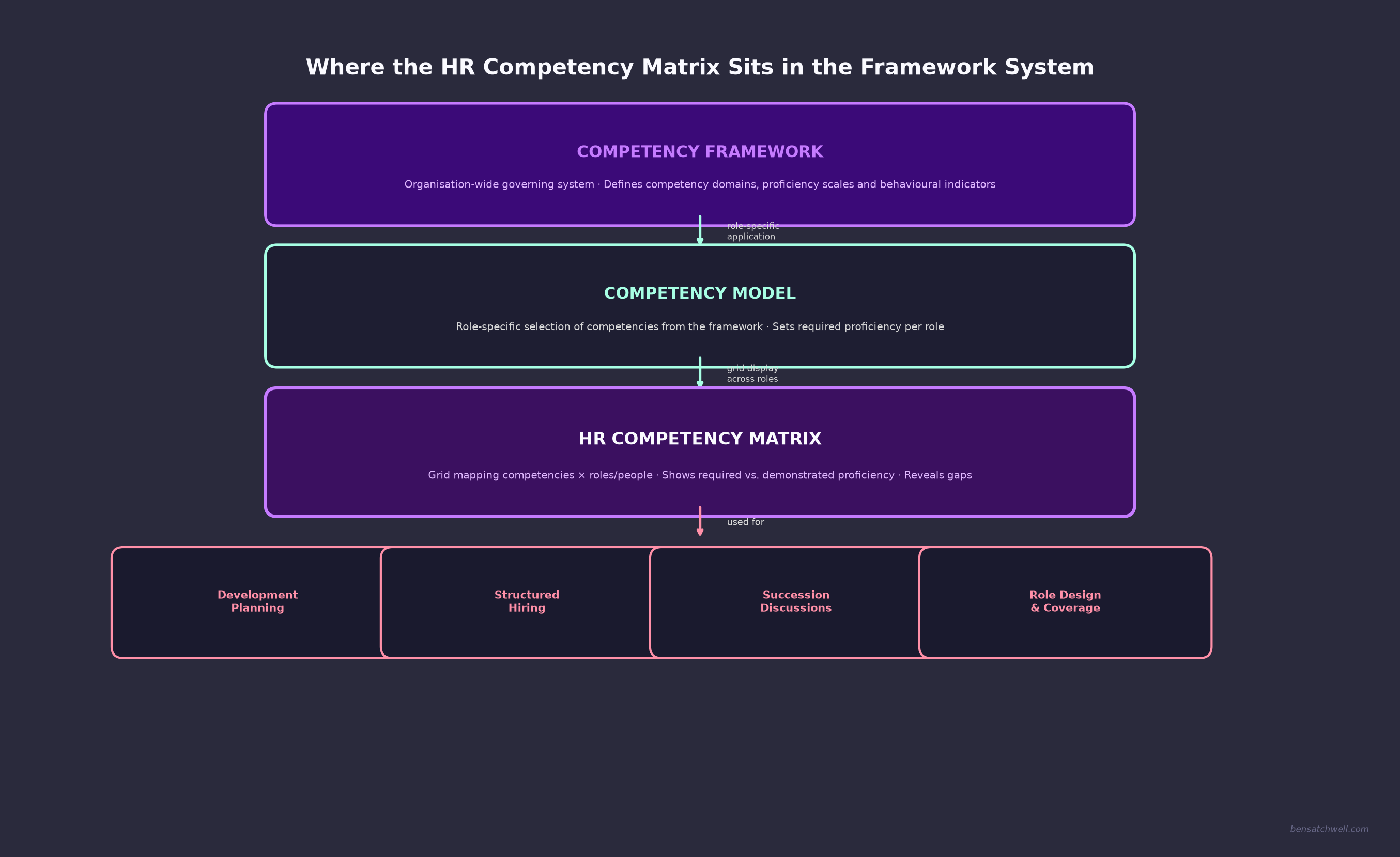
A note on terminology. A competency framework is also called a competency model, especially in the United States. I use competency profile for the competencies and required levels for one role, and competency matrix for the grid of required against current proficiency. Usage varies by region, and I explain the differences in this competency model definition.
Why an HR Competency Matrix Exists
HR functions have a structural problem this tool was designed to address. The work inside an HR function is highly varied. A Compensation Analyst, a HR Business Partner, an L&D Specialist, and an HR Data Analyst need different knowledge, skills, and judgement to do their jobs well, yet most functions are managed as if a single performance framework covers all of them. Standard performance tools used in organisations were not built with functional specialisation in mind.
The result is that meaningful capability gaps go undetected until they become problems, career conversations happen without a shared language for what progression actually looks like, and hiring decisions rely on gut feel rather than defined role requirements.
The CIPD, whose work on professional standards for HR practitioners is the most widely referenced in the UK and Commonwealth contexts, notes that competency frameworks can increase clarity around performance expectations and establish a clear link between individual and organisational performance when developed properly. The HR competency matrix operationalises that clarity into something visible and usable.
The matrix exists because the HR function, like any function with specialised roles, needs a tool that holds required and demonstrated capability alongside each other so decisions about development, deployment, and hiring can be made on consistent criteria.
How an HR Competency Matrix Works in Practice
A working matrix has three structural layers.
The competency set defines what capabilities HR professionals are expected to demonstrate across the function. This typically covers two domains: technical HR competencies specific to HR roles and disciplines, and behavioural competencies shared across the team. The SHRM competency model, published as the SHRM Body of Applied Skills and Knowledge, has eight behavioural competencies in three clusters (Leadership, Interpersonal and Business) plus one technical competency, HR Expertise. These form the row inputs for the matrix.
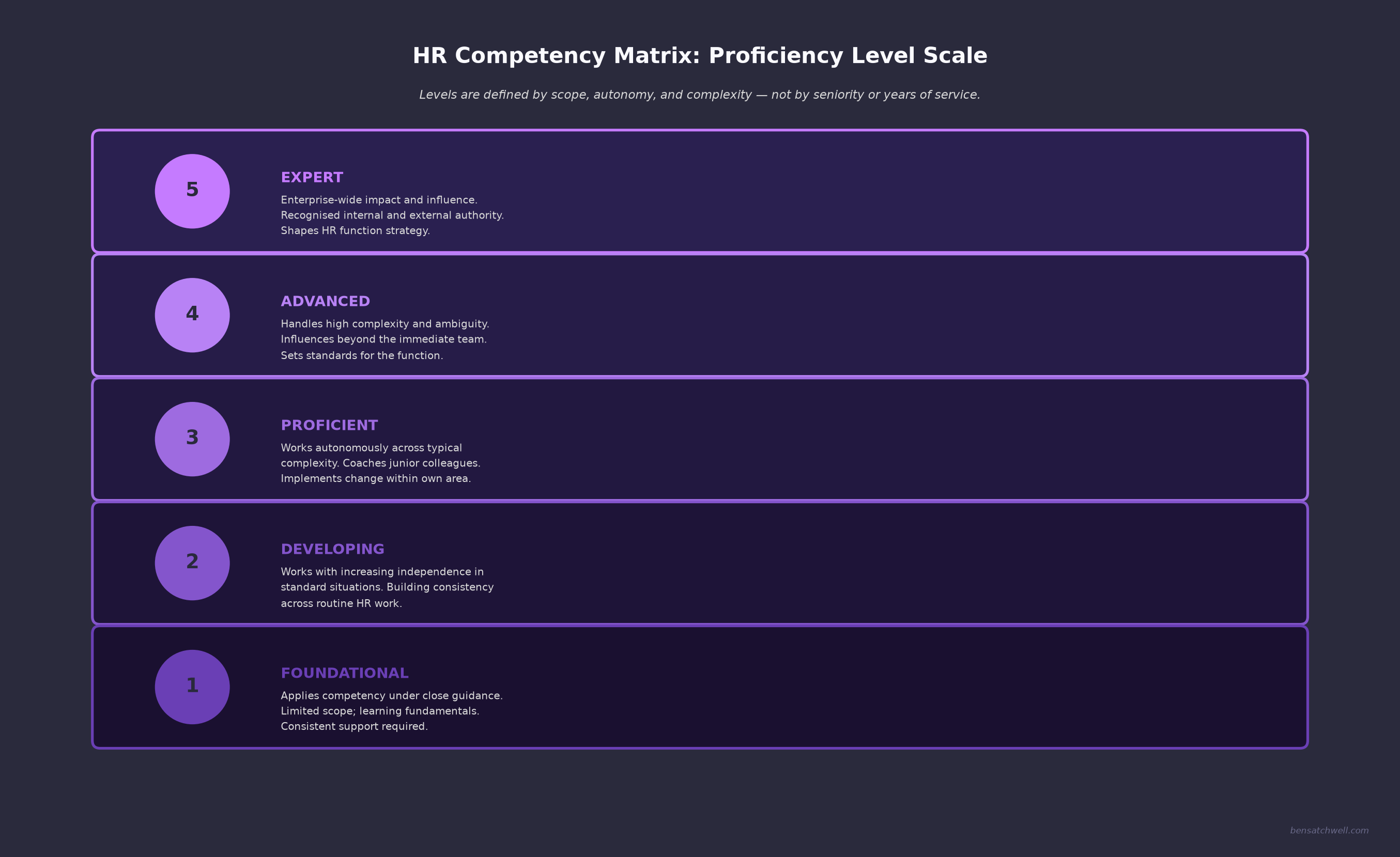
The proficiency scale defines what each level of performance looks like. Most working matrices use between four and six levels. The APSC HR Capability Framework, which sets capability standards for HR professionals in the Australian Public Service, uses progressive proficiency levels tied to scope of impact, autonomy, and complexity of work rather than to seniority or grade alone. That distinction matters: a proficiency level describes what someone can do and at what level of complexity, not what job title they hold.
The role profiles map required proficiency levels to specific HR roles. A Graduate HR Advisor might require foundational proficiency in HR analytics and developing proficiency in stakeholder engagement. A Senior HR Business Partner might require advanced proficiency in workforce strategy and influencing at the executive level. These profiles, built from the competency framework, populate the matrix columns.
When these three layers are combined, the matrix becomes a functional tool for talent decisions, development planning, succession discussion, and structured hiring. For more on how competency profiles are built and applied before the matrix stage, see my article on HR competency profiles.
What an HR Competency Matrix Is Not
The terms in this space are used interchangeably, and the conflation is costly. Being precise about what the matrix is not clarifies where it actually belongs in the system.
Not a competency framework. The competency framework is the governing structure. It defines, groups, and standardises the competencies so they can be applied consistently. The matrix is a display artefact derived from that framework. If the matrix is built without a framework behind it, there is no standard anchoring the definitions, and the ratings become subjective. For a detailed explanation of how competency frameworks are structured, my article on the competency framework covers this in full.
Not a competency profile. The competency profile is the role-specific selection of competencies drawn from the framework. If you have defined which competencies a Senior HRBP must demonstrate and at what level, you have a profile. If you have laid that profile alongside others for all HRBP seniority levels in a grid, you have a matrix.
Not a performance review tool. The matrix provides the criteria. The performance process uses them. Merging the two into a single spreadsheet creates a document that tries to do both jobs and does neither well.
Not a skills inventory. Skills and competencies are different constructs. A skills inventory lists discrete, granular capabilities often drawn from a skills taxonomy or ontology. A competency matrix maps integrated behavioural performance across proficiency levels. Treating them as equivalent produces a matrix that is too granular to be meaningful and too generic to drive real development conversations.
Named Framework References for HR Competency Matrices
Three published standards are most commonly referenced when building HR competency matrices in Australia and internationally.
SHRM Competency Model. SHRM's framework, grounded in research with HR practitioners, identifies eight behavioural competencies and one technical competency, HR Expertise. Business Acumen and Ethical Practice sit alongside HR-specific technical knowledge. It is the dominant professional reference in US and Asia-Pacific commercial contexts and provides useful validation for matrices used in internationally operating organisations.
CIPD Profession Map. CIPD's updated Profession Map defines core behaviours and specialist knowledge areas for people professionals at four career levels. It covers specialist knowledge across thirteen HR domains, including talent management, employee relations, reward, and organisational design. It is the leading professional standards reference in the UK and Commonwealth and the most applicable starting point for Australian organisations wanting a credible external anchor for their matrix design.
APSC HR Capability Framework. The Australian Public Service Commission's HR capability framework organises capability expectations by functional stream, including HR analytics, workforce planning, employee relations, and talent acquisition, and applies progressive proficiency levels across each. Agencies can use it as a reference to develop role-specific matrices or adapt it wholesale to their context.
For practical examples of how major organisations have structured published frameworks that inform matrix design, my article on competency framework examples includes detailed comparisons of named frameworks.
Common Failure Modes
Defining competencies inside the matrix. When competency definitions are written directly into matrix cells, those definitions cannot be consistently applied across other HR processes. The matrix becomes the source of truth rather than a display of it, and the definitions drift over time without anyone noticing.
Using job titles instead of role profiles as column headers. A matrix that lists "HR Manager" as a column describes a title, not a function. If five HR Managers in the same organisation do substantially different work, one column cannot represent all of them accurately. Role profiles, defined by responsibilities and accountability, should anchor the columns.
Rating people without calibrating the scale first. Proficiency level descriptors need to be calibrated across all raters before anyone is assessed. Without calibration, two managers using the same five-point scale will produce different ratings for the same person. The matrix appears objective while the inputs are inconsistent.
Conflating required proficiency with aspirational targets. The matrix should show what the role requires now, not what you hope someone will eventually reach. Building aspirational levels into required proficiency columns immediately invalidates the gap analysis. If you want to show growth targets, use a separate column.
Building the matrix before the framework. This is the most common structural error. Organisations build the matrix because it feels tangible and deliverable, then try to reverse-engineer the framework from it. The matrix is a downstream artefact. It requires the framework to give it meaning.
Trade-offs and Constraints
An HR competency matrix works best for functions where roles are defined clearly enough that meaningful proficiency differences can be stated and compared. If role boundaries are blurred, shift frequently, or differ substantially between incumbents with the same title, maintaining accurate role profiles in the matrix becomes a maintenance problem that leads to abandonment.
The matrix also only delivers value if the developmental infrastructure around it can respond to what it reveals. A matrix that surfaces capability gaps creates an implicit commitment to address them. If the function cannot fund or prioritise the development investment the gap analysis implies, the tool will demoralise the team rather than develop them. This is not a reason to avoid building it. It is a reason to scope it realistically and use it for decisions where capability data will actually be acted on.
Start with the roles and competencies that matter most to current priorities. A matrix covering six roles and ten competencies that is actively used for hiring, development, and succession is worth considerably more than a comprehensive matrix covering the entire function that nobody opens. My overview of leadership competency framework examples shows how scoping decisions differ across different function types.
Frequently Asked Questions
What is an HR competency matrix used for?
An HR competency matrix is used to map required competency proficiency levels against HR roles and compare those requirements to the current demonstrated capability of the people in those roles. It supports development planning, structured hiring, succession discussions, and decisions about role design and team coverage.
What is the difference between an HR competency matrix and an HR competency profile?
A competency profile defines the set of competencies and required proficiency levels for a specific HR role, level, or job family. A competency matrix is the grid that displays those role requirements alongside each other, or alongside the actual capability of the people currently in those roles, so patterns and gaps are visible at a glance. The profile is the source; the matrix is the display.
How many proficiency levels should an HR competency matrix use?
Most frameworks use between four and six proficiency levels. Fewer than four lacks the granularity to show meaningful development stages. More than six creates rating burden without adding useful precision. Levels should be anchored to observable scope, autonomy, and complexity of work, not to seniority or years of experience.
Which published framework should I use to build an HR competency matrix?
In Australian contexts, the CIPD Profession Map and the APSC HR Capability Framework are the most immediately applicable references. SHRM's competency model is useful for organisations with North American operations or an internationally-minded HR function. Many organisations use a combination: CIPD or APSC for the proficiency architecture and SHRM for validation of the competency list.
Can an HR competency matrix be used for performance reviews?
It can provide the competency criteria that inform a performance assessment, but it should not replace the conversation-based performance process. The matrix shows what is required and what is demonstrated. A performance review uses that information in context, with nuance, and in dialogue with the person being assessed. Reducing a performance review to matrix cell comparisons loses the interpretive work that makes the process valuable.
How often should an HR competency matrix be reviewed?
Role profiles should be reviewed at minimum annually or whenever significant changes to the work occur. Competency definitions, sitting in the framework, require less frequent review but should be validated when the operating model or organisational strategy changes substantially. If a matrix has not been updated in two years and significant change has occurred, the gap analysis it produces is likely misleading.