
Most organisations I work with apply the term "HR competency matrix" to three different things simultaneously. They call the framework a matrix. They call the profile a matrix. They call the assessment grid a matrix. Only one of those is correct, and the conflation creates real problems when you are trying to assess people, plan development, or make resourcing decisions.
What Is an HR Competency Matrix?
An HR competency matrix is a grid. More precisely, it is a structured display artefact that maps competencies against people or roles within the HR function, showing required proficiency versus current proficiency across both dimensions at once.
The matrix does not define the competencies. It does not govern how they are applied. It does not set proficiency levels. Those tasks belong to the competency framework and the competency profiles drawn from it. The matrix is where all of that structural work becomes visible as data.
A well-constructed HR competency matrix answers two questions simultaneously: what does each HR role require at each competency, and what does each person currently hold? The gap between those two columns is the development agenda.
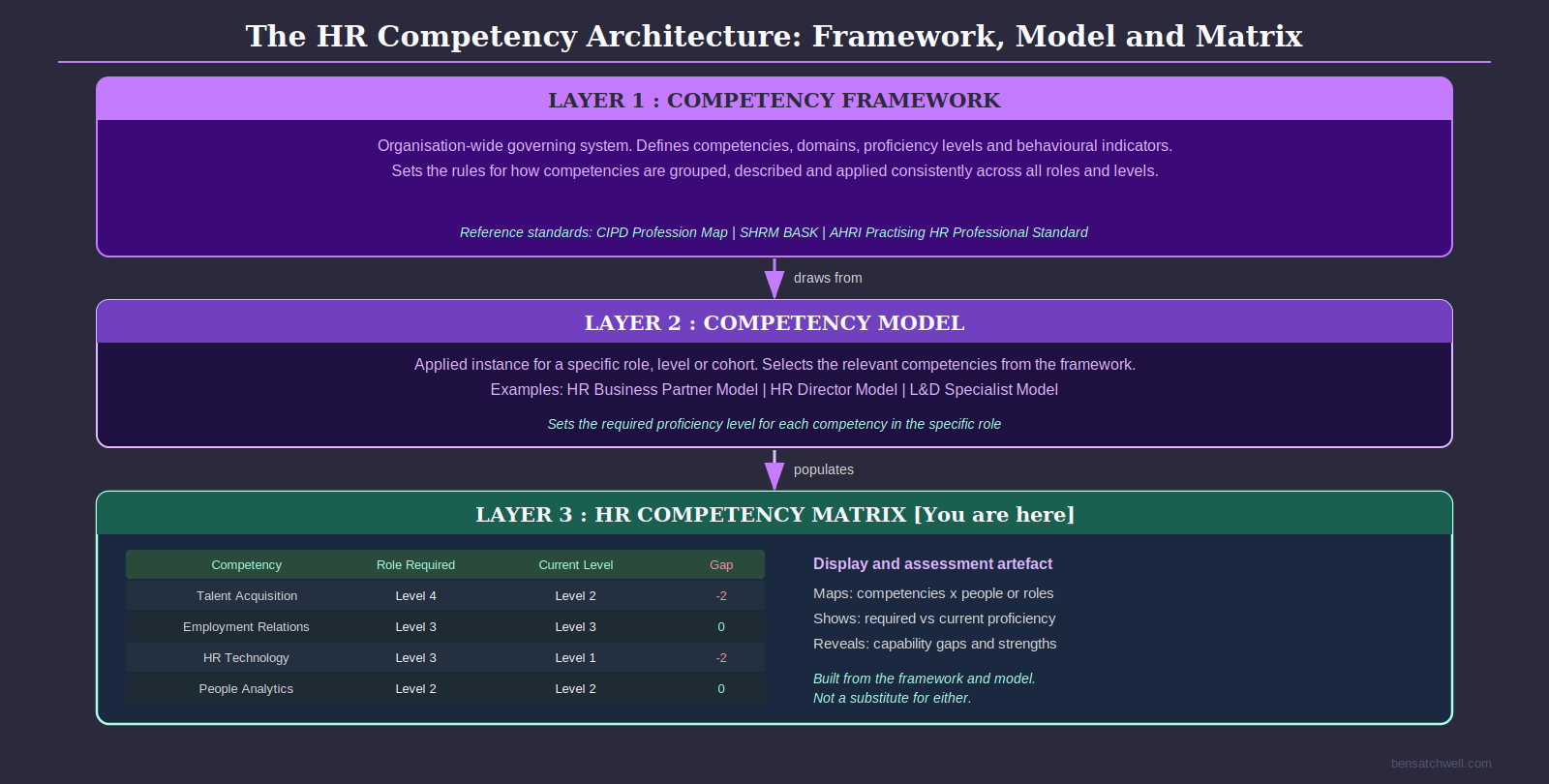
A note on terminology. A competency framework is also called a competency model, especially in the United States. I use competency profile for the competencies and required levels for one role, and competency matrix for the grid of required against current proficiency. Usage varies by region, and I explain the differences in this competency model definition.
Why the HR Function Needs a Competency Matrix
HR functions occupy an unusual position. They design and deploy competency frameworks for the broader organisation, and then frequently fail to apply the same rigour to themselves. This is partly a resource problem, partly a professional blind spot.
A competency matrix for the HR function serves several distinct purposes. It surfaces capability gaps at the team level, not just the individual level. It supports resource and succession decisions: who can cover for whom, who is ready for a broader role, where the team is exposed if key people leave. It provides an objective foundation for development conversations that cuts through the personal dynamics that accumulate in small specialist teams.
The HR function often spans highly varied work: business partnering, learning and development, talent acquisition, reward and recognition, employee relations, HR analytics. Each area requires a different competency profile. A matrix makes those differences legible and comparable without requiring a separate conversation about each one.
How an HR Competency Matrix Works in Practice
Building the Grid
The horizontal axis lists the people or roles being assessed. The vertical axis lists the competencies being mapped, typically drawn from the organisation's competency framework through function-specific profiles for the HR team. Each cell in the grid shows either a required proficiency level, a current proficiency level, or both.
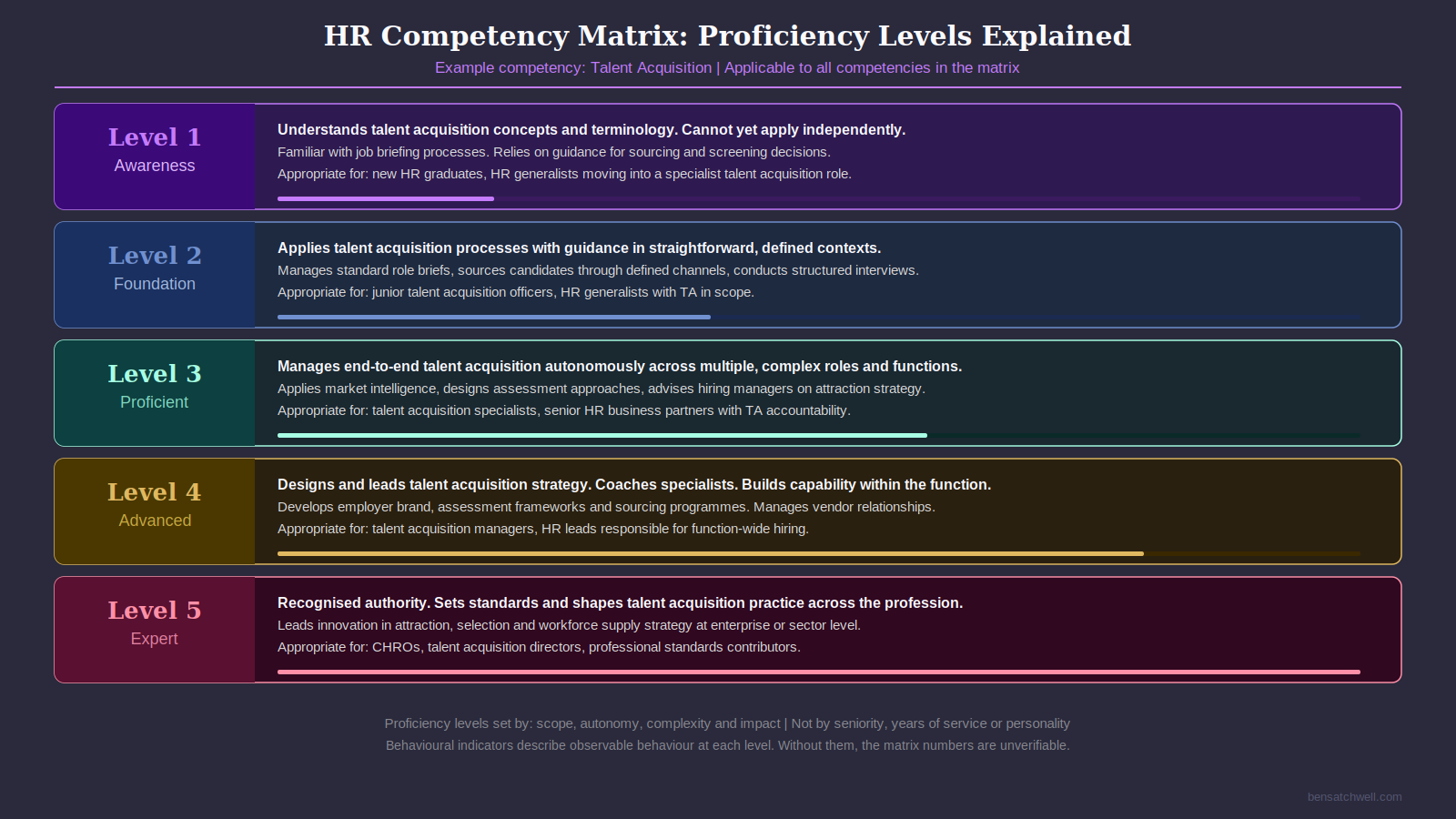
Proficiency levels describe the scope, autonomy, complexity and impact at which a competency is held. They are not proxies for seniority or years of experience. A common structure uses four levels: Foundation, Developing, Proficient, and Advanced. The exact labels matter less than the definitions behind them.
The CIPD Profession Map provides a well-developed set of HR competencies and proficiency descriptors that many organisations use as a starting point for their HR function-specific matrix. The SHRM Body of Applied Skills and Knowledge (BASK) performs a similar function in the North American context, mapping HR competencies across behavioural and technical dimensions.
Populating the Matrix
Populating the matrix requires decisions about scope. Does it cover all HR competencies or a prioritised subset? Does it apply to every person in the HR function or a defined cohort at a particular level?
Smaller functions often start with a subset: six to eight competencies most relevant to the team's current priorities. Larger functions may maintain a comprehensive matrix updated annually, with a lighter quarterly pulse check on the critical few.
Assessment against the matrix can be self-assessment, manager assessment, or a combination of both. The most useful matrices I have seen combine both approaches and make the gap visible rather than blurring it into an averaged score.
What an HR Competency Matrix Is Not
The matrix is not a competency framework. A competency framework is the organisation-wide governing structure that defines competencies, proficiency levels, and how they are applied. The matrix is a derivative of that structure, not the structure itself.
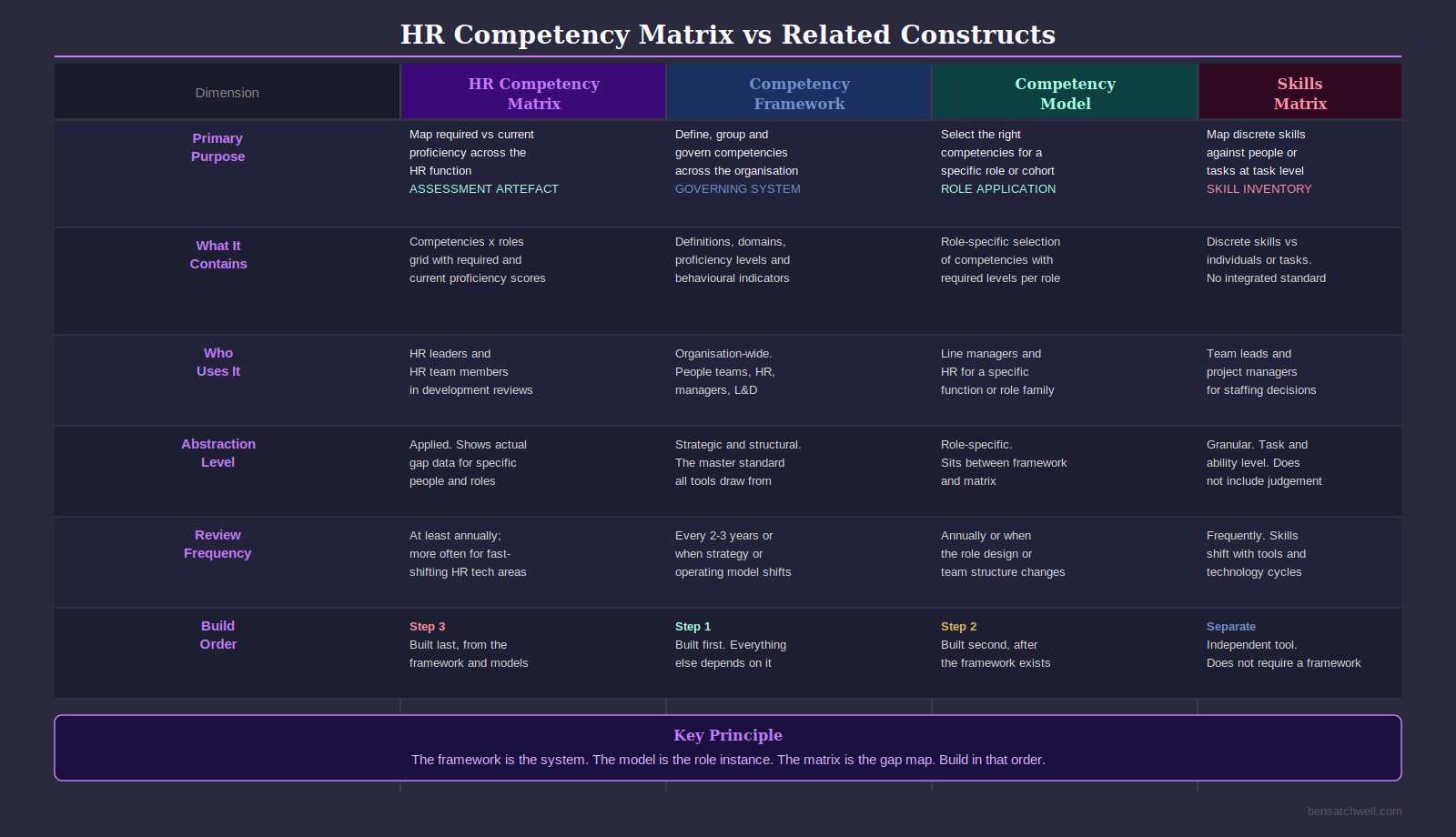
The matrix is not a competency profile. A competency profile is the selection of competencies and required levels for a specific role, level, or cohort. The matrix draws from profiles to populate its rows. Profiles are inputs; the matrix is an output.
The matrix is not a skills taxonomy. A skills taxonomy classifies discrete skills in a structured hierarchy. Competencies integrate skills with knowledge and judgement, and are observed as behaviour. These are related but distinct constructs. Conflating them produces a grid that is either too granular to be useful or too abstract to assess reliably.
The matrix is not a performance management tool, though it is frequently pressed into that role. It shows proficiency holdings. It does not show contribution, output, or impact. An HR professional can hold a competency at Advanced and still underperform against their objectives. The matrix captures capability; performance management captures results.
Named Standards and Framework References
The CIPD Profession Map is the most widely referenced HR competency standard in the UK and Australia. It organises HR competencies into eight core behaviours and a set of specialist knowledge areas, with four proficiency levels. Many HR functions in Commonwealth countries build their competency matrix directly from this structure, and it is a sound starting point for any team without a bespoke competency framework example to draw from.
SHRM's BASK provides an equivalent foundation in North American contexts, covering both behavioural competencies and technical knowledge domains across four proficiency levels. For HR functions operating within organisations that have already deployed Korn Ferry or Lominger frameworks enterprise-wide, the HR matrix typically draws from those same frameworks applied to the HR function rather than introducing a separate standard. Consistency across the organisation outweighs functional specificity in most cases.
Common Failure Modes
The most common failure I see is building the matrix before the profile exists. Teams pull together a list of competencies, attach proficiency levels without clear definitions, and then ask people to self-rate. The result is not a competency matrix. It is an opinion poll with a grid format.
Research into HR skill gap analysis using matrix-based approaches consistently identifies undefined competency standards as the primary source of unreliable assessment data. Where raters lack a shared behavioural standard to calibrate against, the resulting proficiency scores reflect personal interpretation rather than observable performance.
The second failure is treating the matrix as a one-time deliverable rather than a live assessment tool. A matrix built from a single round of self-assessment and then filed away has no value. The value is in the gap it reveals and the development it drives over time.
The third is scope creep. Organisations attempt to map every HR competency, every person, and every level simultaneously. The matrix becomes unmanageable, assessment quality drops, and the exercise is abandoned mid-cycle. Starting with a defined subset and expanding from there is almost always the right approach. This mirrors common failures in leadership competency framework design, where over-engineering at the outset reliably kills implementation.
Trade-offs and Constraints
The matrix is most useful when the HR function is large enough to have distinct roles with genuinely different competency requirements. In a team of three, a matrix adds administrative overhead without proportional insight. In a team of twenty with five distinct sub-functions, it is near-essential.
Accuracy depends on the quality of the competency definitions underneath the matrix. Vague behavioural indicators produce unreliable ratings. Before investing in the matrix, confirm that the competency profile it draws from has clear, observable, level-specific behavioural indicators.
The matrix also requires regular refresh. HR functions change: new capabilities become critical (HR analytics, AI literacy), old ones become table stakes. A matrix built on a three-year-old profile will diverge from reality faster than most teams notice. Annual recalibration, aligned to the performance cycle, is the recognised minimum for functions operating in environments where the skills landscape is shifting.
Frequently Asked Questions About HR Competency Matrices
What is the difference between an HR competency matrix and a competency framework?
A competency framework is the governing structure that defines competencies, proficiency levels, and application rules across the organisation. A competency matrix is a display artefact, a grid that shows how people or roles currently sit against those competencies. The framework comes first; the matrix draws from it.
How many competencies should an HR competency matrix cover?
Most well-designed HR matrices cover six to twelve competencies. Fewer than six often misses critical functional distinctions. More than fifteen typically exceeds what can be assessed reliably and maintained consistently over time.
Can an HR team use CIPD's Profession Map as the basis for their competency matrix?
Yes. The CIPD Profession Map is designed precisely for this purpose. It provides defined competencies, behavioural indicators, and proficiency levels that populate the rows of an HR competency matrix directly. Organisations should review whether the full map applies or whether a subset is more appropriate for their context.
What proficiency levels should an HR competency matrix use?
Four levels work well for most HR functions: Foundation, Developing, Proficient, and Advanced. The critical factor is not the label but the behavioural descriptor behind each level. Proficiency levels should reflect scope, autonomy, complexity and impact rather than years of service or job title.
How often should an HR competency matrix be updated?
Assessments should be refreshed at least annually, aligned to the performance cycle where practical. The underlying competency profile should be reviewed every two to three years or when the HR function's strategy or structure changes materially.