
A team capability matrix and a team skills matrix get used as if they're the same tool, and most templates circulating online treat the two labels as interchangeable. That's not a cosmetic mix-up. A grid built to track who can do what this quarter answers a different question to one built to track what each person is broadly and durably capable of, across roles, as the team's work changes. Conflate the two and you get a matrix that looks tidy in a slide deck and tells a team lead almost nothing useful about resourcing, succession or development.
What Is a Team Capability Matrix
A team capability matrix is a grid that maps the capabilities held by each person on a team against the capabilities the team as a whole needs, so gaps, redundancies and development priorities are visible in one view. It is also called a capability grid, or a solution capability matrix in program and solution-delivery contexts.
It is a display and assessment artefact, not a governing structure. A capability framework defines what a capability is and how it is levelled across the organisation. A capability profile selects which of those capabilities apply to a given team or role. The matrix takes that profile and lays individual holdings against target levels, person by person, so the pattern across the team is visible at a glance.
Rows are usually team members. Columns are the capabilities relevant to that team's work. Each cell records the proficiency level a person currently holds against the level the role or the team's mandate requires. Colour or numeric coding is layered on top to make the gaps scannable, but the coding is a presentation choice, not the substance of the tool.
Because capability, in this sense, is held by the person rather than tied to a single role, a capability matrix is meant to travel with people as they move between projects or roles inside the team. That is the feature that separates it from most of the adjacent grids people build and then call a capability matrix by habit.
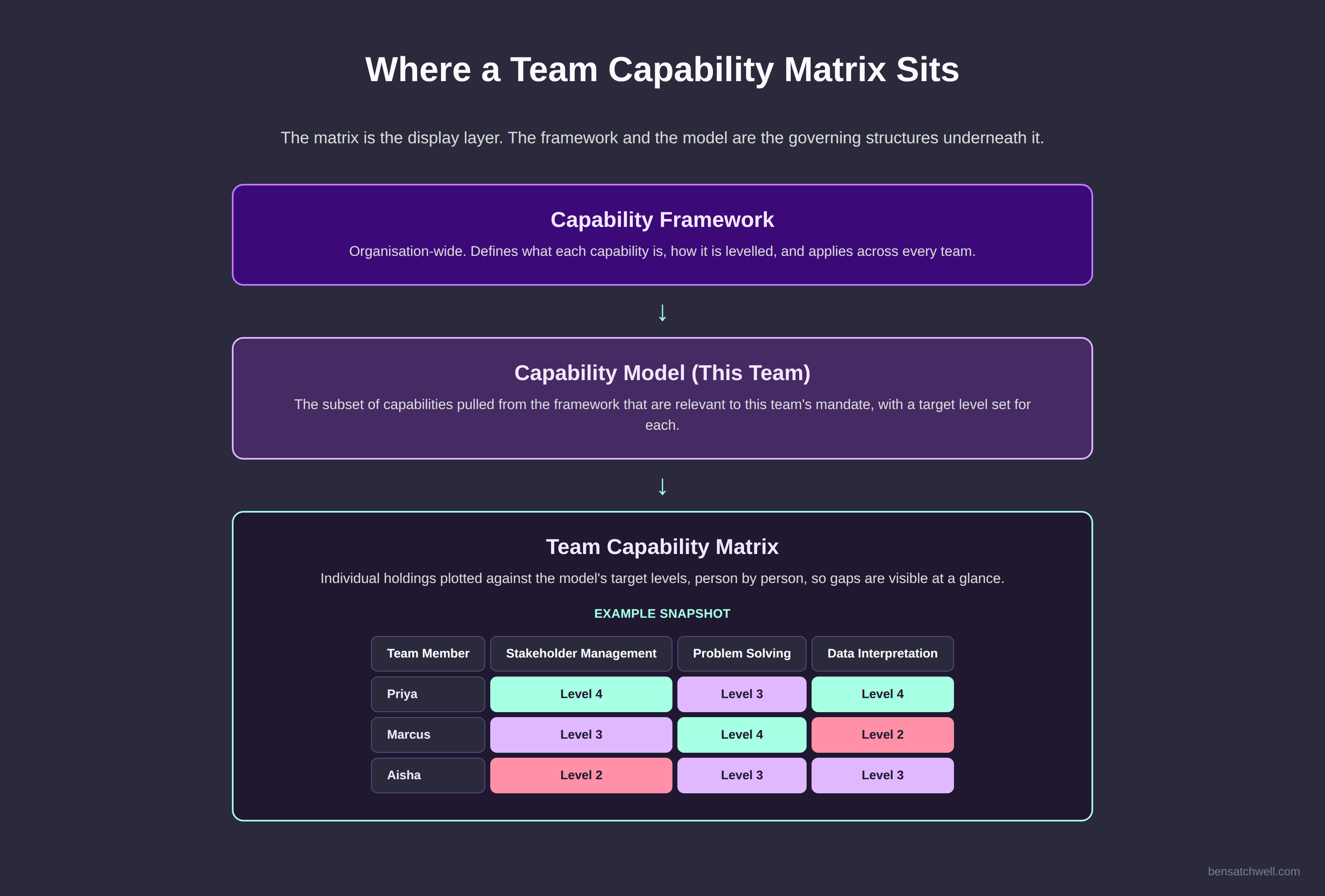
The team capability matrix is the display layer built on top of the capability framework and the team's capability profile.
A note on terminology. A competency framework is also called a competency model, especially in the United States. I use competency profile for the competencies and required levels for one role, and competency matrix for the grid of required against current proficiency. Usage varies by region, and I explain the differences in this competency model definition.
Why a Team Capability Matrix Exists
Team leads make workforce decisions constantly: who can pick up a stretch piece of work, who could backfill a colleague on leave, who is ready for a broader role, where the team is exposed if someone leaves. That information usually exists somewhere, scattered across performance reviews, L&D records and manager memory, but none of it is scoped to the team or built to be scanned in one sitting.
The matrix exists to solve exactly that aggregation problem. It takes individual capability holdings, already defined and levelled by the organisation's capability framework, and re-projects them onto the team's actual work. A team lead should be able to look at the grid and answer "can this team take on that piece of work" or "who is our single point of failure" without reopening every person's file.
Government capability frameworks are built with this kind of team and role-level application in mind. The NSW Government's public sector capability framework, for example, is explicitly designed to support role design, recruitment and performance development across a large, varied workforce, which only works if the underlying capabilities and levels can be applied consistently down to individual teams.
How a Team Capability Matrix Works in Practice
Building one properly follows a sequence, and skipping steps is where most matrices go wrong.
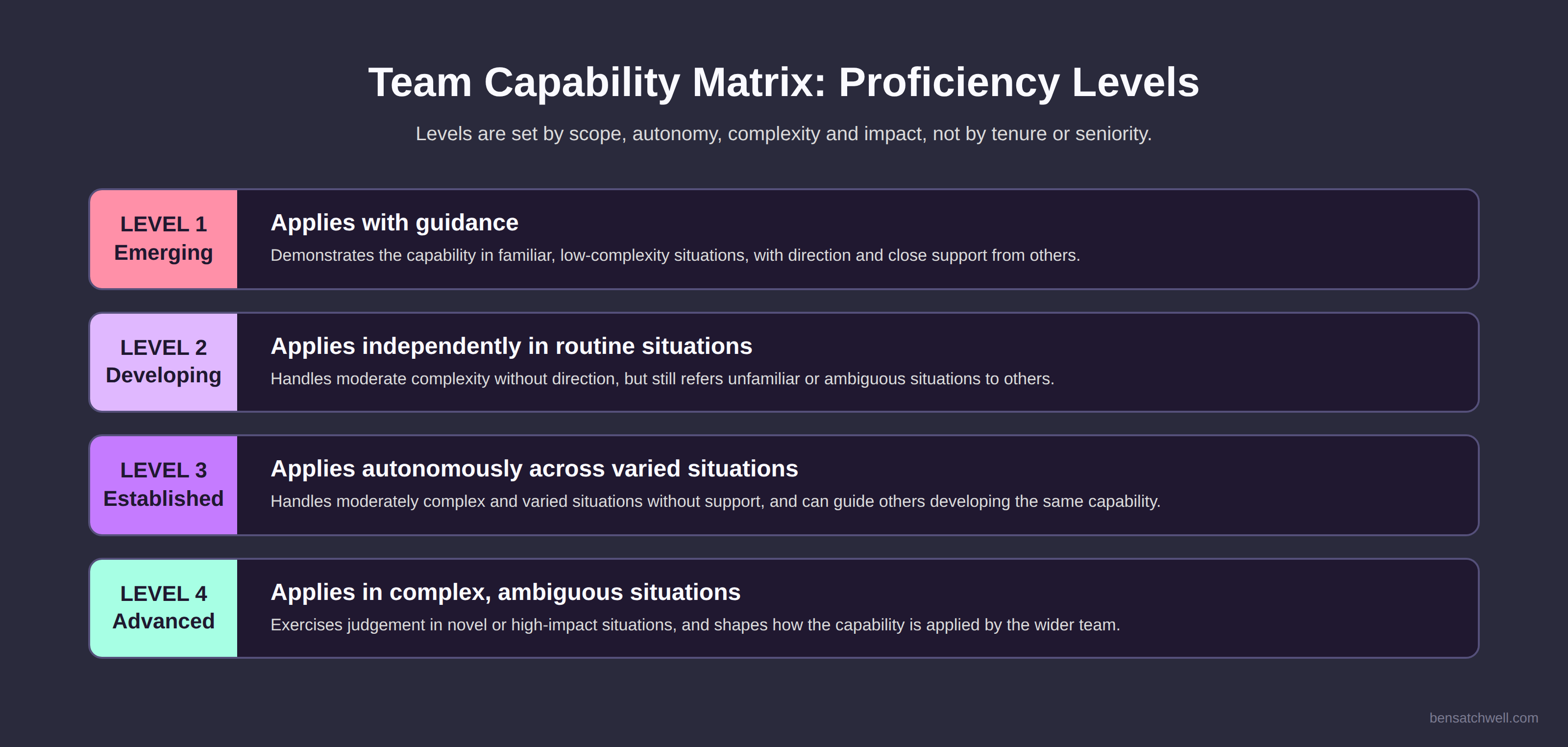
Proficiency levels in a team capability matrix are set by scope, autonomy, complexity and impact, not by tenure.
Start from the capability framework. Select the four to eight capabilities that matter for this team's work. That selection is the team capability profile, and it keeps the columns stable and comparable with every other team that draws on the same framework.
Set the target level for each capability. The target is what the team's work requires, not what the strongest person on the team happens to hold. Targets can differ between roles in the same team.
Assess each person against the behavioural indicators. Use evidence from real work and manager input, not self-report alone. Self-assessment is useful as a conversation starter, but it drifts high for some people and low for others.
Plot current against target. The grid then shows gaps, over-reliance on a single person and areas of unused depth. The aim is a pattern across the team, not a score for each individual.
Review it when the work changes. A new service line, a departure or a change in strategy moves the profile. Re-run the selection and targets first, then the assessments.
What a Team Capability Matrix Is Not
The label gets attached to several adjacent tools that are worth separating out explicitly.
It is not a skills matrix. A skills and competency matrix maps discrete, specific abilities, often technical ones tied to a particular tool or method. Skills shift as tools and technology change, which makes a skills matrix a higher-maintenance, faster-decaying artefact than a capability matrix, where the columns are meant to stay broadly stable for years.
It is not a competency matrix. A competency matrix, as covered in the HR competency matrix distinction between framework, profile and matrix, maps role-specific behavioural performance expectations, usually anchored to a specific role right now. Capabilities are broader and travel with the person across roles, which is why the same grid structure produces a genuinely different tool depending on which construct populates the columns.
It is not a capacity plan. Capacity is the volume of work a person or team can take on. A capability matrix says what someone can do, not how much of their time is available to do it. Teams that merge the two end up with a grid that can't answer either question cleanly.
It is not a performance rating tool. The matrix records what a person is capable of, assessed against a defined standard. It is not a ranking of who is "better" than whom, and using it that way undermines the honesty of the assessments feeding it.
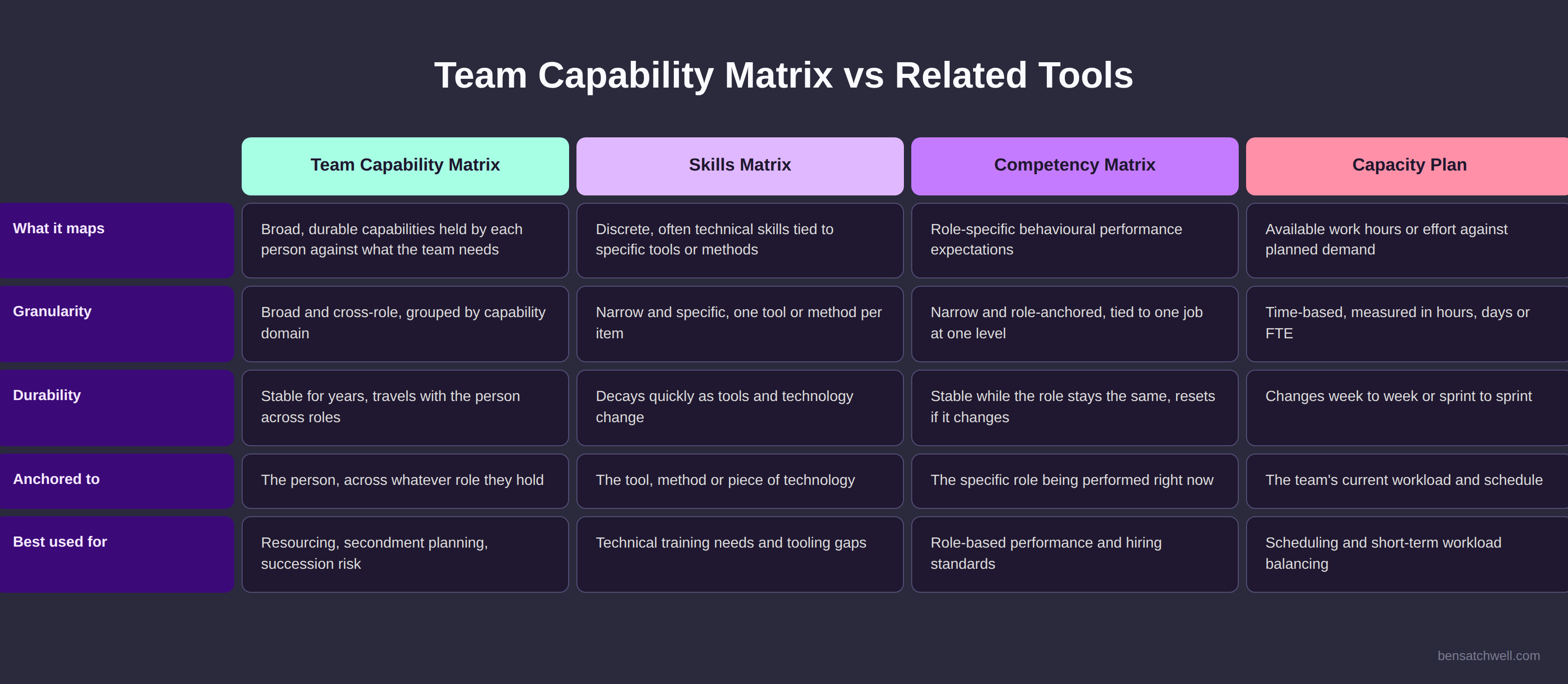
A team capability matrix, a skills matrix, a competency matrix and a capacity plan look similar but answer different questions.
Named Frameworks and Standards Worth Knowing
Several established frameworks shape how organisations think about levelling and structuring the columns of a matrix like this, even when they were not designed with a team-level grid specifically in mind.
SFIA defines seven levels of responsibility, and is explicit that proficiency at a given level requires both the professional skill itself and the generic attributes that go with it, autonomy, influence and complexity among them. That two-part structure is a useful check on any capability matrix: a level rating that only reflects technical ability and ignores autonomy or judgement is measuring half the construct.
The CIPD Profession Map organises its standards around core knowledge, core behaviours and specialist knowledge. It's a useful reference point for how a professional body structures the layer that sits above individual skills, closer to the capability end of the spectrum than the narrow technical skill end.
Korn Ferry and Lominger's competency libraries are frequently pulled into capability matrix templates wholesale. That's worth naming directly: those are competency libraries, tied to role-specific behavioural performance, so a matrix built from them unmodified is a competency matrix wearing a capability label.
Common Failure Modes
The same handful of mistakes show up across most poorly performing matrices.
- No framework behind it. Without a shared capability framework, every team defines the columns and the levels differently and nothing rolls up.
- Skills in the columns. Listing tools and methods turns the grid into a skills matrix, which goes stale as soon as the tools change.
- Too many columns. A grid with twenty or thirty capabilities cannot be assessed honestly or read at a glance.
- Self-rated levels only. Ratings with no behavioural evidence behind them make the grid look precise while telling the team lead very little.
- Built once and left. A matrix that is not reviewed when the work changes describes a team that no longer exists.
Trade-offs and Constraints
A team capability matrix earns its keep for specific, bounded questions: resourcing a project, planning a secondment, identifying succession risk, or working out where a small team is thin. It is not a substitute for an organisation-wide capability framework, and it does not scale much beyond a single team or a small cluster of related teams, because without the framework behind it, every team ends up defining capabilities differently and nothing rolls up.
The colour coding that makes a matrix easy to scan is also its biggest distortion risk. Collapsing a genuinely nuanced capability, judgement under ambiguity, for instance, into a single traffic-light cell inevitably loses information. Treat the matrix as a conversation starter and a planning input, not as the finished assessment.
There is also a real maintenance cost. Someone has to run the assessment, calibrate ratings, and keep the grid current as roles shift. For a stable team doing largely unchanging work, that overhead may not be worth it. For a team absorbing new work or facing succession risk, it usually is.
FAQ
What is a team capability matrix?
A grid that maps the capabilities each person on a team currently holds against the capabilities the team needs, used to spot gaps, plan development and inform resourcing decisions.
What is the difference between a team capability matrix and a skills matrix?
A skills matrix tracks discrete, often technical abilities that shift as tools and methods change. A capability matrix tracks broader, more durable abilities that travel with a person across roles.
How is a team capability matrix different from a competency matrix?
A competency matrix maps role-specific behavioural performance expectations, usually tied to one role at one level. A capability matrix maps broader abilities that are not anchored to a single role.
How do you build a team capability matrix?
Start from an existing capability framework, select the capabilities relevant to the team, set four to six proficiency levels based on scope and complexity, assess each person against those levels with manager input rather than self-report alone, then plot the results in a grid and revisit it as the team's work changes.
How many proficiency levels should a team capability matrix have?
Most workable frameworks use four to six levels, defined by scope, autonomy, complexity and impact rather than seniority or years of service.
Can a team capability matrix be used in performance reviews?
It can inform development conversations, but using it to rank or compare people publicly undermines the honesty of the assessments that feed it. Treat it as a planning tool, not a scoring system.