

A lot of organisations have competency frameworks. Far fewer have career competency frameworks, and that distinction matters more than most HR teams realise. A standard competency framework tells you what good looks like. A career competency framework tells you what good looks like at each stage of a career. That is not a minor revision. It is a different purpose, a different structure, and a different use case entirely.
What Is a Career Competency Framework?
A career competency framework is a structured system that defines the competencies required at each career level within a pathway, from entry to senior roles. It makes progression criteria explicit, observable, and assessable.
Unlike a general competency framework, which defines competencies for use across the organisation, a career competency framework is organised around career levels. Each level specifies what someone needs to know, do, and demonstrate behaviourally to be performing at that stage, and what they need to demonstrate to move to the next.
Understanding what a competency actually is is a prerequisite to designing a framework that assesses it well. A competency is the integration of skills, knowledge, judgement and behaviour applied effectively in the context of a role. A career competency framework gives that definition structure and sequence across a career.
A note on terminology. A competency framework is also called a competency model, especially in the United States. I use competency profile for the competencies and required levels for one role, and competency matrix for the grid of required against current proficiency. Usage varies by region, and I explain the differences in this competency model definition.
Why a Career Competency Framework Exists
The problem it is designed to solve is straightforward: without defined criteria at each career level, progression decisions default to gut feel, informal advocacy, and inconsistent standards.
Most organisations can tell you they have levels, such as a Grade 3, a Senior Analyst or a Principal Consultant. Fewer can articulate what someone at Grade 3 actually needs to demonstrate compared to Grade 4. The career competency framework fills that gap. It turns a job level from an administrative label into a set of defined performance expectations.
This matters for three reasons. First, fairness: individuals can see the criteria for advancement, and there is no hidden standard that managers apply inconsistently. Second, development: when the gap between current and next level is explicit, development conversations become purposeful rather than vague. Third, decision quality: promotion and performance decisions are anchored to observable evidence rather than manager impression.
How a Career Competency Framework Works in Practice
The design logic starts with the career pathway, not the competencies. You define the levels first, then specify what each level requires.
Each level is differentiated by three dimensions: autonomy (who directs the work), complexity (the nature of problems being solved), and scope of impact (what or who the work affects). A Level 2 analyst works with guidance on defined tasks. A Level 4 lead defines the approach for their team and is accountable for collective outcomes. A Level 5 principal sets standards and shapes how the discipline operates across the organisation.
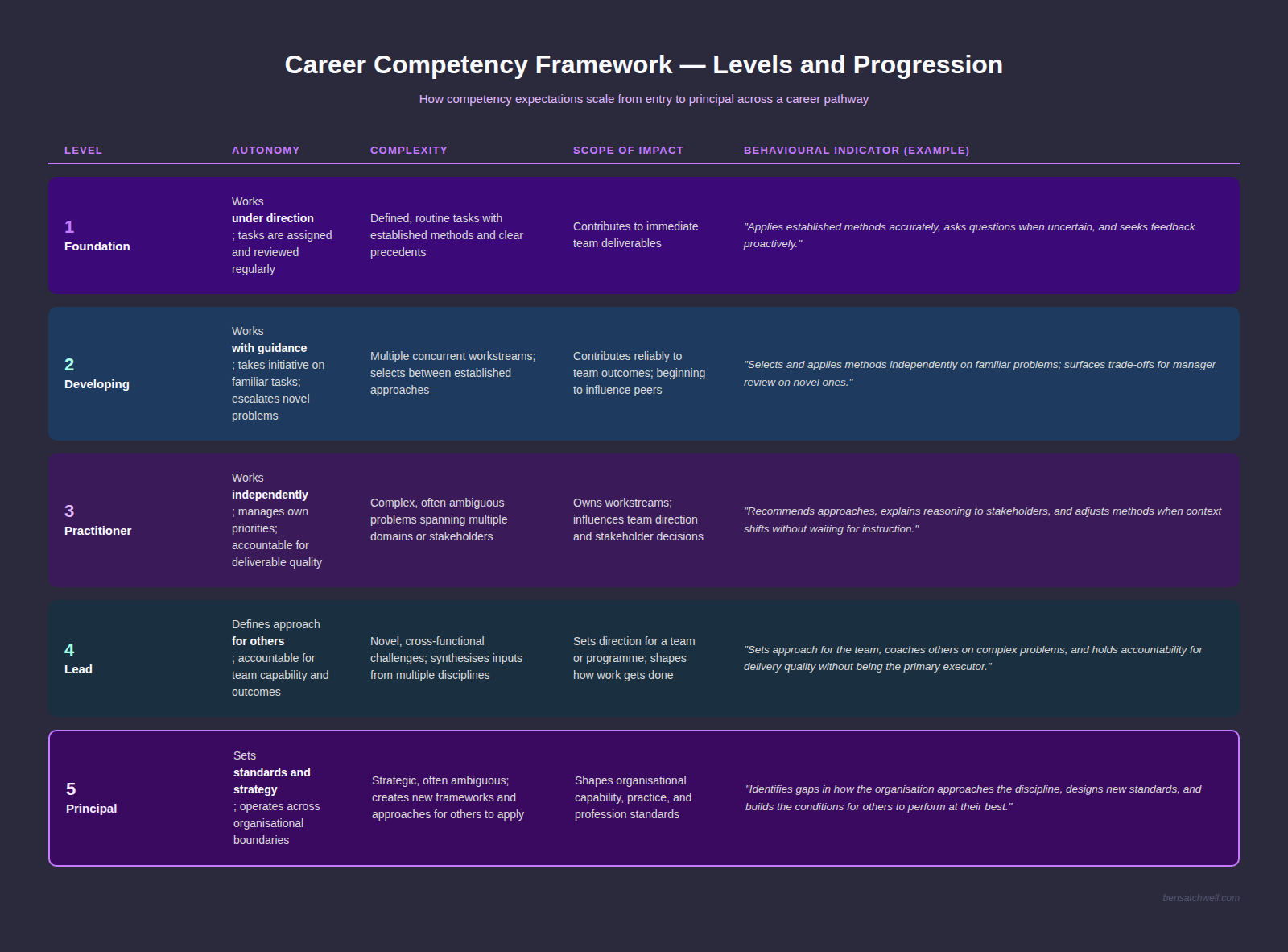
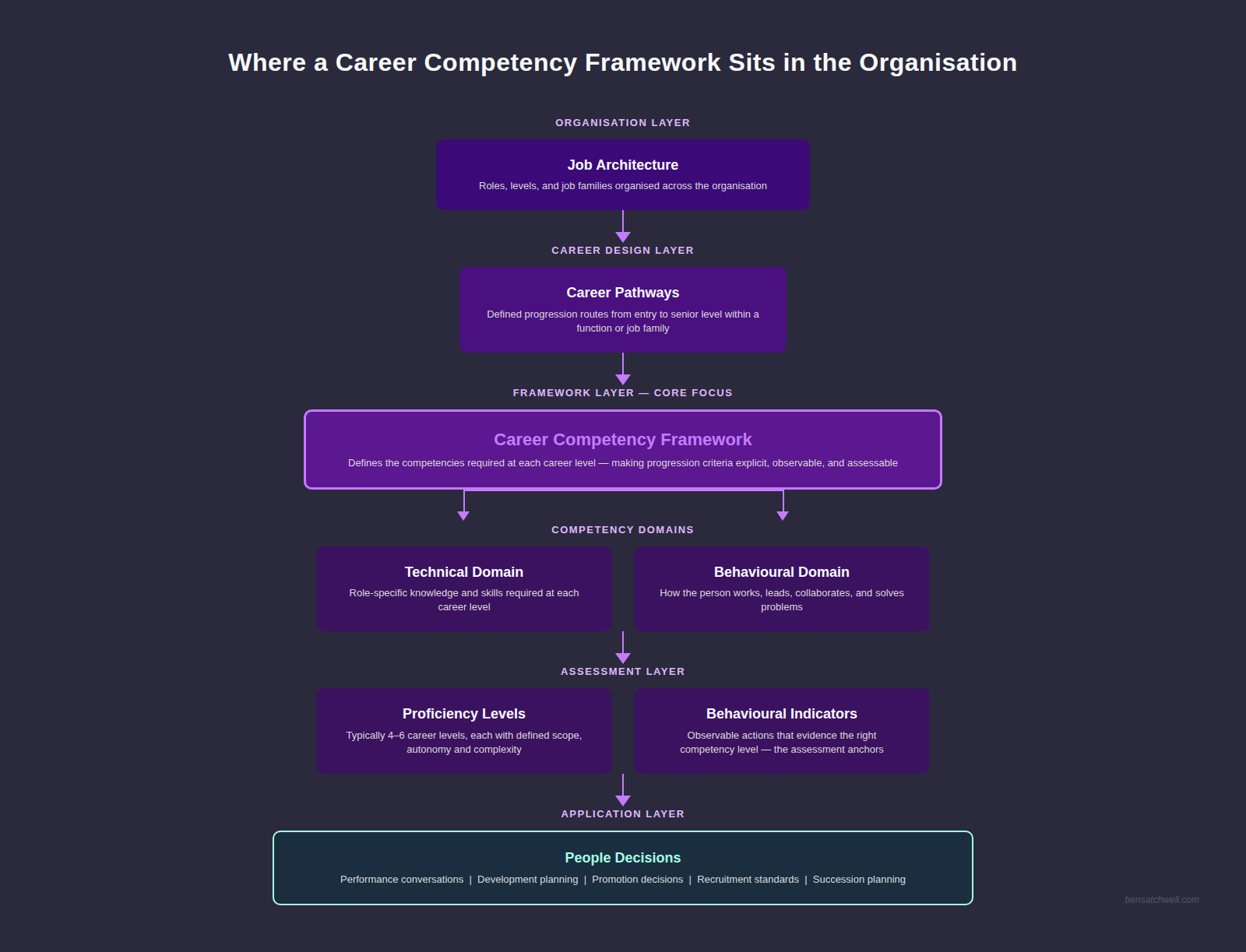
Once levels are defined, competencies are specified at each level. The behavioural domain typically covers areas like stakeholder influence, problem solving, communication, and leadership. The technical domain covers role-specific knowledge and practice. At each level, the competencies are described through behavioural indicators, which are observable statements that serve as the assessment anchors for performance reviews and promotion calibrations.
The framework sits inside a broader people system. Job architecture defines the levels. The career competency framework defines what each level requires. Performance and development conversations use the framework to assess current position and identify next steps.
What a Career Competency Framework Is Not
This is where terminology typically breaks down, so it is worth being precise.
A competency framework is an organisation-wide governing system that defines and standardises competencies so they can be applied consistently across all roles and levels. It is the source of truth that all role profiles draw from. A career competency framework is more specific: it takes those competencies and applies them progressively across a career pathway.
A competency profile is even more specific: the competencies and required levels for a single role, level, or function. A career competency framework spans multiple levels; a competency profile typically addresses one.
A skills framework, such as the SFIA framework for information technology roles, catalogues discrete skills and their proficiency levels across a discipline. SFIA has seven levels and maps skills to each. It is a reference taxonomy, not a career progression tool as such, though organisations do build career frameworks using it. The distinction is that a skills framework classifies capability; a career competency framework specifies what is required for progression.
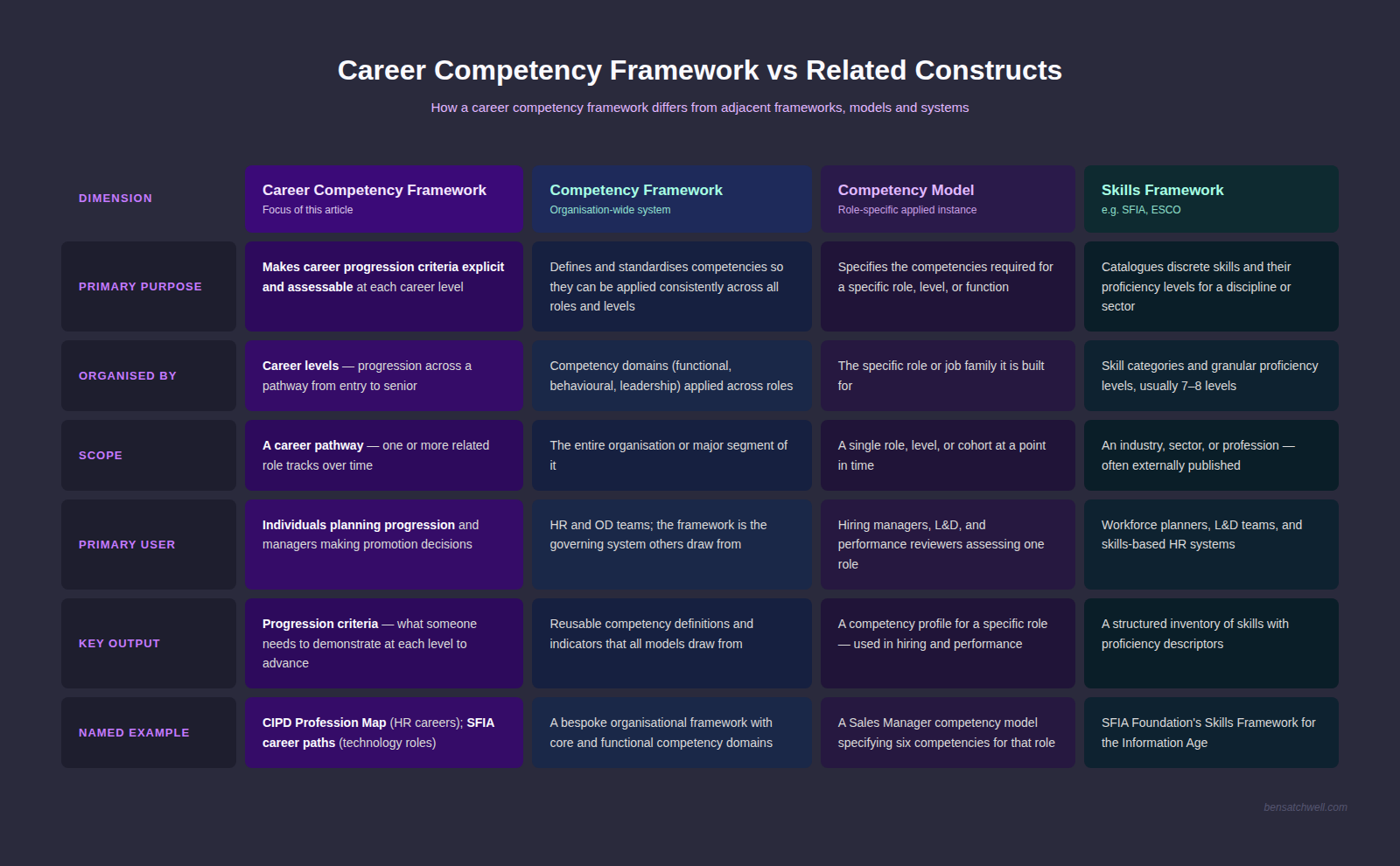
Named Examples of Career Competency Frameworks
Several well-known frameworks are built on this logic.
The CIPD Profession Map is a career competency framework for HR and people development professionals, published and maintained by the Chartered Institute of Personnel and Development. It defines eight core behaviours and specialist knowledge areas, mapped across four career levels from Foundation to Chartered Fellow. It is widely used in the UK as a reference for HR career design and professional development.
The SFIA framework is a skills framework for technology and digital roles, maintained by the SFIA Foundation. It defines over 120 skills across seven levels. While it is technically a skills framework, many organisations use SFIA career paths to construct career competency frameworks for their technology workforce, overlaying SFIA skill descriptors with behavioural expectations to create a full framework.
The PSC Capability Framework used in the NSW public sector defines capabilities across career levels in government roles, with behavioural indicators at each level used to assess suitability for roles and to guide development planning.
O*NET, maintained by the US Department of Labor, provides occupation-specific competency data that workforce designers sometimes draw on when building career frameworks for technical roles, though it functions more as a reference taxonomy than a career progression tool.
Common Failure Modes
Most career competency frameworks underdeliver because of design errors, not implementation errors.
The most common mistake is building levels without differentiating them. The framework lists competencies at each level but the descriptions are nearly identical. A Level 3 "develops clear communication" and a Level 4 "develops effective communication" tells no one anything. Levels need to differentiate by scope, autonomy, and complexity, not by adding adjectives.
The second failure is treating proficiency as a personality trait rather than a situational standard. Behavioural indicators should describe what someone does in their work context, not what kind of person they are. "Takes initiative" is not an indicator. "Identifies and progresses tasks without waiting for instruction when the approach is clear" is.
The third failure is overengineering. Frameworks with ten levels, five domains, and thirty competencies each become unusable in practice. A workable career competency framework has four to six levels, two to three domains, and five to eight competencies per domain, each with two to four indicators per level.
Finally, some frameworks fail to connect to any decision. If performance conversations, promotion calibrations, and development plans do not reference the framework explicitly, it becomes an artefact rather than a tool.
Trade-Offs and Constraints
A career competency framework is most useful when an organisation has a clear career pathway with a defined set of levels within a job family or function, enough roles at each level to make consistent assessment meaningful, and people decisions that genuinely benefit from shared criteria such as promotions and performance calibrations.
It is less well-suited to flat organisations where career levels are not defined, or to highly individualised expert roles where differentiated criteria are difficult to establish.
The design investment is real. A well-built framework requires engagement from practitioners and managers, validation across levels, and maintenance as roles evolve. Organisations often underestimate both the initial effort and the ongoing governance required to keep it current and connected to actual role expectations.
Frequently Asked Questions About Career Competency Frameworks
What is the difference between a career competency framework and a competency framework?
A competency framework is an organisation-wide system that defines and standardises competencies for use across all roles and levels. A career competency framework is more specific: it organises competencies by career level within a pathway, making progression criteria explicit and assessable at each stage. The competency framework is the governing system; the career competency framework is one of its most direct applications.
How many levels should a career competency framework have?
Four to six levels is the workable range for most organisations. Fewer than four makes it hard to describe meaningful progression. More than six creates complexity without proportionate benefit. The right number depends on the genuine span of career stages that exist in the role family, not on copying another organisation's structure or defaulting to a pay-grade count.
What is a behavioural indicator in a career competency framework?
A behavioural indicator is a written statement describing what good performance looks like at a specific career level for a specific competency. It must be observable, context-specific, and descriptive rather than evaluative. Indicators are the assessment anchors used in performance and promotion conversations, and they are what makes the difference between a framework that sounds good and one that actually works in calibration.
How is a career competency framework used in practice?
It is used in three main contexts: performance conversations, where managers and individuals assess current performance against level criteria; development planning, where gaps are identified and goals are set for the next level; and promotion decisions, where calibration panels assess whether someone is consistently demonstrating the criteria for the level they are being considered for.
Can a career competency framework be used for recruitment?
Yes, though with care. The framework's level criteria can inform job descriptions and interview questions, helping assess whether a candidate is likely to perform at the target level. The risk is that frameworks built for internal progression may not map cleanly onto external candidate experience, so some translation is usually needed for hiring contexts.
Does every organisation need a career competency framework?
Not every organisation and not every function. Where career levels are clear, decisions are consequential, and people want to understand what advancement requires, a career competency framework provides genuine value. Where roles are highly individualised or the career path is not defined, the framework may not have enough to anchor to, and a simpler approach to role design and assessment may serve better.