
Many organisations that tell me they have a competency framework actually have something smaller: a career competency model. That is not a problem. A career competency model is a specific and useful thing, and it is often exactly what the work needs. The error comes from mixing it up with a governing framework, or applying framework logic where only one career path needs guidance. This article looks at the content of a career profile: what it holds at each stage, how it is used and how it differs from a career ladder.
What Is a Career Competency Model?
A career competency model is the set of competencies and proficiency levels expected at each career stage of one job family or progression track. I call it a career competency profile. It is not an organisation-wide system. It governs one path. A competency is the integration of skills, knowledge, judgement and behaviour applied effectively in the context of a role, so each entry in the profile reads: this competency, at this level, at this career stage. For the full definition, see my guide to competency.
The profile draws every definition from the organisation's competency framework, which keeps language consistent across career paths and lets you compare one function with another. Individual role profiles then draw on the stages defined for the path.

Every definition traces back to the framework, so language stays consistent across paths.
A note on terminology. A competency framework is also called a competency model, especially in the United States. I use competency profile for the competencies and required levels for one role, and competency matrix for the grid of required against current proficiency. Usage varies by region, and I explain the differences in this competency model definition.
Why Career Paths Need Their Own Profile
A framework might define thirty competencies across six domains and eight levels. That scope suits an organisation-wide reference, but it tells a junior project manager eighteen months into a career very little about what to develop next. A career profile narrows the scope to one path. It names which competencies apply, at which level and at which career stage. That specificity supports individual development plans, structured performance conversations, learning priorities and promotion decisions, all of which need focused guidance more than broad governance.
How a Career Profile Works
A profile typically covers three to five named career stages within one job family or track, such as entry analyst, analyst, senior analyst and principal analyst. Each stage has a short descriptor and a set of competency expectations. For each competency at each stage, the profile gives the required level and the behavioural indicators that confirm someone is performing there. That is what separates a working profile from a competency list attached to job levels. The levels and indicators make consistent assessment possible.

One competency, four stages of the same career path.
It is used in three main ways.
- Development planning. People review expectations at their current and next stage, find gaps and direct their learning.
- Career conversations. Managers and individuals use the profile as a shared reference and replace vague talk of capability with observable evidence.
- Promotion and progression. It provides an agreed reference point in place of subjective managerial judgement.
What a Career Profile Is Not
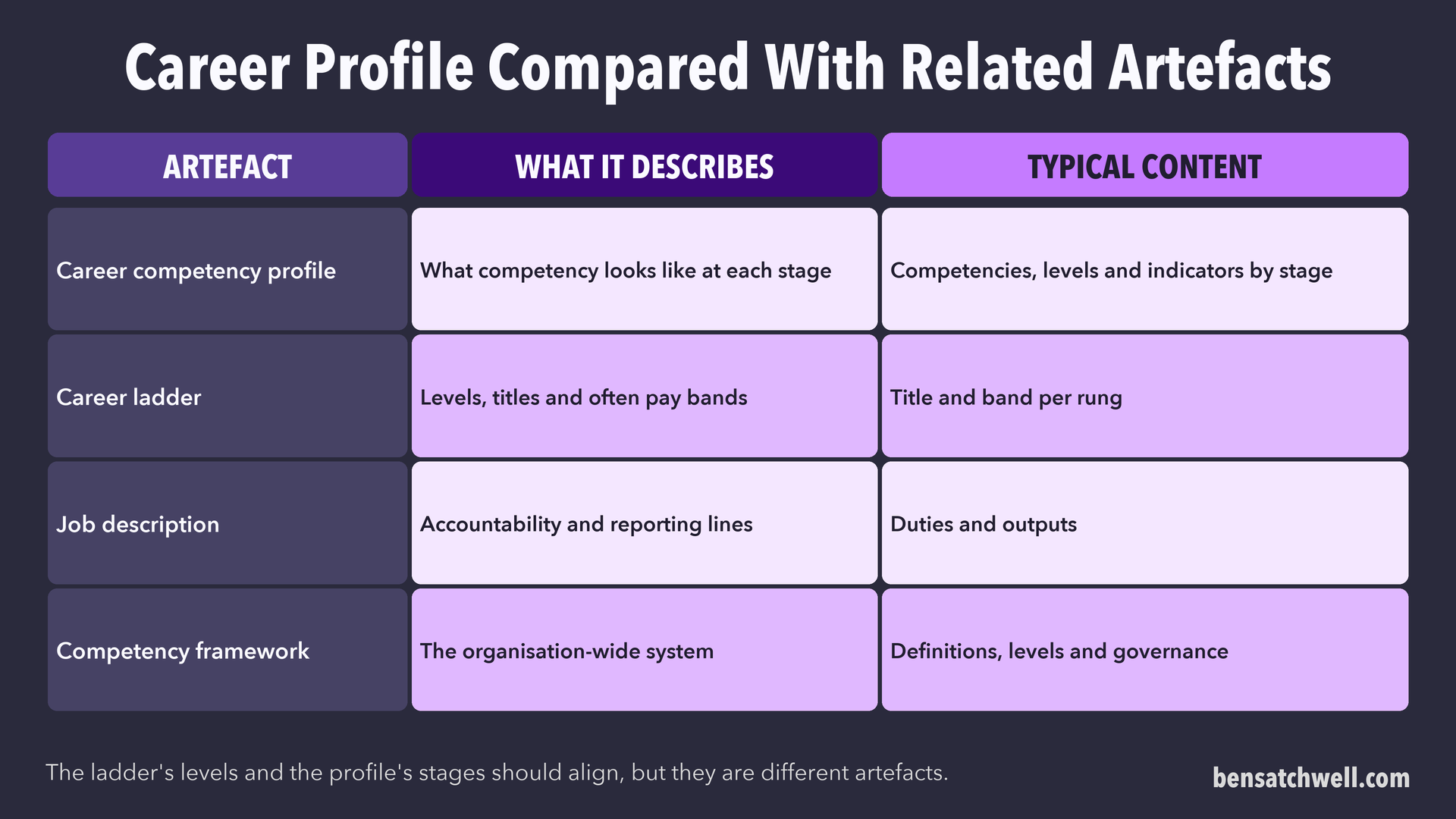
The ladder's levels and the profile's stages should align, but they are different artefacts.
- Not the framework. Organisations that build one profile, treat it as the governing structure and then try to extend it to other job families cannot apply consistent standards. The profile governs one path and the framework governs the organisation.
- Not a job description. A job description defines accountability, outputs and reporting lines. The profile defines the competencies and behaviours needed to fulfil them at a level.
- Not a career ladder. The ladder describes levels, titles and often pay bands. The profile describes what competence looks like at each of those levels.
Published Standards That Work as Examples
The SFIA framework, maintained by the SFIA Foundation, organises digital and technology skills across seven levels of increasing autonomy, influence and complexity. It is built to be applied at the role or career-path level, which makes it a common reference for technology career profiles. My guide to the SFIA framework explains the structure. The CIPD Profession Map applies similar logic to HR, and its competency factsheet sets out the CIPD's approach to defining competencies. In government, the Australian Public Service Commission's Integrated Leadership System defines capabilities for public service leaders at each classification, with behavioural indicators aligned to career stage. For a role-specific build, see my product manager competency framework.
Where Career Profiles Fail
- Cut off from the framework. Each team builds its own definitions and descriptors, and the organisation ends up with a pile of documents, not a system. Comparing talent or moving people between paths becomes impossible.
- Shallow levels. A profile that lists competencies against stages without saying what each looks like at each level is a list with stage labels.
- Scope creep. Profiles work because they are specific. Merging technical, leadership and professional competencies for several job families into one profile makes it too broad to guide any of them.
Trade-Offs and Constraints
A working profile takes investment. Selecting competencies, calibrating levels and writing indicators is time-intensive, and the result needs review as tools, structures and ways of working change. Specificity is also a constraint. A profile built for a product management path cannot be lifted onto a data engineering path without significant rework, so organisations needing coverage across many functions need several profiles or a framework from which to derive them efficiently. Finally, governance matters. Decide who owns the profile, how often it is reviewed and who approves changes, because a profile that described a role accurately three years ago may misrepresent it today.
FAQ
What is the difference between a career competency model and a competency framework?
There is no difference in structure. Competency model is the usual US name for the organisation-wide system and competency framework is more common in the UK and Australia. The competencies and levels for one career path are a competency profile.
How many career stages should it cover?
Three to five. Fewer misses meaningful distinctions. More creates distinctions too fine to assess and slows career conversations.
How many competencies should it include?
Eight to twelve is a practical range for most paths. Below six it is too sparse to guide development, and above fifteen it is hard to use.
How does it support promotion decisions?
It states the competencies and levels expected at the next stage, so the assessment asks whether the person already demonstrates that behaviour. That replaces subjective judgement with evidence against one reference.
Can it work without a broader framework?
Yes, many organisations run effective standalone profiles. The limit is scale. Without a framework, language and standards drift as more profiles are built.