

An HR business partner job description records what the role is accountable for, not every task the person touches in a week. Most are written as a list of HR activities, which hides the thing that makes the role different: it exists to help business leaders make better people decisions. This page sets out what to put in one, using the structure from my guide to the job description and the standard in the HR business partner competency framework.
I use the US term job description here. In Australia the same document is usually called a position description, and everything below applies unchanged. The job description vs position description page covers the wording differences.
What is an HR business partner job description?
An HR business partner job description is a short written record of why the role exists, the outcomes it is accountable for with the business units it supports, and the essential requirements of doing it well.
The CIPD business partnering factsheet describes the essence of business partnering as the people function working effectively alongside other parts of the organisation to deliver people solutions. It adds that business partners work closely with leaders to help build organisational and people capabilities, and that the original model was conceived by Dave Ulrich in the late 1990s.
That points to outcomes, not activities. Activities change with every system and leader. Outcomes mostly do not.
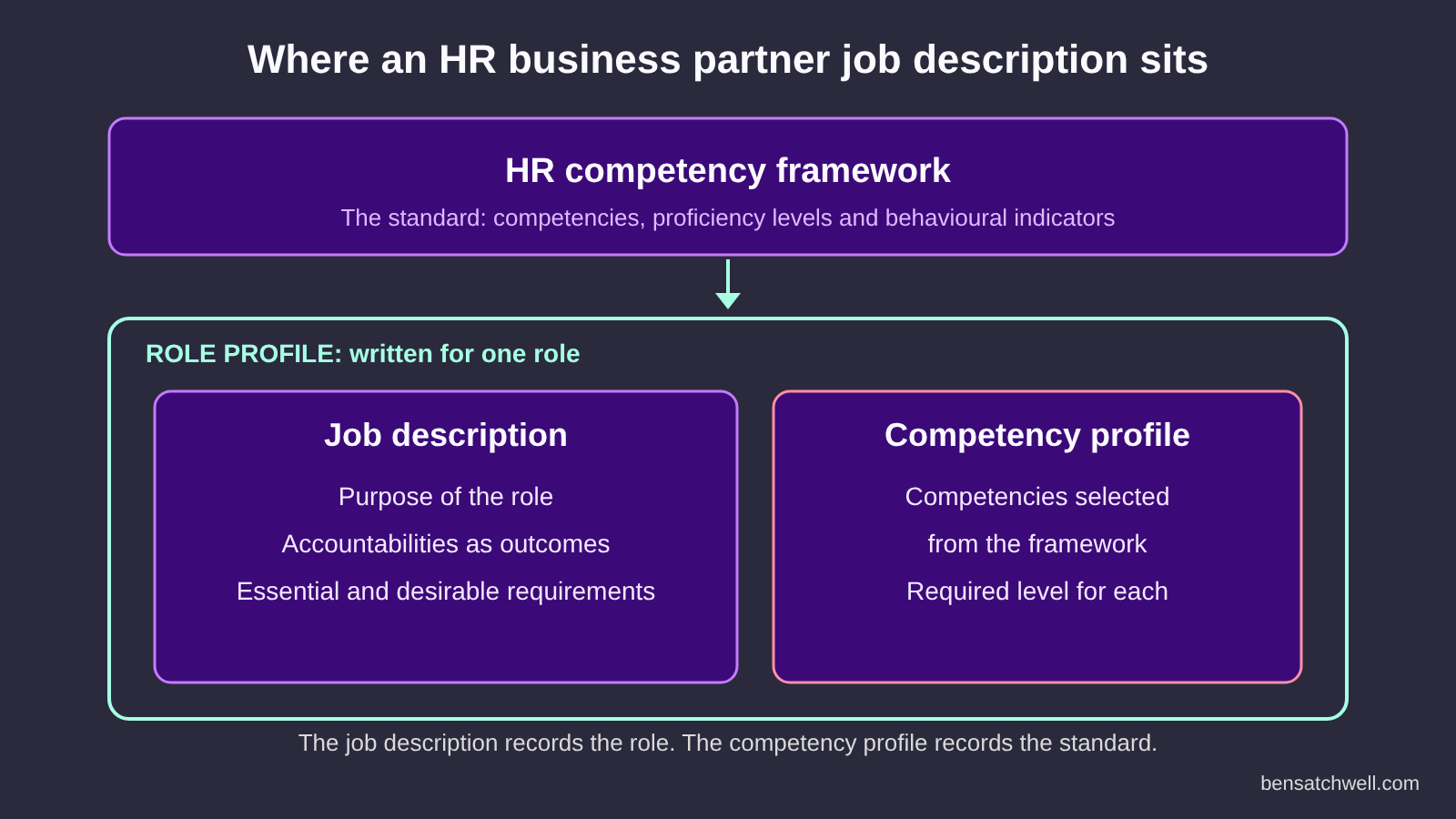
A note on terminology. A competency framework is also called a competency model, especially in the United States. I use competency profile for the competencies and required levels for one role, and competency matrix for the grid of required against current proficiency. Usage varies by region, and I explain the differences in this competency model definition.
What is the purpose of an HR business partner role?
The purpose statement is one or two sentences that say why the role exists. The NSW Government describes a role description as a short summary of a job that explains why the role exists, what outcomes it delivers, and where and how the role works. Its guidance is to focus on outcomes, not tasks or processes.
A workable purpose for an HR business partner reads like this:
To advise the leaders of an assigned business unit on workforce decisions, and to connect the unit's plans to the organisation's people practices, so that people risks are managed and the unit can deliver its objectives.
What accountabilities should an HR business partner job description include?
Five to seven accountabilities is enough. Each one is written as an outcome that someone could check, not as a duty. The table shows how common HR business partner tasks convert.
| Task people usually list | Accountability written as an outcome |
|---|---|
| Attends leadership team meetings | Unit leaders have timely, evidence-based people advice when they make decisions about structure, capability and workforce cost |
| Supports restructures and change | Organisational changes in the unit are planned, consulted on and delivered with the people risks identified and managed |
| Handles complex employee relations cases | Complex cases are diagnosed early, handled fairly and resolved or escalated within agreed timeframes |
| Produces workforce reports | The unit's leaders use workforce data to decide where to hire, develop or redeploy |
The how to write a job description page walks through the steps and the review checklist for this part.
What essential requirements should it list?
Keep the essential list short and separate from the desirable list.
Essential: working knowledge of employment law and HR policy in the jurisdiction, experience advising senior stakeholders on people matters, and the ability to read workforce data and explain what it means for a business decision.
Desirable: experience in the unit's industry or function, which can be learned in the first months, and a tertiary qualification in HR, business or a related field. List the qualification as essential only if the work cannot be done without it.
What competency profile fits an HR business partner?
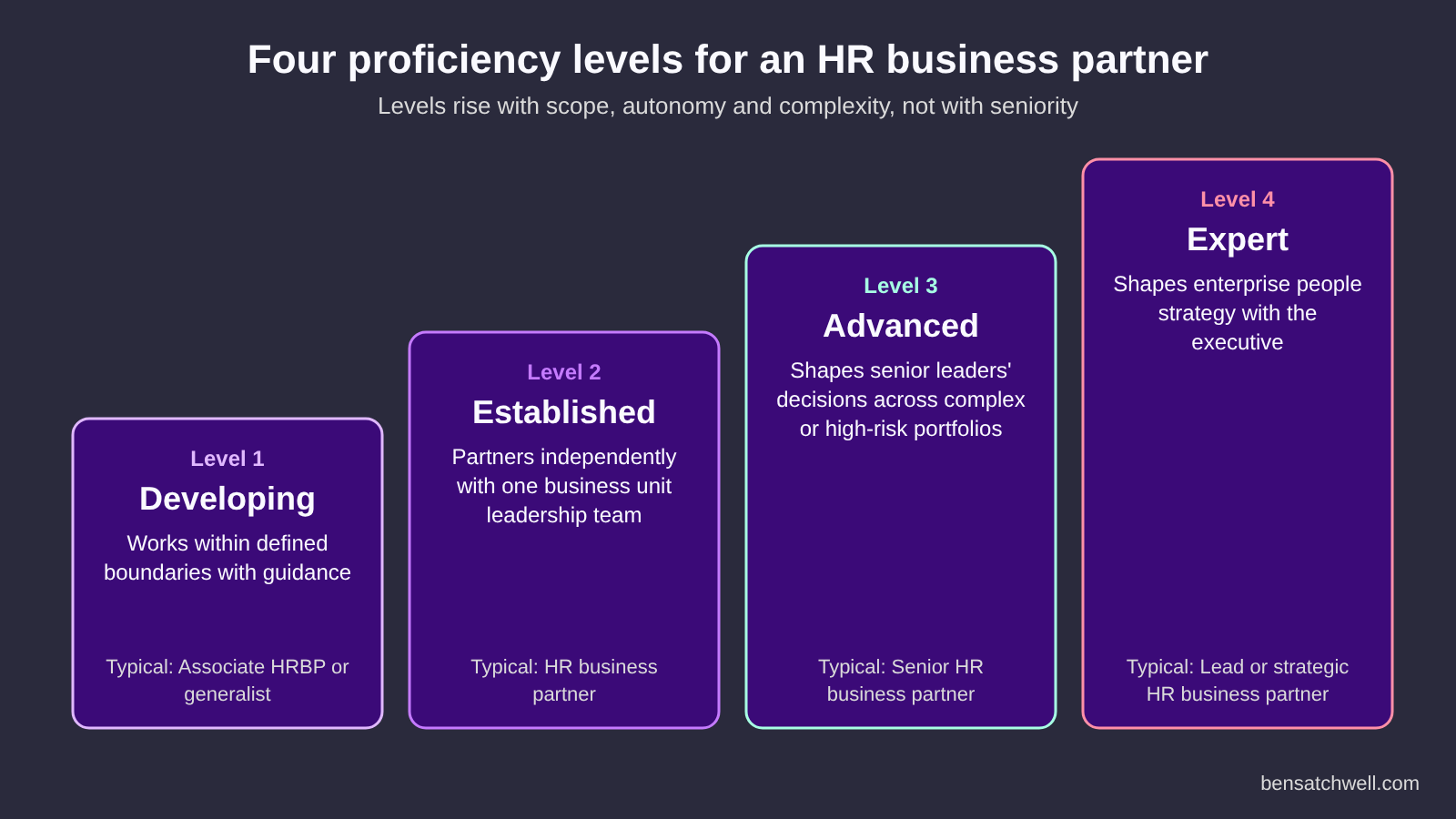
The job description says what the role is accountable for. The competency profile says what standard the role needs, and it selects from the organisation's framework rather than inventing new competencies. Written together they form a role profile. The competencies below come from the eight in the HR business partner framework, and the levels are illustrative. Set them against your own framework.
| Competency | Required level | What it looks like in this role |
|---|---|---|
| Business acumen | Level 2 (Established) | Frames recommendations in business terms such as productivity, service or risk, and quantifies the cost of inaction |
| Consulting and influencing | Level 2 (Established) | Diagnoses the real problem behind a request and persuades leaders to act without line authority |
| Data and people analytics | Level 2 (Established) | Uses workforce data to test a leader's assumptions and shape the advice given |
| Ethical practice and professional courage | Level 3 (Advanced) | Raises uncomfortable issues with senior leaders and holds the line on fairness and legal obligations |
The CIPD Profession Map follows the same logic. It sets out the purpose, values, core knowledge, behaviours and specialist knowledge for the people profession, and it applies at any career level or specialism.
What an HR business partner job description is not
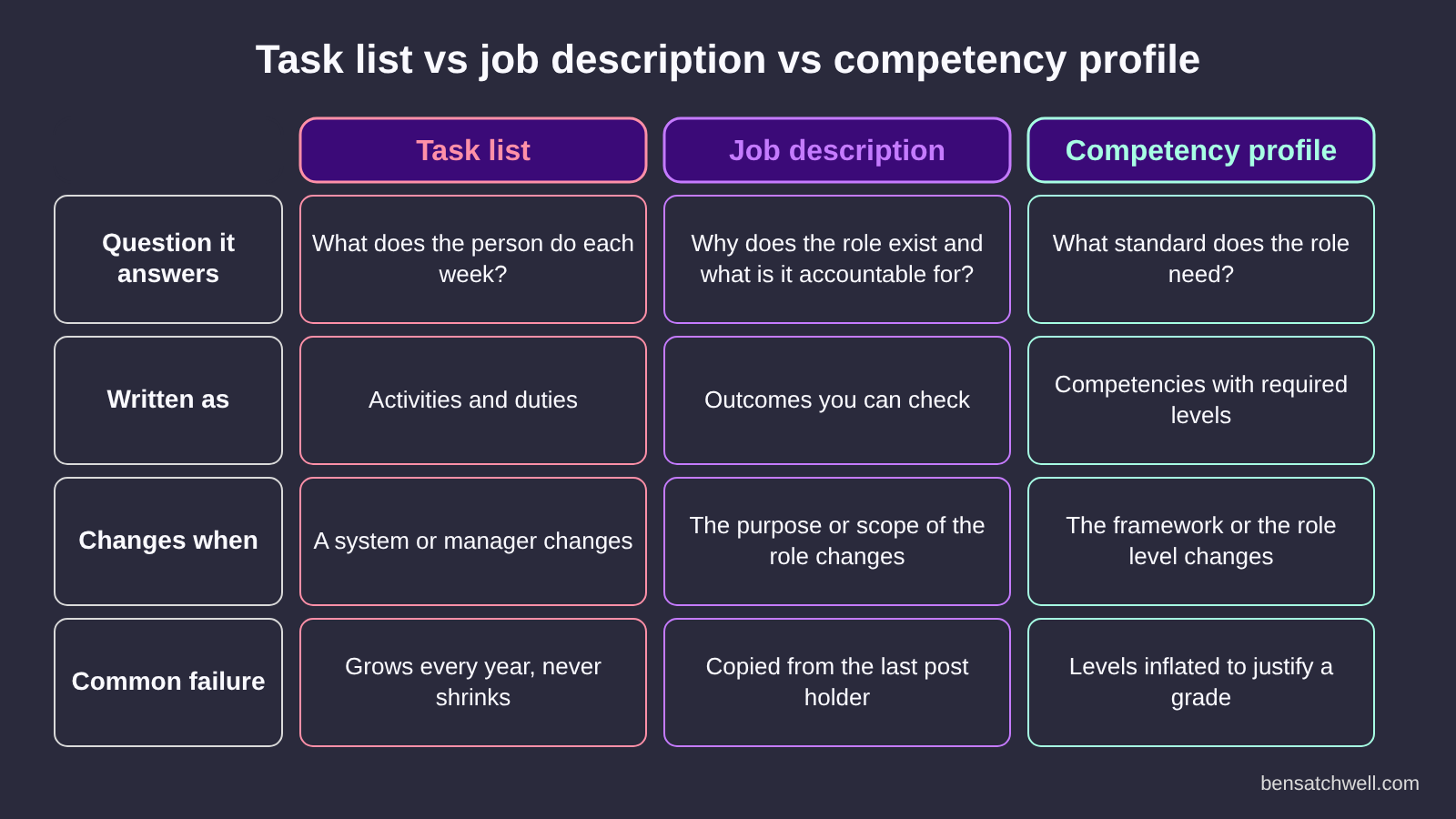
It is not a task list, a job advertisement, a performance review or a competency profile. Each of those answers a different question, and mixing them is the main reason these documents become unusable.
Where do HR business partner job descriptions go wrong?
- Generalist duties relabelled. The generalist task list is copied across and the title changed, so the advisory outcomes that define the role never appear. The HR generalist job description shows the contrast.
- Process ownership. Running recruitment, payroll queries and record keeping are written in as accountabilities, which turns a partner into an administrator.
- No scope. The document does not say which business unit, how many employees or what decisions the role advises on, so levels cannot be set.
- Levels set by seniority. Required levels are inflated to justify a grade, instead of being set by scope, autonomy and complexity.
Starting from the job description template avoids the last two, and the job description examples show the same structure applied to other roles.
What are the trade-offs when writing one?
Outcome wording takes longer to write than a task list and is harder to get agreement on. It pays back at review time, because outcomes survive a change of systems, leaders and legislation.
A single document for every HR business partner is simple to maintain but hides differences in portfolio. Where partners work at different levels, write one document per level with the same competencies at different required levels.
FAQ
What is the difference between an HR business partner and an HR generalist job description?
An HR generalist job description covers a broad range of HR administration and advice at a working level. An HR business partner job description is accountable for strategic advice to a business unit, so it uses outcomes about decisions and risk, and it usually asks for higher required levels in influencing, business acumen and analytics.
How long should an HR business partner job description be?
One to two pages. A purpose statement, five to seven accountabilities, a short essential and desirable list, and a pointer to the competency profile is enough.
What qualifications does an HR business partner need?
Many hold a tertiary qualification in HR or business, but it is not universal. Only list a qualification as essential if the work cannot be done without it, and describe the knowledge and experience the role needs instead.
Is an HR business partner job description the same as a position description?
Yes. Position description is the common term in Australia and job description is the common term in the United States. The content and structure are the same.
How often should an HR business partner job description be reviewed?
Review it when the business unit, the reporting structure or the scope of advice changes, and at least once a year.