
Most HR competency frameworks in circulation either borrow loosely from SHRM or CIPD without saying so, or collapse into a generic list of strategic thinking and communication skills that could describe any professional. The 5 competency model for HR professionals takes a specific position: whatever their specialisation, HR practitioners need five distinct domains of competency to do the work well. This article sets out those domains, how they map to published standards and where the approach has limits. For the wider picture of what HR competencies cover, see my guide to human resources competencies.
What Is the 5 Competency Model for HR Professionals?
It is a competency framework for the HR function that organises practitioner development across five domains: business acumen, HR expertise, stakeholder influence, ethical practice, and data and analytics. Each domain carries behavioural indicators written across four proficiency levels: developing, applying, leading and shaping. For a given HR role, the selection of domains and required levels is a competency profile.
It is not issued by a professional body. It is my synthesis, drawing on the SHRM Body of Applied Skills and Knowledge, the CIPD Profession Map, Dave Ulrich's HR competency research and the AHRI Model of Excellence. When I lay those sources side by side, five areas of practice recur. That recurrence is a useful signal, but it is a judgement on my part, not proof, and I treat the domains as a working structure to test against your own context.
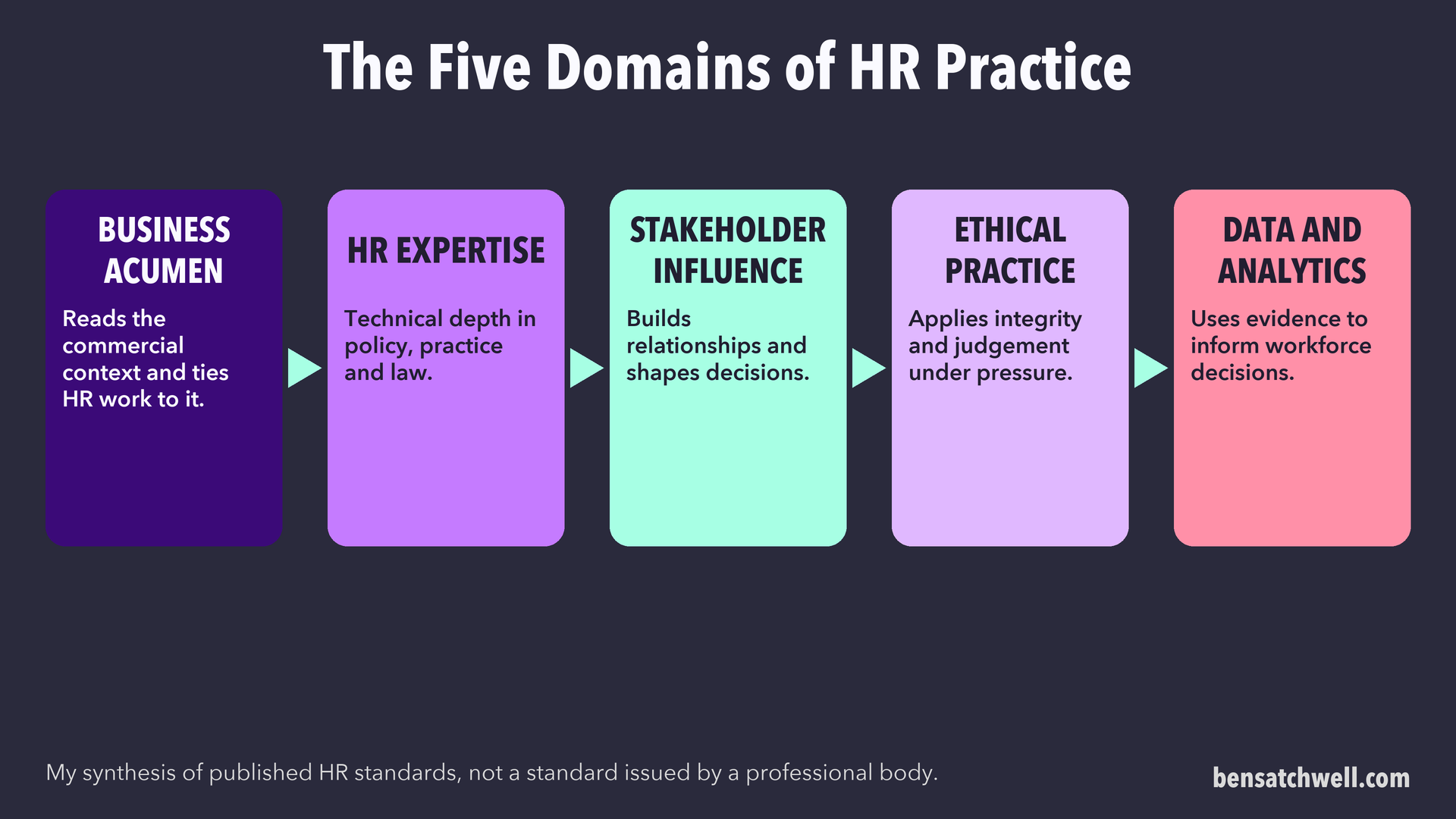
My synthesis of published HR standards, not a standard issued by a professional body.
A note on terminology. A competency framework is also called a competency model, especially in the United States. I use competency profile for the competencies and required levels for one role, and competency matrix for the grid of required against current proficiency. Usage varies by region, and I explain the differences in this competency model definition.
Why Five Domains
The HR profession has a credibility problem and most practitioners know it. Business leaders question whether HR understands the commercial environment well enough to be a strategic partner, while HR professionals with deep technical expertise often struggle to influence executive decisions. A cross-model review of HR competency research is one place to see how widely the profession's models overlap. These gaps are structural, not personal. The profession lacks a shared vocabulary for what good practice looks like at different career stages.
The expectation that HR will use data to inform workforce decisions has also outpaced the profession's analytics capability. That is why data and analytics sits as its own domain here, instead of being folded into critical thinking or HR expertise.
How the Five Domains Are Used
Organisations use the framework in three ways.
- Role profiling. Define which domains matter most at each step of the HR career ladder and what level each requires.
- Capability assessment. Rate practitioners against the levels to find strengths and gaps. The grid of required against current level is a competency matrix.
- Development planning. Use the gaps to build structured learning and experience plans.
A business partner role, for instance, draws most heavily on stakeholder influence and business acumen at the applying and leading levels, because the job is to translate HR thinking into commercial outcomes. Setting that out in levels makes the expectation explicit instead of leaving it to inference. The role-specific build is covered in my guide to the HRBP competency model.

Levels reflect scope, autonomy, complexity and impact, not job title.
The levels map roughly to career stages from coordinator through advisor and business partner to head of people, but proficiency is not determined by title alone.
What the Five-Domain Framework Is Not
- Not a job description. It defines the competencies needed to do HR work well, not what a given role is accountable for.
- Not a learning curriculum. The domains describe good performance. They do not say how to develop it.
- Not a framework built for one organisation. It is a cross-sector synthesis. Most organisations should adapt it before applying it. For the organisation-specific build, see HR competency models.
How the Domains Map to Published Standards
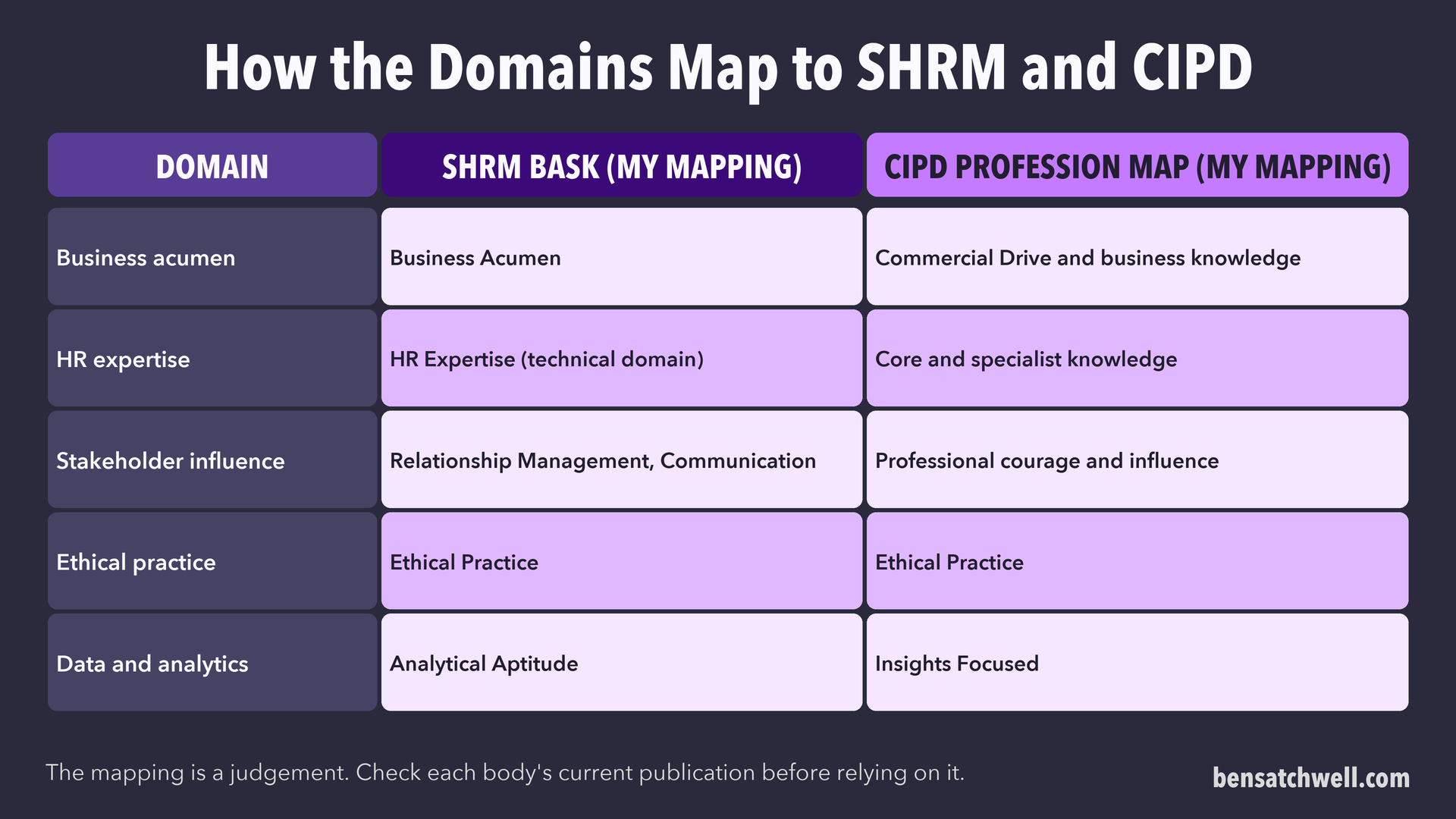
The mapping is a judgement. Check each body's current publication before relying on it.
The SHRM Body of Applied Skills and Knowledge sets out eight behavioural competencies and a technical knowledge domain in its 2026 edition. In my mapping, SHRM's Business Acumen sits with business acumen, Ethical Practice with ethical practice, Relationship Management and Communication with stakeholder influence and Analytical Aptitude with data and analytics. The CIPD Profession Map structures development across core behaviours, core knowledge and specialist knowledge. Its Commercial Drive behaviour sits with business acumen, Ethical Practice with ethical practice, Professional Courage and Influence with stakeholder influence and Insights Focused with data and analytics. My guide to the SHRM competency model gives more on that source.
What Goes Wrong
- Used as a communication tool, not a development tool. It is launched, distributed and filed. Nobody assesses against it or connects it to career conversations or promotion decisions.
- Cut to fewer domains. Five can feel like too many to manage, so organisations reduce to three or four. Each domain does distinct work. Ethical practice is not a subset of HR expertise, and analytics is not the same as critical thinking. Merging them removes the detail that makes diagnosis possible.
- Levels ignored. Business acumen without a description of what it looks like for a coordinator and for a head of people is a label, not a standard.
Trade-Offs and Constraints
The five-domain structure suits organisations where HR is a distinct function and career development is taken seriously. In very small organisations or highly specialised functions it can add more complexity than it resolves, and a narrower role-specific profile may serve better. It also needs an owner and a review cycle, particularly around data and analytics, which changes quickly. Finally, a cross-sector synthesis is less precise than one built for a sector. In financial services, government or health you will likely weight the domains differently and add sector-specific indicators. The structure gives you a start, and your own context gives it precision.
FAQ
What are the five domains?
Business acumen, HR expertise, stakeholder influence, ethical practice, and data and analytics. Each has behavioural indicators across four proficiency levels.
How does it differ from the SHRM competency model?
The 2026 SHRM Body of Applied Skills and Knowledge has eight behavioural competencies and a technical domain. The five-domain framework synthesises SHRM, CIPD and other sources into five areas, and SHRM's competencies map into them in my reading.
Can it be used for HR performance appraisal?
Yes. The levels and indicators give a standard to assess against, though most organisations adapt the indicators to their context first.
Is it for generalists or specialists?
Both. Generalists use all five domains. Specialists use the most relevant ones, with a baseline in all five.
How many proficiency levels does it use?
Four: developing, applying, leading and shaping.
Is a competency model the same as a competency framework?
There is no difference in structure. Competency model is the usual US name and competency framework is more common in the UK and Australia. The competencies and levels for one HR role are a competency profile.