


People assume a CFA competency framework works like any other professional competency framework: a set of role-specific behaviours an employer writes down and rates staff against. It doesn't. The CFA competency framework is CFA Institute's own structure for defining what investment professionals need to know and do, built through a global research process called practice analysis, and it operates at the level of a profession rather than a single organisation. Confusing the two leads firms to either over-rely on the charter as a proxy for internal competency, or under-use it when it would genuinely strengthen a technical competency domain.
What Is a CFA Competency Framework?
A competency framework is an organisation-wide system that defines, groups and standardises competencies so they can be applied consistently across roles and levels. CFA Institute's version applies that logic to an entire profession rather than a single employer.
The CFA competency framework is the structure CFA Institute uses to define the knowledge, skills and abilities investment professionals need, organised into competency areas and mapped against job role families through an ongoing practice analysis process.
It is built on two connected outputs. The Candidate Body of Knowledge (CBOK) defines the core knowledge, skills and abilities a recently qualified charterholder is expected to demonstrate in a generalist context. The Global Body of Investment Knowledge (GBIK) is the broader outline of knowledge relevant across a full investment career, from analyst through to portfolio manager and beyond. CFA Institute's own career skills framework research extends this further, mapping specific competencies against distinct investment job families such as credit analyst, quantitative analyst and economist.
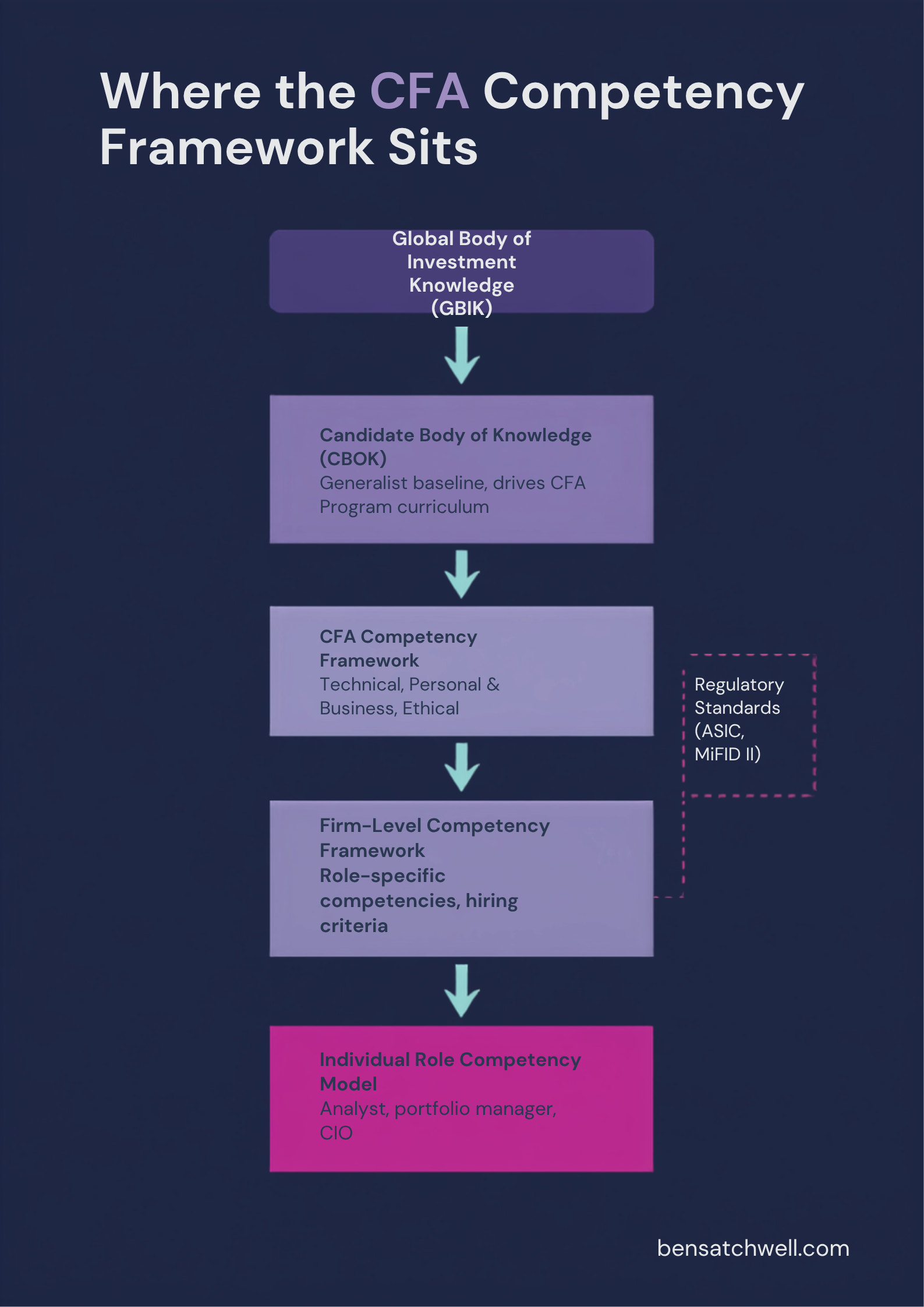
Why the CFA Competency Framework Exists
Any competency framework exists to solve a specific problem: without one, the definition of "good performance" drifts, and decisions about hiring, development and assessment become inconsistent. For CFA Institute the stakes are structural. The CFA Program curriculum and exams have to stay current with what practising investment professionals actually do, not what they did a decade ago, or the charter loses credibility as a signal of competence.
Practice analysis is the mechanism that keeps the framework honest. It is a recurring cycle of interviews and surveys with practitioners, regulators, university faculty and policymakers, run to identify where the required knowledge, skills and abilities have shifted. Recent cycles have pushed harder on ESG integration, quantitative methods and financial statement analysis, and practitioner feedback has consistently pointed to the growing weight of personal and business competencies alongside technical ones.
How the CFA Competency Framework Works in Practice
Three Competency Areas
The framework is organised into three broad competency areas: Technical, Personal and Business, and Ethical. This is a direct parallel to how a technical competency framework separates role-specific expertise from behavioural and professional expectations, except CFA Institute applies it across an entire industry rather than one employer's role library. Technical competencies cover things like financial statement analysis, valuation and portfolio construction. Personal and business competencies cover communication, client management and business judgement. Ethical competencies sit apart deliberately, reflecting CFA Institute's position that ethics is not a soft add-on to technical skill but a distinct, non-negotiable standard.
How Knowledge, Skills and Abilities Are Defined
Within this structure, CFA Institute is precise about what each term means: knowledge is the body of information applied directly to a function, skills are observable, learned acts specific to a role, and abilities are the underlying attitudes and capacities that support behaviour. That distinction matters. A charterholder can hold deep technical knowledge from the curriculum without having yet demonstrated the applied skill an employer needs in a live mandate, which is exactly where firm-level assessment still has work to do.
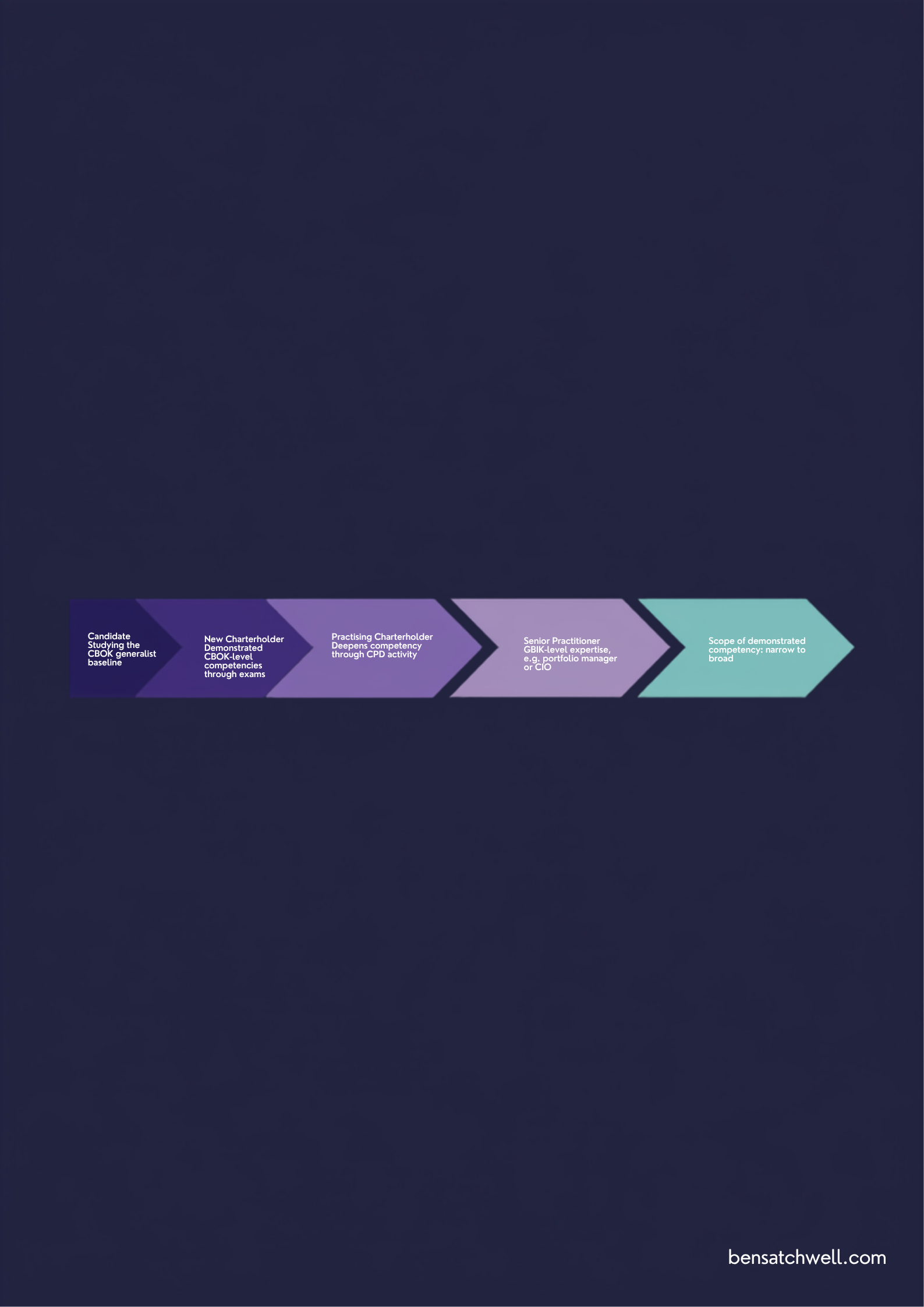
The CPD Competency Framework for Practising Charterholders
Once someone holds the charter, CFA Institute maintains a separate but related competency structure for continuing professional development, used to guide what practising charterholders should keep building across their careers. It is deliberately less prescriptive than the CBOK, because practising professionals specialise in different directions, but it still anchors development activity back to the same three competency areas.
What a CFA Competency Framework Is Not
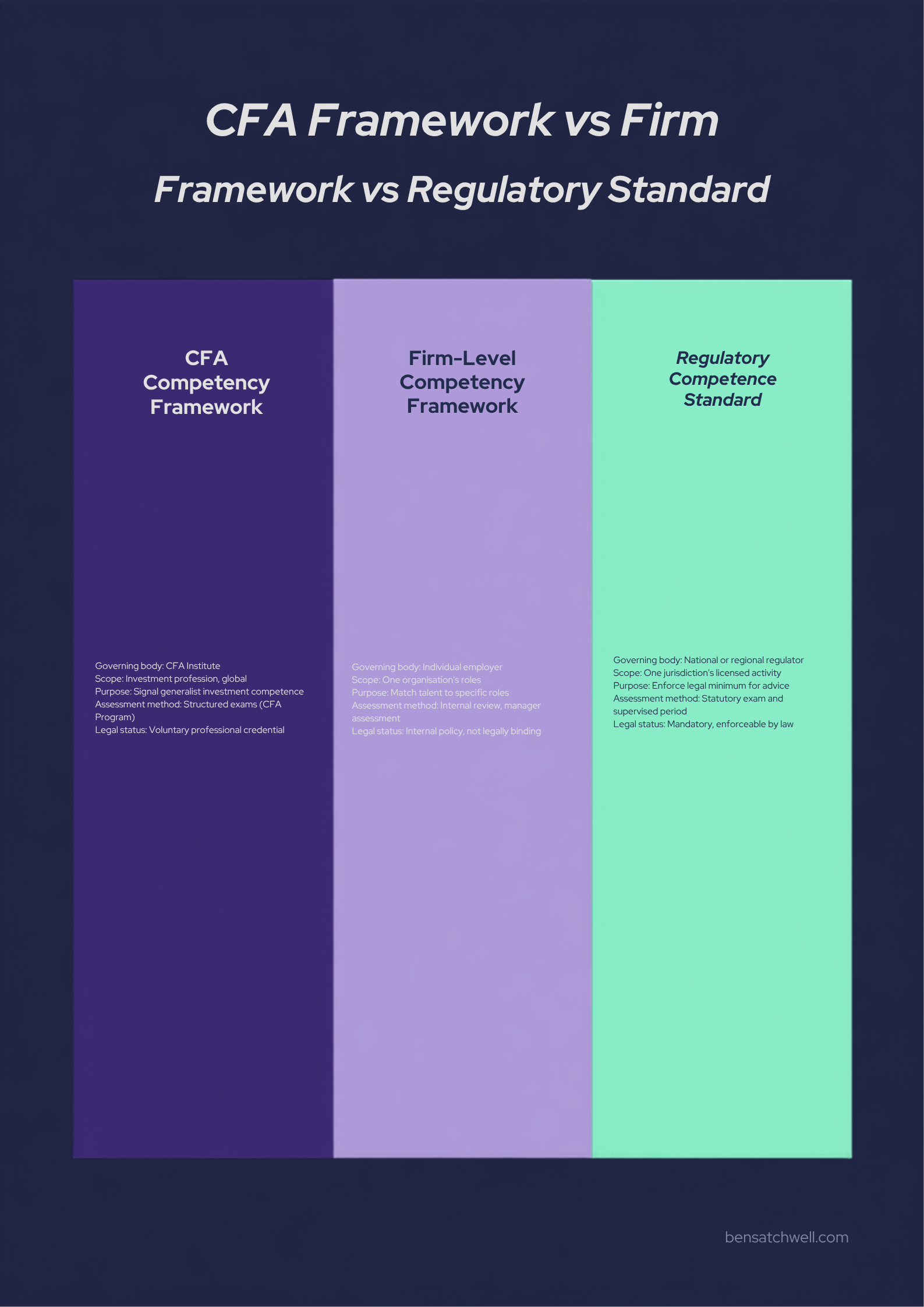
It is not an internal HR competency framework. A bank or asset manager still needs its own framework, built the way an accounting competency framework or any other function-specific framework is built, to cover roles the CFA curriculum was never designed to address, such as operations, technology or leadership pathways.
It is not a statutory qualification standard. Passing the CFA Program demonstrates competence against CFA Institute's own criteria, not automatic compliance with a jurisdiction's legal requirements for giving financial advice. Regulators run separate, legally binding processes for that. The European Securities and Markets Authority's guidelines for the assessment of knowledge and competence under MiFID II set out what firms must verify in staff giving investment advice, and holding a charter can support that assessment without replacing it. Australia's regime works the same way: ASIC's professional standards for financial advisers require a specific approved qualification, a supervised professional year and a statutory exam, none of which the CFA charter substitutes for on its own, even though CFA Program study can count toward the education requirement.
It is also not a skills taxonomy. It does not map the granular relationships between individual skills, roles and tasks the way a skills ontology would. It operates at the competency level: integrated, applied, and tied to demonstrated performance rather than a flat inventory of discrete skills.
Named Standards It Sits Alongside
The comparison practitioners reach for most often is SFIA, but the two solve different problems. SFIA defines and levels skills for the information and digital technology profession across any industry. The CFA competency framework does the equivalent job for investment management specifically, closer in shape to how CIPD structures the HR profession map for the people profession. Where SFIA and CIPD are open, published standards a firm can license and apply directly, the CFA framework's competency detail is mostly internal to the CFA Program, expressed publicly through the CBOK outline, exam topic weights and the career skills framework research rather than as a licensable model.
Regulatory frameworks like ESMA's knowledge and competence guidelines and ASIC's adviser standards are a different category again. Those are compliance instruments a firm must satisfy regardless of what any professional body defines. A well-run competency assessment framework at firm level typically treats the CFA charter as one input, alongside internal technical assessment and the evidence a regulator specifically requires, rather than as a stand-in for either.
Common Failure Modes
The most common mistake is treating the charter as proof of complete competence. It signals a strong, tested baseline in the CBOK's generalist scope, not mastery of a specific mandate, product set or house methodology. Firms that skip role-specific technical assessment because "they're a charterholder" end up with real gaps in applied capability.
The second is over-indexing on Technical competencies and treating Personal and Business, and Ethical, as secondary. CFA Institute deliberately structures these as separate, equal-weighted areas because practice analysis keeps surfacing the same finding: technical failure is rare among qualified professionals, judgement and conduct failure is not.
The third is assuming the CBOK is static. It is reviewed and partially updated annually, and treating a five-year-old understanding of the curriculum as current is a quiet way to fall behind what the framework actually now requires.
Trade-offs and Constraints
Use the CFA competency framework as a reference point when building technical competency domains for investment, research or portfolio management roles, when designing hiring criteria for analyst-level positions, or when benchmarking a firm's own framework against an external, practitioner-validated standard.
Do not rely on it where the requirement is a firm-specific behavioural model, a non-investment role, or a jurisdiction's statutory competence obligation. In those cases, it is one credible input into a broader framework, not the framework itself.
Frequently Asked Questions
What is a CFA competency framework?
It is the structure CFA Institute uses to define the knowledge, skills and abilities investment professionals need, built through practice analysis and organised into Technical, Personal and Business, and Ethical competency areas.
Is the CFA Program itself a competency framework?
Not entirely. The CFA Program curriculum is derived from the competency framework, specifically the Candidate Body of Knowledge, but the framework also extends beyond the Program into the broader Global Body of Investment Knowledge and the CPD structure for practising charterholders.
How is the CFA competency framework different from a company's internal competency framework?
The CFA competency framework operates at profession level, defined by CFA Institute for investment roles generally. An internal competency framework is built by an individual organisation for its own roles, including ones the CFA framework was never designed to cover.
Does holding the CFA charter meet regulatory competency requirements like ASIC's or MiFID II's?
Not on its own. Regulators run separate statutory processes, such as ASIC's adviser exam and professional year, or the knowledge and competence assessments required under MiFID II. The charter can support those requirements but does not automatically satisfy them.
What are the three competency areas in the CFA Institute framework?
Technical, Personal and Business, and Ethical. They are weighted as distinct, equally important areas rather than treating ethics or behaviour as secondary to technical knowledge.
How often is the CFA competency framework updated?
The Candidate Body of Knowledge is reviewed on an ongoing basis and partially updated annually, informed by recurring practice analysis research with practitioners, regulators and academics.