
Most organisations that employ technical specialists do not have a clear, shared definition of what good looks like at each level. They have job descriptions that list responsibilities and systems that record learning activity, but they do not have a structured way to assess whether someone is actually competent to work at the level they have been hired or promoted into. A technical competency framework solves that problem, and it does so in a way that a generic competency framework cannot.
What Is a Technical Competency Framework?
A technical competency framework is a structured framework that defines the knowledge, skills, and behavioural indicators required to perform technical work at defined proficiency levels. It is designed specifically for technical functions, which means roles in ICT, data, engineering, digital, or technology, rather than the general workforce.
A technical competency framework specifies not only what a practitioner needs to know and be able to do, but at what level of proficiency, and what observable behaviours distinguish one level from another.
That third element, the behavioural indicators, is what makes it operationally useful. Without them, a framework is just a list of skills. With them, it becomes a calibration tool that assessors can use consistently across different managers, teams, and hiring panels.
A note on terminology. A competency framework is also called a competency model, especially in the United States. I use competency profile for the competencies and required levels for one role, and competency matrix for the grid of required against current proficiency. Usage varies by region, and I explain the differences in this competency model definition.
Why a Technical Competency Framework Exists
Generic frameworks do not serve technical functions well. Behavioural competencies like "communicates effectively" or "collaborates across teams" matter for every role, but they tell a hiring manager nothing about whether a cloud engineer can architect a fault-tolerant system, or whether a data analyst can build a model that a business can actually act on.
Technical work is domain-specific. The knowledge that distinguishes a junior database administrator from a senior one is not better communication; it is a deeper understanding of indexing strategies, query optimisation, and disaster recovery design. A framework that captures that distinction has to be built for the domain.
The second reason a technical competency framework exists is consistency. Without one, every manager assesses technical capability according to their own mental model, which varies widely even within the same function. A framework gives the organisation a common language and a shared calibration point. That matters for hiring, for promotion decisions, and for identifying gaps at scale.
How a Technical Competency Framework Works in Practice
The basic design logic is straightforward: identify the technical domains relevant to the function, define the proficiency levels that apply across those domains, and write behavioural indicators that describe what each level looks like in observable terms.
Most frameworks that I have seen in practice organise this as a matrix. Technical domains run across the top, proficiency levels run down the side, and each cell contains the indicators that describe work at that intersection. A cybersecurity framework, for example, might have domains including Threat Analysis, Incident Response, and Security Architecture, each with indicators from foundational awareness through to enterprise leadership.
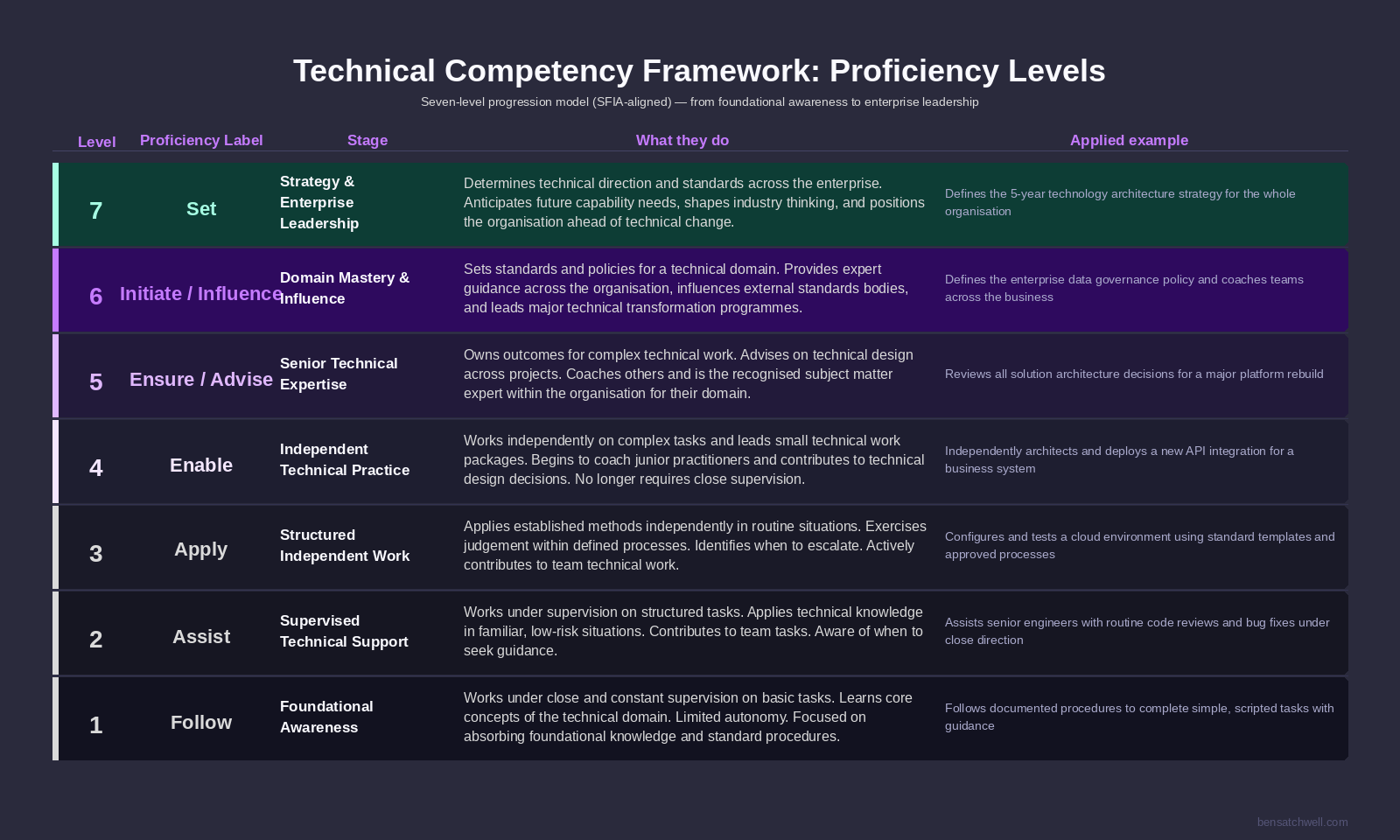
Proficiency levels are typically adapted from an established framework. The Skills Framework for the Information Age (SFIA) uses a seven-level scale, running from Follow at Level 1 through to Set strategy at Level 7. Many organisations adapt this structure, using five or six levels with renamed labels that fit their internal language. The important thing is not the exact number of levels; it is that the distinctions between levels are real, observable, and usable in assessment conversations.
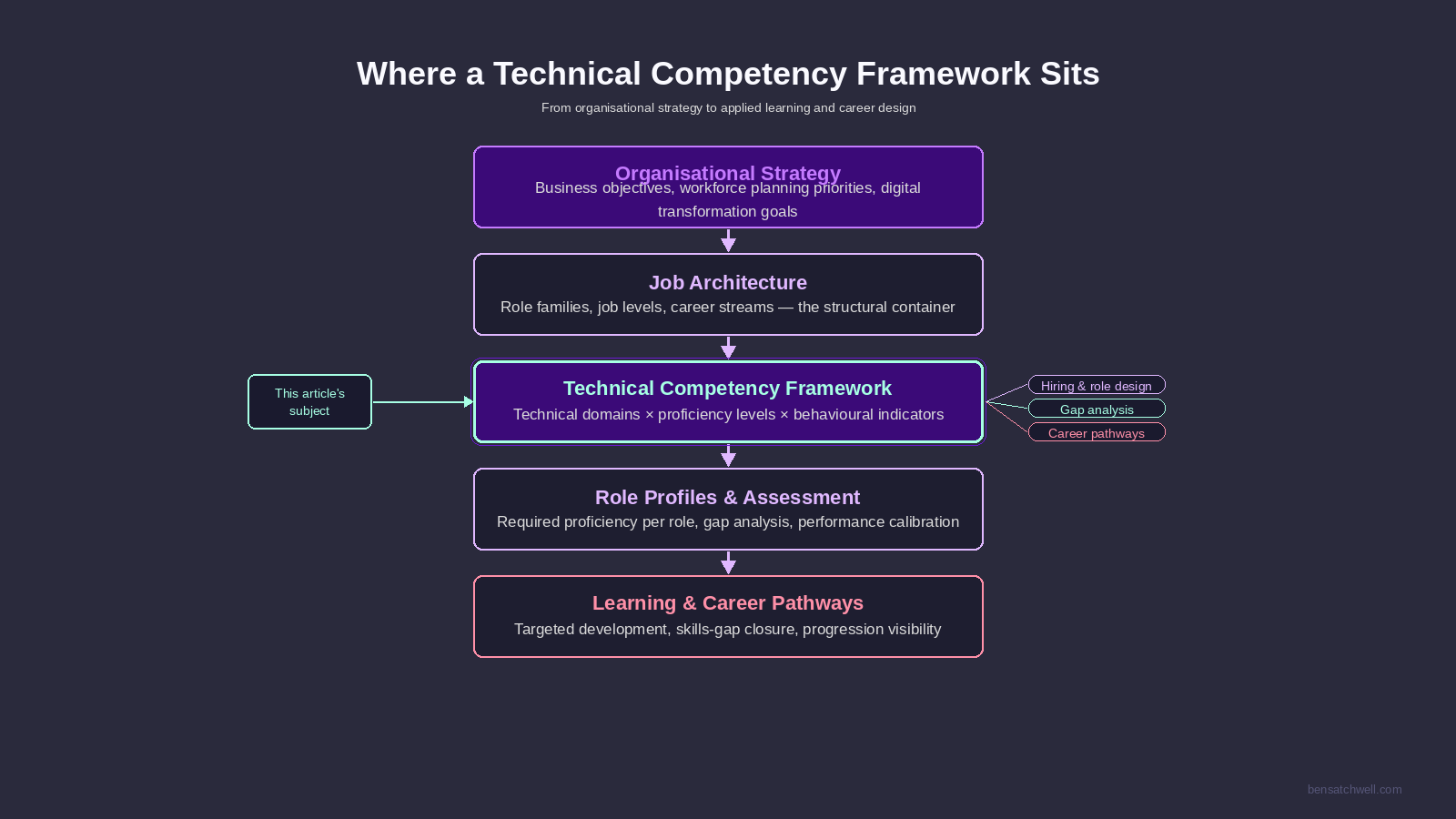
Once the framework is built, it connects to role profiles. Each role is mapped to a set of domains and the expected proficiency level within each. That mapping is what makes the framework useful for hiring, performance assessment, and career pathway design. Without role mapping, the framework is a reference document; with it, it becomes an operating tool.
What a Technical Competency Framework Is Not
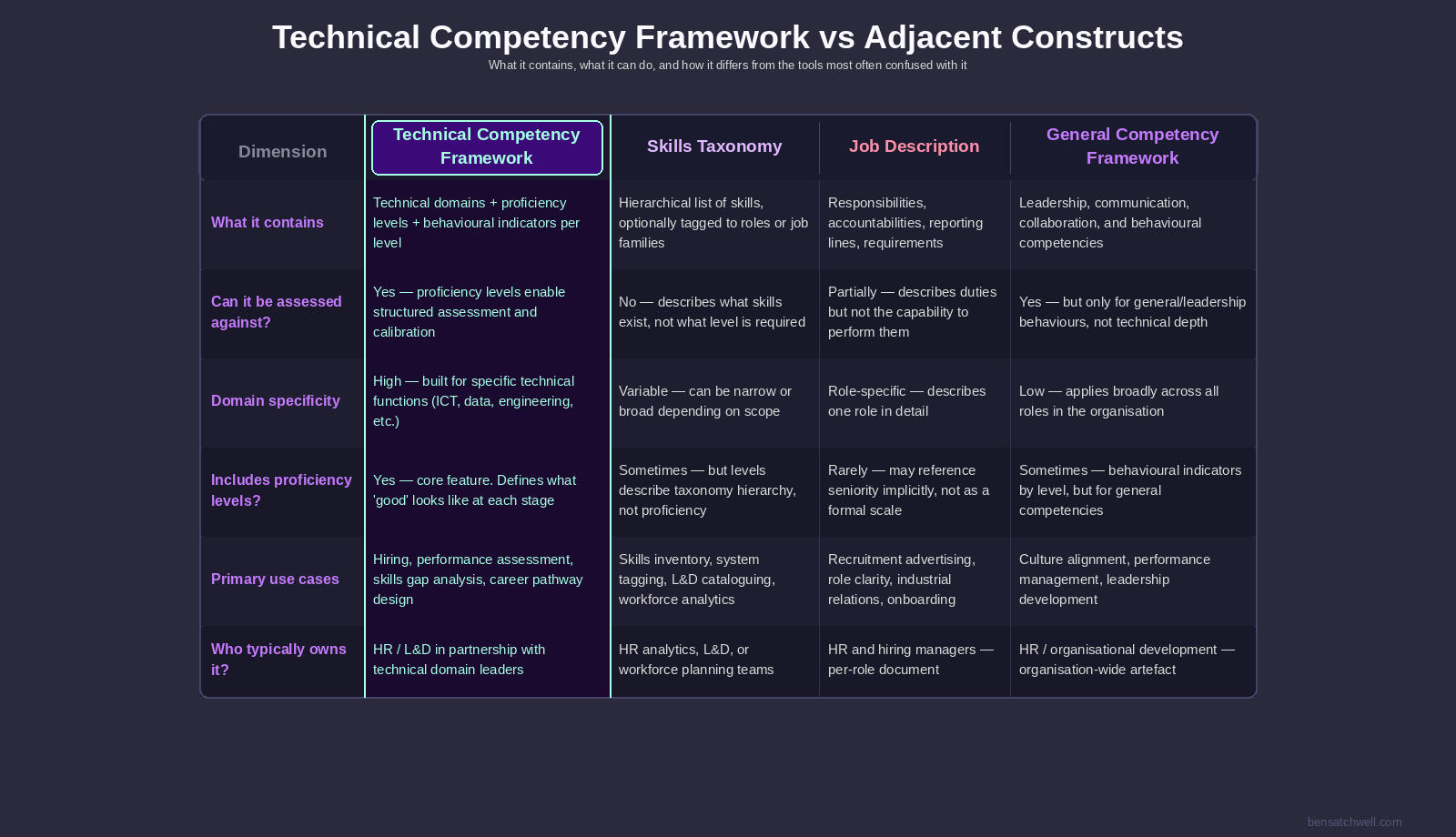
The constructs most often confused with a technical competency framework are the skills taxonomy, the job description, and the general IT competency framework. Each is a legitimate tool. None is a substitute for the other.
A skills taxonomy lists and categorises skills. It is useful for tagging, cataloguing, and workforce analytics, but it does not define what level of proficiency is required or what good looks like at each stage. You cannot run a structured assessment against a taxonomy alone.
A job description describes the responsibilities and requirements of a specific role. It is role-specific and largely static. It tells a candidate what they will be doing, not how well they need to do it or what distinguishes a competent practitioner from an excellent one.
A general competency framework covers behavioural and leadership competencies that apply across the whole organisation. It is valuable for culture alignment and management capability, but it has no domain specificity and cannot assess whether someone is technically capable of performing the work in their function.
Named Framework and Standard References
Several established standards inform how technical competency frameworks are built. SFIA is the most widely recognised in the ICT and digital domain. It covers over 120 professional skills across seven proficiency levels, and it is used by governments, universities, and private sector organisations across more than 180 countries. Organisations building frameworks for ICT, data, or digital functions typically start with SFIA as a reference architecture and adapt it to their context.
The OECD has published guidance on digital government talent and competency frameworks for public sector organisations, which reflects how intergovernmental bodies are approaching technical capability at a system level. The CIPD offers authoritative guidance on competency framework design, including the distinction between behavioural and technical competencies.
For data functions specifically, frameworks like those built on a data competency framework draw on both SFIA and DAMA International for domain coverage and proficiency structure respectively.
Common Failure Modes
The most common failure is building a framework that is too broad to be useful. Organisations list every technical skill they can think of, produce a spreadsheet with hundreds of rows, and then find that no one uses it because assessing against it takes hours and produces inconsistent results. A framework has to be scoped to the function, at a level of specificity that is meaningful but manageable.
The second failure is writing indicators that are not actually observable. "Demonstrates deep technical knowledge" is not a behavioural indicator. It is a label. An observable indicator describes what someone does at that level: "designs and implements scalable data pipeline architectures independently, making trade-off decisions about processing latency and cost without escalation." That is something an assessor can look for.
The third failure is building the framework without connecting it to role profiles. A framework that exists in isolation is a reference document. The moment it is mapped to roles and used in hiring panels and performance conversations, it becomes infrastructure. Without that connection, the investment in building it rarely pays off.
Trade-offs and Constraints
A technical competency framework is a significant investment. Building one properly for an ICT function of meaningful scope can take months, requires input from senior technical practitioners who are busy, and needs ongoing maintenance as the technical landscape evolves. It is worth doing when the function is large enough, the hiring and assessment volume justifies it, and the organisation has the capacity to maintain it.
For small technical functions, a lighter approach using a skills inventory and a handful of role profiles mapped to expected levels may deliver most of the value at a fraction of the cost. The question to ask is: do we need to assess and calibrate technical capability consistently at scale? If yes, the framework is the right tool. If the function is small and assessment is largely informal, the overhead may not be warranted.
Frameworks also become outdated. Cloud, AI, and data engineering disciplines in particular shift quickly. A framework built in 2021 may have significant gaps by 2025. Organisations need to build a review cadence into their governance arrangements, or the framework will gradually lose credibility as practitioners start pointing to skills it does not cover.
Frequently Asked Questions About Technical Competency Frameworks
What is the difference between a technical competency framework and a skills taxonomy?
A skills taxonomy lists and categorises skills but does not define proficiency levels or behavioural indicators. A technical competency framework defines what good looks like at each proficiency level for each technical domain, making it usable for structured assessment. A taxonomy answers "what skills exist"; a framework answers "what level of proficiency is required and how is it demonstrated."
How many proficiency levels should a technical competency framework have?
Most frameworks use between four and seven levels. SFIA uses seven. Five or six levels are common in organisational frameworks because they map more cleanly to career stages from graduate to senior specialist. The right number depends on how many genuine, observable distinctions exist between levels in your context. Avoid adding levels that do not correspond to meaningful differences in what practitioners actually do.
Can a technical competency framework be used for hiring as well as performance management?
Yes, and that dual use is one of its primary advantages. For hiring, the framework defines the proficiency expectations for a role, which structures interview scoring and reduces panel inconsistency. For performance management, the same indicators provide a shared language for calibration conversations, development planning, and promotion decisions.
Is SFIA the only standard for technical competency frameworks?
No. SFIA is the most widely adopted standard for ICT and digital roles, but other frameworks exist. The OECD's digital competency frameworks are used across public sectors internationally. DigComp covers digital literacy for citizens and workers. DAMA provides domain coverage for data management roles. Which standard to reference depends on the function and the level of specificity required.
How long does it take to build a technical competency framework?
For a function of meaningful scope, between three and six months is a realistic timeline. This includes scoping the domains, drafting the proficiency levels and behavioural indicators, validating with technical practitioners, mapping to role profiles, and socialising across HR and business leadership. Shortcutting the practitioner validation step is the most common cause of frameworks that do not get adopted.
When is a technical competency framework not the right tool?
When the technical function is very small (fewer than 10 to 15 practitioners), a full framework may be disproportionate. A lighter approach using a skills inventory and a few role profiles with expected levels is often sufficient. A framework becomes clearly worth the investment when you are hiring at volume, running regular capability assessments, or designing structured career pathways for a sizable technical team.