
IT competency frameworks get treated as a smaller, techier cousin of the general competency framework, and that's where most of them go wrong. An IT competency framework is not a skills list with a technology label stuck on it. It is a structured system for defining what good performance looks like in technology roles, and if you build it like a generic HR template with "SQL" swapped in for "communication," it will not survive contact with an engineering team.
What Is an IT Competency Framework
An IT competency framework is an organisation-wide system that defines, groups and standardises the competencies required across information technology roles, so that performance expectations are consistent and comparable from helpdesk analyst through to enterprise architect.
It is a technical competency framework applied to a specific functional domain: information technology. Each competency in it integrates knowledge, skill and behaviour, levelled against defined proficiency stages, and expressed as observable indicators rather than a checklist of tools.
Done properly, an IT competency framework sits inside the same architecture as any other competency framework: definitions, domains, proficiency levels and behavioural indicators, with the governance to keep role profiles consistent across the technology function.
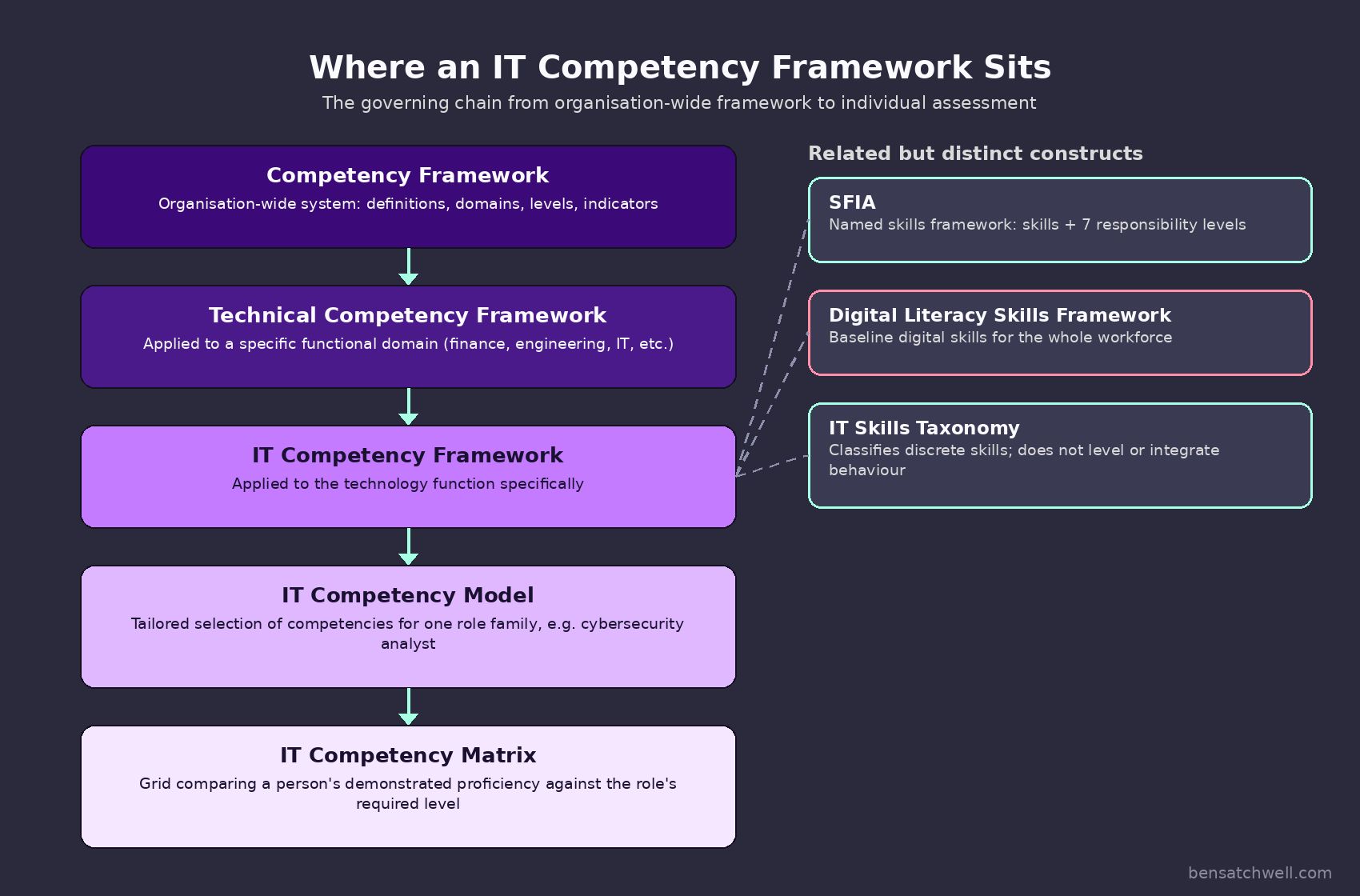
A note on terminology. A competency framework is also called a competency model, especially in the United States. I use competency profile for the competencies and required levels for one role, and competency matrix for the grid of required against current proficiency. Usage varies by region, and I explain the differences in this competency model definition.
Why It Exists
Technology functions have a specific problem general competency frameworks do not solve on their own: the underlying skills move faster than the organisational structure around them. A framework written for finance can stay largely stable for a decade. One written for infrastructure engineering is out of date within two or three years if it names specific tools instead of the underlying competency.
An IT competency framework exists to hold that tension. It gives the organisation a stable way to describe what a network engineer or a data analyst needs to be able to do, at what level, without rewriting the entire framework every time a platform changes. The competency, "designs and implements secure network architecture," survives a migration from one vendor's hardware to another's. A skill list naming the vendor does not.
It also exists to solve a hiring and mobility problem. Without a shared competency language, technology roles get defined by whichever tools happen to be in the job ad that week, which makes it nearly impossible to compare candidates, plan succession, or move people between teams with any confidence in what they can actually do.
How It Works in Practice
A working IT competency framework has four parts.
Competency domains. Most frameworks split technical competencies from core and leadership competencies. The technical domain covers areas such as infrastructure and cloud, software engineering, data and analytics, cybersecurity, and IT service management. Each domain groups related competencies so they can be assessed and reported on together.
Defined competencies. Within each domain, individual competencies are named and described precisely, for example "applies secure coding practices" rather than "knows Python." The competency describes the capability being demonstrated, not the tool used to demonstrate it.
Proficiency levels. Four to six levels, usually running from foundational (assists under supervision) through to expert (sets direction and mentors others). Levels are set by scope, autonomy, complexity and the impact of decisions, not by job title or years in the role.
Behavioural indicators. Each competency at each level is written as an observable statement. "Troubleshoots common incidents using documented procedures" at level 2 looks very different from "designs incident response processes for the organisation" at level 5, even though both sit under the same competency.
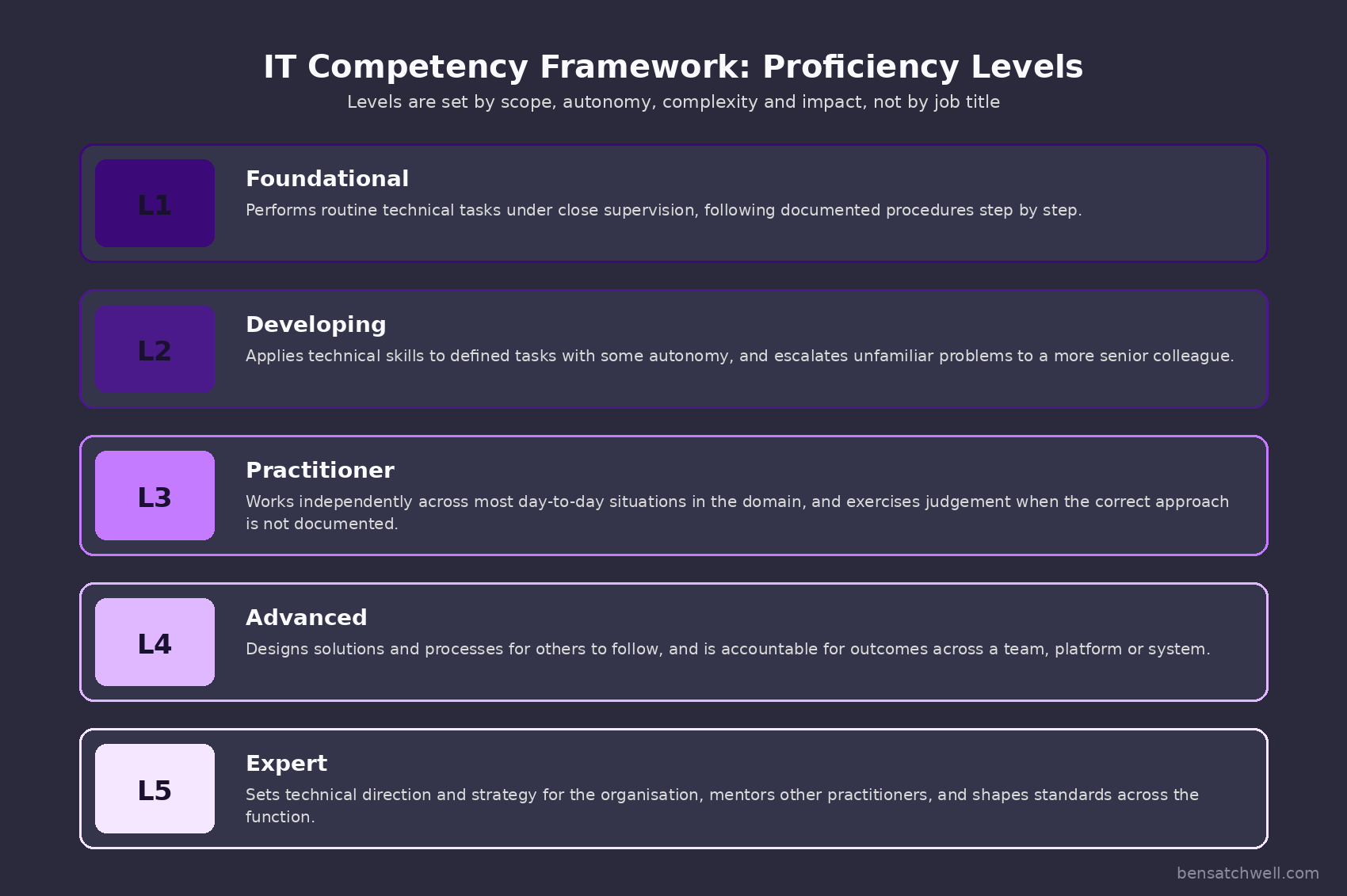
From there, organisations build competency profiles for specific role families (a profile for cybersecurity analysts, another for platform engineers), and use a competency matrix to compare what a person currently demonstrates against what their role requires. The framework is the governing system; the profile and the matrix are what gets used day to day.
Many organisations do not build this from scratch. The SFIA framework is the most widely adopted reference point for structuring technology roles this way, and government IT functions in particular tend to license or adapt it rather than write an equivalent from first principles. The Australian Public Service Commission has adopted SFIA as the core capability reference for its digital profession, and the NSW Public Service Commission maintains a comparable capability set for ICT professionals inside its broader public sector capability framework.
What an IT Competency Framework Is NOT
It is not a certifications list. Certifications indicate that a person has studied a body of knowledge; a competency framework defines what they can demonstrably do with it on the job. A person can hold a certification and still sit at a low proficiency level if they have never applied the knowledge under real conditions.
It is not the same as a technical competency framework in general. Technical competency frameworks are the broader construct, covering any specialist, role-specific domain, whether that is finance, clinical practice or engineering. An IT competency framework is one functional application of that same logic, scoped to technology roles specifically.
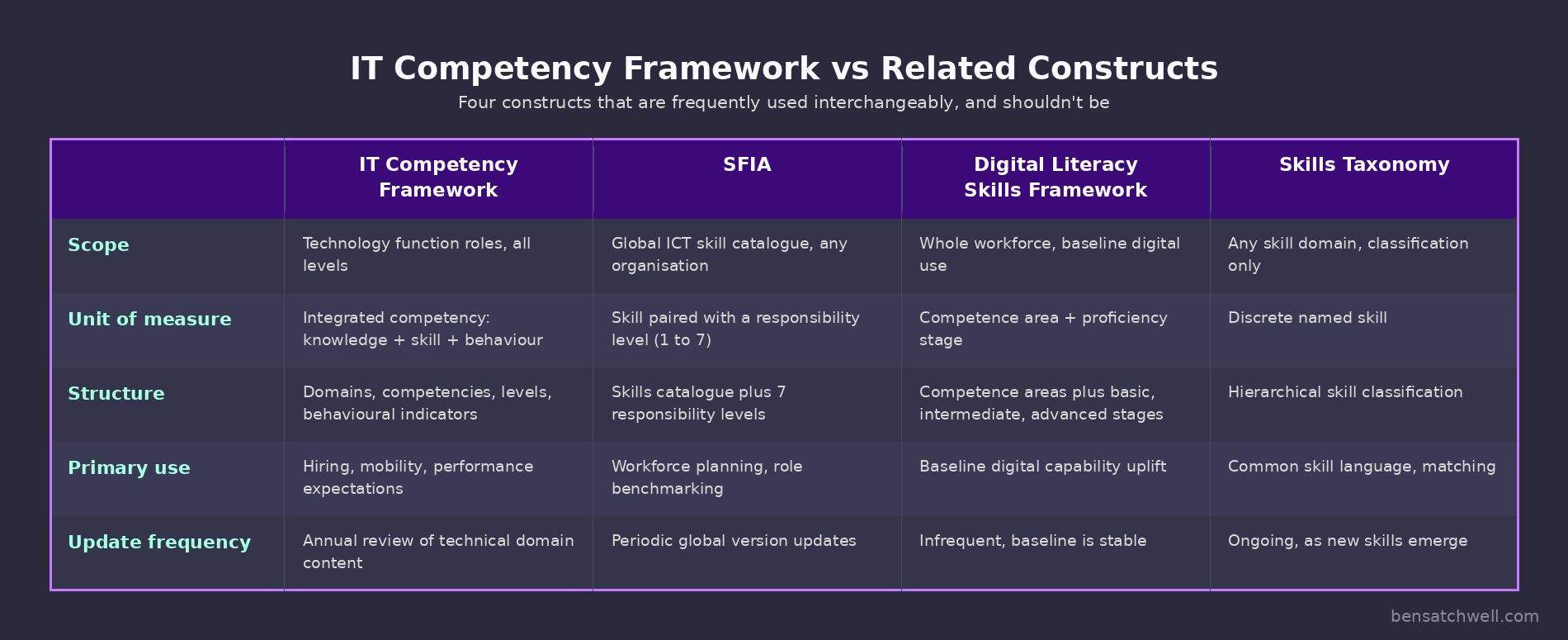
It is not a skills taxonomy. A taxonomy classifies discrete skills into a navigable hierarchy so the same skill means the same thing everywhere it appears. A competency framework goes further, integrating skills with knowledge and behaviour and levelling them against defined performance expectations. SFIA itself sits closer to a skills framework, naming skills and levels of responsibility, which is a related but distinct construct from a competency framework built around integrated behavioural competencies.
It is not a digital literacy framework. A digital literacy skills framework describes the baseline digital skills expected of the whole workforce, using a device, navigating basic security practice, working with common software. An IT competency framework is scoped to people whose job is to build, run, secure or support technology, which is a materially different population with a materially different depth of expectation.
Named Frameworks and Standards
SFIA remains the dominant named reference for structuring IT competency work, particularly in government and larger enterprises, because it already defines skills and seven levels of responsibility across the technology function. Where organisations want a more behaviourally integrated framework rather than a skills-and-levels structure, frameworks built on Korn Ferry or Lominger competency architecture are more commonly adapted, layering technology-specific competencies onto a generic leadership and behavioural spine.
CIPD and SHRM guidance on competency framework design is broadly applicable to the IT function as well, since the governance principles, definitions, domains, levels, and indicators, do not change because the domain is technical rather than commercial. What changes is the content of the technical domain itself, and that content needs genuine subject matter input from engineering and technology leaders, not HR working from a generic template.
Common Failure Modes
The most common failure is writing competencies at the tool level instead of the capability level. A competency called "AWS" or "Kubernetes" is obsolete the moment the organisation changes platforms, and it tells you nothing about whether the person can actually design resilient systems. Name the underlying capability, then note the current tooling as context, not as the competency itself.
The second is importing a generic competency framework and relabelling it. IT roles have a genuinely different shape of work: more asynchronous, more incident-driven, often measured by systems outcomes rather than interpersonal ones. A framework that has not been built or reviewed with technical leaders will misjudge what a senior engineer's proficiency actually looks like.
The third is treating the framework as a one-off project instead of a governed asset. Technology moves fast enough that a framework left untouched for five years will describe a workforce that no longer exists. It needs an owner and a review cycle, the same governance any competency framework requires, applied more frequently because the underlying domain changes faster.
The fourth is conflating the framework with performance management. A competency framework describes what good performance looks like at each level. It is not, on its own, a scoring tool for annual reviews, and using it that way tends to push people toward defensive box-ticking rather than genuine capability growth. Academic work on ICT competency and industry employability makes a similar point from the education side, arguing that competency frameworks only work as a curriculum or workforce tool when they are matched explicitly against real industry skill requirements, rather than assumed from theory.
Trade-offs and Constraints
An IT competency framework is worth building when the technology function is large enough or complex enough that role clarity, hiring consistency and internal mobility genuinely matter, typically once an organisation has enough technology roles that informal, tribal knowledge of "who's good at what" stops scaling.
It is not worth building from scratch in a small technology team where everyone already knows what good looks like, and where the effort of governance would outweigh the benefit. In that context, adopting an existing reference like SFIA and adapting only what is genuinely different about the organisation is the more sensible path.
The constraint to hold onto is currency. An IT competency framework has a shorter useful life than most other competency frameworks in the business, precisely because the domain moves faster. Build the governance and review cycle in from day one, or the framework will describe a technology function that stopped existing two platform migrations ago.
FAQ
What is the difference between an IT competency framework and SFIA?
SFIA is a named skills framework that catalogues specific skills and seven levels of responsibility across the technology function. An IT competency framework is the broader organisational system, definitions, domains, levels and behavioural indicators, and many organisations use SFIA as the content inside that system rather than building an equivalent from scratch.
Is an IT competency framework the same as a technical skills matrix?
No. A matrix is a display and assessment artefact that maps competencies against people or roles to show gaps. The framework is the governing structure the matrix is built from.
Who should own an IT competency framework?
Ownership sits jointly between HR or people teams, who manage the governance and framework architecture, and senior technology leaders, who provide the subject matter accuracy of what each competency and level actually means in practice.
How often should an IT competency framework be reviewed?
Annually at a minimum for the technical domain content, given how quickly tooling and platforms shift. The core structure, domains, levels, indicator format, can remain stable for longer.
Does an IT competency framework replace certifications?
No. Certifications and competency frameworks answer different questions. A certification indicates studied knowledge; a competency framework defines demonstrated, levelled performance on the job.
Can a small technology team use SFIA directly instead of building its own framework?
Yes, and for most small to mid-sized technology functions this is the more efficient path. Adapt the relevant skills and levels rather than building a parallel competency framework from first principles.