


A competencies and values framework is not a competency framework with a mission statement stapled to the cover. It puts two categorically different constructs side by side on purpose: competencies, which are levelled and behavioural, and values, which are neither. The clearest working example of this structure, and the reason the phrase is often capitalised as a proper name, is the UK's Competency and Values Framework (CVF) for policing, built and maintained by the College of Policing. This piece uses the CVF as its running example throughout. For the general, sector-agnostic version of this structure, see Competency and Values Framework: Definition & Governance.
What Is a Competencies and Values Framework?
A competencies and values framework is an organisation-wide structure that presents an organisation’s competencies alongside its values, and deliberately keeps the two on separate tracks. A competency framework defines, groups and levels the behaviours needed for effective performance across roles. Values sit outside that structure entirely. They are the small set of principles the organisation expects everyone to act on, regardless of role, seniority or context, and they do not get easier or harder to meet as a person moves up a level.
The College of Policing's CVF pairs six competencies, clustered into three groups and expressed across three cumulative behavioural levels, with four values: impartiality, integrity, public service and transparency. Every officer, from constable to chief constable, is held to the same four value statements. Only the six competencies scale by level.

The competencies and values framework runs two governance tracks side by side, one levelled, one fixed.
Why Does a Competencies and Values Framework Exist?
Competency frameworks answer one question: can this person do the work to the required standard? They say nothing about whether the person will do it the right way when nobody is watching, when incentives point the wrong direction, or when doing it properly is slower and less convenient. In policing specifically, that second question carries as much weight as the first, because officers exercise powers, including the use of force and the deprivation of liberty, that most professions never touch.
A values track exists to answer it directly, and to make it enforceable independent of technical performance. Conduct in England and Wales policing is judged against the Standards of Professional Behaviour, a separate statutory framework that misconduct panels apply regardless of an officer's operational competence. An officer with strong tactical or investigative competency who breaches a standard such as honesty and integrity is not offset by that competency. That is precisely why values cannot live inside a levelled competency structure. Levelling implies gradation, and a value is a threshold, not a gradient.
How Does a Competencies and Values Framework Work in Practice?
In practice, the framework runs two parallel tracks inside one document, governed differently.
- The competency track is organised into three grouped clusters, each with cumulative behavioural levels running from entry-level constable through to senior command. This is standard competency framework architecture, and it is assessed on a scale appropriate to rank and role.
- The values track is the fixed set of four value statements, with no levels and no domains. Assessment against it is binary. The behaviour observed either meets the value or breaches it. There is no partial credit.
The CVF is built into the policing career lifecycle at several distinct points. Entry-route assessment centres for new officers, run under the Police Education Qualifications Framework, use CVF-based scenarios and structured interviews to assess candidates against both tracks before they ever attend a physical assessment centre. Annual performance and development reviews reference the same competency and values language, so the standard an officer is coached against in year one is the same standard applied at a promotion board years later. Misconduct proceedings sit apart from this developmental use of the CVF: they are run against the separate Standards of Professional Behaviour rather than the CVF's competency language, but the values named in the CVF, impartiality, integrity, public service and transparency, echo the same conduct expectations that misconduct panels apply.
Governance is split accordingly. Learning and development functions within each force own the competency track and its use in appraisal and promotion. Professional standards departments, distinct from L&D, own conduct and misconduct matters, because a breach is treated as a discipline question first and a development question a distant second.
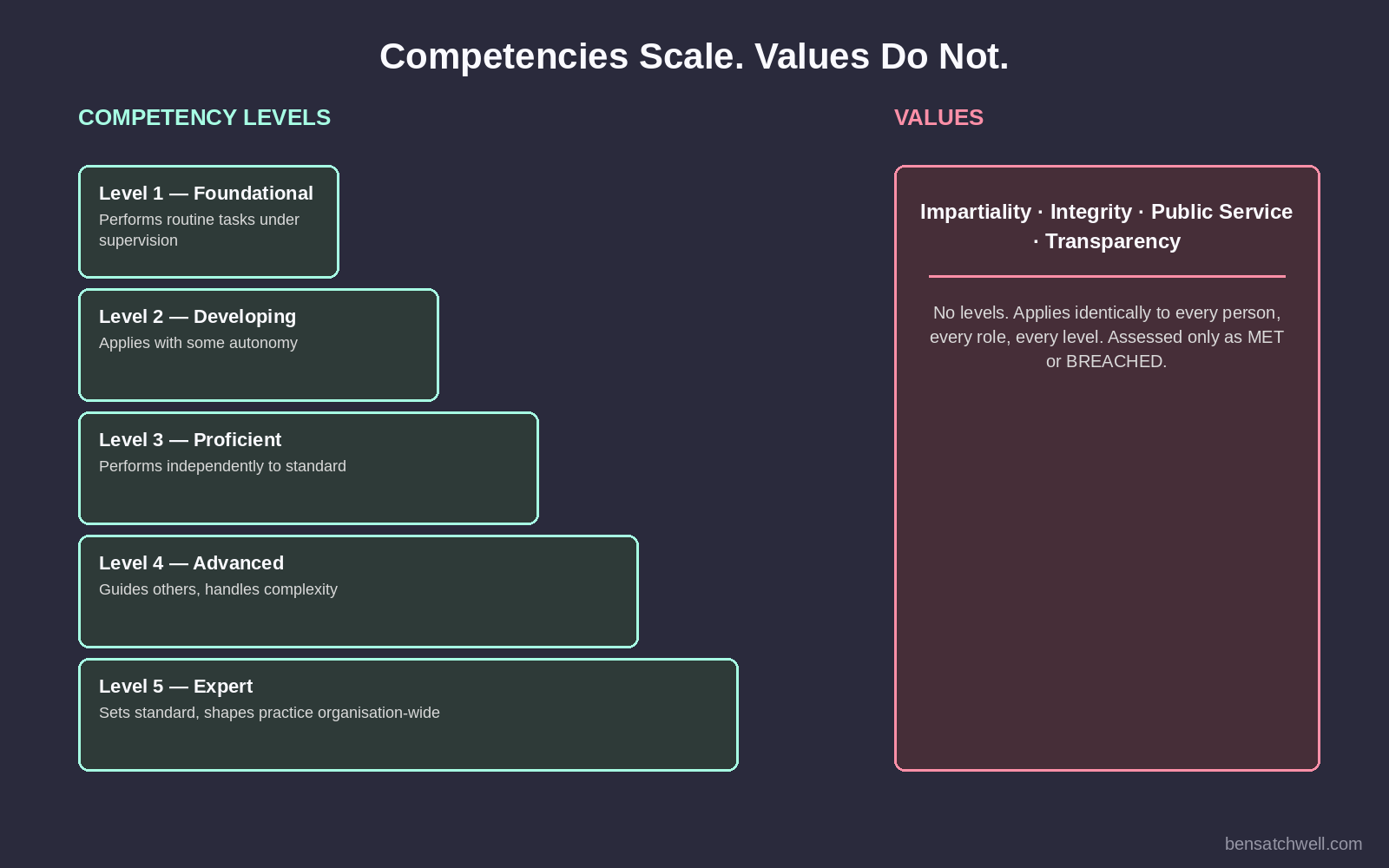
Competencies progress through defined levels. Values do not; they apply identically to everyone.
What Is a Competencies and Values Framework Not?
- It is not a competency framework with a values statement in the foreword. If a document defines four values purely as narrative and never assesses anyone against them, it is not a competencies and values framework. It is a competency framework with decoration.
- It is not a document where values get scored on the same one-to-five proficiency scale as competencies. A value is a threshold a person meets or breaches. Scoring “integrity: 3 out of 5” implies a person can be partially dishonest and still pass, which defeats the purpose of naming it a value at all.
- It is not a misconduct or disciplinary code by itself. The CVF describes developmental expectations used in recruitment, appraisal and promotion. Formal misconduct is assessed against the separate Standards of Professional Behaviour, even though the two documents describe closely related conduct.
- It is not culture. Culture is descriptive. It is what people actually do when nobody is enforcing anything. Values are prescriptive. They are what the organisation has committed to enforce. A force can operate the CVF while its actual culture does not yet match it. That gap is a failure of implementation, not evidence the framework itself is wrong.
- It is not the Competing Values Framework. This is a genuine and common confusion, and both constructs share the initials CVF. Cameron and Quinn’s Competing Values Framework is an organisational culture diagnostic built around competing dimensions of flexibility versus stability and internal versus external focus. The policing CVF is a workforce and conduct structure with no relationship to that model beyond the coincidence of acronym.
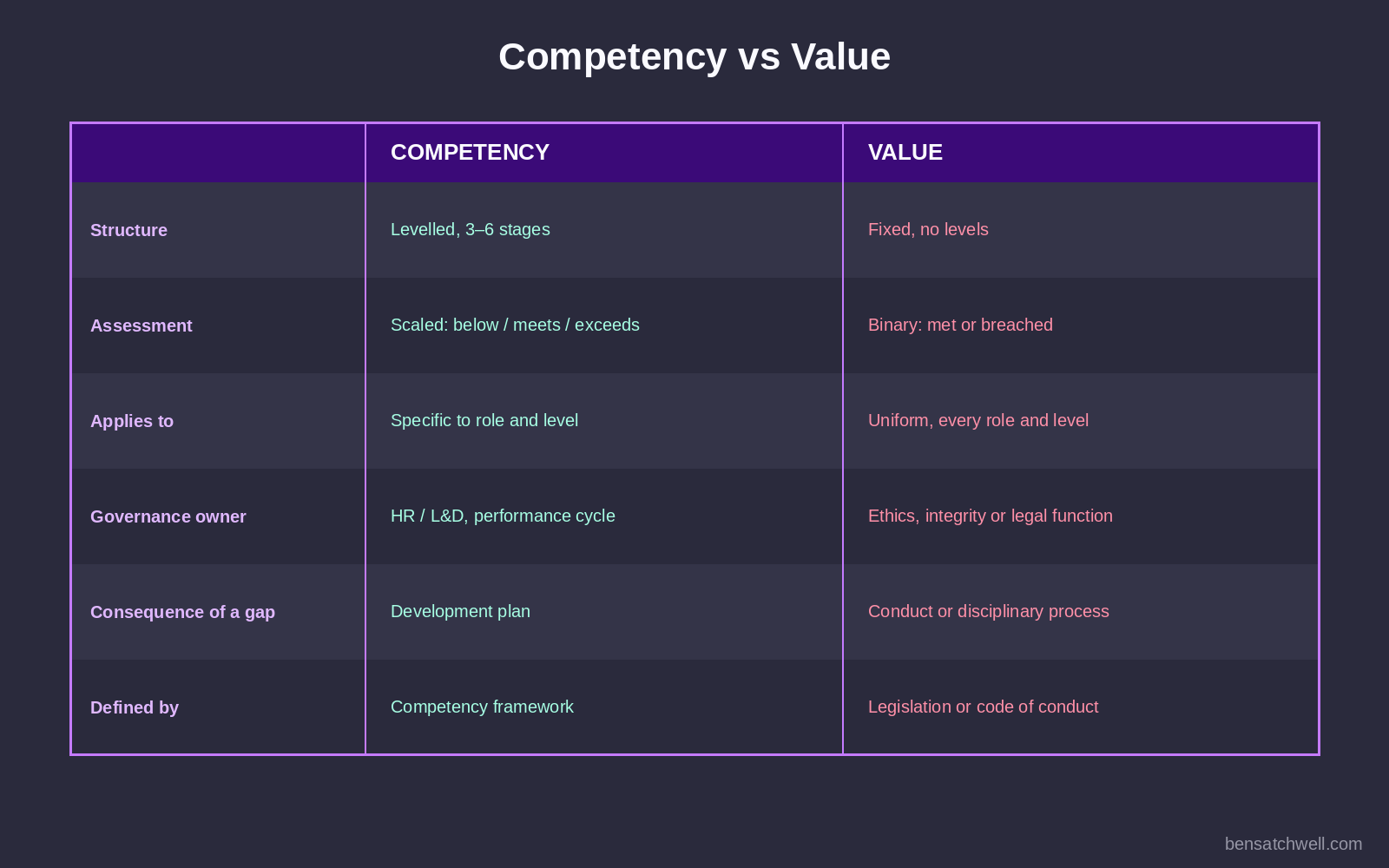
Competency and value differ across every governance dimension, not just in name.
Where This Sits Among Named Frameworks
The College of Policing's CVF is the most fully worked national example of a branded, single-document competency-and-values structure: six competencies across three levels, paired with four fixed values that carry no levels at all. Other professional bodies build the same underlying pairing without branding it as a single named framework in the way policing has. CIPD's Profession Map, SFIA, Korn Ferry and DDI's competency libraries, and sector-specific statutory codes such as the Australian Public Service Values, all separate competency and conduct in some form, but none package the two into one document under a shared name the way the CVF does. A wider survey of those adjacent models sits in the companion piece on competency and values frameworks more broadly.
Common Failure Modes When Adapting the CVF Model
- Scoring values on a competency scale is the single most common design fault when other sectors try to replicate the CVF structure, and it undermines the whole point of naming something a value rather than a competency.
- Treating the values as a preamble rather than an assessed control means nobody is ever actually held to them, which quietly turns the document into a competency framework in practice.
- Confusing this construct with the Competing Values Framework at the procurement or vendor-brief stage sends organisations looking for a culture diagnostic tool when they need a conduct framework, or the reverse.
- Assuming the CVF's competency and values language can substitute for a formal misconduct code. It cannot. Developmental standards and disciplinary standards are related but administered separately, even within policing itself.
- Copying the CVF's four values verbatim into a different sector without testing whether they hold local meaning. Impartiality and public service carry specific weight in a warranted policing role that does not automatically transfer to a private-sector context.
When Is a Competencies and Values Framework the Right Tool?
This structure earns its complexity in professions where discretion under pressure creates real risk to the public: policing, health, the courts, defence and financial services. In those settings, technical competence and honest conduct are both non-negotiable, which is exactly why policing built a single named, publicly documented framework rather than leaving the pairing implicit.
It is usually the wrong tool for low-discretion roles with limited public-facing risk. A standard competency framework covers the ground adequately, and adding a values track creates governance overhead, extra assessment, ownership and escalation steps, without a matching rise in the risk being managed.
The other constraint is enforceability. A values track is only credible if the organisation is prepared to act on a breach independent of competency, including removing someone who is technically excellent at the job. Policing's separate misconduct regime is what makes its values track credible; without an equivalent enforcement mechanism, a combined framework becomes a document nobody trusts.
FAQ
What is the difference between a competency and a value in this kind of framework?
A competency is levelled and behavioural. It describes graded performance from foundational through to expert. A value is a fixed threshold with no levels. It describes conduct that is either met or breached, regardless of role or seniority.
Is the Competency and Values Framework the same as the Competing Values Framework?
No. They share the initials CVF by coincidence. The Competency and Values Framework used in UK policing is a workforce and conduct structure. The Competing Values Framework, developed by Cameron and Quinn, is an organisational culture diagnostic built around competing dimensions of flexibility, stability, internal and external focus. They solve different problems.
Do values have proficiency levels like competencies do in the CVF?
No. The CVF's four values are assessed as met or breached. Adding proficiency levels to a value implies partial compliance is acceptable, which defeats the purpose of stating it as a value.
How is the CVF different from the Standards of Professional Behaviour?
The CVF is a developmental framework used in recruitment, appraisal and promotion. The Standards of Professional Behaviour is the separate statutory basis for misconduct proceedings. Both describe related conduct expectations, but they are administered through different processes for different purposes.
Can the CVF model be adapted outside policing?
Yes, and other regulated professions use structurally similar competency-and-values pairings, but the specific four values, and the enforcement mechanism behind them, were built for policing's context. Adapting the model means recalibrating both the values and the enforcement route, not copying the document.
Who owns the competency track versus the values track under the CVF?
Force-level learning and development functions typically own the competency track and its use in appraisal and promotion. Professional standards departments own conduct matters, because breaches are assessed as discipline questions rather than development gaps.