
Most CEO competency frameworks I see are not frameworks at all. They are leadership wish lists: a page of admirable traits compiled by the board, the outgoing CEO, or a consultant who interviewed four executives and synthesised the themes. The result is a document that describes an idealised person rather than a defined performance standard. That distinction matters more than most boards appreciate, and it explains why so many CEO frameworks end up filed rather than used.
What Is a CEO Competency Framework?
A CEO competency framework is an organisation-specific system that defines the competencies required for effective performance in the chief executive role, including the observable behaviours that evidence each competency at the appropriate proficiency level.
In the United States the same structure is usually called a CEO competency model. The two names describe the same idea, and my guide to the CEO competency model looks at building the profile for one organisation's chief executive seat.
A competency is the integration of skills, knowledge, judgement and behaviour applied effectively in the context of a role. A competency framework organises these into a governing structure: defining what they are, how they are grouped, and what good performance looks like at each level. At the CEO level, competencies are assessed against outcomes that are strategic, long-horizon, and non-routine. The framework must reflect that specificity. A generic leadership framework applied to the CEO role is a mismatch of scope, not a useful shortcut.
A note on terminology. A competency framework is also called a competency model, especially in the United States. I use competency profile for the competencies and required levels for one role, and competency matrix for the grid of required against current proficiency. Usage varies by region, and I explain the differences in this competency model definition.
Why a CEO Competency Framework Exists
The CEO role is structurally unusual. It combines strategic direction, external representation, board accountability, and internal leadership into a single position with few clear performance indicators and no direct supervisor observing day-to-day behaviour. That ambiguity creates a concrete problem: how do you define what good looks like for a role where the outputs are complex, delayed, and difficult to attribute?
A CEO competency framework solves this by specifying the behaviours that evidence effective performance before the outcomes arrive. It gives boards a language for evaluating CEO performance beyond financial metrics. It gives incumbent CEOs a clear picture of where to develop. It provides a consistent basis for succession planning and executive assessment.
Without it, boards default to personality-based assessment, saying things like "she's strategic" or "he's a strong communicator", that is neither consistent nor defensible across the board's lifecycle or governance obligations.
How a CEO Competency Framework Works in Practice
Most CEO competency frameworks cluster competencies into three to five domains. These typically include:
- Strategic leadership: setting direction, making decisions under uncertainty, and allocating resources across long horizons
- Stakeholder and board management: communicating with the board, managing investors, and representing the organisation externally
- Organisational leadership: building and leading the executive team, setting culture, and enabling performance
- Commercial acumen: understanding the business model, managing risk, and driving sustainable growth
- Adaptive leadership: responding to disruption and changing direction without destabilising the organisation
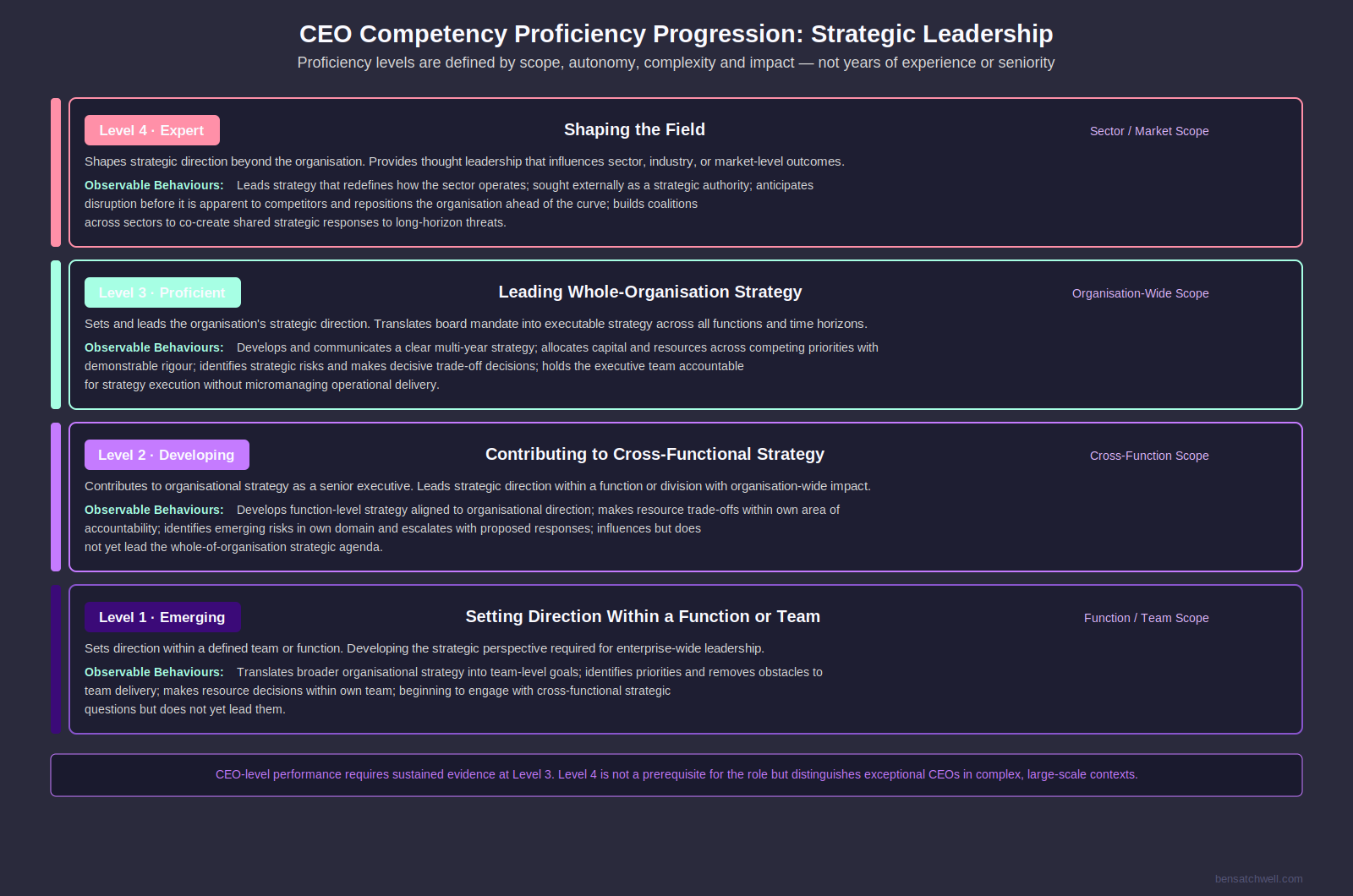
For each competency, a well-designed framework specifies behavioural indicators at the required proficiency level. Because the CEO operates at the highest level of scope and accountability, every indicator should reflect that: system-wide impact, long-term horizon, minimal supervision, and high ambiguity.
A peer-reviewed study involving 30 CEOs from multinational subsidiaries found that communication and interpersonal relationships was named by 70% of participants as a critical competency, followed by leadership and people management (53%) and strategic thinking (43%). Financial knowledge, despite its perceived importance, was cited by only 13% as a primary differentiator. The competencies that most distinguish effective CEOs are behavioural, not technical.
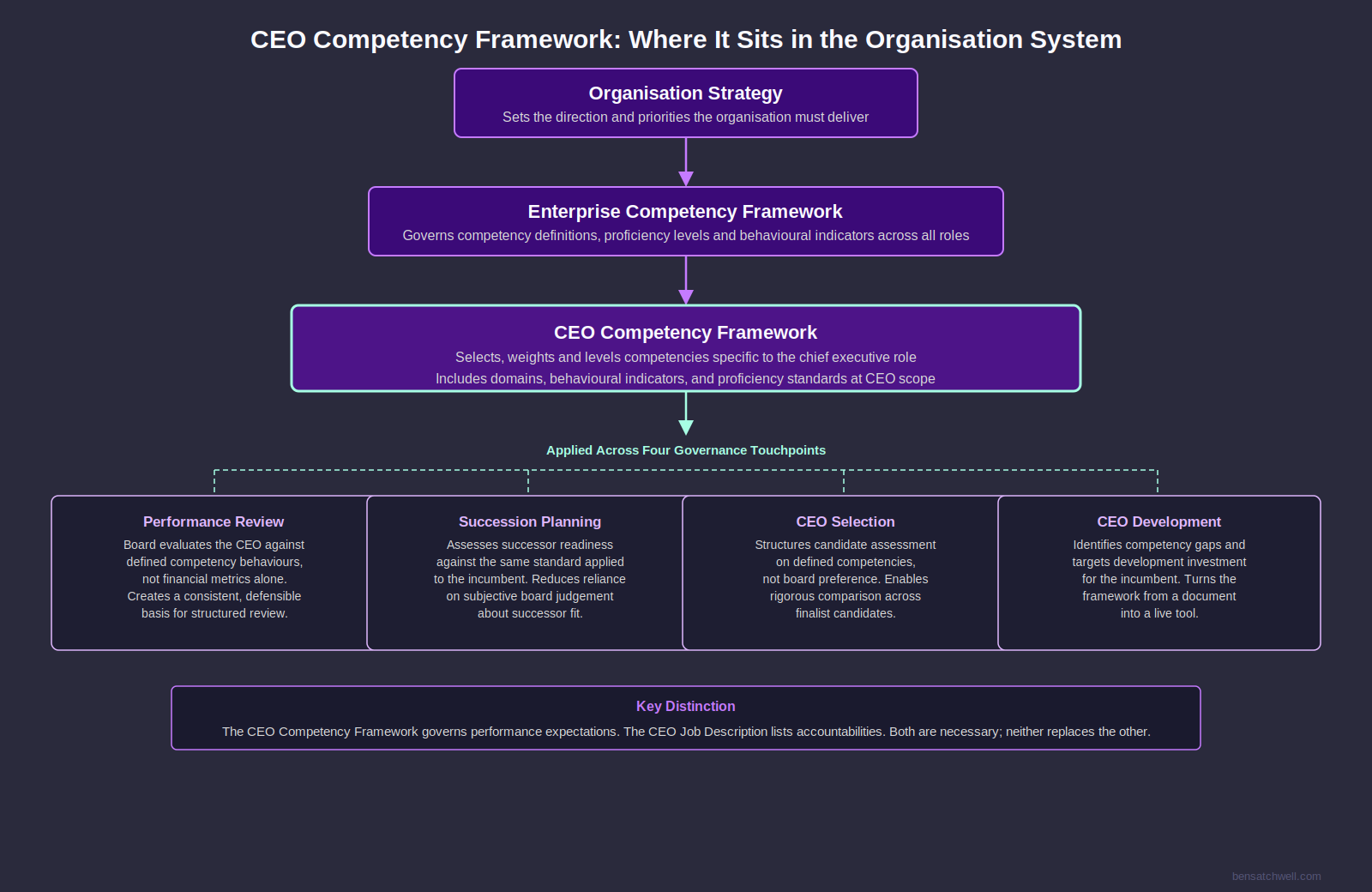
In some organisations, the CEO framework functions as a standalone document. In others, it operates as a competency profile drawn from a broader enterprise-wide framework, selecting and weighting competencies relevant to the chief executive role. Either approach can work, but the latter maintains consistency of language and proficiency level definitions across the wider organisation.
What a CEO Competency Framework Is NOT
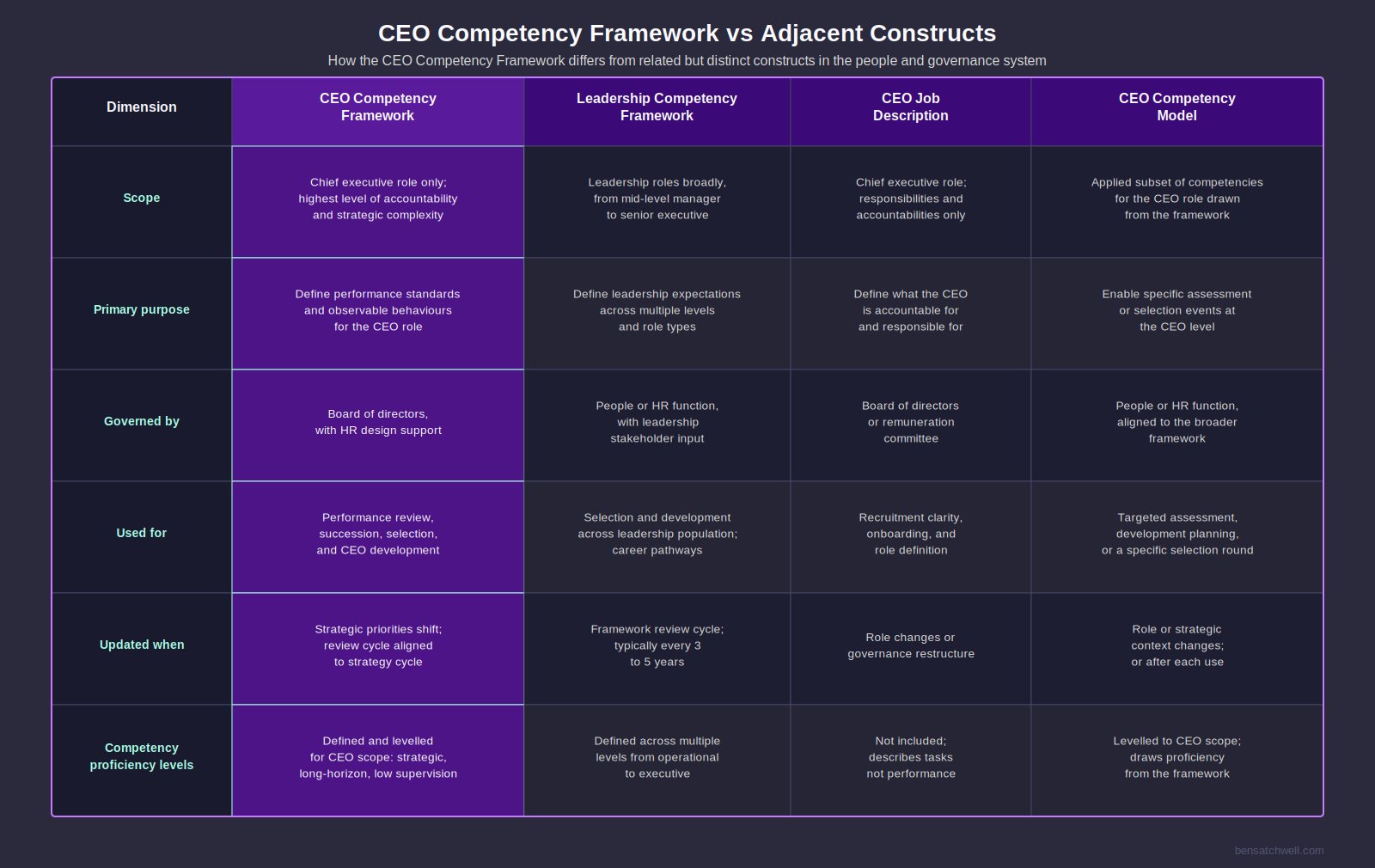
It is not a job description. A job description lists responsibilities and accountabilities. A competency framework defines what the person needs to be able to do to perform those responsibilities effectively. Both are necessary; neither replaces the other.
It is not a leadership competency framework applied at CEO level. A leadership competency framework covers leadership roles broadly, often from mid-level manager to senior executive. A CEO framework is specific to the chief executive role. The scope, complexity, and accountability are categorically different. Applying a generic leadership framework to the CEO role underspecifies what the position actually requires, particularly in terms of board accountability, external representation, and strategic horizon.
It is not a CEO profile or person specification. A profile describes the characteristics of an ideal candidate. A framework defines performance standards for the incumbent. Conflating these two produces documents useful for recruitment but useless for ongoing performance management or development planning.
It is not static. A CEO competency framework built for a growth phase may not serve an organisation in turnaround or consolidation. The framework should have a defined review cycle, typically aligned with the strategic planning cycle.
Named Framework and Standard References
The Korn Ferry Leadership Architect organises leadership competencies across four factors: Thought, Results, People, and Self. At CEO level, organisations typically select 10 to 14 competencies from the full set of 38, weighted toward strategic and people domains. That selection is a design decision requiring organisational judgement, not a mechanical process.
DDI's work on executive readiness distinguishes between competencies effective at middle management and those that become more critical as scope increases. Competencies such as driving execution, which are critical at operational levels, are less differentiating at CEO level than strategic vision, influencing others, and leading change.
SHRM's leadership competency resource addresses executive-level competencies through the construct of Leadership and Navigation: the ability to create a compelling vision aligned with the strategic priorities of the organisation. SHRM's framework illustrates how behavioural competencies at the executive level are defined differently from operational ones, with a shift in emphasis from task execution toward strategic direction and stakeholder influence.
The CIPD notes that competency frameworks, when done well, increase clarity around performance expectations and establish a clear link between individual and organisational performance. At the CEO level, that clarity is most often what is missing: the role is visible but rarely defined with the rigour applied to lower-level positions.
Common Failure Modes
Starting with the person, not the role. When the outgoing CEO is popular, the successor is assessed against that person's strengths. When there is a crisis, the framework is built around the perceived failure. Neither approach defines what the role actually requires. The framework must describe performance requirements, not historical personalities.
Selecting too many competencies. A CEO framework with 20 or more competencies is not a framework. It is a hedge. A workable framework selects 8 to 12 competencies and defines each with precision. More than 12 becomes unmanageable as a development tool and dilutes focus during performance assessment.
Writing indicators at the wrong level. Behavioural indicators for the CEO role should reflect strategic scope, long-horizon outcomes, and system-wide impact. If the indicators could equally describe a senior manager, the framework is underlevelled. Getting the proficiency level right matters as much as selecting the right competencies.
Using the framework only for recruitment. The most common failure is building a CEO competency framework during a succession event and then filing it. The document has no value sitting in a folder. It has value when the board uses it consistently for performance review, development planning, and onboarding.
Trade-offs and Constraints
A CEO competency framework requires board buy-in to function. If the board does not use it in performance reviews, it is not a framework in any meaningful sense. It is a document. Securing that buy-in is a governance and relationship challenge as much as a design one.
Different governance structures also require different competencies. A CEO in a listed company faces a different accountability structure than one in a family-owned business, a government agency, or a not-for-profit. A framework built for one context will not transfer directly to another without significant adaptation.
The framework will also need to evolve as strategy changes. Competencies critical during transformation may be less relevant during consolidation. Treating the framework as permanent is a design error.
Understanding the leadership competency model research helps boards ask sharper questions when commissioning or reviewing a CEO framework, particularly around whether the behavioural indicators are levelled correctly for the position's actual scope and accountabilities.
FAQ
Is a CEO competency framework the same as a CEO competency model?
They describe the same underlying structure. "Framework" is the usual name in the UK and Australia and "model" in the United States. The competencies and required levels for one organisation's chief executive role are a competency profile, but both terms refer to the same competencies, proficiency levels and behavioural indicators.
What is a CEO competency framework?
A CEO competency framework is an organisation-specific system defining the competencies required for effective performance in the chief executive role. It includes competency definitions, behavioural indicators, and proficiency levels relevant to the scope and accountability of the CEO position.
What competencies should a CEO have?
Research points to communication and interpersonal effectiveness, strategic thinking, leadership and people management, adaptability, and emotional intelligence as the most frequently cited CEO competencies. The specific mix depends on organisational context, sector, and current strategic priorities.
How many competencies should a CEO framework include?
Eight to twelve competencies is the workable range. Fewer than eight may underspecify the role; more than twelve becomes unmanageable as a development and assessment tool and dilutes focus.
What is the difference between a CEO competency framework and a leadership competency framework?
A leadership competency framework covers leadership roles across multiple levels. A CEO framework is specific to the chief executive role, reflecting the highest level of scope, accountability, and strategic impact. The frameworks may share some competencies but the required proficiency levels and behavioural indicators will differ significantly.
How is a CEO competency framework used in practice?
It is used in CEO selection and assessment, onboarding, performance reviews, development planning, and succession planning. Its value is highest when the board applies it consistently across all of these events rather than only during recruitment.
Does the CEO competency framework need to align with the organisation's broader framework?
Where an enterprise competency framework exists, the CEO profile should draw from the same governing structure to maintain consistency in language and proficiency levels. Where no enterprise framework exists, the CEO framework should at minimum be designed with compatible terminology to enable future integration.