
A skills framework is the structure that decides what a skill means, how well someone needs to do it and how that standard applies to a role. Most organisations that say they have one have a list. The list names skills, perhaps in groups, and then stops. It has no levels, no rules for use and no link to the roles that need the skills, so two managers read the same entry and expect different things. This guide sets out what a skills framework is, how it differs from a skills taxonomy, how to build one and where the well-known examples fit.
What is a skills framework?
A skills framework is a governing structure that defines skills together with proficiency levels and the rules for how they are applied.
It adds levelling and application logic on top of classification. A skill is a discrete, learned ability to do something, and skills are transient: they shift as tools, technology and methods change. A framework gives each skill a stable definition and a defined scale, so a statement such as "data analysis at level 3" means the same thing in every team. The best-known example is SFIA, the Skills Framework for the Information Age, which the SFIA Foundation describes as the global skills and competency framework for the digital world and which defines seven levels of responsibility (SFIA Foundation, the SFIA framework).
A skills framework has four working parts.
- Skill definitions. A short, plain statement of what the skill is and is not.
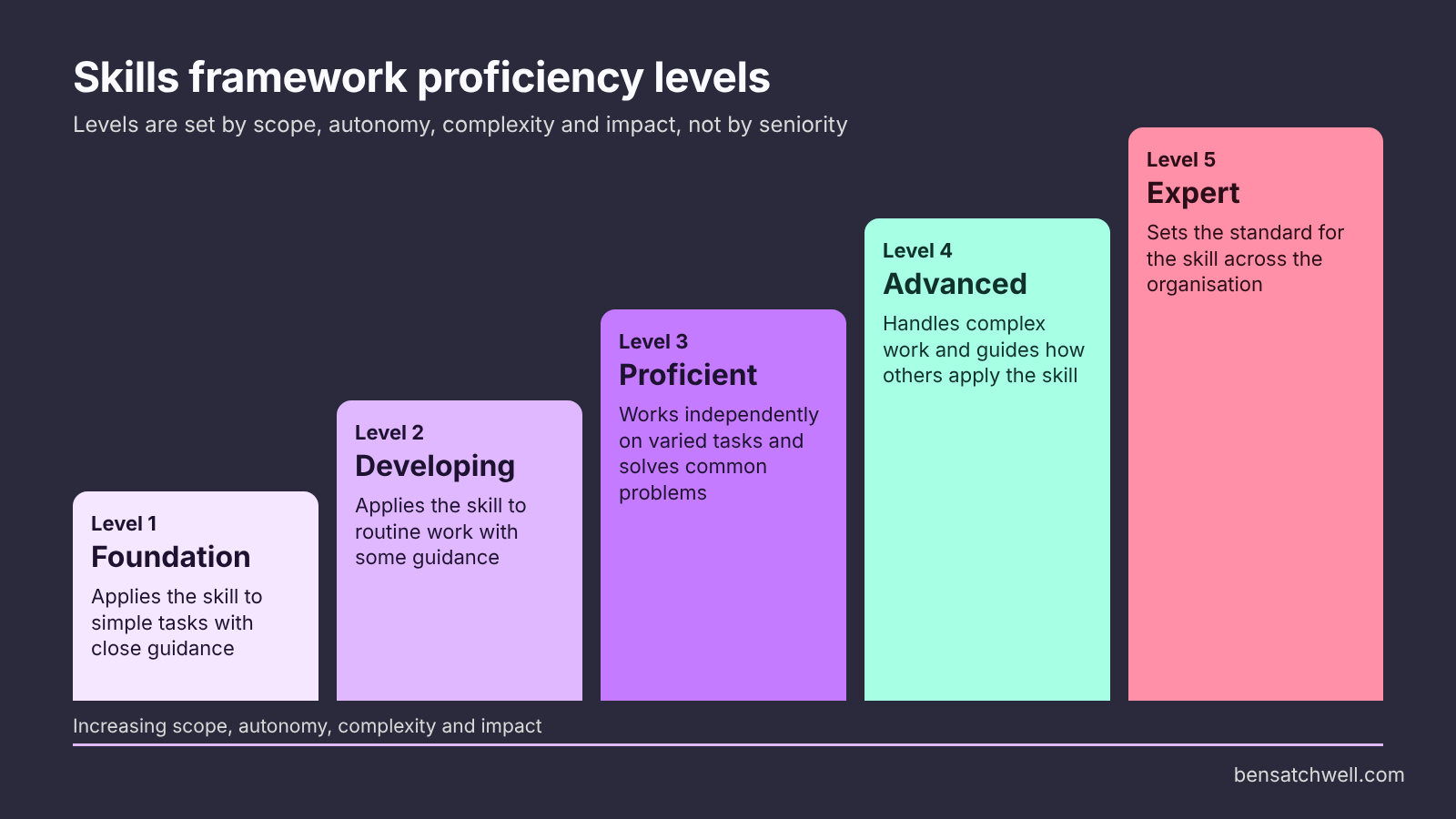
- Proficiency levels. A scale of four to six levels set by scope, autonomy, complexity and impact, not by seniority or years of service.
- Level descriptors. The written statements of what performance looks like at each level, so assessment has something to test against.
- Application rules. How the framework is used: which roles draw on it, who assesses, how often, and who owns changes.
If you need the building blocks first, read what skills and skills taxonomies are and what knowledge is.
A note on terminology. A competency framework is also called a competency model, especially in the United States. I use competency profile for the competencies and required levels for one role, and competency matrix for the grid of required against current proficiency. Usage varies by region, and I explain the differences in this competency model definition.
Why does a skills framework exist?
It exists because skills data is only useful when it is comparable. Without a shared definition and scale, a skills inventory records opinions. One team rates a person "advanced" in project management because they run large programmes, another rates a person "advanced" because they finished a certification. The numbers cannot be added up, compared or used to plan.
A framework fixes the comparison problem, and four decisions then draw on it.
- Workforce planning. What the organisation can do today against what the strategy needs.
- Hiring and mobility. Matching people to roles on evidence of skill, not job titles.
- Learning and development. Targeting effort at the gap between held and required levels.
- Job design. Stating the skills a role needs in the role's job description, at a stated level.
How does a skills framework work in practice?
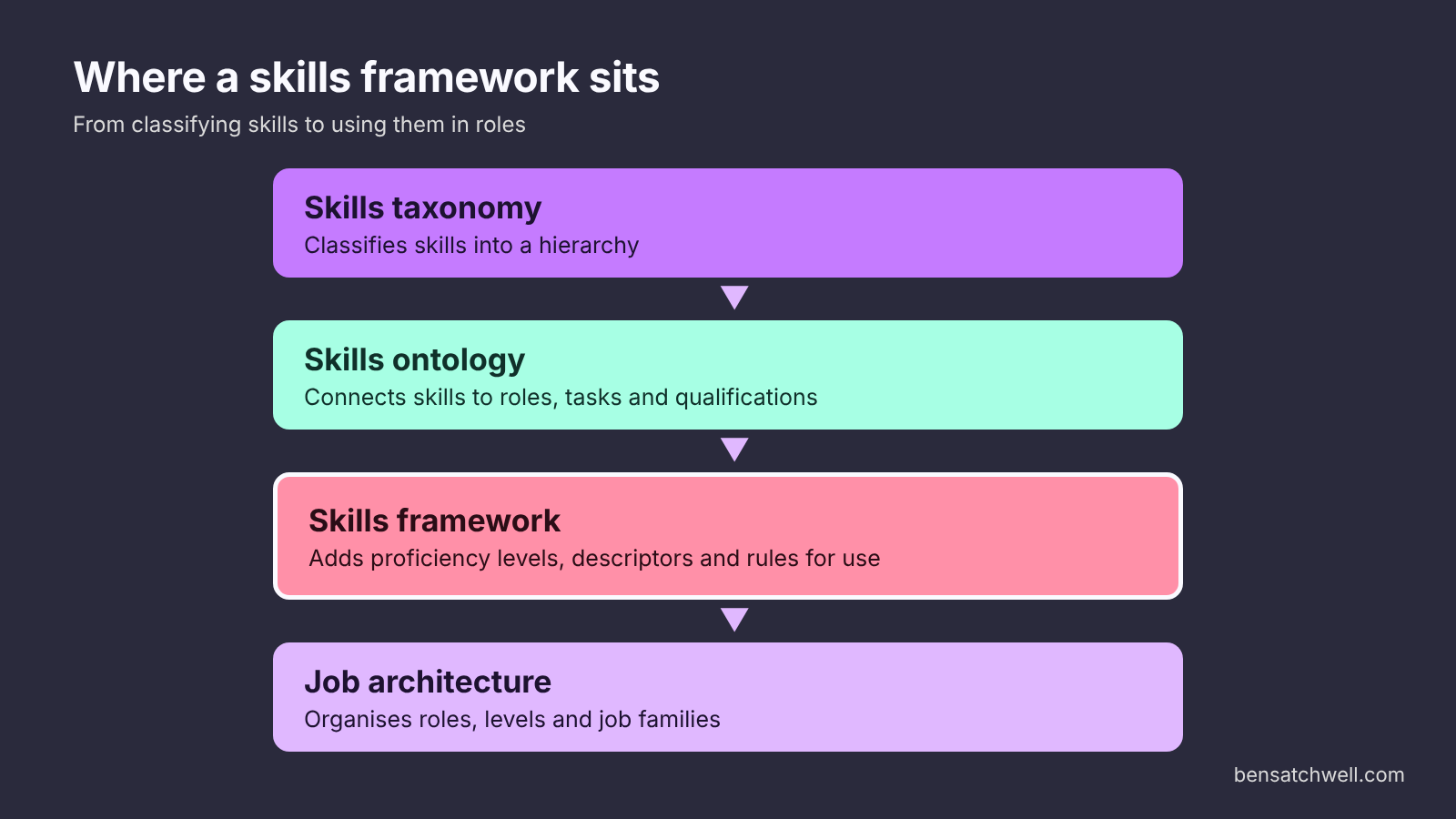
The framework sits in the middle of a stack. A skills taxonomy is a structured, hierarchical classification of skills, grouped and defined so a skill means the same thing wherever it appears. A skills ontology goes further and defines the relationships between skills and other entities such as roles, tasks, competencies and qualifications. Where a taxonomy classifies, an ontology connects. The framework adds the part neither supplies: levels, descriptors and rules for use.
Taxonomies can be very large. ESCO, the European Commission's multilingual classification of skills, competences and occupations, describes 3,039 occupations and 13,939 skills and links skills to the occupations they relate to (European Commission, ESCO). That scale is useful for matching and search. It is not a framework, because a list of thousands of skills carries no statement of how well anyone needs to perform them.
In practice a skills framework works at two levels. At the organisation level it defines the skills that matter and the scale. At the role level, a role profile selects a handful of skills and states the required level of each. SFIA follows the same pattern: its professional skill level definitions are aligned to its seven levels of responsibility, so a role and a person can be described on the same scale.
What are the types of skills framework?
Skills frameworks differ by who they serve and what they cover. The main types are below.
Occupational skills frameworks
These describe the skills of one professional field at defined levels. SFIA is the standard example for digital and IT work. I explain the structure in SFIA Framework Explained and how its skills and levels combine in SFIA Skills.
Foundation skills frameworks
These describe the reading, writing, numeracy and learning skills that nearly every job relies on. The Australian Core Skills Framework is the national example, and I cover its five levels in ACSF Levels 1 to 5 Explained.
Digital skills frameworks
These set a common scale for digital literacy across a population. The digital literacy skills framework guide compares DigComp, UNESCO and the Digital Literacy Skills Framework.
Employability skills frameworks
These cover the transferable skills that apply across jobs. The O*NET Content Model separates the skills needed for most jobs, such as reading, writing, maths and learning, from transferable skills used across different jobs, such as communication, problem solving and teamwork (O*NET Center, Content Model). I work through the issue in Employability Skills Framework. Note that much of what the market calls soft skills is better described as capability, because it is broad, durable and transferable rather than a discrete skill.
What is the difference between a skills framework and a skills taxonomy, a competency framework and a capability framework?
These structures are often treated as interchangeable. They answer different questions, and I keep them apart.
| Structure | What it organises | Question it answers |
|---|---|---|
| Skills taxonomy | Skills, in a hierarchy | What skills exist and how are they grouped? |
| Skills ontology | Skills and their links to roles, tasks and qualifications | How do skills relate to everything else? |
| Skills framework | Skills with levels and rules for use | How well must this skill be performed, and how is that judged? |
| Competency framework | Competencies, which integrate skills, knowledge, judgement and behaviour in a role | What does good performance look like in the role? |
| Capability framework | Broad, durable human capabilities that people carry across roles | What can this person grow into as work changes? |
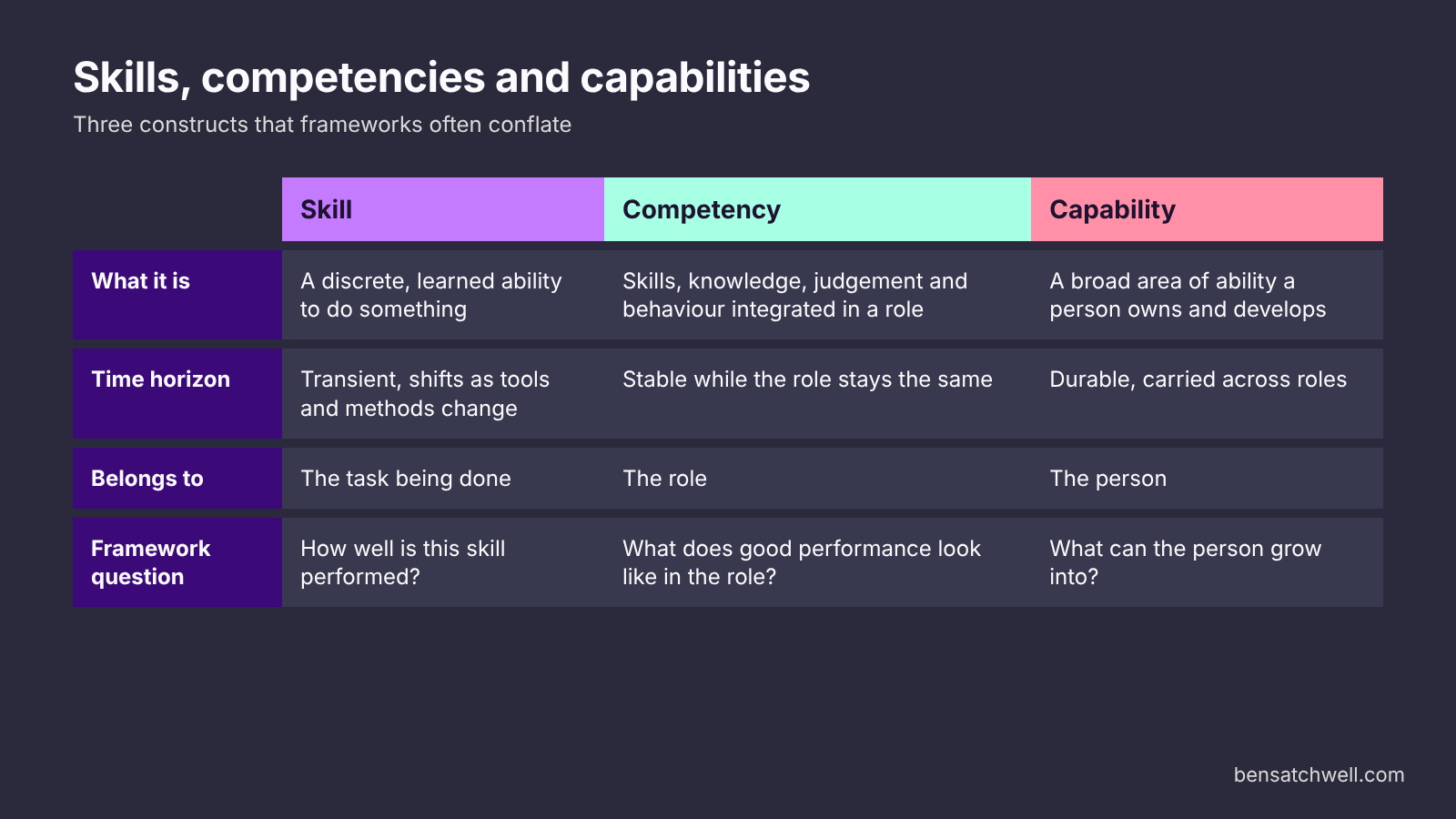
A skills framework is not a competency framework with a different name. Skills are the granular, changeable inputs. Competencies integrate them with knowledge, judgement and behaviour at a level of proficiency in a role. Capabilities are broader again and belong to the person, not to a single role. A skills framework is also not a skills taxonomy, though it usually contains one, and it is not a job architecture, which is the structure of roles, levels and job families that all three framework types plug into.
How do you build a skills framework?
1. Decide the purpose and the population
Name the decision the framework supports, whether workforce planning, hiring or development, and the roles it covers. A framework built to serve every purpose serves none.
2. Start from a standard where one exists
Use SFIA for digital roles, the ACSF for foundation skills and ESCO or O*NET as reference lists for occupations. Selecting from a standard is faster than writing definitions from scratch, and it gives you a common language with the market.
3. Define each skill in one or two sentences
State what the skill is and what it is not. If you cannot separate it from a neighbouring skill, merge the two.
4. Set four to six proficiency levels
Define the scale by scope, autonomy, complexity and impact. Check that each level is distinguishable from the one above and below, and that no level depends on seniority or tenure.
5. Write level descriptors as observable statements
Describe what a person does at each level, in the present tense, with an example from the work. Descriptors are what assessors test against, so vague wording defeats the framework.
6. Attach skills to roles
For each role, select five to seven skills and state the required level of each. This is the point where the framework meets the job description, and where many frameworks stop short.
7. Assign an owner and a review cycle
Skills change faster than competencies or capabilities, so schedule a review at least yearly. Record who can add, retire or redefine a skill.
Where do skills frameworks commonly fail?
- A list in place of a framework. Skills are named but not levelled, so nothing can be compared.
- Too many skills. A framework of several hundred skills cannot be maintained or assessed, and people stop using it.
- Levels tied to seniority. Level 4 becomes "manager", and the scale measures status instead of skill.
- Self-rating with no evidence. Scores drift upwards and the data loses value within a year.
- No link to roles. The framework lives in the learning system and never reaches the job description.
- Mixed constructs. Skills, competencies and capabilities sit in one list as though they were the same kind of thing.
What are the trade-offs when designing a skills framework?
Breadth against upkeep. A broad framework covers more of the workforce but costs more to maintain. Cover the skills that drive decisions and leave the rest to the taxonomy.
Standard against custom. A published standard such as SFIA is credible and portable but may not fit your work. A custom framework fits but must be maintained by you. Many organisations adopt a standard and add a thin local layer.
Skills against capabilities. Skills suit work that changes slowly or where precision matters, such as technical and regulated roles. Capabilities suit work that changes quickly, because they carry across roles. Use a skills framework where the specific ability must be certain, and a capability framework where adaptability matters more.
FAQ
What is a skills framework?
A skills framework is a governing structure that defines skills together with proficiency levels and the rules for how they are applied. SFIA is the best-known example.
What is the difference between a skills framework and a skills taxonomy?
A skills taxonomy classifies skills into a hierarchy so each skill has one clear place and meaning. A skills framework adds proficiency levels, descriptors and rules for application. Most frameworks contain a taxonomy, but a taxonomy alone is not a framework.
What is the difference between a skills framework and a competency framework?
A skills framework defines discrete, learned abilities and the levels at which they are performed. A competency framework defines competencies, which integrate skills, knowledge, judgement and behaviour as applied in a role.
How many levels should a skills framework have?
Four to six is a workable range. Fewer levels cannot separate real differences in performance, and more than six are hard to describe and harder to assess consistently. SFIA uses seven levels of responsibility, and individual SFIA skills are not defined at every level.
What is an example of a skills framework?
SFIA for digital and IT roles, the Australian Core Skills Framework for foundation skills, and DigComp for digital literacy are three well-known examples.