
Most discussions of the employability skills framework treat it as a checklist. Eight items, each with a label: Communication, Teamwork, Problem Solving, and the rest. A broad expectation that people either have them or they do not. That reading misses what makes the framework useful and why it exists in the first place.
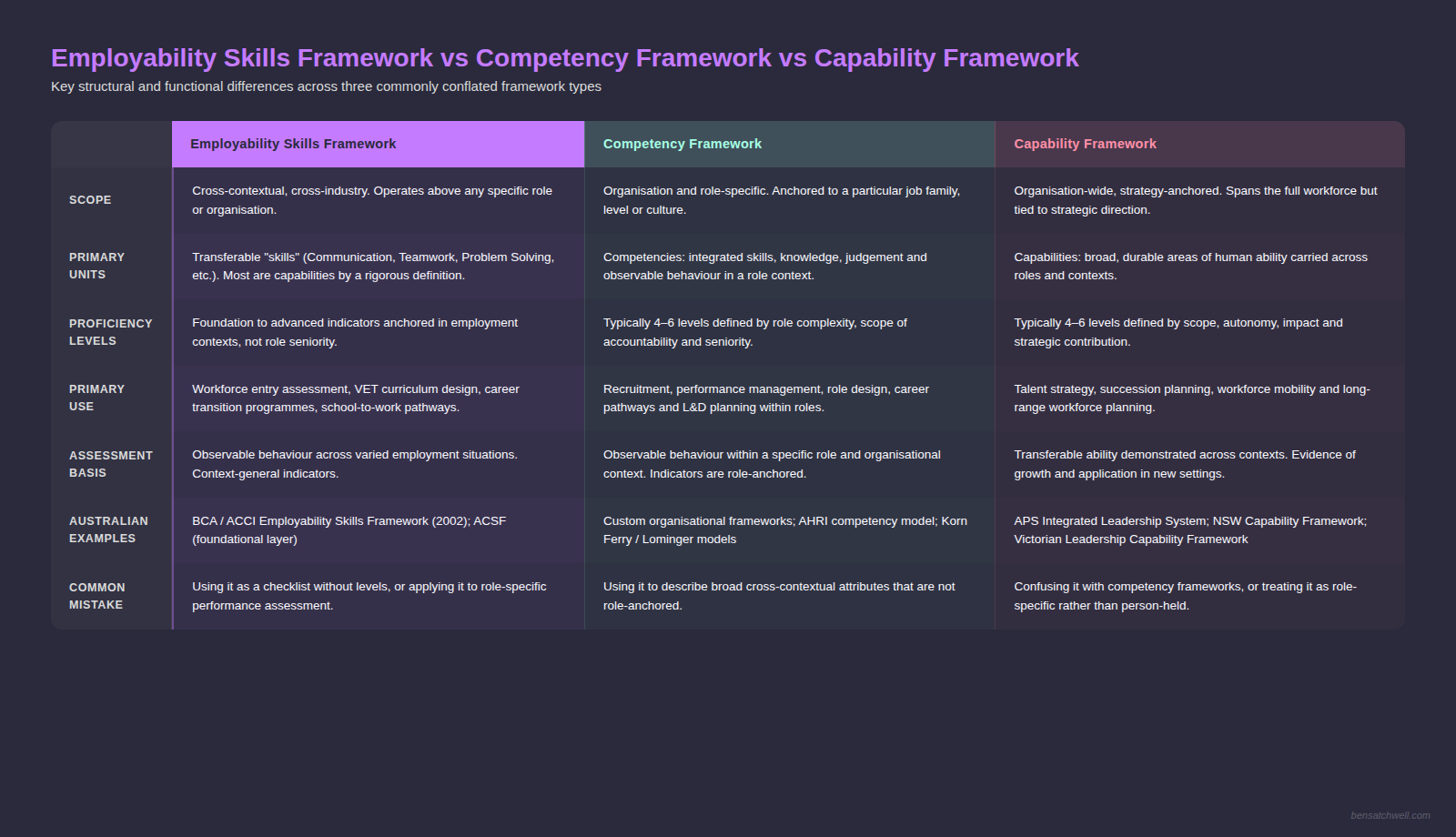
An employability skills framework is a structured system that defines the transferable, cross-contextual skills a person needs to participate effectively in employment, regardless of their industry, role, or level of seniority. It operates above the role. Where a competency framework asks whether someone can perform well in a specific job, an employability skills framework asks whether they are ready to work at all. A competency framework is also called a competency model, especially in the United States, and usage varies by region. I explain the differences in this competency model definition.
What Is an Employability Skills Framework?
An employability skills framework is a defined set of transferable workplace skills, with indicators of what each skill looks like at different levels of proficiency, used to assess and develop a person's general readiness for employment across diverse work settings.
The most established Australian example is the Business Council of Australia and Australian Chamber of Commerce and Industry framework published in 2002, often called the BCA/ACCI framework. It defined eight skills: Communication, Teamwork, Problem Solving, Initiative and Enterprise, Planning and Organising, Self-Management, Learning, and Technology. Each skill was accompanied by observable indicators describing what effective workplace performance looks like.
The framework was built for workforce entry assessment, VET curriculum design, and school-to-work transition programmes. Its purpose was to give educators, employers, and jobseekers a shared language for readiness. Not performance in a specific role. The foundational behaviours that make employment viable across contexts.
Why the Employability Skills Framework Exists
The problem the framework was designed to solve is structural. Employers consistently reported that graduates and new entrants could demonstrate technical knowledge but struggled in the realities of work: managing their time, communicating clearly under pressure, working within teams they did not choose, or responding constructively when plans changed. These were not gaps in subject matter. They were gaps in workplace behaviour.
VET at the time was heavily content-focused. Qualifications confirmed what someone knew, not how they performed. The employability skills framework gave VET providers and schools a structure for addressing behavioural readiness alongside content knowledge, and gave employers a common reference for what "job ready" actually meant.
The framework also addressed a language problem. Employers called these attributes "soft skills." Providers called them generic skills or key competencies. Researchers called them transferable skills. None of these terms mapped cleanly to each other, and none gave a consistent picture of what was being measured. A shared framework replaced the noise with something workable.
How the Employability Skills Framework Works in Practice
The framework operates at two levels. At the national level, it provides a shared classification of the skills that employment readiness requires. At the individual level, it provides a set of observable behavioural indicators that can be used for assessment and development.
Each of the eight skills includes a set of facets: more specific dimensions of that skill. Communication, for example, includes listening, reading, writing, and oral communication facets. Teamwork includes contributing to team outcomes, understanding team roles, and supporting others. These facets give assessors and educators something specific to observe and develop, rather than a vague general attribute. Understanding that knowledge, skills, and capabilities are distinct constructs matters here: as the article on what knowledge is explains, knowing something and being able to apply it in the context of work are not the same thing.
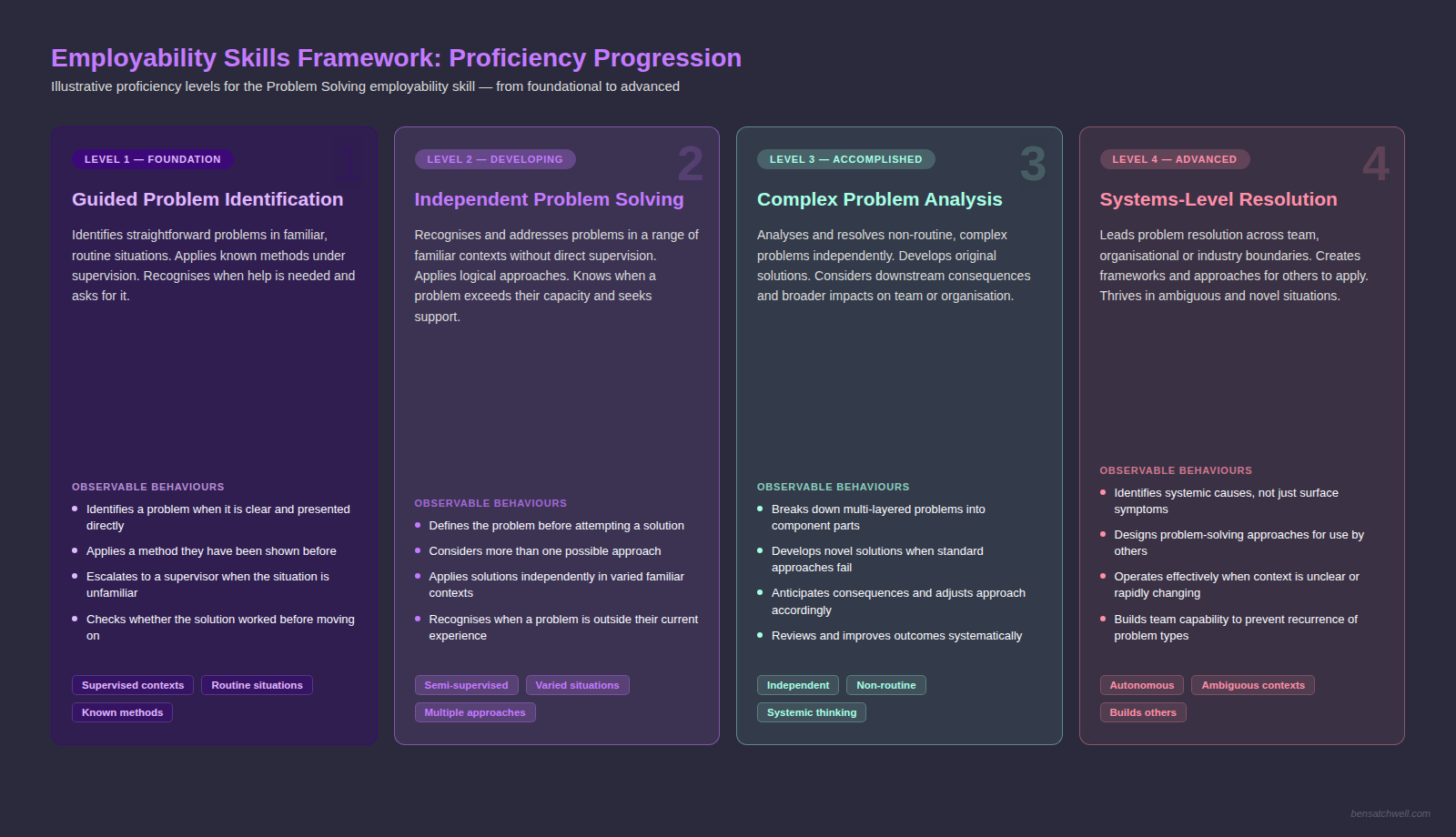
Proficiency indicators describe what each skill looks like at a foundation level, a developing level, and an advanced level. The distinctions are anchored in employment contexts, not role seniority. A foundation-level Problem Solving indicator might describe identifying a clear problem in a routine situation and applying a known method. An advanced indicator describes addressing complex, ambiguous problems, developing novel approaches, and contributing to systemic improvements.
This levelling structure is what separates a skills framework from a checklist. A competency framework uses similar levelling logic but anchors it to a role, a level of seniority, and an organisational context. The employability skills framework anchors its levels to general employment situations, which means the same framework applies equally to a retail environment, a construction site, or a government office.
What the Employability Skills Framework Is Not
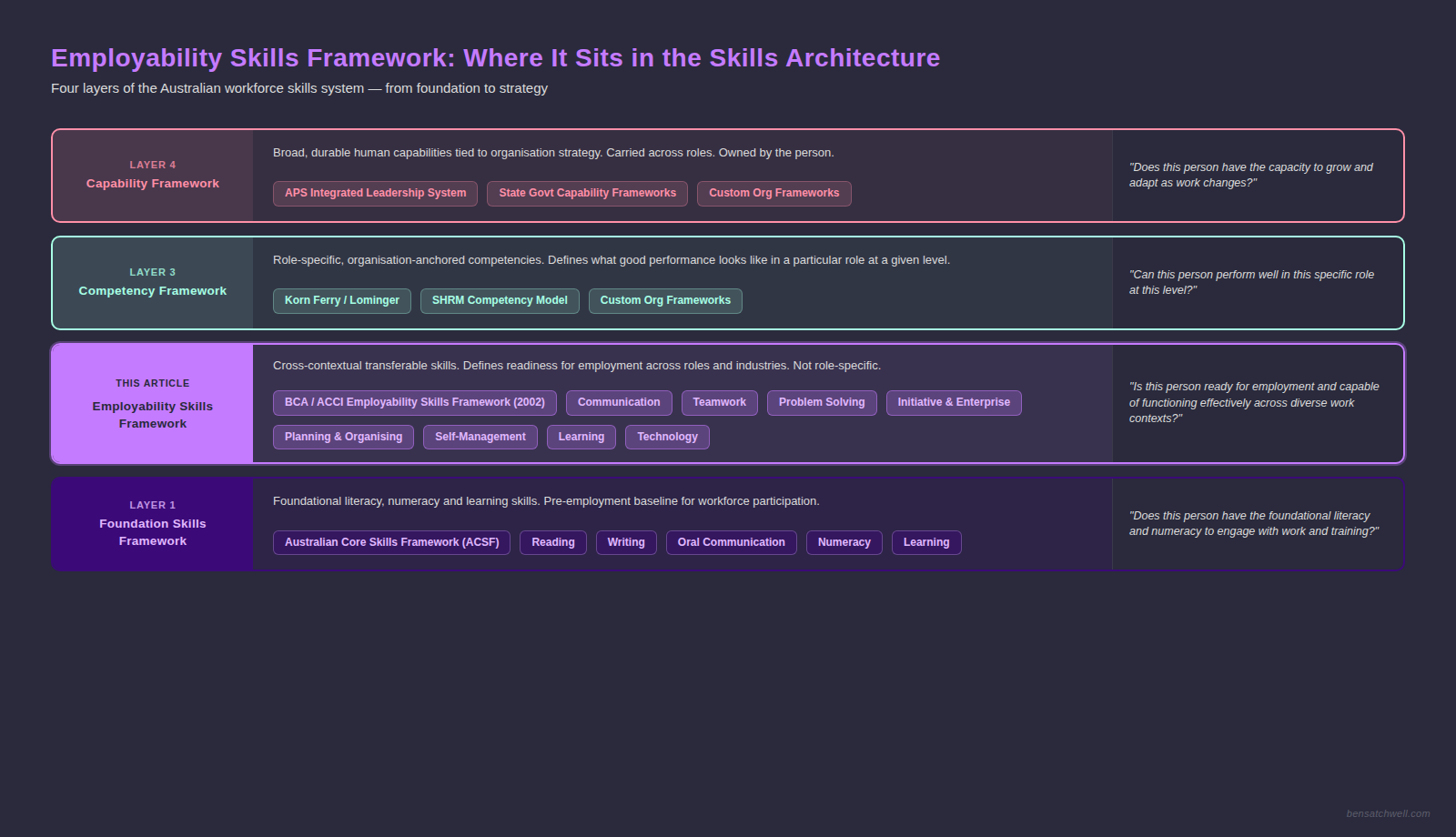
The most common error is using the employability skills framework as a substitute for a competency framework. They address different questions. A competency framework asks: can this person perform well in this specific role, at this level, in this organisation? The CIPD's guidance on competency frameworks confirms that competencies are role-anchored by design, defined against specific performance expectations within a role family and organisational context. An employability skills framework asks: is this person ready for employment in general? The frame of reference is the world of work, not a particular organisation or job.
The second common error is treating the framework as equivalent to a capability framework. This is a conceptual misfit. A capability, by rigorous definition, is a broad, durable area of human ability carried across roles and contexts, owned by the person rather than the role. Most of what the employability skills framework calls a "skill" is actually a capability. Communication is not a discrete skill in the technical sense. It is a broad capability. Problem Solving is a capability. Self-Management is a capability.
The BCA/ACCI framework used the word "skills" because that term was accessible to the broadest audience in 2002. By more rigorous definitions, though, most of the eight items are capabilities, not skills. A skill is discrete, learned, and specific. A capability is broad, durable, and transferable. Treating Problem Solving as if it were a discrete technical skill and assessing it through a single test misrepresents what is being measured. Most of the eight items require observation across varied situations over time, which is a capability assessment method.
Third, the employability skills framework is not a foundation skills framework. The Australian Core Skills Framework (ACSF) covers the pre-employment layer: reading, writing, oral communication, numeracy, and learning. Each of those five core skills is described across five ACSF levels. These are the literacy and numeracy foundations that make employment engagement possible. The employability skills framework sits above that layer, addressing the behavioural and interpersonal attributes that shape how someone functions in work once they can engage with it.
Named Examples and Related Frameworks
The BCA/ACCI framework is the most direct Australian example. It shaped the vocational education sector's approach to generic skills for over a decade and remains a reference point in contemporary VET curriculum design.
The ACSF, published by the Australian Government, defines the foundational literacy layer below the ESF. Practitioners need to hold both frameworks in mind when working with workforce entry populations. They address sequential, not overlapping, concerns.
Internationally, the European Commission's Skills Agenda frames a similar set of concerns at policy level: the broad skills that enable labour market participation. The specific constructs and their relationship to national frameworks vary by country, but the underlying challenge is consistent.
The SFIA framework (Skills Framework for the Information Age) offers a useful contrast. SFIA is a skills framework in the technical sense: it defines specific, levelled skills within the technology sector and provides detailed proficiency descriptors. Where SFIA is granular and sector-specific, the employability skills framework is broad and cross-contextual. Both use proficiency levels, but to different ends.
Common Failure Modes
Using it as a tick-box checklist. The framework is only useful if the proficiency indicators are applied. Rating someone as "has Communication" tells you nothing. Rating them as "Level 2 on the oral communication facet, Foundation on the written communication facet" gives you something actionable.
Applying it to role performance assessment. The framework is not designed to assess whether someone is performing well in a specific role. It assesses employment readiness across contexts. Using it for performance management substitutes a general instrument for a specific one and produces unfair comparisons.
Ignoring the distinction between skills and capabilities. Treating every item as a discrete skill creates assessment problems. Most of the eight items require observation across varied situations over time, which is a capability assessment method, not a skills test.
Conflating it with the ACSF. Foundation skills assessment is a pre-condition for employability skills assessment, not a substitute. A person who scores well on the ACSF may still show significant gaps on the employability skills framework. They are measuring different things.
Trade-offs and Constraints
The employability skills framework is a broad-brush instrument. That is its design. It cannot tell you whether someone will perform well in a specific role. It tells you whether they have the general behavioural readiness that employment requires. It should always be supplemented with role-specific competency assessment at the point of recruitment.
The framework is also static by design. It does not accommodate emerging constructs such as digital literacy, data literacy, or AI fluency in any meaningful way. Technology is included as one of the eight skills, but the facets described in 2002 no longer reflect the actual demands of contemporary work. Practitioners using the framework for workforce planning need to recognise this gap and supplement accordingly.
A competency profile built from a current competency framework will be more specific and more actionable for recruitment and performance management. The employability skills framework serves a different function: it describes readiness for work, not readiness for a specific job.
Frequently Asked Questions
What is an employability skills framework?
An employability skills framework is a structured system that defines the transferable, cross-contextual skills a person needs to engage effectively in employment across industries and roles. The most established Australian example is the BCA/ACCI framework (2002), which defines eight skills: Communication, Teamwork, Problem Solving, Initiative and Enterprise, Planning and Organising, Self-Management, Learning, and Technology.
How does an employability skills framework differ from a competency framework?
A competency framework is role-specific and organisation-anchored. It defines what good performance looks like in a particular job at a particular level. An employability skills framework is cross-contextual. It defines the general behavioural readiness a person needs to function in any employment setting, regardless of role or industry.
Are employability skills the same as soft skills?
No. Soft skills is an informal label covering a broad range of interpersonal and behavioural attributes. The employability skills framework gives those attributes a defined structure, with specific facets and proficiency indicators. Most of what is labelled "soft skills" in practice are capabilities by a rigorous definition: broad, durable, transferable areas of human ability. Not discrete skills in the technical sense.
What is the difference between the Employability Skills Framework and the Australian Core Skills Framework?
The ACSF defines foundational literacy and numeracy skills: the pre-employment baseline needed to engage with work and learning. The Employability Skills Framework sits above that layer, describing the behavioural and interpersonal attributes required for effective workplace functioning. They are sequential frameworks addressing different layers of the same workforce readiness challenge.
Can the employability skills framework be used for performance management?
No. The framework assesses general employment readiness, not performance in a specific role. Using it for performance management substitutes a broad cross-contextual instrument for a role-anchored one, which produces inaccurate assessments. Performance management requires a competency framework built for the specific role and context.
Who developed the Australian Employability Skills Framework?
The most widely referenced Australian framework was developed through a collaboration between the Business Council of Australia and the Australian Chamber of Commerce and Industry in 2002, commissioned by the Australian Department of Education, Science and Training. It built on earlier work from the Mayer Committee (1992) and the Finn Review (1991) on key competencies in post-compulsory education.