


A customer success manager job description records what the role is accountable for, not every task a customer success manager touches in a week. Most are written as long lists of activities copied from the last incumbent, which is why they are out of date by the time they are signed. This page sets out what to put in one, using the structure from my guide to the job description and the standard described in the customer success competency model.
I use the US term job description here. In Australia the same document is usually called a position description, and everything below applies unchanged. The job description vs position description page covers the wording differences.
What is a customer success manager job description?
A customer success manager job description is a short written record of why the customer success manager role exists, the outcomes it is accountable for across customer adoption, value, retention and growth, and the essential requirements of doing it well.
Customer success manager is a title the standard occupation lists have not settled on. O*NET has no occupation by that name. Its nearest match, customer service representatives, covers people who interact with customers to provide basic or scripted information in response to routine inquiries about products and services. That is a narrower job than most customer success managers hold, and none of the reported job titles for that occupation is customer success manager.

A note on terminology. A competency framework is also called a competency model, especially in the United States. I use competency profile for the competencies and required levels for one role, and competency matrix for the grid of required against current proficiency. Usage varies by region, and I explain the differences in this competency model definition.
What is the purpose of a customer success manager role?
The purpose statement is one or two sentences that say why the role exists. The NSW Government describes a role description as a short summary of a job that explains why the role exists and what outcomes it delivers, and its guidance on creating a role description is a sound model for the wording. It tells writers to focus on outcomes, not tasks or processes, and to include only information that applies to all applicants and will stay the same over time.
A workable purpose for a customer success manager follows that advice:
To make sure each customer in the portfolio reaches the value they bought the product for and keeps getting it, so that the organisation retains and grows the customer relationship on the strength of results the customer can see.
What accountabilities should a customer success manager job description include?
Five to seven accountabilities is enough. Each one is written as an outcome that someone could check, not as a duty. The table shows how common customer success tasks convert into outcomes.
| Task people usually list | Accountability written as an outcome |
|---|---|
| Runs customer onboarding calls | New customers reach their first agreed result within the time the organisation has set, and the starting point is recorded |
| Holds quarterly business reviews | Every customer has a success plan with measures the customer has agreed to, reviewed on a set rhythm |
| Monitors usage and health scores | Risks to a customer's results are found early, with an owner and an action recorded |
| Manages renewals and expansion | Renewal and growth conversations rest on evidence of value delivered, and the sales team knows where each account stands |
| Passes on customer feedback | Recurring customer issues reach product and support in a form those teams can act on |
The how to write a job description page walks through the steps and the review checklist for this part.
What essential requirements should it list?
The requirements are yours to set, so keep them short. A degree is common in this field but not a given, so list one as essential only if the work cannot be done without it.
- Essential: experience managing a portfolio of customer accounts, experience showing customers the results they are getting, and experience working with sales, product and support colleagues.
- Desirable: knowledge of the organisation's sector or product category, and familiarity with its customer systems, both of which can be learned in the first months.
What competency profile fits a customer success manager?
The job description says what the role is accountable for. The competency profile says what standard the role needs, and it selects from the organisation's framework rather than inventing new competencies. Written together they form a role profile. The levels below use a four-level scale for a mid-level customer success manager and are illustrative. Set them against your own framework.
| Competency | Required level | What it looks like in this role |
|---|---|---|
| Value management | Level 3 | Agrees measurable results with each customer and shows progress against them |
| Stakeholder influence | Level 3 | Builds working relationships across a customer's organisation, including senior sponsors |
| Commercial acumen | Level 2 | Links delivered value to renewal and growth, and works with sales on the approach |
| Product and market knowledge | Level 3 | Advises customers on how to use the product for their situation |
| Cross-functional collaboration | Level 3 | Settles trade-offs with product and support without escalating routine ones |
Do not confuse these proficiency levels with role levels. The NSW Public Sector Capability Framework, for example, uses five capability levels from Foundational to Highly Advanced, and notes that its behavioural indicators are not exhaustive and not all will be relevant for every role. The role level says how big the job is. The proficiency level says how well a competency is held.

What a customer success manager job description is not
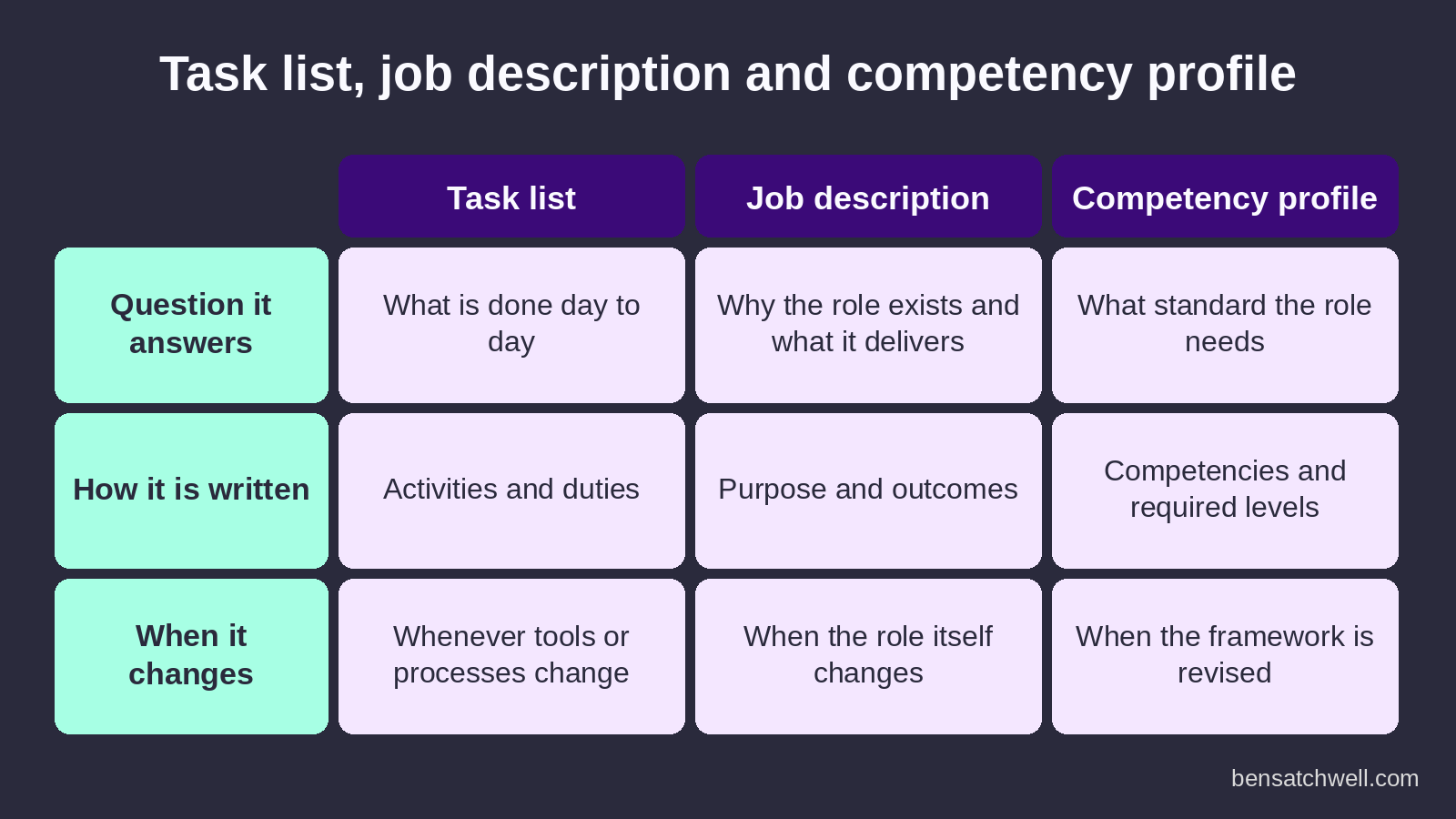
It is not a task list, a job advertisement, a performance review or a competency profile. Each of those answers a different question, and mixing them is the main reason these documents become unusable.
Where do customer success manager job descriptions go wrong?
- Sales in disguise. The role is described as a renewals quota with a friendly title, when the accountability is for the customer's results.
- Support in disguise. The role is described as answering questions and fixing issues, which is the work of the support team.
- Task inventories. The list grows with every tool and process the team adopts, until nobody can tell what the role is for.
Starting from the job description template avoids the third.
What are the trade-offs when writing one?
Outcome wording takes longer to write than a task list. It pays back at review time, because outcomes survive a change of tools, teams and methods.
A customer success description also has to fit the customers. A role covering a few large accounts and a role covering hundreds of small ones share the title but not the measures. Write for the portfolio you have, and let the competency profile hold the common standard.
FAQ
What is the difference between a customer success manager and an account manager job description?
A customer success manager job description is accountable for the results a customer gets from the product. An account manager job description is usually accountable for the commercial relationship, such as sales and renewals. The two overlap, so the accountabilities should say which outcomes belong to which role.
How long should a customer success manager job description be?
One to two pages. A purpose statement, five to seven accountabilities, a short essential and desirable list, and a pointer to the competency profile is enough.
What qualifications does a customer success manager need?
There is no single standard. O*NET has no occupation titled customer success manager, so there is no official benchmark to follow. List a qualification as essential only if the work needs it.
Is a customer success manager job description the same as a position description?
Yes. Position description is the common term in Australia and job description is the common term in the United States. The content and structure are the same.
