
Customer success has a capability problem. Most organisations hire customer success managers on intuition or sales adjacency, then assess them against vague rubrics such as relationship-focused or commercially aware. The result is a function with no shared language for what good performance means. A customer success competency model changes that. It gives the team a defined, consistent standard: the competencies expected at each role level, the proficiency required and the behavioural indicators that describe good practice. This article is written for the HR professional supporting that function.
What Is a Customer Success Competency Model?
A customer success competency model is a role-level selection of competencies from the organisation's competency framework, tailored to the customer success function. I call it a customer success competency profile. It specifies the competencies a CSM holds at each role level, from associate CSM to lead or manager, together with the proficiency required and the indicators that show what good looks like. The framework is the organisation-wide system that defines and standardises competencies across all roles. The profile is one instance of it, calibrated to the realities of this work. For the general method, see my guide to the competency model.
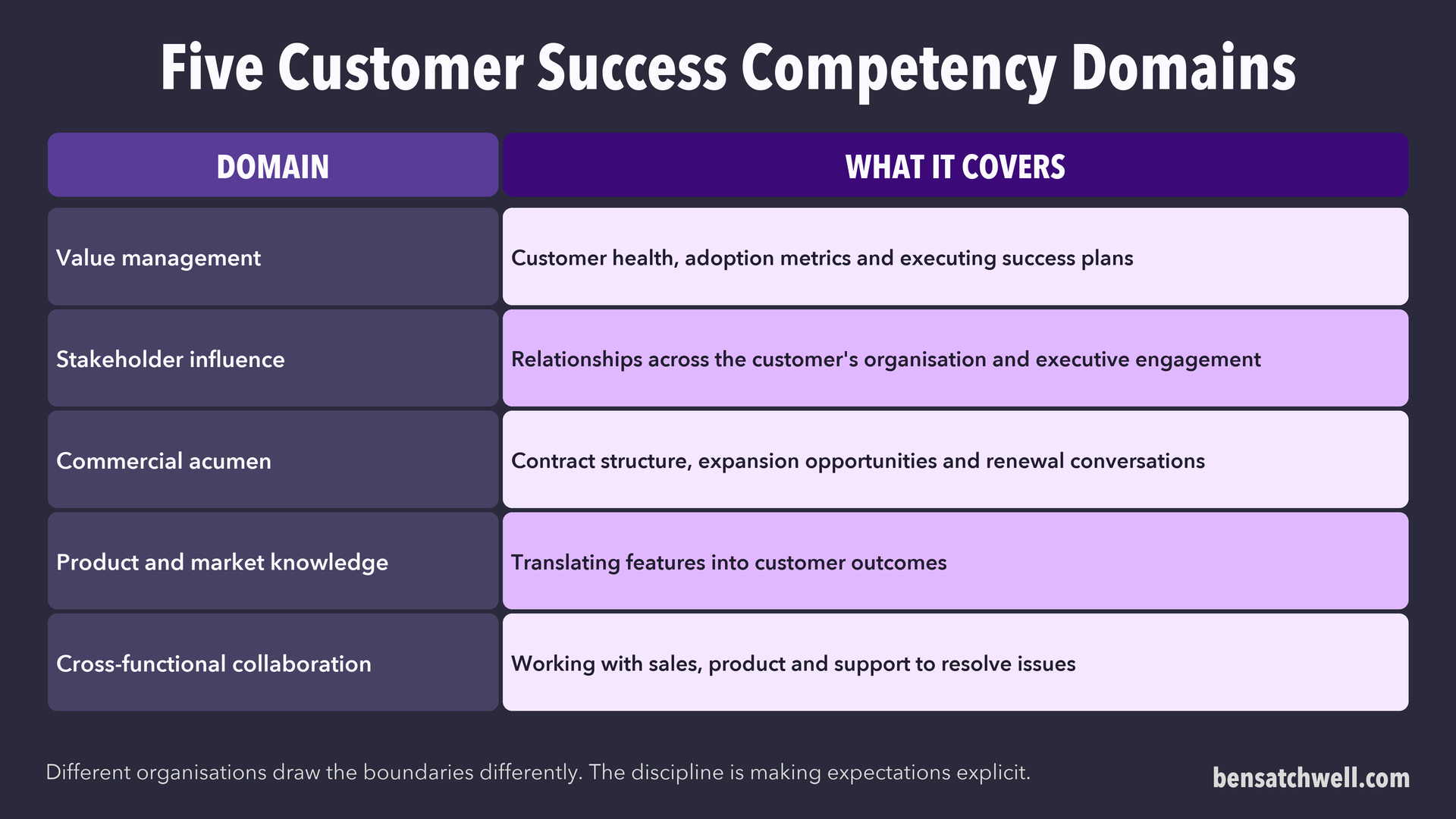
Different organisations draw the boundaries differently. The discipline is making expectations explicit.
A note on terminology. A competency framework is also called a competency model, especially in the United States. I use competency profile for the competencies and required levels for one role, and competency matrix for the grid of required against current proficiency. Usage varies by region, and I explain the differences in this competency model definition.
Why Customer Success Needs One
Customer success sits in an awkward place in most organisations. It is not sales, support or account management, though it overlaps with all three. That ambiguity creates a persistent hiring and performance problem: without a defined profile, every leader sets different standards, and what counts as a strong CSM varies from team to team. Hochstein and colleagues, in their industry and academic perspective on customer success management, describe an emerging field still developing shared standards and role definitions. A profile gives the function the definitional rigour it lacks.
It also solves a progression problem. Many CSMs have no clear picture of what senior performance requires, and are told to be more strategic without a definition of strategic in observable terms. The profile supplies one.
Domains, Levels and Indicators
Domains
Typical domains are value management, stakeholder influence, commercial acumen, product and market knowledge and cross-functional collaboration. The labels matter less than the discipline of making expectations explicit.
Levels
Four to five levels is typical: associate CSM, CSM, senior CSM, lead or principal CSM and CS manager. They are set by scope, autonomy, complexity and impact, not years of service.

The competency is the same. The level and the expected behaviour change.
An associate CSM applies value management under supervision and follows defined playbooks. A senior CSM manages it independently across complex, high-value accounts and adapts when the standard playbook does not fit.
Behavioural indicators
These are the written, levelled statements of observable behaviour that assessment is conducted against. At associate level one might read: follows the standard onboarding programme and tracks adoption milestones to defined playbook criteria. The CIPD's competency factsheet makes the general point that indicators are only useful when they describe observable action. Builds trust is not an indicator. Establishes a documented executive sponsor relationship within 90 days of onboarding is.
What the Customer Success Profile Is Not
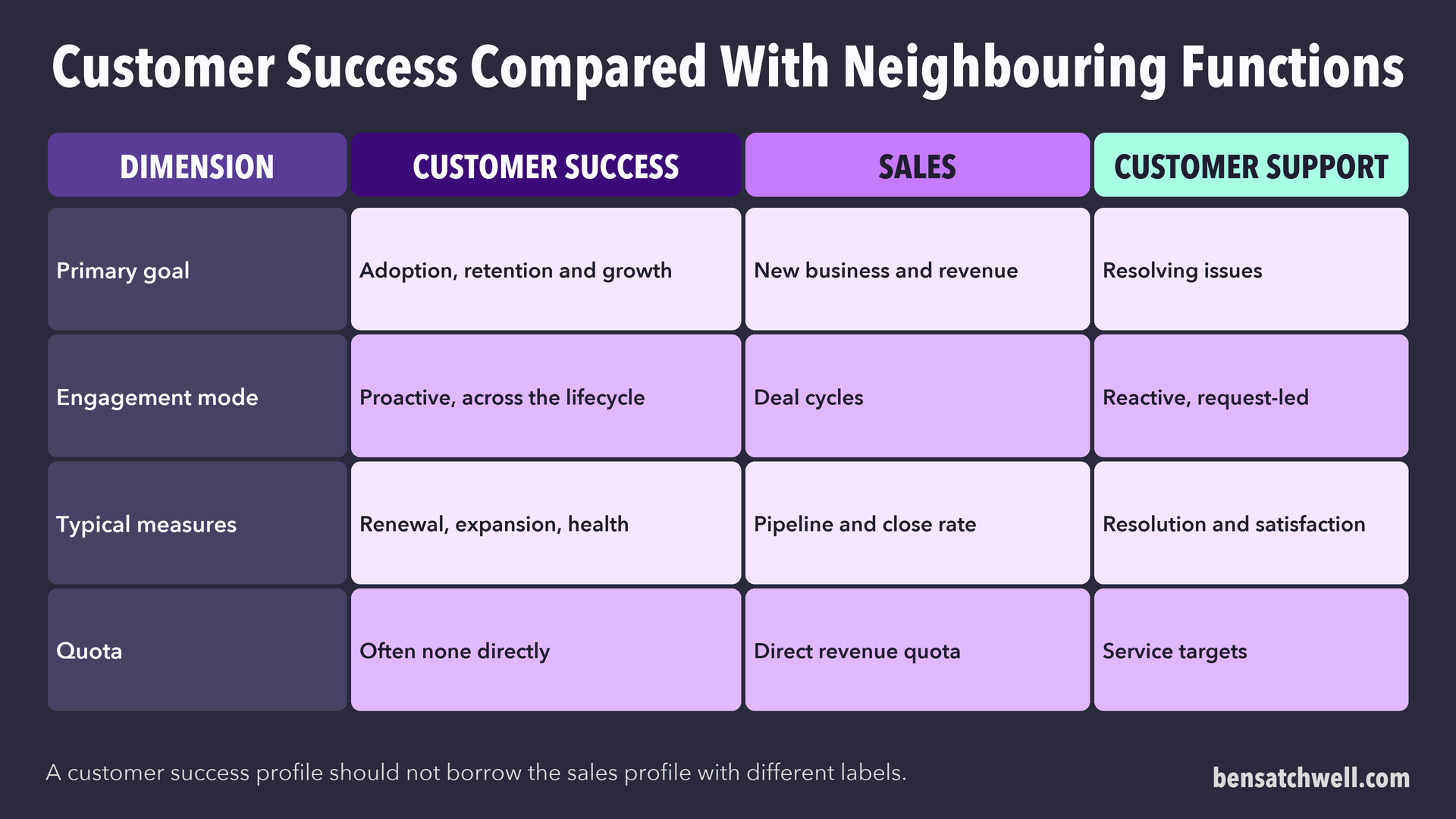
A customer success profile should not borrow the sales profile with different labels.
- Not the framework. The framework spans the organisation. See the competency framework guide.
- Not a job description. A job description lists accountabilities. The profile defines the behaviours needed to meet them well.
- Not a performance scorecard. A scorecard tracks outputs such as renewal rate, net revenue retention and health scores. The profile assesses the behaviours that produce them. A CSM can hit targets in a favourable period and still fail every behavioural standard.
- Not a sales or HR profile. They share structure, but customer success runs on proactive lifecycle management and adoption-focused engagement without a direct revenue quota. Compare the sales competency model.
Reference Standards
No single published standard governs customer success competency modelling in the way SFIA governs technology skills. The field is still building a shared vocabulary, and published community material rarely offers a properly levelled framework with auditable indicators. A more reliable route is to anchor the profile in a recognised structure, such as the CIPD's approach or the logic of the HR competency models built from professional standards, then add customer success domains and indicators on a shared governance layer.
Common Failure Modes
- Not grounded in the work. A profile designed by HR without the function describes generic professional behaviour. The adoption logic, lifecycle discipline and retention accountability disappear.
- Indicators that are not behavioural. Demonstrates commercial awareness is a trait claim. It cannot be witnessed or assessed.
- Never used. A profile not tied to hiring, calibration or career progression is documentation, not infrastructure.
Trade-Offs and Constraints
A good profile takes investment to build and discipline to maintain. As the motion shifts from high-touch to scaled, from small business to enterprise or as work changes with new tools, competencies and indicators need review. Not every team needs a bespoke profile. A smaller function may be served by a broader customer-facing profile, and the threshold for a dedicated one is roughly when inconsistent assessment creates visible hiring or progression problems. The profile also does not replace managerial judgement. A manager still has to tell a CSM who is developing normally from one who is genuinely under the standard for their level.
FAQ
What is the difference between a customer success competency model and a competency framework?
There is no difference in structure. Competency model is the usual US name for the organisation-wide system and competency framework is more common in the UK and Australia. The selection for the customer success function is a competency profile.
How many proficiency levels should it have?
Four to five. Four well-defined levels are more useful than seven blurred ones.
What are the core domains?
Value management, stakeholder influence, commercial acumen, product and market knowledge and cross-functional collaboration. They should reflect your motion, whether high-touch enterprise, scaled mid-market or low-touch.
How is it used in performance assessment?
Managers review observable behaviour against the indicators for the CSM's level. It sits beside measures such as renewal and expansion and does not replace them.
Should it differ from a sales profile?
Yes. Customer success manages ongoing lifecycle relationships and is accountable for adoption and retention. Sales works deal cycles and is accountable for pipeline and close.
Can a small team use a published profile?
With caution. Test any published profile against the team's actual work first. Generic indicators rarely hold up without calibration.