

A skills matrix is a grid that shows which skills a team needs and how well each person can do them. Most of the matrices I see are a column of names, a row of skills and a tick in each cell. That tells you who has been near a skill, not how well they apply it. This page sets out what a skills matrix should contain, how to build one and where it breaks.
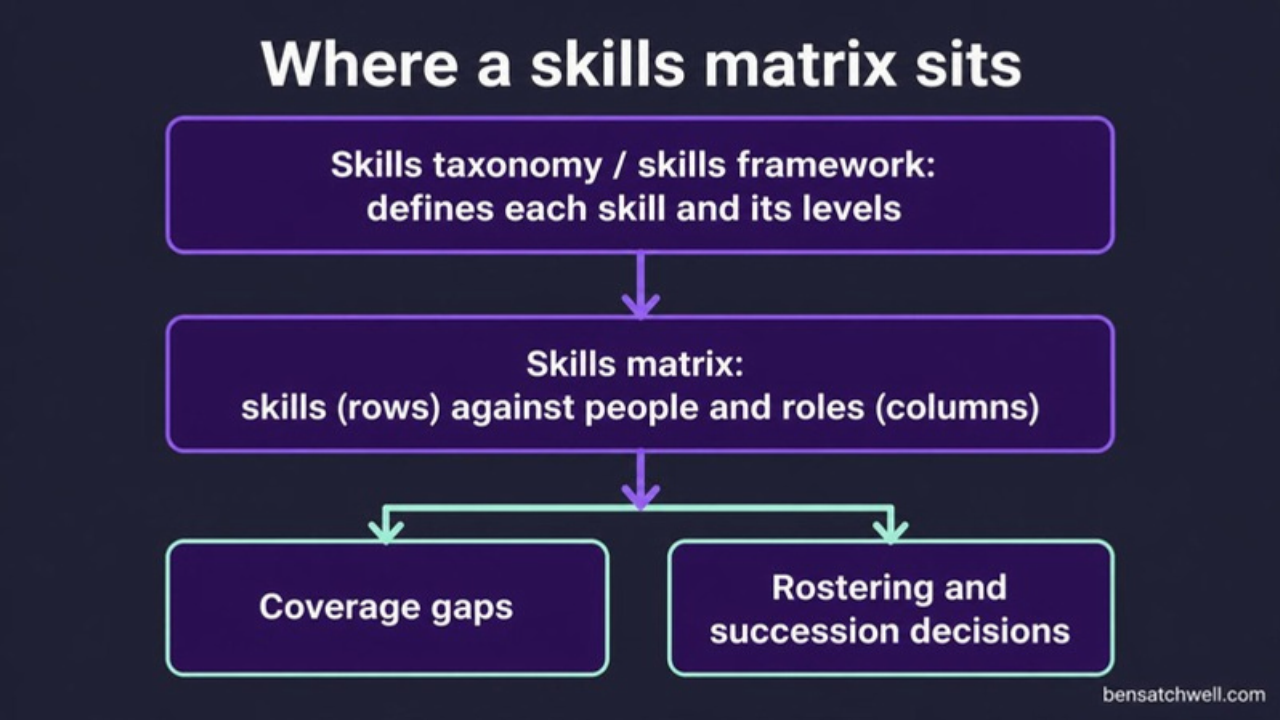
A skills matrix is built on the skills that a skills framework defines, so the quality of the matrix depends on how clearly each skill and each level is described. If your skills are vague, the grid will only record opinion.
What is a skills matrix?
A skills matrix is a grid that maps skills against people, roles or teams and records the proficiency level held, required or both.
A skill is a discrete, learned ability to do something, such as building a pivot table or reviewing a contract. A skills matrix lists skills at that level of detail. It does not list broad areas of ability such as judgement or adaptability, which are capabilities, and it does not list competencies, which integrate skills, knowledge and behaviour in a role. The skills and skills taxonomies page explains why that distinction matters.
A note on terminology. A competency framework is also called a competency model, especially in the United States. I use competency profile for the competencies and required levels for one role, and competency matrix for the grid of required against current proficiency. Usage varies by region, and I explain the differences in this competency model definition.
Why does a skills matrix exist?
It exists to answer a coverage question: for the work we have to deliver, who can do what, and where are we thin? A manager can usually answer that for a team of five from memory. Past about fifteen people, or across several sites, memory fails, and decisions about rosters, hiring and succession are made on whoever comes to mind.
The matrix makes that knowledge visible and comparable. It also gives workforce planning a starting point. The US Office of Personnel Management lists workforce planning among the uses of competency and skills data, alongside selection and performance management (US Office of Personnel Management, competencies).
How does a skills matrix work in practice?
1. Choose the skills
List the skills the work needs, grouped into three to six families. Keep each skill specific enough that two managers would rate it the same way. "Data analysis" is too wide. "Writes SQL queries that join four or more tables" can be assessed.
2. Define the levels
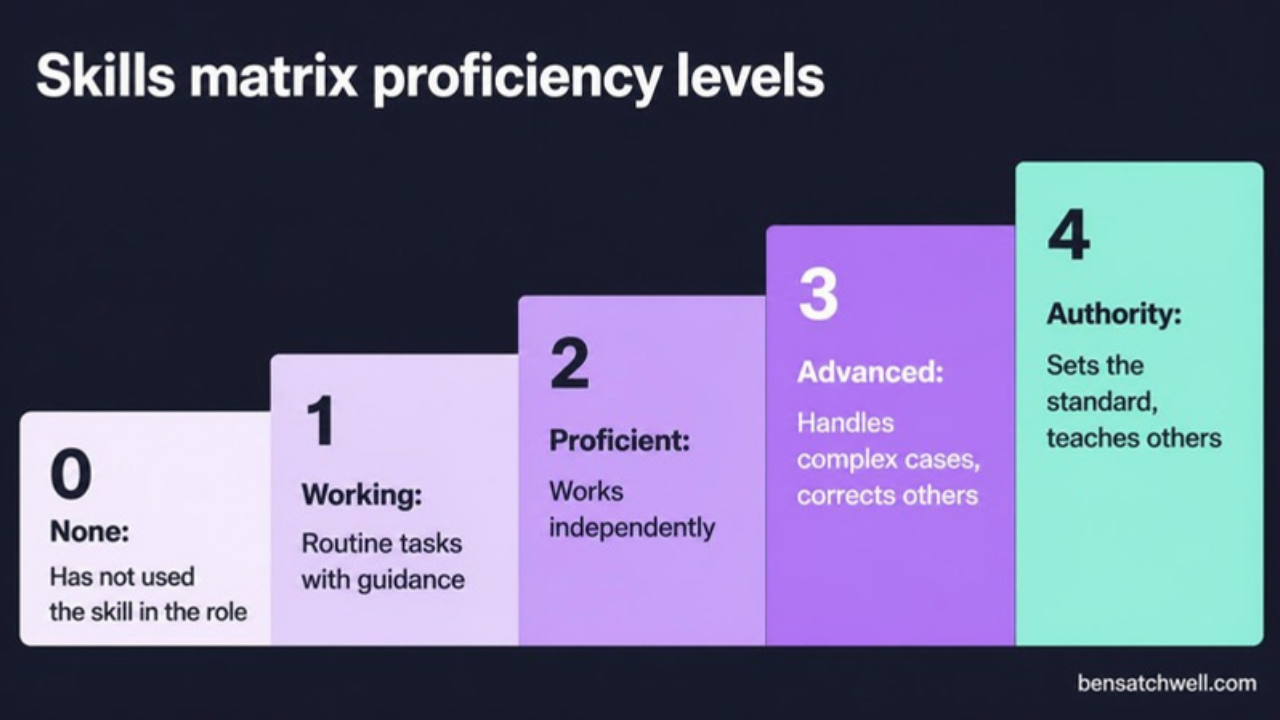
Use one scale for every skill. Four levels are enough for most teams, and I keep to four to six. Define each by what the person can do and how independently, not by job title or years of service.
| Level | Label | What the person can do |
|---|---|---|
| 0 | None | Has not used the skill in the role. |
| 1 | Working | Completes routine tasks with guidance and checking. |
| 2 | Proficient | Completes tasks independently, including less routine cases. |
| 3 | Advanced | Handles complex cases and corrects the work of others. |
| 4 | Authority | Sets the standard for the skill and teaches it to others. |
3. Set the required level for each role
For every role, record the level it needs for each skill. This gives you two readings in each cell: the level required and the level held. The gap between them is the useful number.
4. Rate people against evidence
Rate each person on observed work, a work sample or a short practical check, and ask the person and their manager to agree. A self-rating alone drifts upwards, and a manager-only rating misses skills used outside the team.
5. Read the grid for coverage, not for names
Count how many people hold each skill at level 3 or above. A skill held by one person is a single point of failure. A skill held by nobody is a hiring or development decision.
| Skill | Required | Asha | Ben | Chen | Cover at level 3+ |
|---|---|---|---|---|---|
| Pivot tables | 3 | 3 | 2 | 4 | 2 of 3 |
| SQL joins | 3 | 1 | 0 | 3 | 1 of 3 |
| Dashboard design | 2 | 2 | 3 | 2 | 1 of 3 |
What a skills matrix is not
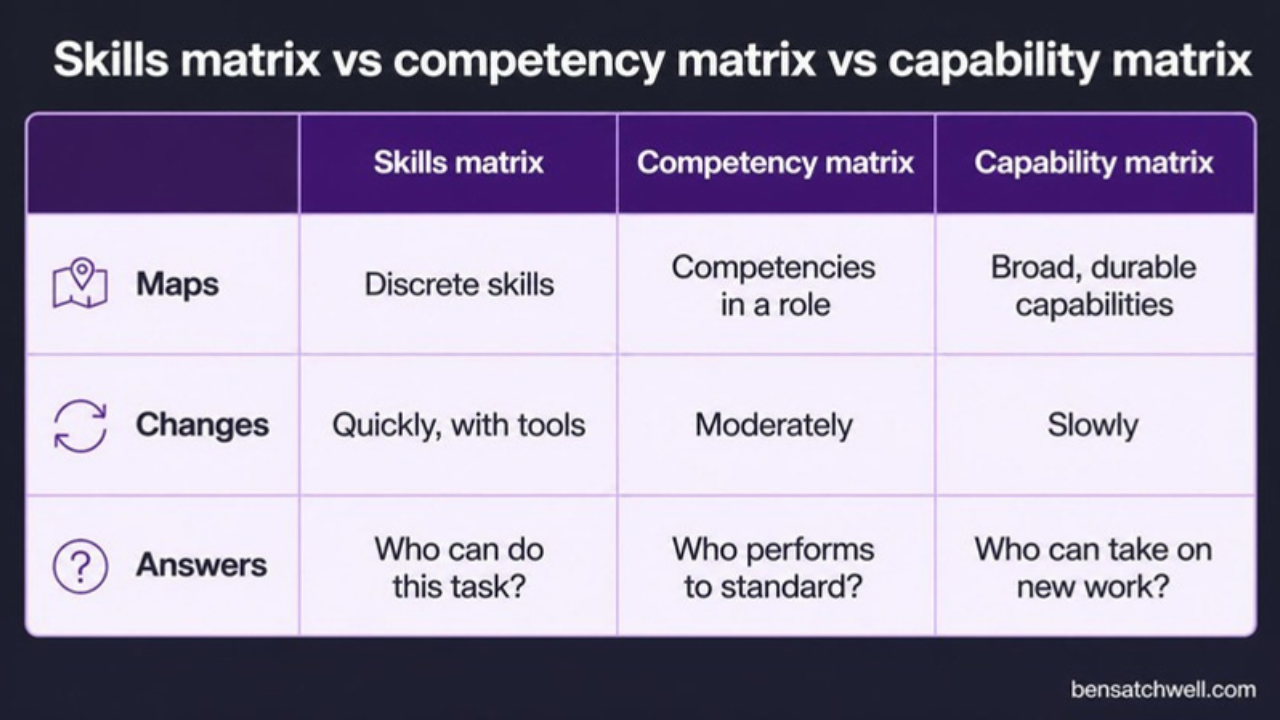
- Not a competency matrix. A competency matrix maps competencies, which combine skills, knowledge and behaviour at a level. The skills and competency matrix page sets out when to use each, and the competency matrix page covers building the second.
- Not a capability matrix. Capabilities are broad, durable and carried across roles. A skills matrix is narrower and changes faster. The team capability matrix page covers that tool.
- Not a skills taxonomy. A taxonomy classifies skills. A matrix applies that classification to people.
- Not a performance review. It records what a person can do, not how well they performed last quarter.
Which standards help you build a skills matrix?
You do not need to write a skills list from nothing. Two public sources give you tested wording and levels.
The SFIA Foundation publishes a framework for digital skills with seven levels of responsibility, and its definitions of skill levels are aligned to those levels (SFIA Foundation, the SFIA framework). My guide to the SFIA framework shows how the levels work. Even outside technology, the idea of one level scale applied to every skill is worth copying.
The European Commission's ESCO classification organises skills in a hierarchy and records relationships between skills and occupations in a profile for each skill (European Commission, ESCO skills pillar). It is a useful reference when you need to name a skill consistently or check which skills an occupation normally draws on.
Where do skills matrices commonly fail?
- Ticks instead of levels. A tick cannot show the difference between someone who has attended a briefing and someone who can do the work alone.
- Self-rating only. People rate themselves generously, and the matrix shows full coverage that does not exist.
- Too many skills. A grid of 120 skills is never updated. Forty well-chosen skills that are reviewed beat 120 that are not.
- No required level. Without a target for each role, the grid describes people and cannot show gaps.
- No review date. Skills move with tools and methods. A matrix older than twelve months describes a team that no longer exists.
- Used to rank people. Once the matrix feeds pay or performance ratings, people inflate their scores and the data loses its value for planning.
What are the trade-offs of using a skills matrix?
A skills matrix works best for a team of ten to sixty doing technical or procedural work, where skills are specific and can be seen. It works poorly for roles that rely on judgement and behaviour, because those are capabilities and competencies, and reducing them to a number removes what matters.
It is also a maintenance commitment. Each skill added is another cell to rate and review for every person. Start with the skills that carry operational risk, prove the matrix is used in rostering or succession decisions, and extend it only when it is.
Use a skills matrix when you need to know who can do a defined task. Use a competency matrix when you need to know who performs to standard in a role. Use a capability matrix when you are planning for work that does not exist yet.
FAQ
What is a skills matrix?
A skills matrix is a grid that maps skills against people, roles or teams and records the proficiency level each person holds and each role requires.
What is the difference between a skills matrix and a competency matrix?
A skills matrix records discrete abilities such as writing SQL queries. A competency matrix records competencies, which integrate skills, knowledge, judgement and behaviour as applied in a role. The first answers who can do a task. The second answers who performs to standard.
How many skills should a skills matrix include?
Between twenty and forty for most teams. Fewer leaves gaps in coverage. More than that is rarely reviewed, and the data goes stale.
How many proficiency levels should a skills matrix have?
Four to six. Define each by what the person can do and how independently they do it, not by job title or years of service.
How often should a skills matrix be updated?
At least once a year, and whenever a major tool, process or team change happens. Review the ratings of people who changed roles first.
Can I build a skills matrix in Excel or Google Sheets?
Yes. A spreadsheet with skills in rows, people in columns and a number from your level scale in each cell is enough. Add a column for the required level and a count of people at level 3 or above to see coverage.