

A contract management competency framework defines what good looks like for the people who run contracts after signature: the competencies they need, the proficiency levels they work at, and the behaviours that show it. Most organisations invest heavily in the tender and award, then leave contract management to whoever inherits the file. This article sets out how a contract management competency framework is built and where it breaks. It sits inside the wider competency framework system, so the same rules for definitions, levels and indicators apply.
What is a contract management competency framework?
A contract management competency framework is a structured set of competencies, proficiency levels and behavioural indicators that describes the work of managing a contract through its operational life, from mobilisation to exit. It is a competency framework scoped to one function, in the same way an accounting competency framework is scoped to finance work.
Three terms matter here. A competency is the integration of skills, knowledge, judgement and behaviour applied effectively in a role. A proficiency level is the defined stage at which a competency is held or required, set by scope, autonomy, complexity and impact rather than seniority. A behavioural indicator is the written statement of what a person does at that level, and it is the unit you assess against.
So a contract management competency framework answers three questions. What must a contract manager be able to do? How well, at each level of contract complexity? And what would I see them doing if they could?
A note on terminology. A competency framework is also called a competency model, especially in the United States. I use competency profile for the competencies and required levels for one role, and competency matrix for the grid of required against current proficiency. Usage varies by region, and I explain the differences in this competency model definition.
Why does contract management need its own competency framework?
Because the work is different from buying and different from project delivery. A procurement professional is judged on the quality of the award. A contract manager is judged on whether the supplier delivers what was promised, at the price agreed, without the relationship collapsing. That requires commercial judgement, contract interpretation, performance measurement and relationship skill in the same person.
The gap is well documented in the public sector. The UK government publishes contract management standards and guidance on GOV.UK, developed by the Crown Commercial Service, including an operating model overview that sets out the main functions in contract and supplier management. Treating those functions as a defined body of practice is the right instinct: contract management skill does not arrive automatically with the job title.
A framework gives you a shared definition of the work. Without one, position descriptions describe the contract rather than the person, recruitment relies on seniority, and development is guesswork.
How does a contract management competency framework work in practice?
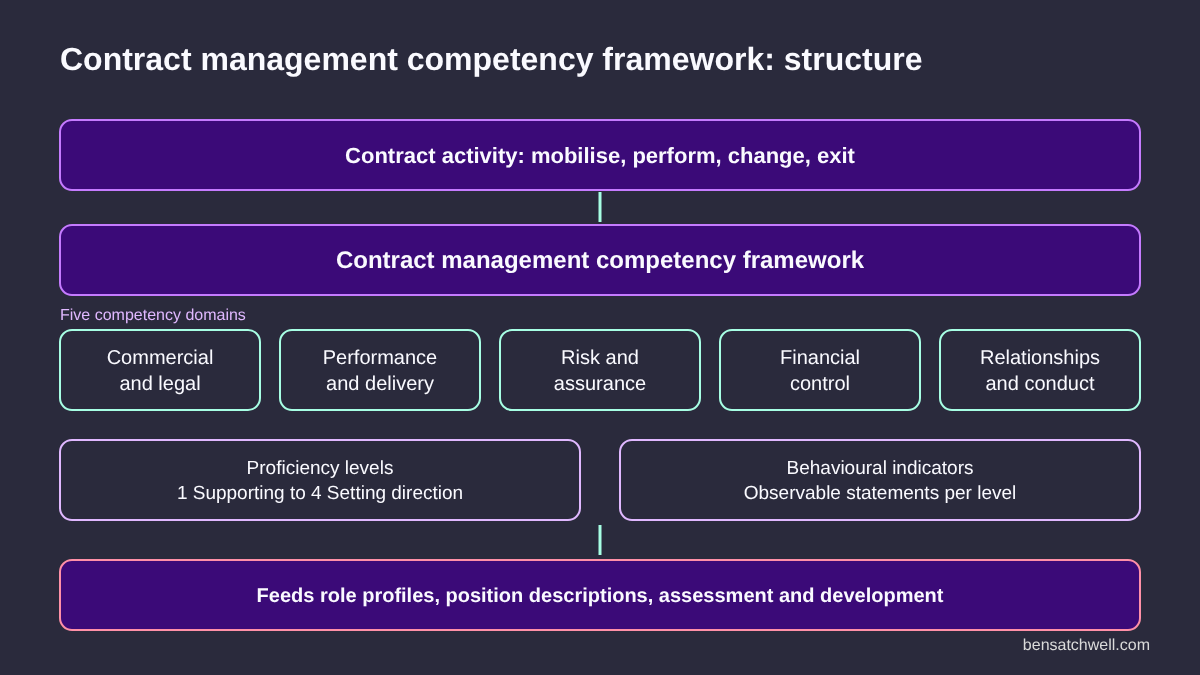
It has three layers. Competencies are grouped into domains. Each competency is described at several proficiency levels. Each level carries behavioural indicators. The framework then feeds role profiles, position descriptions, assessment and development plans.
Which competency domains does it contain?
A competency domain groups related competencies by the type of performance they describe. A workable contract management framework needs five domains, with technical content in most of them.
| Domain | Example competencies | Type |
|---|---|---|
| Commercial and legal | Interpreting contract terms, managing variations, applying remedies | Technical |
| Performance and delivery | Setting service measures, monitoring performance, validating supplier data | Technical |
| Risk and assurance | Managing contract risk, escalating issues, planning for exit | Technical |
| Financial control | Verifying invoices, forecasting spend, managing price adjustments | Technical |
| Relationships and conduct | Negotiating with suppliers, resolving disputes, acting with probity | Behavioural |
How are proficiency levels set?
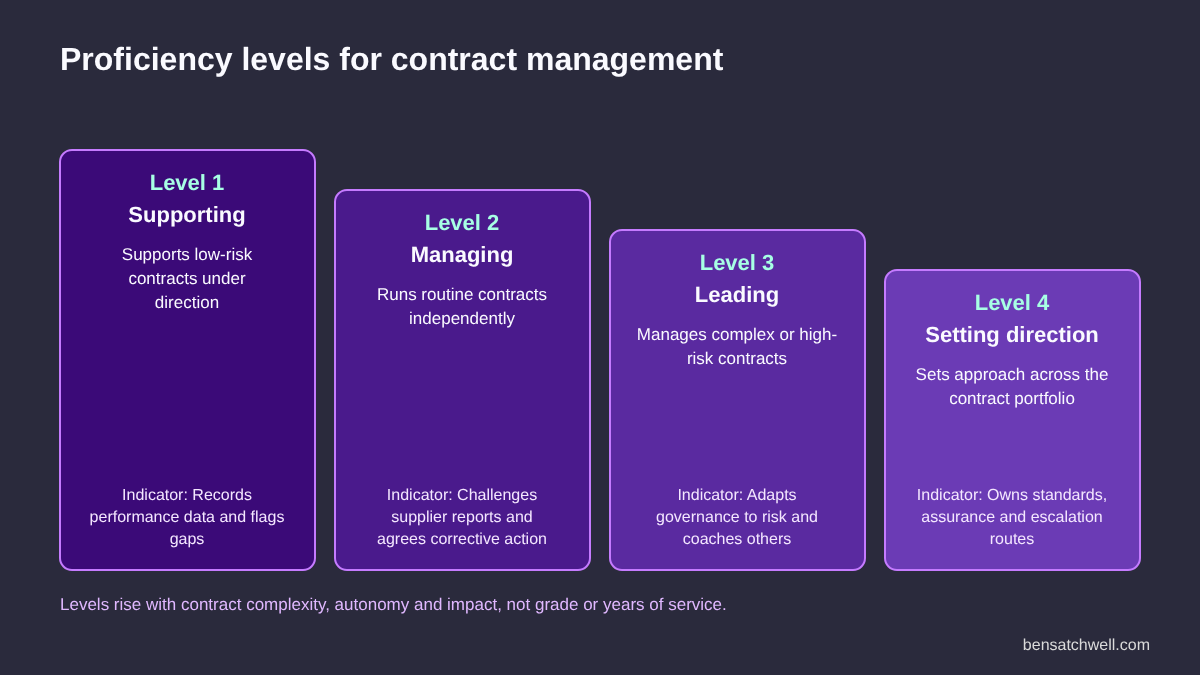
Levels should track the complexity and risk of the contracts a person manages, not their grade. Four levels is usually enough: supporting, managing, leading and setting direction. The UK Commercial Career Framework shows the same logic at scale. It lists 39 technical capabilities, each mapped to a level from 1 to 4, from basic knowledge through to expert status, and it places contract and supplier management as its own pillar with role profiles from Commercial Support up to Commercial Specialist.
What do behavioural indicators look like?
An indicator is observable. "Understands the contract" is not an indicator. "Maintains a variations register and refers every change to the agreed approval route before work starts" is. A good test is whether two assessors watching the same contract manager would write down the same thing.
- Supporting level: records supplier performance data accurately and flags gaps to the contract manager.
- Managing level: challenges supplier performance reports against source data and agrees corrective actions.
- Leading level: adjusts the governance approach as contract risk changes and coaches less experienced managers.
What a contract management competency framework is not
It is not a contract management process. A process tells you what to do and when. A framework tells you what the person doing it must be able to do. Confusing the two produces a document that lists the stages of the contract lifecycle and calls them competencies.
It is not a skills list either. A skill is a discrete learned ability, such as building a performance dashboard. A competency integrates skills with knowledge, judgement and behaviour. A person can hold every skill on a list and still not be competent, because competence is fitness for purpose in the real role.
It is not a capability framework. A capability is a broad, durable ability that a person carries across roles and contexts, such as critical thinking. Contract management competencies are specific to the function. The two work together: capabilities describe the person's transferable base, competencies describe performance in the contract manager role.
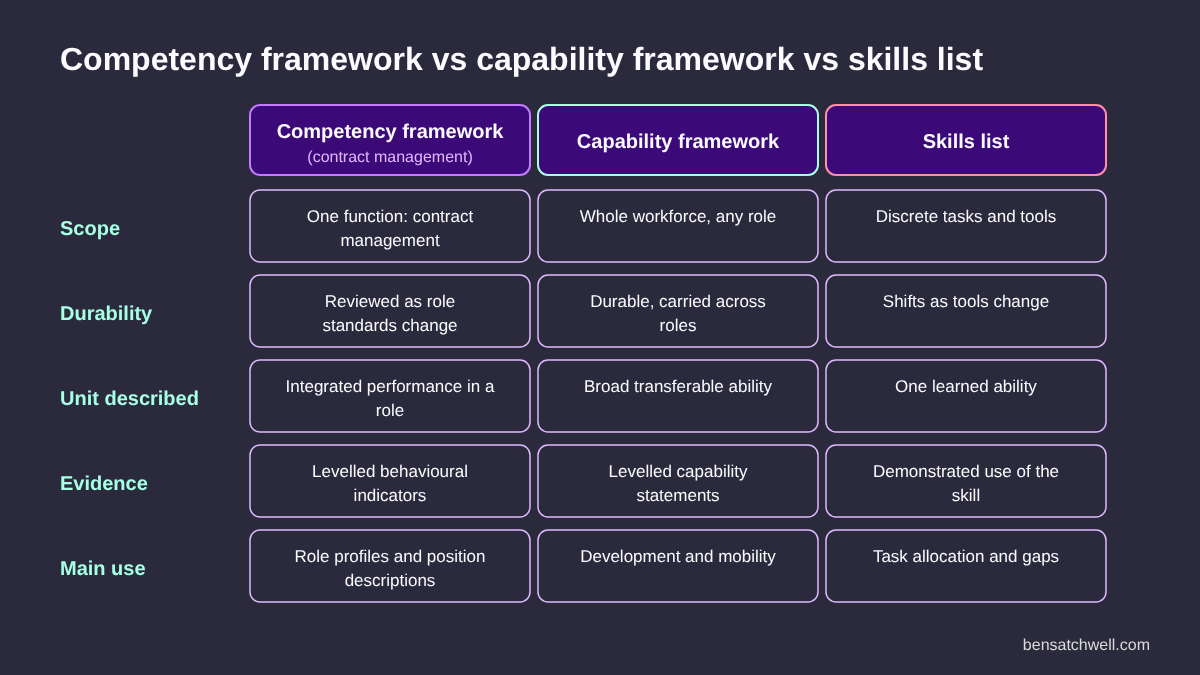
Note that the UK government uses "capability" for what this article would call technical competencies and skills. That is a naming difference between sources, not a different concept, and it is a good reason to define your terms before you borrow from anyone's framework.
Which standards and examples sit behind contract management competencies?
You do not need to start from a blank page. The UK Commercial Career Framework and the UK contract management standards, both linked above, are the most complete public references. The Commercial Career Framework describes contract management work as overseeing commercial governance and reporting, preparing for contract commencement, controlling contract changes, managing risks and disputes, and evaluating supplier performance. That list maps cleanly onto the domains in the table above.
The same pattern appears in other functions. A business development competency framework and a customer service competencies framework both organise function-specific competencies into domains and levels, so you can compare structures before you decide on yours. For worked layouts across many functions, see these competency framework examples.
Where do contract management competency frameworks fail?
- They describe the lifecycle, not the person. Stages are not competencies.
- Levels follow grade. A senior manager with a simple contract is not at a higher level than a practitioner running a complex one.
- Indicators are vague. If assessors cannot agree on what they saw, the framework is decoration.
- The framework never reaches position descriptions. The NSW Audit Office report Ensuring contract management capability in government (2019) found that the Department of Education took a systemic approach to defining the capability required for contract management roles, and that five of six sampled contract manager position descriptions aligned with the framework. One did not. That one gap is the usual pattern: the framework exists, but not every role is anchored to it.
- Nobody owns it. Contract management sits between procurement, legal, finance and the business, so the framework needs a named owner.
What are the trade-offs and constraints?
A function-specific framework is more precise than a generic one, but it adds to the number of frameworks you maintain. Use a dedicated contract management competency framework when contracts carry material spend or risk, when contract managers are spread across business units, or when you need to defend how people are appointed and developed. Use a smaller set of contract management competencies inside your wider framework when you have few contracts and a small team.
Keep the number of competencies low. Fifteen to twenty well-defined competencies will be used. Sixty will not. Also be honest about what the framework cannot do: it describes expected performance, it does not fix weak supplier terms or poor contract design. A job analysis can help you ground the competencies in the real work, and this piece on competency model job analysis covers how.
FAQ
What is a contract management competency framework?
It is a structured description of the competencies, proficiency levels and behavioural indicators needed to manage contracts after award. It defines what a competent contract manager does at each level of contract complexity.
What competencies does a contract manager need?
Typically commercial and legal judgement, performance management, risk and assurance, financial control, and relationship and conduct competencies such as negotiation, dispute resolution and probity.
How many proficiency levels should a contract management competency framework have?
Four to six is workable. Four is usually enough, defined by the complexity and risk of the contracts managed rather than by job grade.
What is the difference between contract management and procurement competencies?
Procurement competencies focus on sourcing and award. Contract management competencies focus on delivery, performance, change and exit after the contract is signed. Some competencies, such as commercial judgement, appear in both.
Can I use the UK government framework as a starting point?
Yes, as a reference. The Commercial Career Framework is public and well structured, but adapt the competencies, levels and language to your organisation and check it against your own contracts before adopting any of it.
How do I link the framework to a position description?
Select the competencies and required level for the role, record them as the role's competency profile, and state them in the position description alongside the accountabilities.
