
Most customer-facing teams have a set of values on the wall and a development programme catalogue that refreshes every year. What they don't have is a clear account of what good actually looks like, defined at every level, applied consistently across roles, and tied to how people are assessed and developed. A customer service competencies framework is the thing that fills that gap. It is not a soft skills list. It is a structured system.
What Is a Customer Service Competencies Framework?
A customer service competencies framework is an organisation-wide structure that defines the competencies required to perform customer-facing work effectively, describes what those competencies look like in practice at each proficiency level, and provides the behavioural indicators against which people can be assessed and developed.
A competency, in this context, is not a skill and not a task. It is the integration of knowledge, skills, judgement, and behaviour applied effectively in the context of a role. A customer service competency describes what proficient performance looks like as observable behaviour, at a defined level of complexity and responsibility.
The framework does not list what customer service people need to know. It defines how they need to perform.
A note on terminology. A competency framework is also called a competency model, especially in the United States. I use competency profile for the competencies and required levels for one role, and competency matrix for the grid of required against current proficiency. Usage varies by region, and I explain the differences in this competency model definition.
Why a Customer Service Competencies Framework Exists
Customer service work is behaviourally complex. A front-line agent handling a complaint is doing something cognitively and relationally demanding: reading emotional cues, applying product knowledge, exercising judgement about escalation, adapting tone to the individual, and working within process constraints simultaneously.
A generic skill list ("communication", "problem solving", "empathy") does not capture that complexity. It gives people a label without a definition, and it gives managers nothing to assess against. The CIPD, which has published extensively on competency frameworks, recognises that organisations often fail to distinguish between what people need to know and what they need to do. That distinction is exactly what a well-designed competency framework makes explicit.
How a Customer Service Competencies Framework Works in Practice
The framework is structured around two layers: a set of core competencies that apply to everyone in customer-facing roles, and a set of functional or technical competencies that apply to specific roles or channels.
Core competencies in a customer service context typically cover areas like complaint resolution, customer communication, service recovery, and collaborative working. These are the competencies every customer service professional is expected to develop, regardless of whether they work in a contact centre, a branch, or an online chat function.
Functional competencies cover the specialist knowledge areas tied to a specific product line, service channel, or customer type. The technical knowledge required for a financial services adviser differs considerably from what a retail service agent needs.
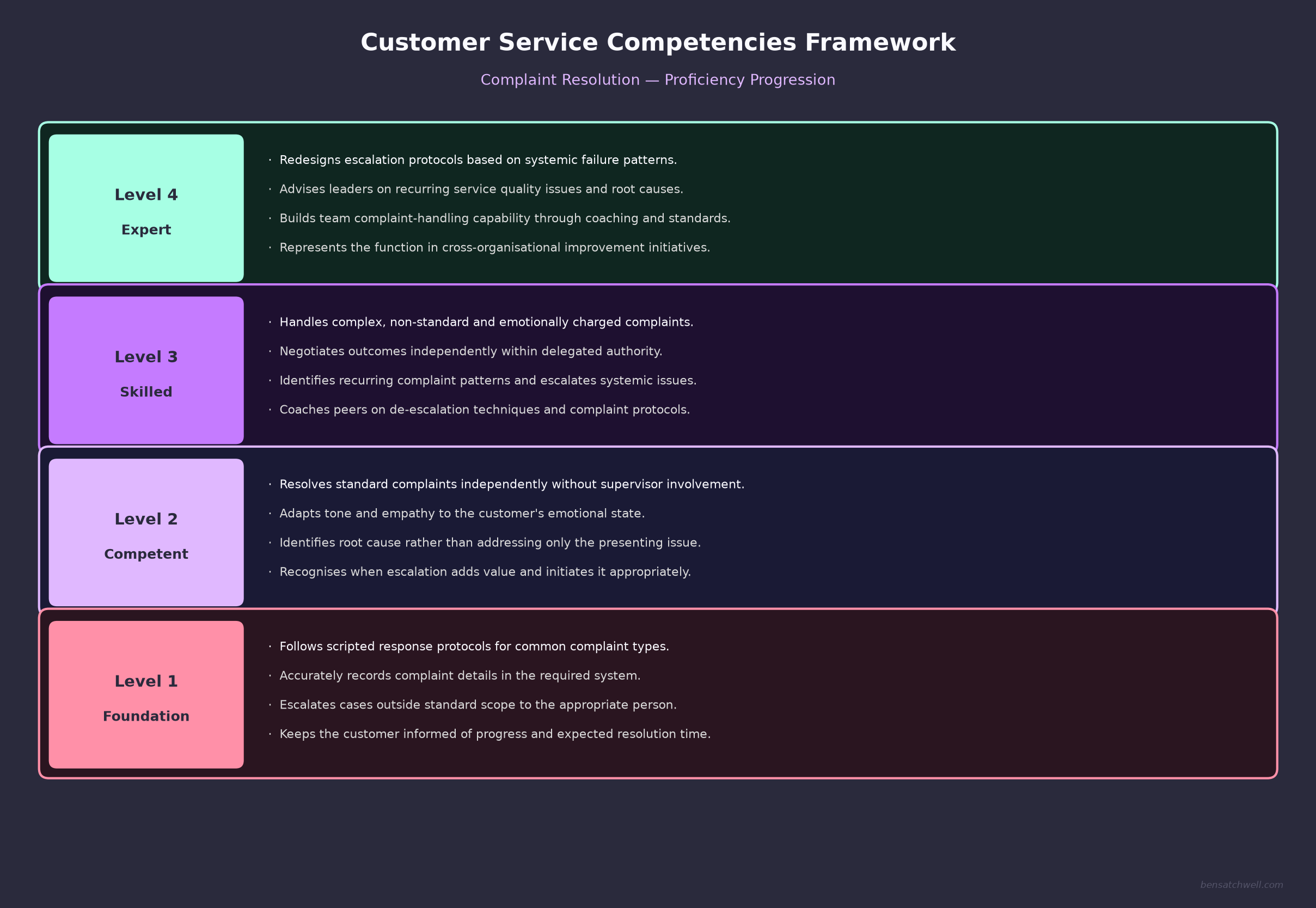
Each competency is defined across proficiency levels. A workable framework uses four to six levels, defined by scope, autonomy, and complexity rather than by seniority or years of service. A Level 1 agent handles scripted complaint resolution with close supervision. A Level 4 expert redesigns the resolution protocol, advises leaders on failure patterns, and coaches peers. The behaviours at each level are written as observable behavioural indicators: specific enough to be assessed, not so specific they describe a single task.
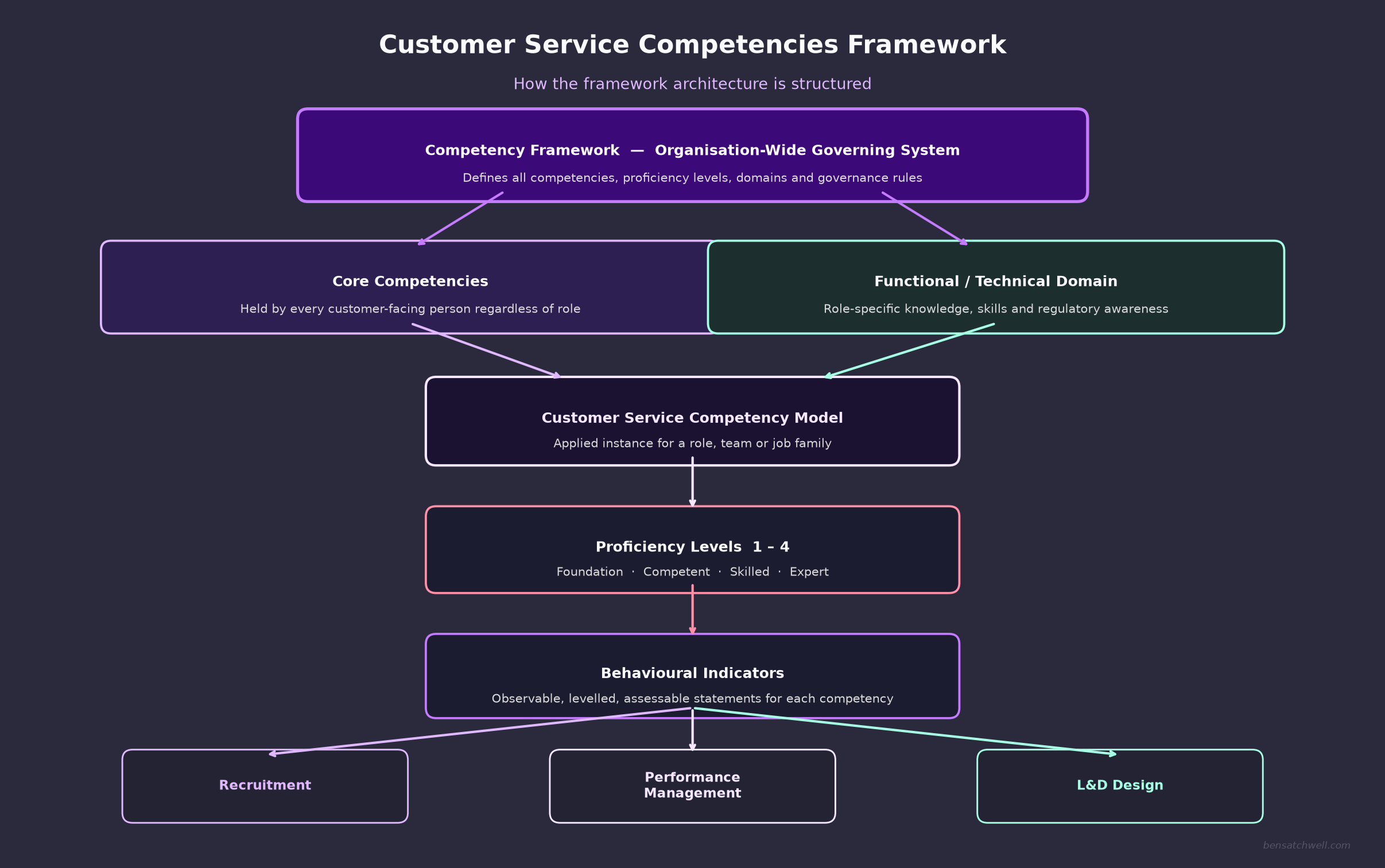
These frameworks connect directly to performance management. The behavioural indicators are the standard against which performance conversations are anchored, and they remove the ambiguity that comes from manager-to-manager variation. When I work with organisations building this kind of framework, the most significant change is usually not the framework itself. It is that managers, for the first time, have a shared reference point for what they are actually looking for. You can see how this plays out across different functions by looking at competency framework examples.
Proficiency assessments then feed performance management processes, development conversations, and hiring decisions in a consistent, evidence-based way.
What a Customer Service Competencies Framework Is NOT
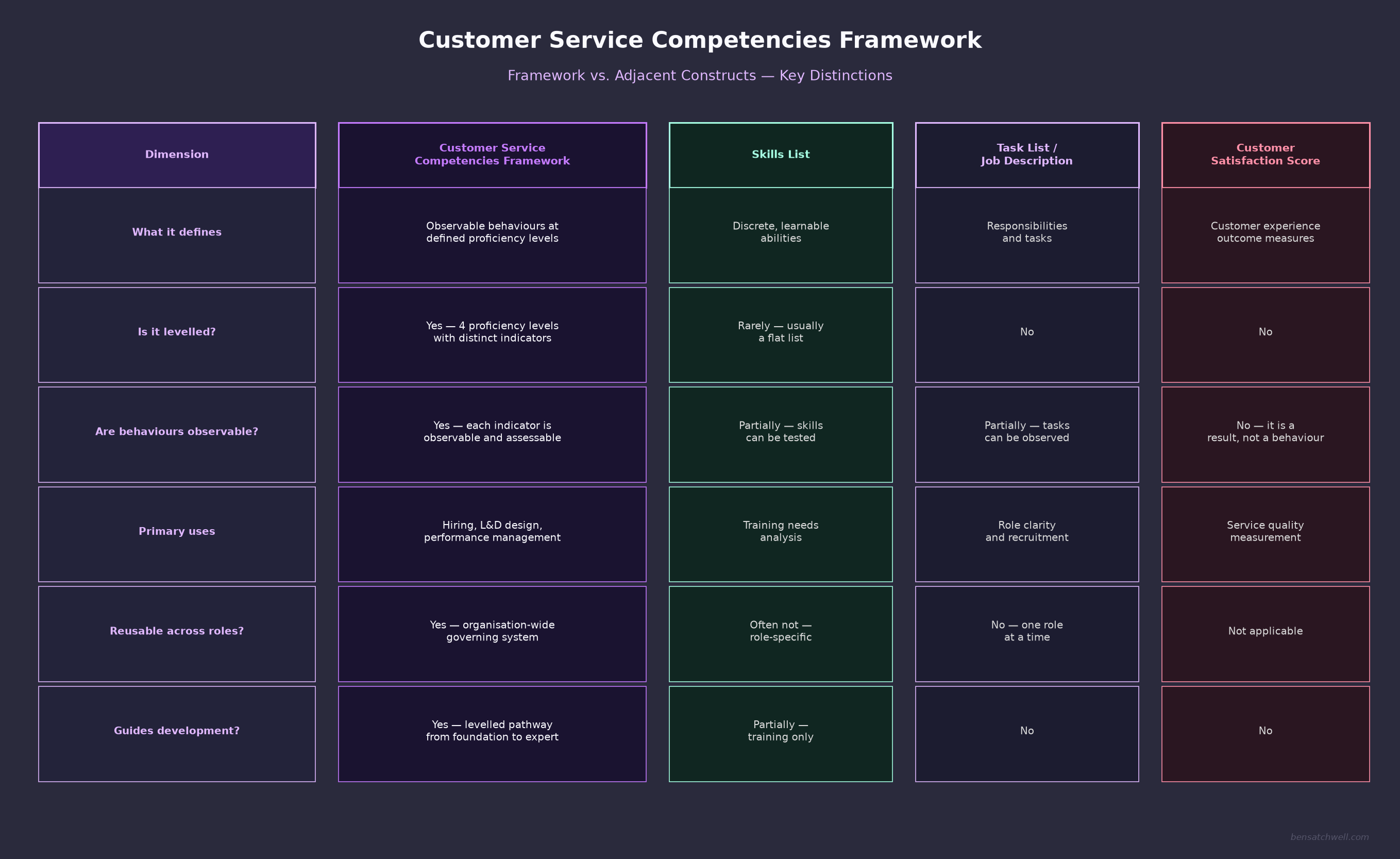
This is where most implementations go wrong, because organisations frequently confuse the framework with adjacent tools.
It is not a skills list. A list of skills tells you what a person can do. A competency framework tells you what good performance looks like in context. Skills are specific, granular, and transient. They shift as tools and methods change. Competencies are broader, integrative, and more durable. Conflating the two produces a framework that cannot support development or assessment in any meaningful way.
It is not a job description. A job description tells you what a role is responsible for. A competency framework tells you what capability the person in that role needs to perform those responsibilities well. Job descriptions define scope. Frameworks define the standard.
It is not a customer satisfaction score. KPIs measure outcomes. A competency framework describes the behaviours that produce those outcomes. If satisfaction scores drop, the framework tells you where to look, in the competency profile rather than in the metric.
It is not a behaviours list from a values exercise. Many organisations run culture or values programmes and produce a list of desired behaviours. These are useful as aspirational signals but they are not competency frameworks. They lack proficiency levels, assessment criteria, and role differentiation.
What the Research and Standards Bodies Say
The CIPD notes that competency frameworks are most effective when they are grounded in actual job analysis rather than theoretical ideals. That applies with particular force in customer service, where the gap between what organisations say they value and what they actually reward is often visible and demoralising.
Research examining customer service contexts consistently finds that organisations which define competencies at a behavioural level, rather than at the level of attitudes or traits, see more consistent assessment outcomes and better development targeting. Studies published on ResearchGate highlight that the shift from trait-based to behaviour-based competency design is one of the most significant levers for improving people process consistency. The distinction matters: organisations that assess attitude cannot develop it. Organisations that assess observable behaviour can.
The OECD's competency framework for professional contexts provides a useful reference framework. Its emphasis on proficiency levels tied to observable indicators is directly applicable to service contexts and mirrors what a well-designed customer service framework should do at the structural level.
A customer service framework structured this way connects cleanly to a broader core competency framework if the organisation has one, pulling the shared behavioural expectations around communication, collaboration, and professional conduct from the core layer and adding the service-specific competencies on top.
Common Failure Modes
The most common failure I see is building a customer service competencies framework that is too generic to be useful. "Customer focus" as a competency heading, without defined levels and observable indicators, is not a framework. It is a values statement masquerading as one.
The second failure is disconnection. Organisations build the framework, use it for a performance cycle or a recruitment campaign, and then leave it sitting in a document library. Frameworks only create value when they are actively used in hiring, in one-on-one development conversations, and in promotion decisions. If the framework is not woven into these processes, it decays.
The third failure is over-complication. I have seen customer service frameworks with forty-plus competencies and seven proficiency levels. No one can hold that in their head, and no manager will use it consistently. A framework with six to eight well-defined competencies at four levels is more powerful than a comprehensive one that no one applies.
Trade-offs and Constraints
A customer service competencies framework takes significant design investment upfront. Job analysis, stakeholder consultation, indicator writing, and calibration all require time and expertise. For small teams, the investment may not be proportionate to the benefit. A structured role profile with clear performance expectations may be a more pragmatic starting point.
There is also a risk that frameworks become static. Customer service contexts change: channel mix shifts, AI-assisted tools change what agents need to do, and customer expectations move. A framework designed for a contact centre in 2019 may not adequately cover the competencies required in an omnichannel or AI-augmented service role. Build in a review cycle from the start.
Finally, the framework needs ownership. Someone in the organisation needs to be accountable for its currency, its application, and its integration into people processes. Without that, even a well-designed framework drifts into irrelevance.
Frequently Asked Questions
What is a customer service competencies framework?
A customer service competencies framework is an organisation-wide structure that defines the competencies required for customer-facing roles, describes what proficient performance looks like at each level, and provides observable behavioural indicators for assessment and development. It is not a skills list and not a job description.
How many competencies should a customer service framework include?
Six to eight competencies is a workable range for most customer service contexts. Enough to cover the meaningful dimensions of the role, including complaint resolution, communication, service recovery, product knowledge application, and collaboration, without creating a framework so large it becomes unusable in practice.
How is a customer service competencies framework different from a skills matrix?
A competency framework defines what good performance looks like at different levels. A skills matrix maps current skill holdings against role requirements. They serve different purposes. The framework is the governing design standard; the matrix is an assessment and planning tool that can be built from it.
What proficiency levels should a customer service competencies framework use?
Four levels works well for most customer service contexts: Foundation (supervised, scripted), Competent (independent, adaptive), Skilled (complex cases, peer guidance), Expert (system-level, strategic influence). Levels should reflect scope, autonomy, and complexity, not years of service.
Can a customer service competencies framework be used for hiring?
Yes, and it should be. Competency-based interviews and structured assessments built from the framework's behavioural indicators produce more consistent and defensible hiring decisions than unstructured interviews. The framework defines the standard; the hiring process tests for it.
How does a customer service competencies framework connect to performance management?
The behavioural indicators in the framework provide the evidence standard for performance conversations. Rather than relying on manager interpretation of "good" performance, the framework gives both the manager and the employee a shared, observable reference point. This improves the quality of feedback and reduces subjectivity in ratings.