
Most organisations that say they have a business development function actually have a sales function with a different job title. The competency frameworks they apply to BD roles confirm it: the same closing skills, the same pipeline metrics, the same short-cycle accountability structures. What is missing is a framework designed for what business development actually does, which is to create markets that do not yet exist and develop relationships that will not convert for twelve months or longer.
What Is a Business Development Competency Framework?
A business development competency framework is an organisation-wide structure that defines the competencies practitioners in BD roles need to perform effectively. It specifies what good performance looks like at each level of seniority, expressed as observable behaviours, and organises those competencies into functional and behavioural domains relevant to BD work.
A competency is the integration of skills, knowledge, judgement and behaviour applied effectively in the context of a role. A business development competency framework applies that logic to BD-specific work: market analysis, partner structuring, opportunity qualification, channel development and stakeholder influence, each defined at multiple proficiency levels.
It is distinct from a BD competency profile. The framework is the organisation-wide governing system that sets the rules, domain structure and proficiency scale. A BD competency profile is the selection of competencies and required levels for a specific BD role, level or job family.
A note on terminology. A competency framework is also called a competency model, especially in the United States. I use competency profile for the competencies and required levels for one role, and competency matrix for the grid of required against current proficiency. Usage varies by region, and I explain the differences in this competency model definition.
Why Business Development Needs Its Own Competency Framework
Business development and sales are not the same function. This is not a semantic debate. The distinction has significant implications for how roles are designed, assessed and developed.
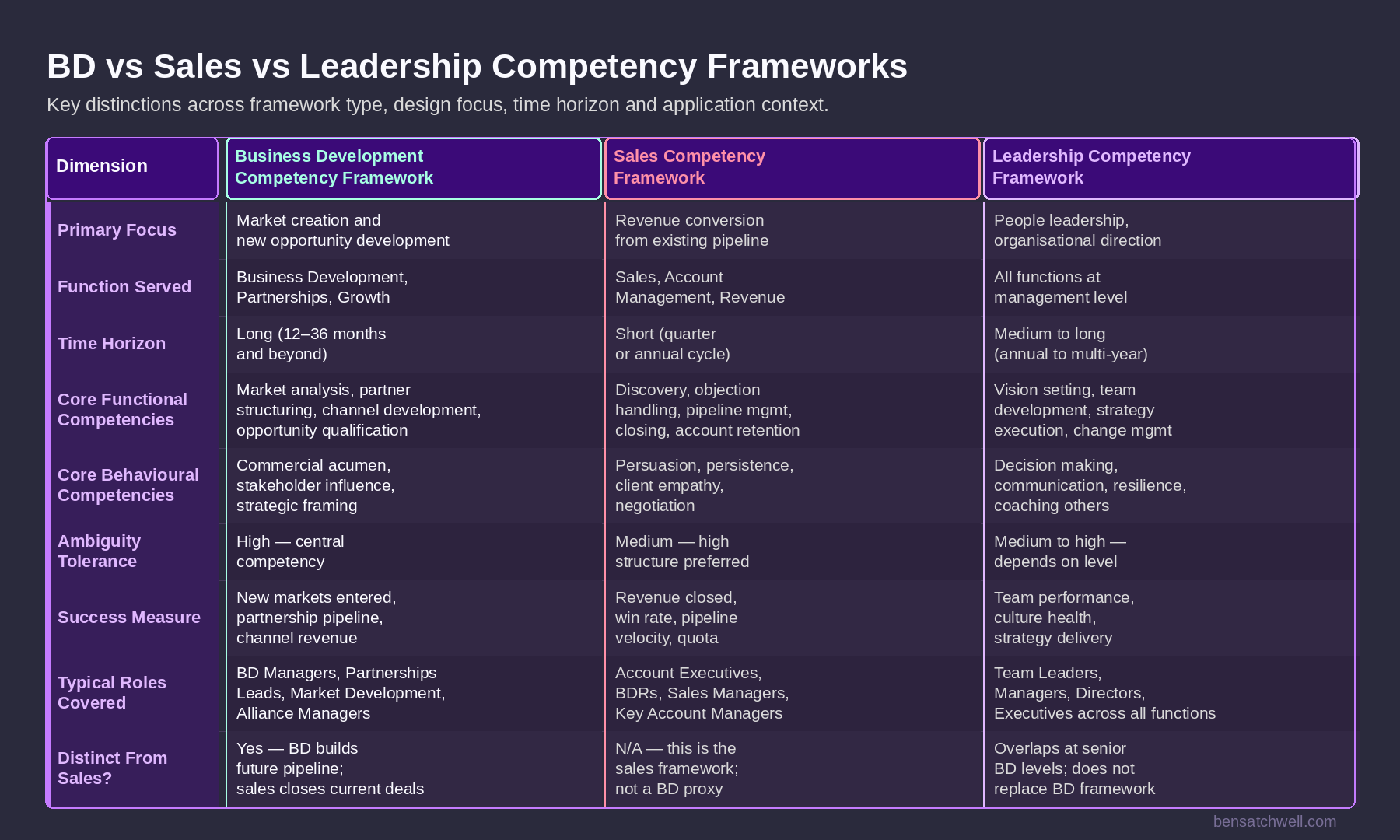
Sales operates on a defined pipeline, a known product and a conversion cycle measured in weeks or quarters. The competencies that matter are discovery, objection handling, negotiation and account retention. Success is measured in revenue closed and quota attained.
Business development operates on ambiguity. The pipeline does not exist yet. The market may not exist yet. The partner relationships that will eventually create commercial opportunity take months or years to develop. The competencies that matter are market analysis, strategic framing, relationship architecture, ambiguity tolerance and long-horizon thinking.
Applying a sales competency framework to a BD role produces the wrong signals at every level: the wrong behaviours are rewarded, the wrong people are promoted, and the organisation ends up optimising for activity that does not match the function's actual purpose. A dedicated business development competency framework exists to solve that misalignment.
How a Business Development Competency Framework Works in Practice
A well-designed BD competency framework organises competencies into two main domains: functional and behavioural.
The functional domain covers the technical competencies specific to BD work: market opportunity identification, partner structuring and development, channel architecture, commercial case development, and opportunity qualification. Each competency is defined with observable behavioural indicators at multiple proficiency levels, typically four to six.
The behavioural domain covers competencies that apply across roles but express differently in a BD context: commercial acumen, stakeholder influence, strategic framing, resilience in ambiguity, and cross-functional collaboration.
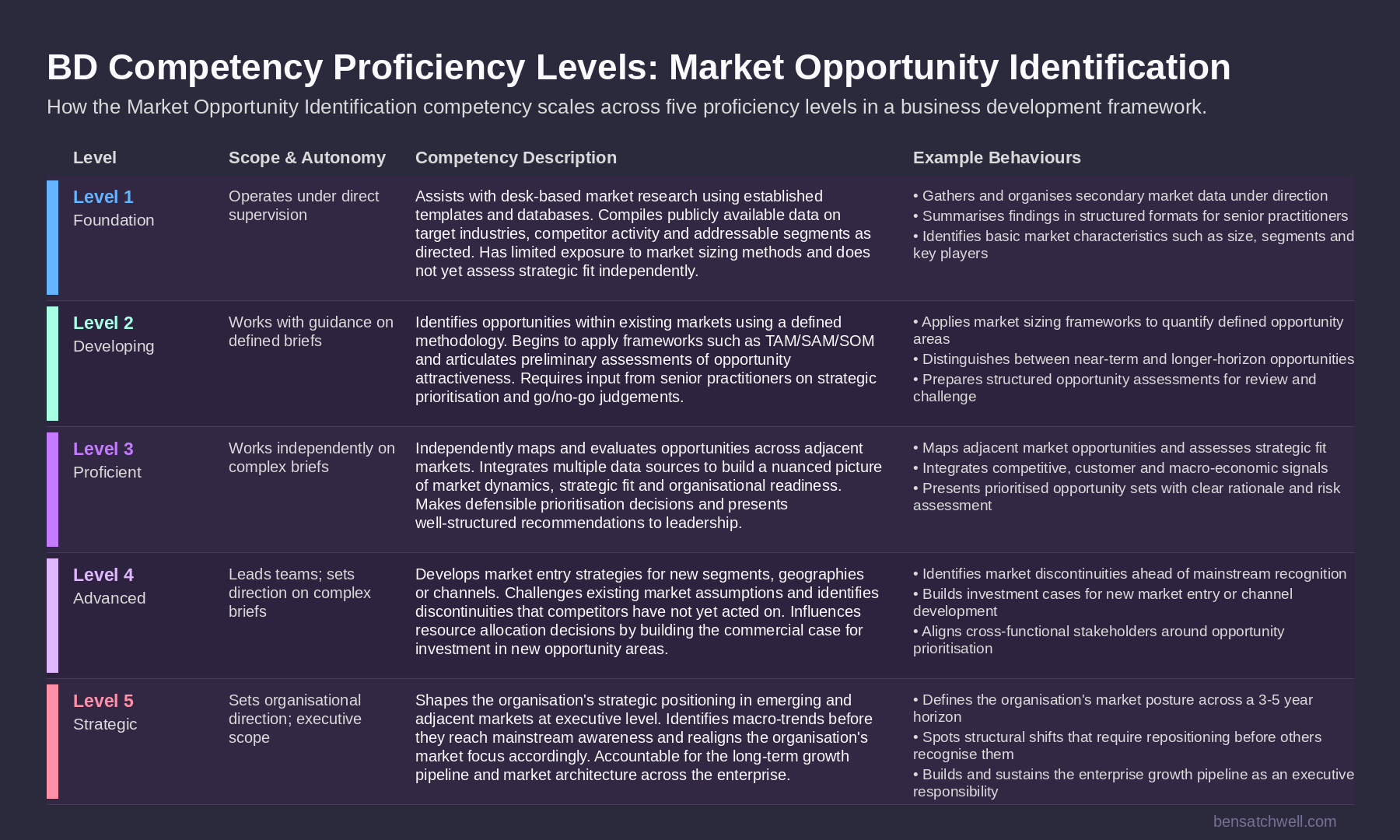
Each competency is levelled. A Level 1 practitioner in market opportunity identification gathers and organises secondary market data under direction. A Level 5 practitioner defines the organisation's market posture across a three-to-five-year horizon and identifies structural shifts before competitors recognise them. The progression is defined by scope, autonomy and complexity, not by seniority or years of experience.
The framework is the governing system. BD competency profiles for specific roles, BD Managers, Partnerships Leads, Alliance Managers and Market Development Managers, draw the competencies they need from the framework and set target proficiency levels for that role. This is the same architecture used in other function-specific frameworks such as a product manager competency framework or a data analytics competency framework: the org-wide system governs, and role-level profiles apply it. Where BD managers lead teams of sellers, their people-management expectations belong in a sales leadership competency framework rather than the BD framework itself.
What a Business Development Competency Framework Is Not
A business development competency framework is not a sales competency framework. If the framework emphasises conversion, pipeline velocity and quota, it is a sales framework with a BD label. BD practitioners are not measured by what they close in the current quarter. They are measured by the quality and scale of the opportunity pipeline they create for the next twelve to thirty-six months.
It is not a job description. A job description lists tasks and responsibilities. A competency framework defines what good performance looks like, expressed as behaviours, at each level of proficiency. The two serve different purposes and should not be conflated.
It is not a KPI framework. A business development competency framework assesses how practitioners operate: the quality of their thinking, the depth of their relationship architecture, the rigour of their market analysis. KPIs measure outputs. Competencies describe the work behind those outputs.
It is not a skills matrix. A skills matrix records whether a skill is present or absent. A competency framework includes proficiency levels and behavioural indicators, which allows a far more nuanced picture of where someone sits and what development they need next.
What Professional Standards Say About Business Development Competencies
The CIPD defines a competency framework as a structure that makes expectations transparent and consistent across an organisation. The CIPD competence factsheet is a useful starting reference.
The SHRM Body of Applied Skills and Knowledge, formerly the SHRM Competency Model, provides a useful structural reference for how a domain-specific competency framework is constructed: functional competencies specific to the discipline sit alongside broader competencies that apply across professional roles, each with defined proficiency levels. See the SHRM Body of Applied Skills and Knowledge. The same architecture applies to BD: a functional domain with BD-specific competencies, a behavioural domain with levelled expectations, and a governance layer that connects both to role profiles and career pathways.
Common Failure Modes in Business Development Competency Frameworks
The most common failure in BD competency framework design is treating business development as a subset of sales. When organisations use a sales framework for BD roles, the framework rewards deal closure over market creation. Practitioners are assessed on behaviours that do not reflect their actual work, and development is directed at the wrong skills.
A second failure is under-specifying the functional domain. Organisations that build BD competency frameworks sometimes populate the functional domain with generic commercial competencies: commercial awareness, stakeholder management, problem solving. These are not BD-specific. A rigorous framework names and defines the competencies that belong to BD work: partner structuring, channel development, opportunity qualification, market analysis. If the functional domain could describe any commercial role, it is not a BD framework.
A third failure is applying the framework without a consistent proficiency scale. Different assessors interpret the same competency definition differently when there is no shared, observable reference point. Behavioural indicators at each level are the mechanism for consistency, not the competency definition alone.
When Does a Business Development Competency Framework Make Sense?
A business development competency framework is appropriate when an organisation has a clearly distinct BD function operating on a long-cycle, market-creation model. If the BD role is structurally similar to a senior sales role with a different label, a well-designed sales framework with some additional competencies may be sufficient.
The investment in a dedicated framework is justified when BD practitioners are assessed, developed and rewarded differently from sales practitioners, when the function operates on a time horizon of twelve months or more, and when the organisation needs to build a genuine succession pathway within the BD function.
If the organisation has fewer than ten people in BD roles, a competency profile for each role, drawn from a short shared list, may be adequate without a full framework build. The framework architecture becomes important when the function grows in scale and complexity and consistency across roles becomes a design requirement.
Frequently Asked Questions About Business Development Competency Frameworks
What is the difference between a business development competency framework and a sales competency framework?
A BD competency framework is designed for market creation, partnership development and long-horizon opportunity building. A sales competency framework is designed for revenue conversion from an existing pipeline. The two functions operate on different time horizons, different ambiguity tolerances and different success metrics. A sales framework applied to BD roles systematically rewards the wrong behaviours.
What competencies belong in a business development competency framework?
A well-designed BD framework includes functional competencies specific to BD work: market opportunity identification, partner structuring and development, channel architecture, commercial case development and opportunity qualification. These sit alongside behavioural competencies levelled for a BD context, including commercial acumen, stakeholder influence, strategic framing and resilience in ambiguity.
How many proficiency levels should a BD competency framework have?
Four to six levels is the standard. Fewer than four levels create insufficient granularity to guide development decisions. More than six introduce complexity that is difficult to sustain in practice. Five levels maps naturally to the scope progression in BD roles from junior analyst to executive level.
How is a BD competency framework different from a BD competency profile?
The framework is the organisation-wide governing system: the full set of defined competencies, proficiency levels, behavioural indicators and governance rules. A competency profile is the selection of competencies and required levels for a specific role, level or job family. The profile draws from the framework but is tailored in scope to the context it serves. Competency model is the usual US name for the framework itself.
Can a generic competency framework be adapted for business development?
Generic frameworks can be adapted, but the functional domain will almost always require significant reconstruction. The core behavioural competencies may translate if levelled appropriately for BD roles, but the functional competencies in a generic framework typically do not include market creation, partner structuring or channel architecture. Adaptation is possible, but usually less effective than a purpose-built framework for the function.
How should a business development competency framework be used in performance assessment?
The framework defines what good performance looks like as observable behaviour at each proficiency level. In assessment, practitioners are evaluated against behavioural indicators, not against the competency definition alone. This provides a consistent reference point across managers and contexts, and links directly to development planning by identifying the specific behaviours that would indicate progression to the next level.