

A compliance competency framework is not a list of the laws your people must know. It is a structured description of what people need to be able to do, at defined levels, so that the obligations in those laws are actually met. Most organisations I see have the first and assume it is the second.
This page sits inside the wider competency framework pillar, and it covers one application: the compliance domain. I write for HR professionals who have been asked to build, review or defend a framework for compliance roles.
What is a compliance competency framework?
A compliance competency framework defines the competencies, proficiency levels and behavioural indicators that describe effective compliance performance, and the rules for applying them to roles across an organisation.
It does three jobs. It states what good compliance practice looks like as observable behaviour. It sets the level of that behaviour each role requires. And it gives managers and HR a common basis for selection, development and assessment decisions.
A competency is the integration of skills, knowledge, judgement and behaviour applied effectively in the context of a role. That matters here, because compliance work is rarely a matter of recalling a rule. It is judgement applied to an ambiguous situation, under pressure, with incomplete information.
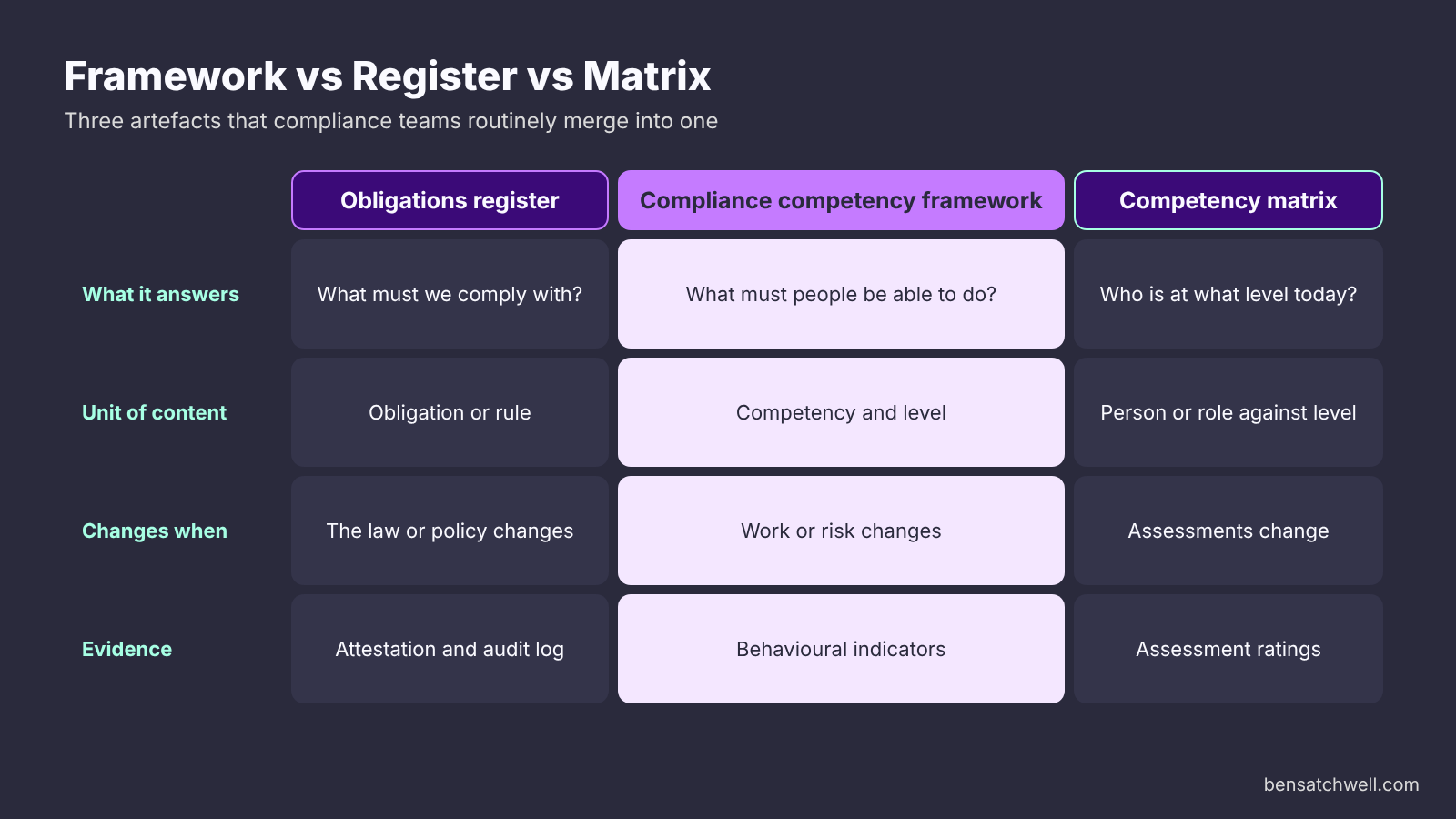
A note on terminology. A competency framework is also called a competency model, especially in the United States. I use competency profile for the competencies and required levels for one role, and competency matrix for the grid of required against current proficiency. Usage varies by region, and I explain the differences in this competency model definition.
Why do organisations need a compliance competency framework?
Regulators do not only ask whether a program exists. They ask whether the people running it can do the job. The United States Department of Justice guidance on evaluating corporate compliance programs asks prosecutors to consider whether those responsible for compliance have sufficient qualifications, seniority and stature, sufficient resources, and sufficient autonomy from management (US Department of Justice, Evaluation of Corporate Compliance Programs, updated September 2024). Qualifications and experience are claims. A framework turns them into something you can inspect.
The same pressure appears in financial services. The Australian Securities and Investments Commission describes what it looks for when it assesses the organisational competence obligation, one of the general obligations on licensees under section 912A(1) of the Corporations Act (ASIC Regulatory Guide 105). In the United Kingdom, the Financial Conduct Authority's rules require a firm not to assess an employee as competent to carry on certain activities until the employee has demonstrated the necessary competence (FCA Handbook, TC 2.1).
The problem the framework solves is consistency. Without it, one manager treats a completed online module as competence and another requires observed practice. The organisation cannot compare people, defend a decision or see where risk is concentrated.
How does a compliance competency framework work in practice?
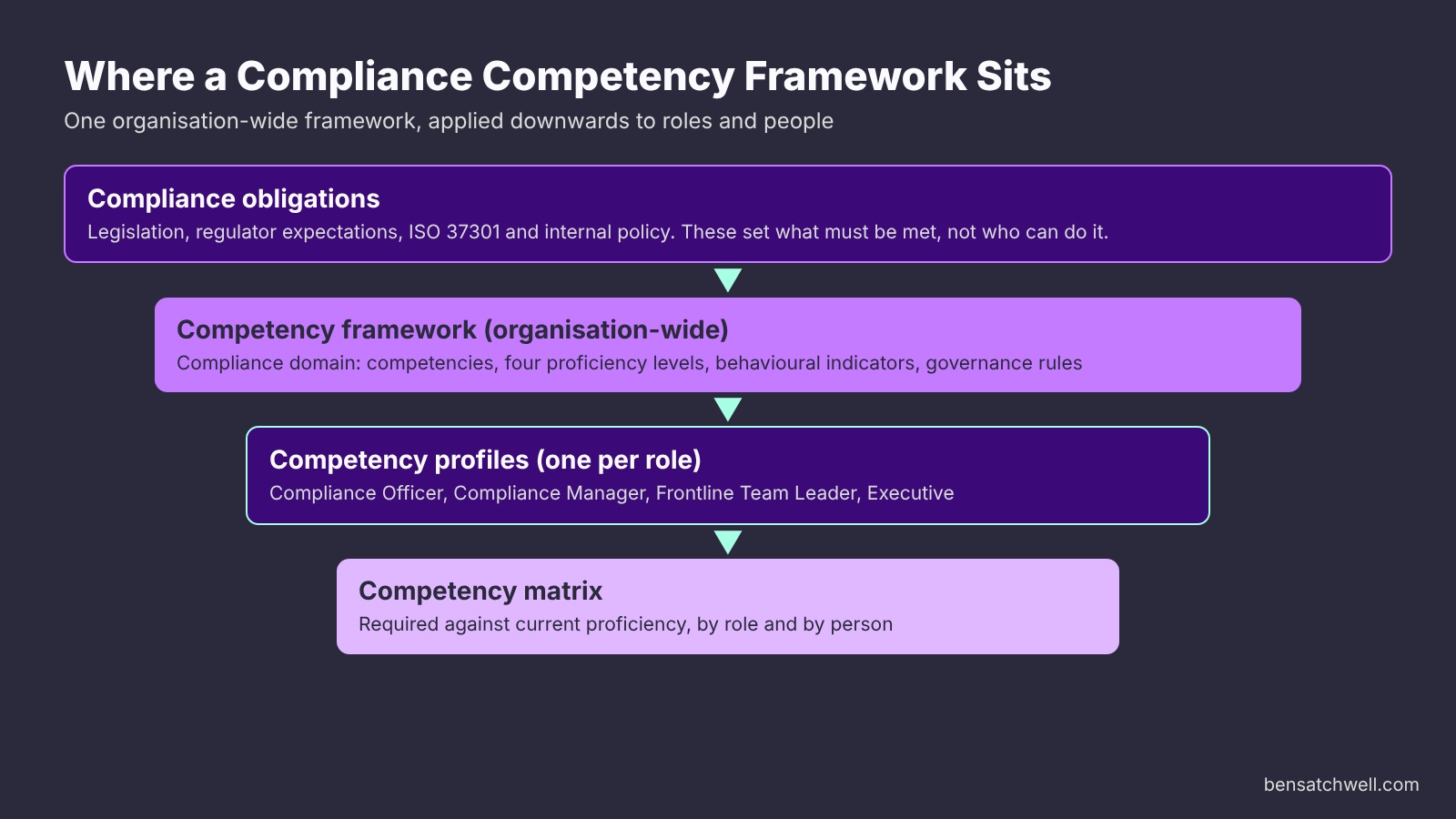
The framework is built in layers, and each layer has a different owner.
Start with the work, not the legislation
Obligations tell you what must be met. They do not tell you who can do it. I begin with the work: identify risks, decisions and activities where compliance is exercised, then describe the performance required. For a frontline team leader that might be recognising a reportable event. For a compliance manager it might be interpreting a regulatory change for the business.
Group competencies into a compliance domain
A competency domain is a grouping of related competencies. A compliance domain usually mixes technical competencies, such as regulatory interpretation and monitoring design, with behavioural ones, such as speaking up and holding a line under commercial pressure. Keep the list short. Eight to twelve well-defined competencies are usable. Thirty are not.
Define four proficiency levels with behavioural indicators
A proficiency level is the stage at which a competency is held or required. Levels are set by scope, autonomy, complexity and impact, not by seniority or years of service. Under each level sit behavioural indicators, which are the written, observable statements assessment is made against.
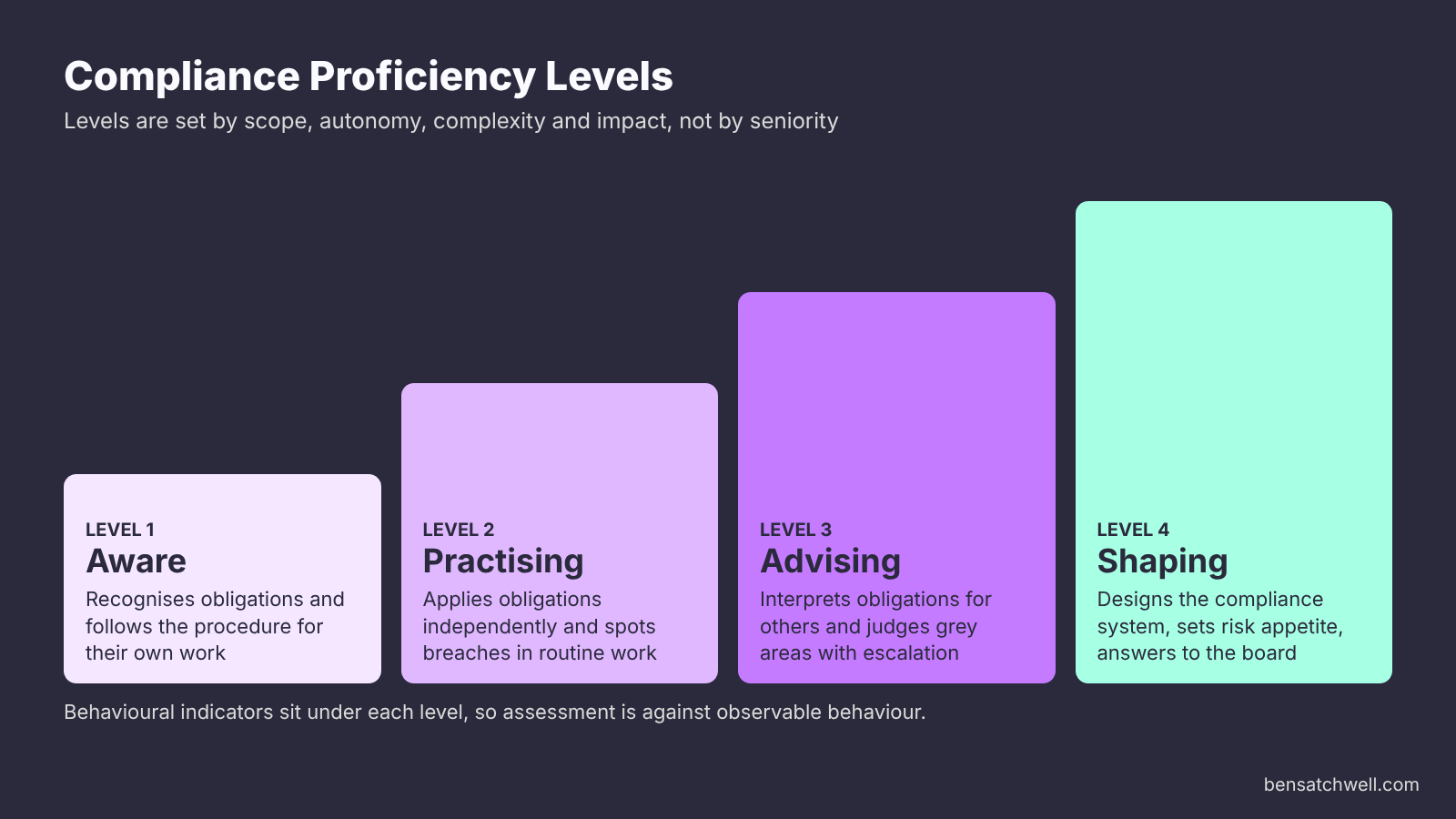
For a competency such as regulatory interpretation, a Level 2 indicator might read: applies the relevant obligation to routine cases without supervision. A Level 3 indicator might read: advises business leaders on how a new obligation changes their process. The indicators describe behaviour, so a manager can say whether they have seen it.
Apply it through profiles and matrices
Each role then receives a competency profile, which is a selection of competencies with the required level for that role. A competency matrix plots required against current proficiency to show where gaps sit. The same logic is used in other functional applications such as the accounting competency framework and the IT competency framework. For more on how levels are set, see competency framework levels.
What a compliance competency framework is not
This is where most confusion sits, so I will be specific.
- It is not an obligations register. A register lists what the organisation must comply with. The framework describes what people must be able to do.
- It is not a record of completed learning. Completing a module is an input. A competency is demonstrated in behaviour.
- It is not a role description. A role defines what someone is accountable for. Competencies define what they need to do it well.
- It is not a skills list. A skill is a discrete learned ability. A competency integrates skills with knowledge, judgement and behaviour.
- It is not a capability framework. Capabilities are broad, durable and carried across roles. Competencies are tied to performance in a role.
Which standards and references shape a compliance competency framework?
Several named sources are useful as inputs, but none of them is a ready-made framework. ISO 37301 is the international standard for compliance management systems, so it is a sensible reference point for the system your people operate within. The regulator guidance cited above shows what examiners look at in practice.
Use these to check coverage, not to copy wording. Your framework has to describe the compliance work in your organisation, in your regulatory setting.
Where do compliance competency frameworks fail?
- Knowledge-only competencies. The framework lists legislation to know and never describes judgement or behaviour. Assessment becomes a recall exercise.
- Levels set by title. Seniors are assumed to be higher level. A senior executive may sit at Level 1 for a competency they have never exercised.
- Too many competencies. Managers cannot assess thirty items, so they stop assessing.
- Behavioural indicators that cannot be observed. Statements such as "understands the importance of integrity" cannot be evidenced.
- No governance. Nobody owns a review cycle, so the framework drifts away from the obligations it was built to serve.
What are the trade-offs and constraints?
A framework is worth the effort when compliance performance varies across roles, when regulators or auditors ask you to demonstrate competence, or when you need consistent decisions on selection and promotion. It is less useful in a very small team where one person holds the whole function, and a short profile may serve better than a full framework.
There is also a tension between stability and currency. Obligations change often, while competencies should change slowly. Keep rule-level detail in the obligations register and keep the framework at the level of enduring performance, so it does not need rewriting every time a rule changes.
Finally, scale the formality to the organisation. The Department of Justice guidance itself notes that sufficiency depends on the size, structure and risk profile of the company. The same principle applies to how elaborate your framework needs to be.
Frequently asked questions
What is a compliance competency framework?
It is an organisation-wide description of the competencies, proficiency levels and behavioural indicators that define effective compliance performance, with rules for applying them to roles.
What is the difference between a compliance competency framework and a compliance program?
A compliance program is the set of policies, controls and processes that manage obligations. The competency framework describes the human performance needed to run that program well. They work together but answer different questions.
How many competencies should a compliance competency framework have?
Eight to twelve is a workable range. More than that makes assessment impractical, and fewer than that usually means distinct behaviours have been merged.
Is a compliance competency framework the same as a competency model?
The two terms are used for the same organisation-wide system, and usage varies by region. The terminology note above and the competency model definition page explain how I use them.
How do you assess competence in compliance?
Assess against the behavioural indicators at the required level, using observed work, case discussions and manager evidence. A completed module is useful evidence, but it does not show that someone can apply an obligation in a live situation.
Who should own a compliance competency framework?
Ownership is usually shared. The compliance function owns the content, HR owns the structure and assessment rules, and a named person owns the review cycle.
