

Competency Framework Design
Most competency frameworks fail before a single behavioural indicator gets written, because the people building them confuse framework design with model design. A framework is the organisation-wide system. A model is one applied instance of it for a role or cohort. Skip that distinction and you end up with role-specific competency lists that do not talk to each other, cannot be compared across the business, and collapse the moment two departments use the same language for different things.
Competency framework design is the discipline of building that governing system properly, so every model, matrix and role profile that draws on it stays consistent. Get it right once and the organisation gets a reusable asset. Get it wrong and you get a spreadsheet with a shelf life of eighteen months.
What Is Competency Framework Design?
Competency framework design is the process of building an organisation-wide system that defines, groups and standardises competencies so they can be reused consistently across roles and levels. It covers the competency definitions themselves, the proficiency levels attached to them, the behavioural indicators that describe what each level looks like in practice, and the governance rules for how competency models and role profiles are permitted to draw on the framework.
A competency is the integration of skills, knowledge, judgement and behaviour applied effectively in the context of a role. It describes what good performance looks like as observable behaviour at a level of proficiency. It is not a task, and it is not a single skill on its own.
Framework design is not the same exercise as writing a competency model for a single job family. A competency model is an applied selection of competencies from the framework, tailored to a specific role, level, function or job family. If the framework is the system, the model is an instance of it. Design the framework first. Everything else, including every model an organisation will ever build, inherits from that decision.
Why Competency Framework Design Exists
Without a governing framework, every business unit invents its own competencies, its own language, and its own proficiency scale. HR ends up with incompatible lists that cannot be compared, rolled up into workforce planning, or used to support consistent hiring, development or promotion decisions.
Framework design exists to solve a specific problem: it makes competency consistent, comparable and scalable across an organisation with more than a handful of roles. The problem a governing people structure is actually there to solve is rarely a lack of competency lists. It is usually a lack of a shared system those lists plug into. Framework design is that system.
This is also why competency frameworks sit apart from one-off role descriptions. A role description tells you what one job does. A framework tells you how every competency statement is defined, levelled and evidenced, so "stakeholder management" means the same thing in finance as it does in operations.
How Competency Framework Design Works in Practice
A properly designed framework has four working parts, and the design process builds them in a deliberate order rather than writing indicators first and working backwards.
Competency domains
A competency domain is a grouping of related competencies within the framework, organised by the type of performance they describe. Common domains are functional or technical, behavioural or interpersonal, leadership, and professional or ethical. Because competencies are often role-specific, most frameworks carry at least one functional or technical domain alongside the domains that apply to everyone.
Within those domains sit two distinct categories of competency. A core competency is one every person in the organisation is expected to demonstrate, regardless of role or level. It carries the shared expectations and culture that every role model draws on. A technical competency, also called a functional competency, is specific to a role, discipline or function, covering the specialist knowledge and skills that particular work requires. Technical competencies vary widely between roles. Core competencies do not.
Proficiency levels
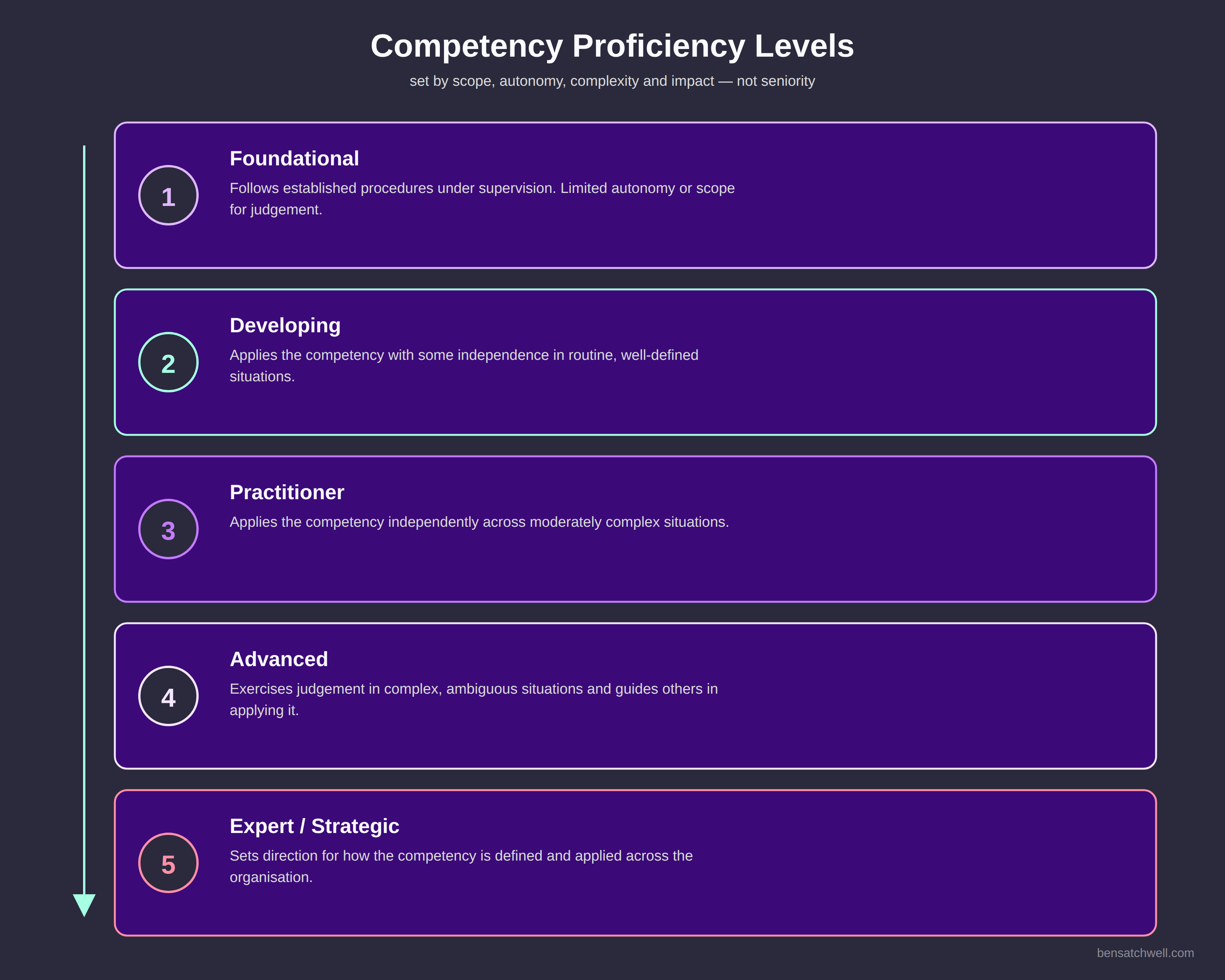
A proficiency level is the defined stage of growth at which a competency is held or required. Levels are set by scope, autonomy, complexity and impact, not by seniority, years of service or personality. A workable framework uses four to six levels. Fewer and the levels cannot discriminate between meaningfully different standards of performance. More and assessors cannot reliably tell levels apart, exactly the failure the SFIA Foundation's own guidance on why SFIA does not define every skill at all seven levels addresses directly: a level should only exist where it describes a genuine, observable difference in responsibility.
Behavioural indicators
A behavioural indicator is the written, levelled statement describing the behaviour expected at a given proficiency level. Indicators are observable, contextual and descriptive rather than evaluative, and they are the unit that assessment is actually conducted against. This is the part of framework design that most organisations under-invest in, and it is the part that determines whether the whole framework is usable.
Governance rules
The framework also has to define the rules for how models and role profiles are allowed to draw on it: which domains a job family can select from, how many competencies a role profile can carry, who owns changes to a definition once published. Without this layer, the framework degrades within a year as teams quietly edit definitions to suit themselves. This is the same discipline covered in the operating model that keeps a people structure functioning after launch, rather than decaying the way most one-off HR projects do.
What Competency Framework Design Is NOT
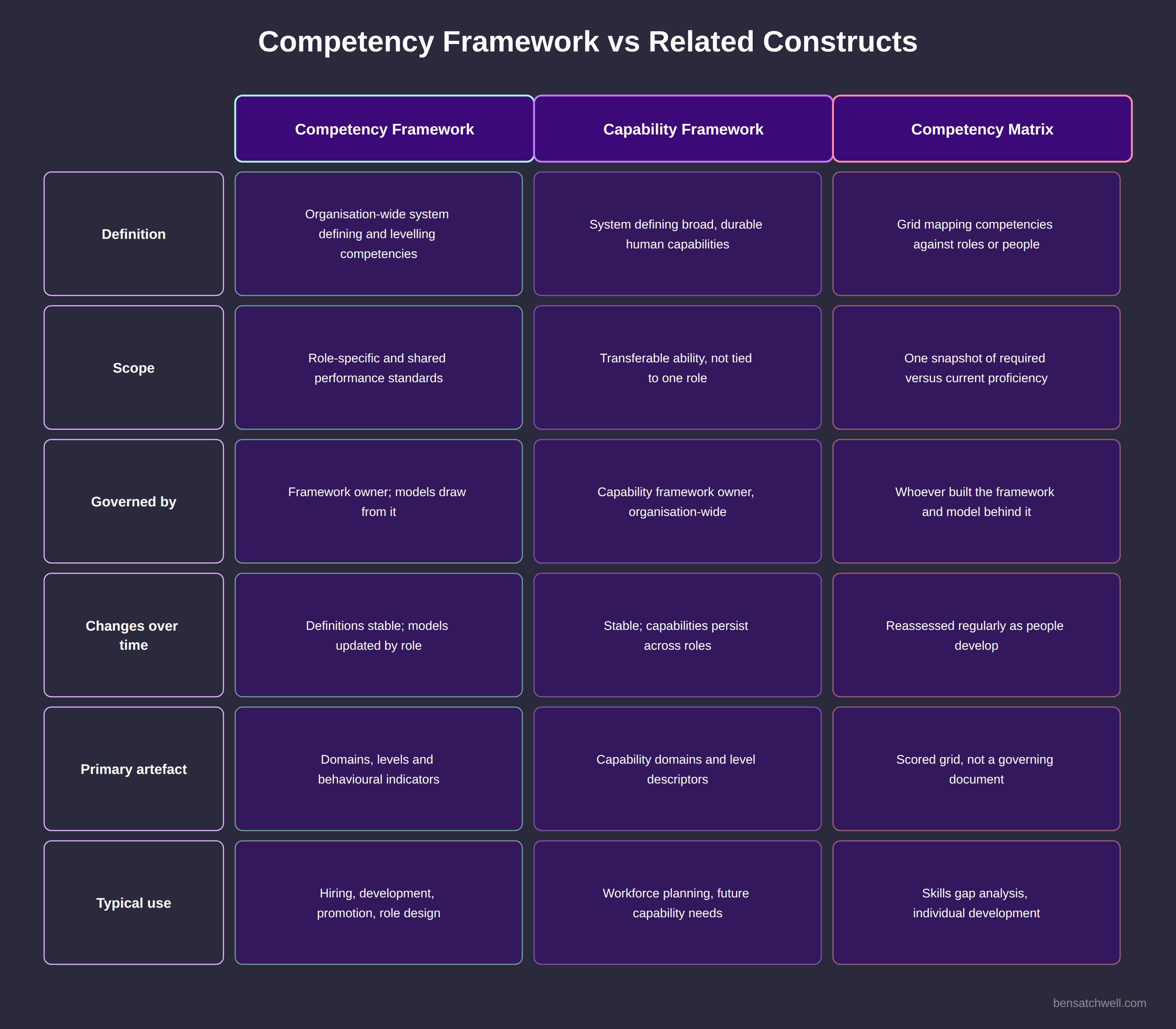
Competency framework design is not competency model design. The framework is the governing system. The model is a tailored selection from it for one role, level or job family. You design the framework once and reuse it across hundreds of models.
It is not a competency matrix. A competency matrix is a grid mapping competencies against roles or people to show required proficiency versus current proficiency. It is a display and assessment artefact built from the framework, not the framework itself. You cannot build a usable matrix without a framework behind it, but the matrix is downstream.
It is not a capability framework. A capability framework defines the broad, durable human capabilities, such as judgement, adaptability or systems thinking, that a person carries across roles and contexts. A competency framework defines role-specific and shared performance standards. The two solve different problems and should not be collapsed into one document, a mistake I cover in more detail in why most capability frameworks fail.
It is not a job description. A role description tells you what one job does. A framework defines the competency language, levels and indicators that every role description in the organisation should be drawing from consistently.
Named Frameworks and Standards
SFIA (the Skills Framework for the Information Age) is the clearest public example of framework design done properly for a technical domain. It uses seven responsibility levels, each characterised by generic attributes such as autonomy, influence, complexity, knowledge and business skills, applied consistently across every skill rather than reinvented skill by skill.
CIPD's own factsheet on competence and competency frameworks makes the design trade-off explicit: a framework too broad fails to guide, while one too detailed becomes bureaucratic and loses credibility. Korn Ferry and Lominger's leadership architecture work follows the same domain-and-level logic, and the OECD's lessons learned implementing a European competency framework for public procurement professionals reach the same conclusion: design governance before you scale, not after.
Common Failure Modes in Competency Framework Design
The most common failure is designing indicators before domains and levels are settled, which produces a framework with no internal consistency. Every competency ends up levelled differently because nobody agreed what a level actually represents.
The second is designing in isolation. CIPD's research is direct: a credible framework needs close collaboration with the people who will use it, not a document handed down from HR. Frameworks written without input from line managers and role holders get ignored, however well constructed the taxonomy underneath is.
The third is skipping governance. A framework with no rules for how models are built from it fragments within a year as business units adapt definitions to suit themselves, and the organisation is back to the incomparable lists it was meant to fix.
The fourth is over-engineering the level structure. More levels feel more precise, but if assessors cannot reliably distinguish between adjacent levels, the extra granularity produces noise, not accuracy.
Trade-offs and Constraints
Competency framework design is worth the investment where consistency matters at scale, typically mid-size to large organisations with multiple business units or job families to compare. The upfront cost is real: defining domains, setting levels, writing indicators and building governance takes months, not weeks.
It is the wrong tool for a very small organisation with a handful of roles, where a lightweight competency model per role achieves the same clarity without the governance overhead. It is also wrong when the underlying need is durable, transferable human capability rather than role-specific performance, in which case a capability framework is the better fit.
Frequently Asked Questions
What is the difference between a competency framework and a competency model?
A competency framework is the organisation-wide governing system that defines competencies, proficiency levels and indicators. A competency model is an applied selection from that framework, tailored to one role, level or job family.
How many proficiency levels should a competency framework have?
Most workable frameworks use four to six levels, set by scope, autonomy, complexity and impact, not seniority. More levels than assessors can reliably distinguish add noise, not precision.
What is the difference between a competency domain and a job family?
A competency domain groups related competencies by the type of performance they describe. A job family groups roles that share a common nature of work, such as finance or engineering. Domains organise content. Job families organise roles.
Who should be involved in designing a competency framework?
Framework design should involve line managers and role holders, not just HR. CIPD's research finds that frameworks built without user input tend to be ignored regardless of how well the underlying taxonomy is constructed.
Is a competency framework the same as a competency matrix?
No. A competency matrix is a grid mapping competencies against roles or people to show required versus current proficiency. It is an assessment artefact built from the framework, not the framework itself.
Should a competency framework and a capability framework be the same document?
No. A competency framework defines role-specific and shared performance standards. A capability framework defines broad, durable human capabilities that carry across roles. Collapsing them into one document is a common design failure.