
Leadership competency models are widely used, frequently cited and routinely misunderstood. In many organisations they quietly turn into aspirational statements, capability wish-lists or informal summaries of values. When that happens they can no longer be assessed, calibrated or governed in any meaningful way. This article treats the leadership competency model as a strict competency construct, written for the HR professional who has to make it work: what it is, how it differs from the framework and neighbouring artefacts, how to design it and how organisations get it wrong.
What Is a Leadership Competency Model?
A leadership competency model is a role-level or level-specific selection of leadership competencies that sets the required standard of leadership performance for a particular leadership role. I call it a leadership competency profile. It draws competencies from the organisation's leadership competency framework, sets the required proficiency level for each and contextualises the observable indicators to the leadership role.
In practical terms it answers one question: what leadership competencies, at what level, does this leadership role need to be performed competently? It is not concerned with future leadership potential. It is concerned with present-state role performance.
Weight sparingly and govern every change back to the framework.
A note on terminology. A competency framework is also called a competency model, especially in the United States. I use competency profile for the competencies and required levels for one role, and competency matrix for the grid of required against current proficiency. Usage varies by region, and I explain the differences in this competency model definition.
Why Leadership Needs a Role-Level Standard
A leadership framework provides structure, but it is too broad to define expectations for one role. The profile closes that gap. Organisations use it to:
- set clear leadership role expectations
- support structured hiring and promotion decisions
- anchor leadership performance conversations
- identify development gaps against role requirements
- calibrate across leaders at the same level
Without a role-level standard, leadership expectations are left to interpretation. With a poorly designed one, they become inconsistent and subjective. Research on leadership competency models is long-standing. The paper Leadership Competency Models is a widely cited academic review of how they are built and used, and a study on the generalizability of leadership competencies shows how much context matters when a set is transferred between roles.
Profile, Framework and Neighbouring Artefacts
The framework is organisation-wide, defines the shared leadership architecture of domains, definitions, levels and indicators, and is relatively stable. The profile is role-specific, selects from the framework, sets target levels for a defined role and changes as leadership roles change. Put simply, the framework defines the system and the profile applies it to a role. If profiles redefine competencies locally, the framework is already broken. My guide to the leadership competency framework covers the system side.
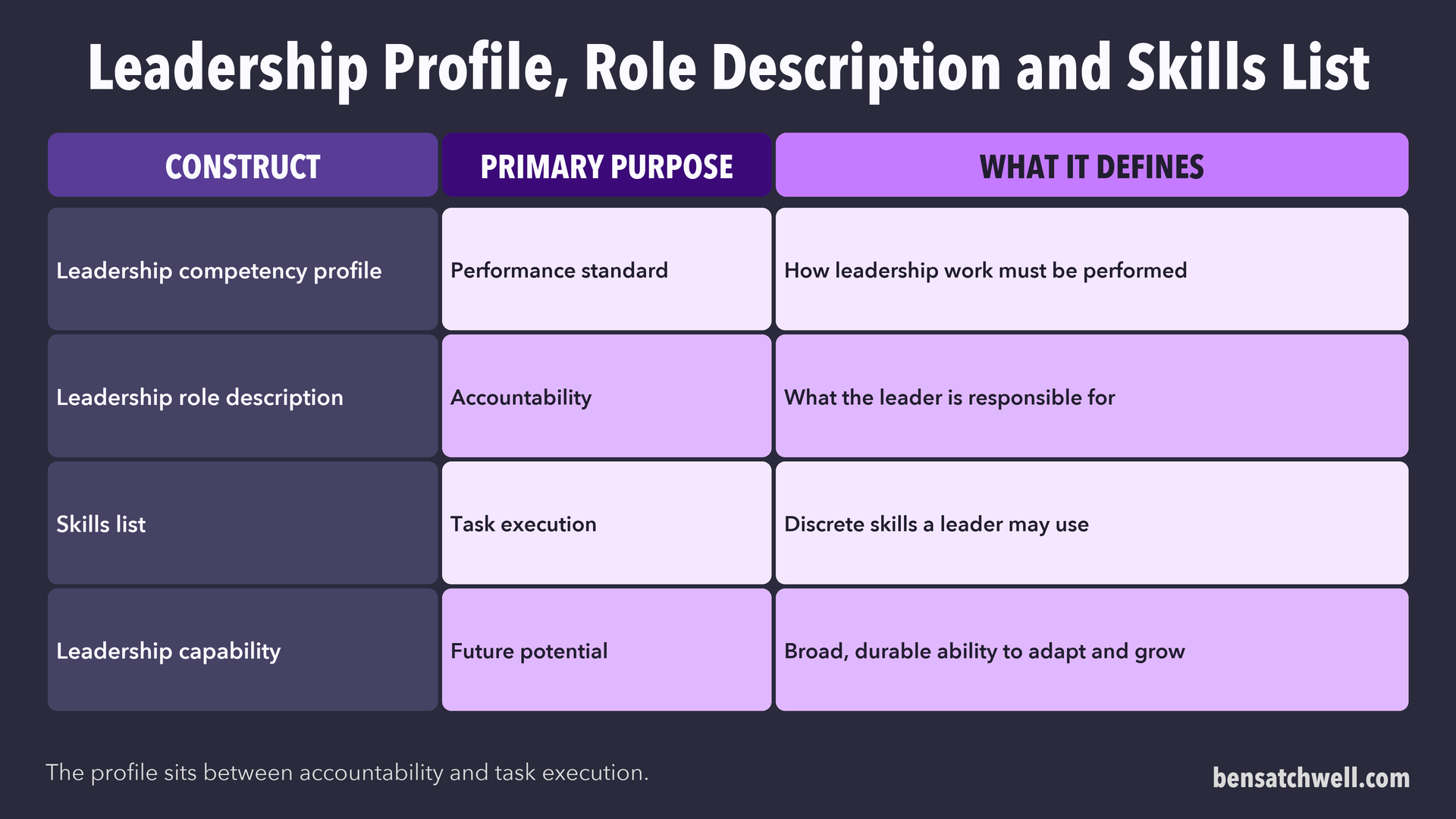
The profile sits between accountability and task execution.
The line with capability is where many organisations drift into error. The profile defines how leadership work must be performed now. It is role-bound, assessable and grounded in observable behaviour and judgement. Leadership capability describes the potential to adapt and perform in future contexts, is forward-looking and not locked to a role, and suits succession planning and workforce strategy. A profile should never be repurposed as a capability statement without redesign, because doing so invalidates assessment and adds ambiguity.
How to Design the Profile
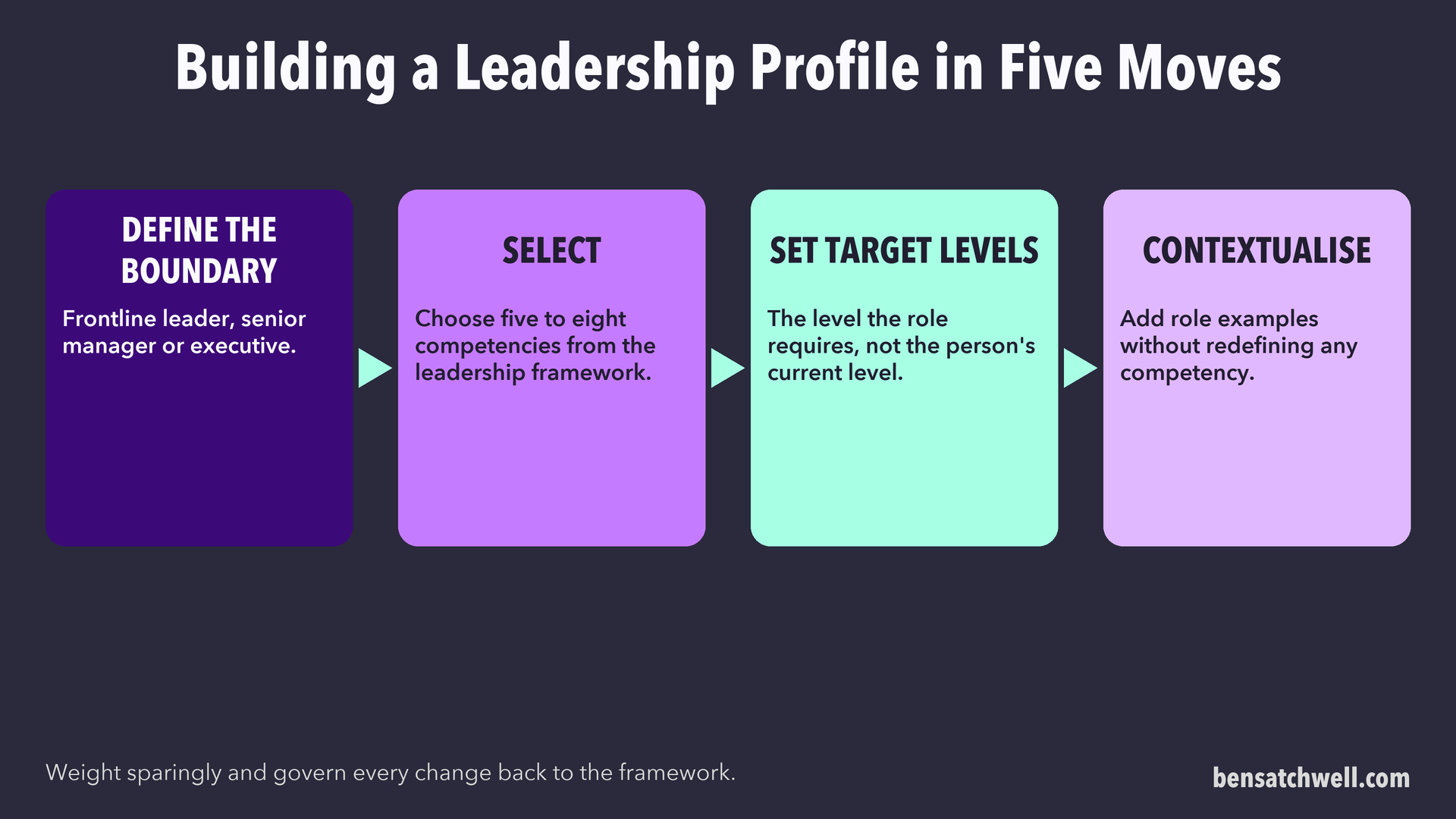
1. Define the role boundary
Apply it to a clearly defined role or level, such as a frontline people leader, a senior manager or an executive leader. If the boundary is unclear, the profile will be vague.
2. Select competencies from the framework
Include only what the role needs, avoid overlapping constructs and keep the set usable. Most leadership profiles carry five to eight competencies. More than that reduces clarity and adoption.
3. Set target proficiency levels
This is the core job. For each competency state the level the role requires. That is not the individual's current performance and not a future aspiration, and the distinction is essential for fair assessment.
4. Contextualise indicators to the leadership scope
Definitions and level logic come from the framework. The profile may add role-specific indicators or examples that clarify expectations, but they must not redefine the competency.
5. Weight sparingly
Some roles emphasise particular competencies. People leadership may dominate in frontline roles and organisational judgement at executive level. Keep weighting minimal, explicit and governed.
Worked Examples
Frontline people leader
Role boundary: a leader with direct reports and operational accountability. Selected competencies: decision-making and judgement, people leadership and operational accountability, each at Proficient. Role-specific indicators include making timely decisions within delegated authority and escalating appropriately, setting clear expectations and addressing underperformance directly, and balancing operational delivery with team wellbeing. The profile defines what competent leadership looks like in the role, not how exceptional the individual is.
Executive leader
Role boundary: a leader with enterprise-wide accountability. Selected competencies: strategic judgement, organisational stewardship, stakeholder influence and ethical leadership, each at Advanced. Indicators include making high-impact decisions under uncertainty with enterprise consequences, balancing commercial outcomes with long-term sustainability and navigating competing stakeholder interests while keeping trust.
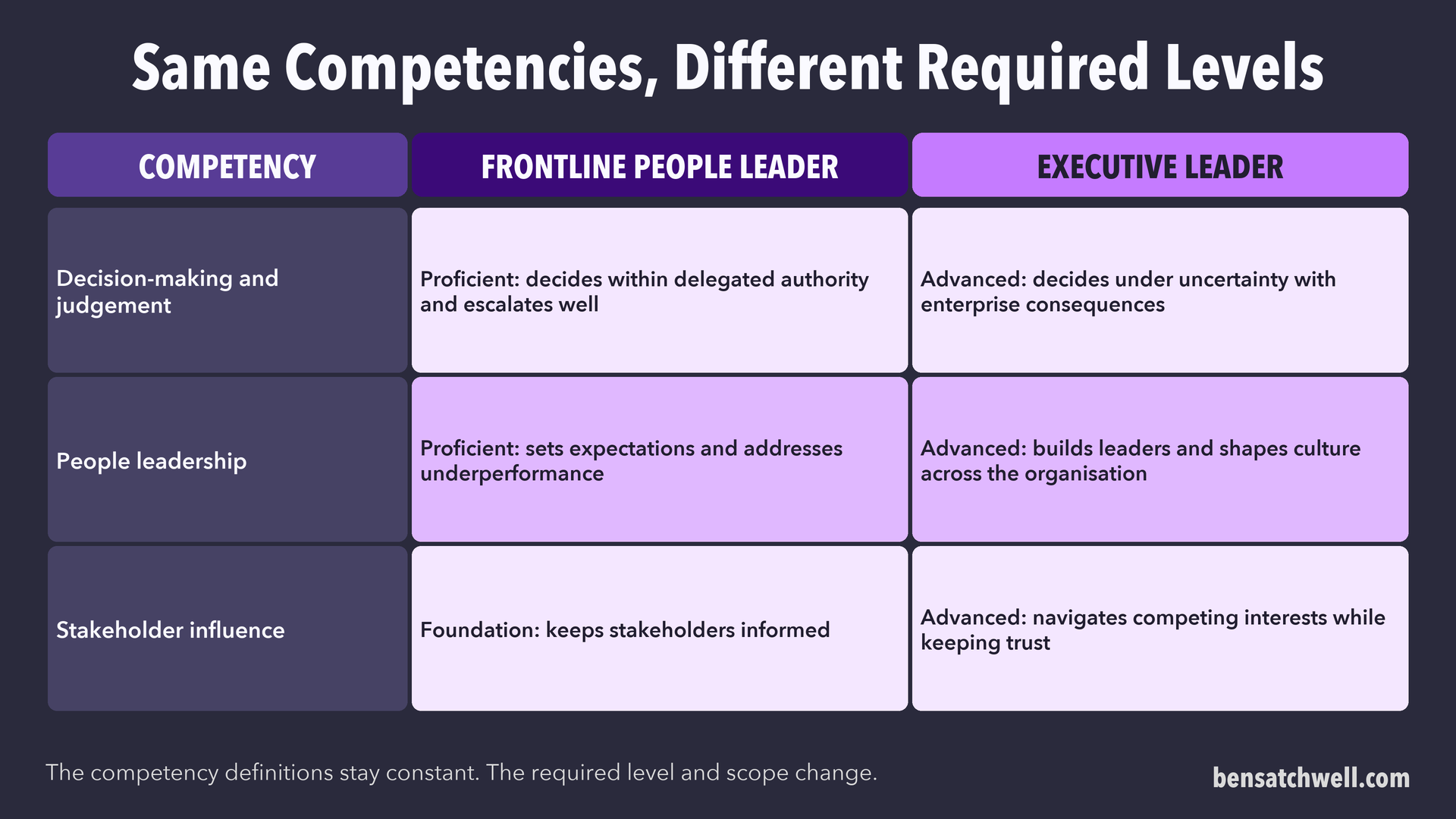
The competency definitions stay constant. The required level and scope change.
Notice that the competencies are drawn from the same framework. What changes is the required level and scope. For named standards that can feed the selection, see my comparison of the best leadership competency models.
What Belongs and What Does Not
A defensible profile holds a defined role or level, selected competencies, target levels and role-relevant indicators. That is enough. Profiles fail when they absorb unrelated elements, so leave out values and culture statements, leadership philosophy, KPIs, personality traits, potential or succession indicators and development plans. These may connect to the profile, but they are not the profile.
Assessment and Governance
Assessment works only when role standards are explicit. A defensible approach separates the role requirement from the individual's performance, assesses evidence against defined indicators and calibrates leaders at the same level against the same profile. The competency assessment framework guide covers the mechanics.
Most profiles fail through poor governance, not poor design. Governance should settle who owns the profile, how changes are approved, how local tailoring is constrained and how alignment to the framework is enforced. Without it, profiles drift, duplicate and lose comparability.
Common Mistakes
- Treating it as the framework. Local redefinition destroys consistency.
- Overloading it. Values, KPIs and development plans make it unusable.
- Confusing the role requirement with a person's rating. The profile defines expectations, not ratings.
- Too many competencies. If leaders cannot remember it, they will not use it.
- Ungoverned tailoring. Local tweaks without approval erode trust and comparability.
Trade-Offs and Constraints
A leadership profile suits organisations where leadership roles are defined and stable, performance must be assessed fairly, expectations must be consistent across teams and development needs a clear reference standard. It works less well in highly fluid or experimental leadership environments, where a capability approach may serve better. Built on a well-governed framework, a profile gives clarity, consistency and defensible assessment. Left to drift into capability language or aspiration, it loses precision and credibility together.
FAQ
What is a leadership competency model?
A role-level selection of leadership competencies and required proficiency levels, used to say what a specific leadership role needs to be performed competently.
How is it different from a leadership competency framework?
There is no difference in structure. Competency model is the usual US name for the whole system and competency framework is more common in the UK and Australia. The framework defines the shared system and the competencies and levels for one leadership role are a competency profile.
Should it include behaviours?
Yes, as observable indicators tied to defined competencies, not as values or traits.
Can it change over time?
Yes. Profiles should evolve as leadership roles change while the framework stays stable.