
Sales competency models are everywhere and frequently wrong. In many organisations a sales competency model quietly becomes a grab bag of quotas, behaviours, personality traits and aspirational attributes. When that happens it cannot be assessed consistently, calibrated across roles or governed. This article treats the sales competency model as a strict competency construct and takes the deal-environment view: how the same competencies are required at different levels across sales roles, what belongs in the profile and what has to stay out of it.
What Is a Sales Competency Model?
A sales competency model is a role-level selection of sales competencies that sets the required standard of sales performance for a particular sales role. I call it a sales competency profile. It draws its competencies from the organisation's sales competency framework, sets a target proficiency level for each and contextualises the indicators to the role and its deal environment.
In practical terms it answers one question: what sales competencies, at what level, does this role need to be performed competently? It describes present-state role performance, not future sales potential. Academic work shows the idea is not new. A study on a competency model for entry-level business-to-business services salespeople and a paper on a sales manager profile built with the analytic hierarchy process both show role-specific selection at work.
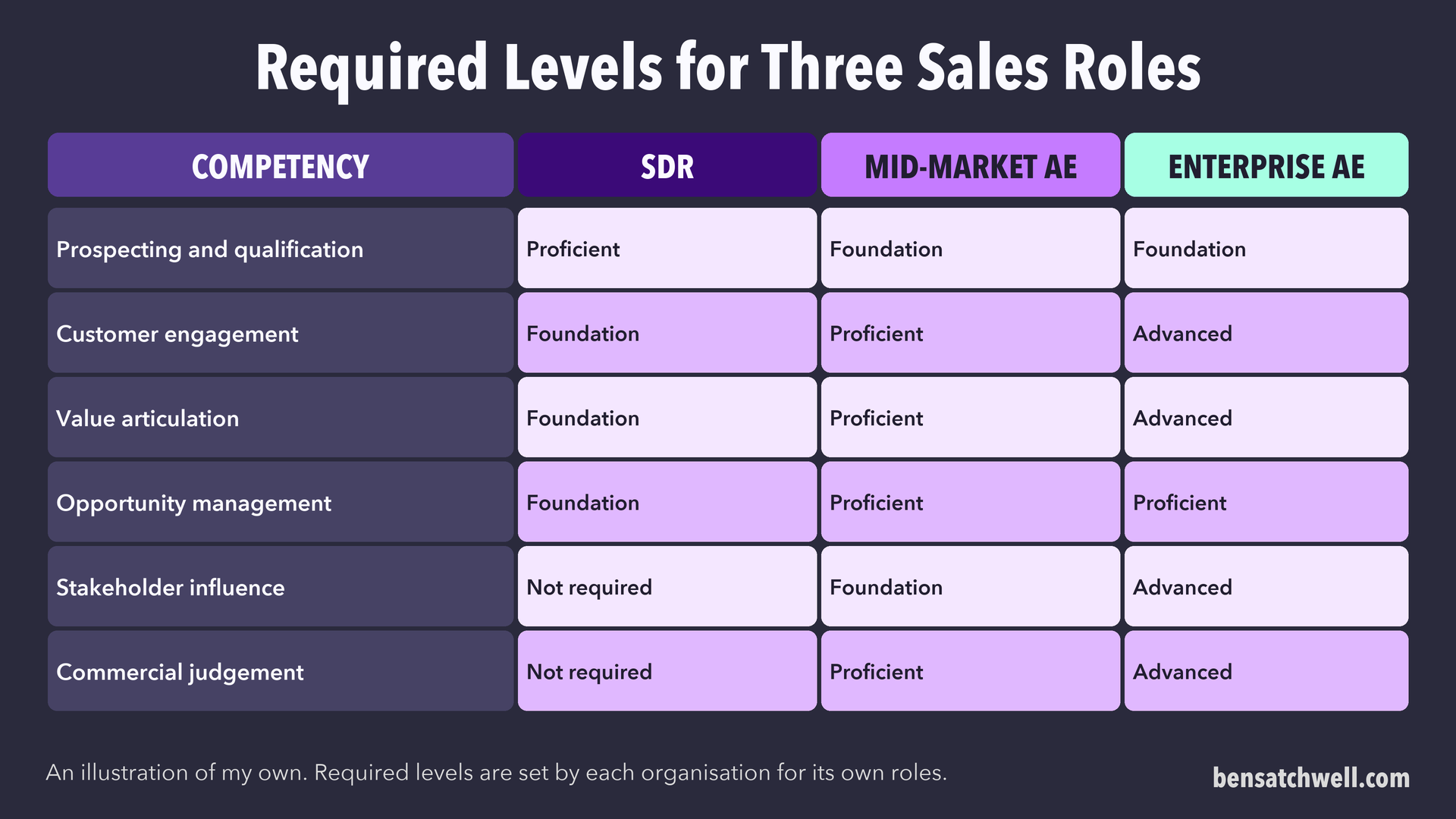
An illustration of my own. Required levels are set by each organisation for its own roles.
A note on terminology. A competency framework is also called a competency model, especially in the United States. I use competency profile for the competencies and required levels for one role, and competency matrix for the grid of required against current proficiency. Usage varies by region, and I explain the differences in this competency model definition.
Why Sales Needs Role-Level Profiles
A framework defines the system, but it is too broad to set expectations for an individual role. Profiles bridge that gap. Organisations use them to clarify what a sales development rep, an account executive or an enterprise executive is expected to do, to support structured hiring and promotion, to anchor performance conversations, to find development gaps against the role and to calibrate across salespeople at the same level. Without profiles, the framework stays abstract. With poorly designed ones, expectations become subjective.
Framework, Profile and Capability
The framework is organisation-wide, defines the shared sales competency architecture of definitions, levels, indicators and governance, and is relatively stable. The profile is specific to a role, such as SDR, account executive or enterprise account executive, selects from the framework, sets target levels and changes as sales roles change. If every sales role redefines competencies, the framework has already failed.
The profile also differs from sales capability. The profile says how sales work must be performed now, is role-bound and assessable and rests on observable behaviour and judgement. Capability describes potential to adapt to new markets, products or sales motions, is forward-looking and not locked to a role and suits workforce planning and transformation. Using a profile to describe future capability invalidates assessment. A profile also sits between the role description, which sets accountability, and a skills list, which names discrete task skills. It defines how the work is done, not what work exists.
How to Build a Sales Profile
1. Define the role boundary
Apply it to one clearly defined role, such as an SDR, a mid-market account executive or an enterprise account executive. If the boundary is unclear, the profile will be vague.
2. Select from the framework
Include only the competencies the role needs, avoid overlaps and keep it usable in real conversations. Most profiles hold five to eight.
3. Set target levels
State the level the role requires, not the individual's current performance and not a future aspiration.
4. Contextualise to the deal environment
Definitions and level logic come from the framework. The profile may add role-specific indicators, such as how discovery works in a multi-stakeholder deal. They must not redefine the competency.
5. Weight sparingly
An SDR role stresses prospecting and qualification. An enterprise role stresses commercial judgement and negotiation. Keep weighting minimal and governed.
Worked Examples
Mid-market account executive
Role boundary: manages multi-stakeholder deals in the mid-market. The competencies are customer engagement, value articulation, opportunity management and commercial judgement, each at Proficient.
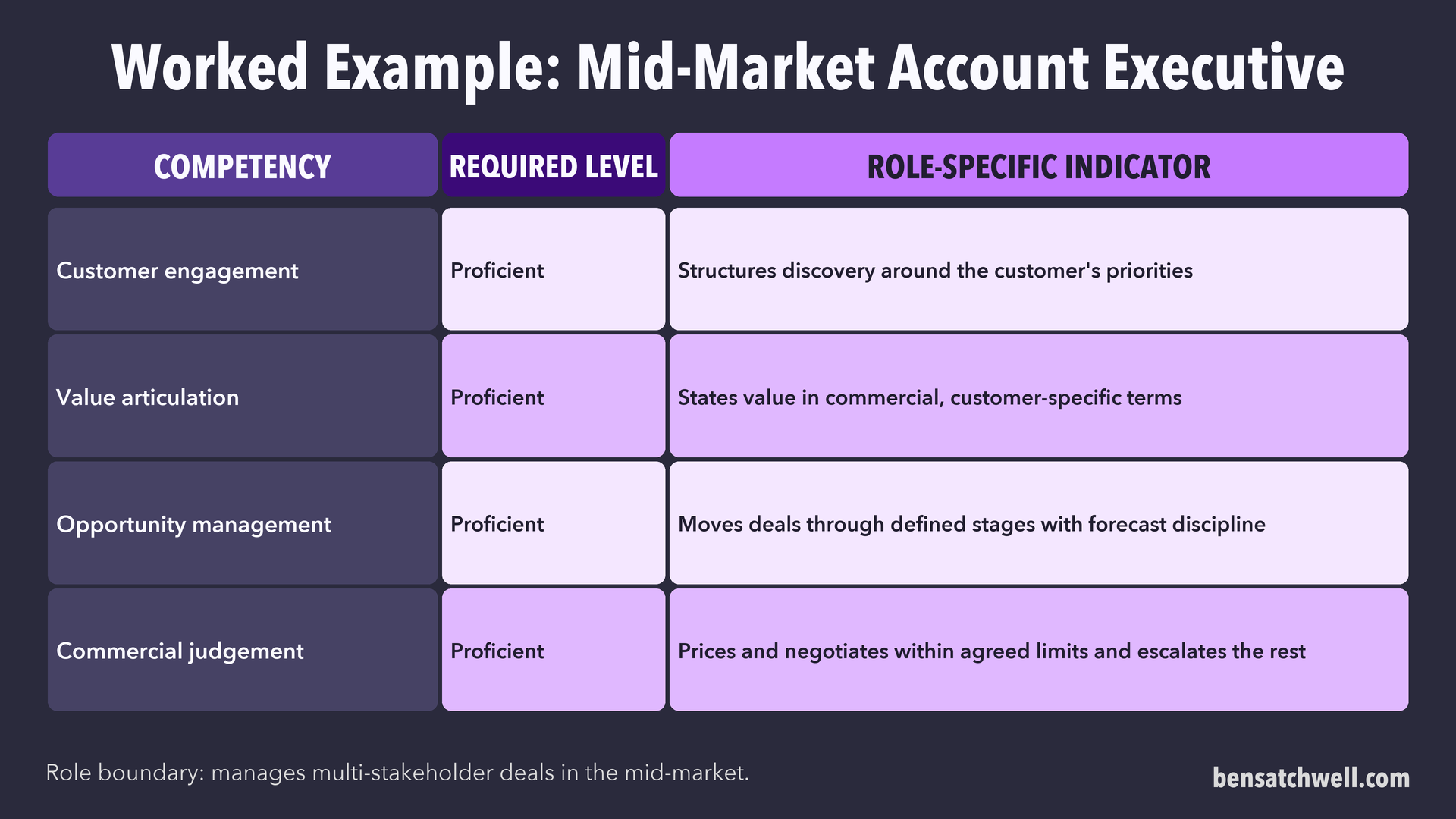
Role boundary: manages multi-stakeholder deals in the mid-market.
Enterprise account executive
Role boundary: manages complex, high-risk deals. The competencies are customer engagement, value articulation, stakeholder influence and commercial judgement, each at Advanced. Indicators include navigating complex stakeholder environments, framing value at organisational and financial-impact level and managing commercial risk across long sales cycles. The competencies are drawn from one framework. What changes is the required level and scope.
What Stays Out

These connect to the profile, but they are separate artefacts.
A defensible profile holds a defined role, selected competencies, target levels and role-relevant indicators. Nothing more is required. Profiles fail when they absorb quotas or targets, compensation rules, methodology steps, personality traits, succession indicators and learning content.
Assessment and Governance
Assessment works only when standards are explicit. Separate the role requirement from the individual's performance, assess evidence against defined indicators and calibrate salespeople at the same level against the same profile. Most profiles decay for want of governance. Settle who owns the profile, how changes are approved, how alignment to the framework is enforced and how duplication is prevented. For the wider method, see my guide to the competency model.
Common Mistakes
- Treating it as the framework. Local redefinition destroys consistency.
- Overloading it. Bloated profiles stop being used.
- Confusing the role requirement with a person's rating. The profile defines expectations, not ratings.
- Too many competencies. If sales leaders cannot remember it, they will not use it.
- Ungoverned tailoring. Local tweaks erode comparability.
Trade-Offs and Constraints
Sales profiles suit organisations where sales roles are defined and stable, performance must be assessed fairly, expectations must be consistent across teams and development planning needs a reference standard. They are less effective in highly experimental sales environments. Built on a well-governed framework they give clarity, consistency and defensible assessment. When they drift into aspiration or capability language, they lose precision and credibility.
FAQ
What is a sales competency model?
A role-level selection of sales competencies and required proficiency levels, used to say what a specific sales role needs to be performed competently.
How is it different from a sales competency framework?
There is no difference in structure. Competency model is the usual US name for the whole system and competency framework is more common in the UK and Australia. The framework defines the shared competencies and the competencies and levels for one sales role are a competency profile.
Should it include behaviours?
Yes, as observable indicators tied to defined competencies, not personality traits.
Can it change over time?
Yes. Profiles should evolve as sales roles change while the framework stays stable.