

A leadership development framework is the structure that connects what leaders are expected to do at each level with how the organisation grows people into that level. Most organisations that say they have one have a list of leadership qualities and a menu of programmes. The list says nothing about levels, and the programmes are not tied to the list, so development is chosen by availability instead of need. A leadership development framework fixes this by sitting on a competency framework, which supplies the leadership competencies, the proficiency levels and the behavioural indicators that development is built around.
This guide sets out what a leadership development framework is, what it contains, how to build one, and where it goes wrong.
What is a leadership development framework?
A leadership development framework is a governing structure that defines the leadership capability required at each leadership level, and the pathways, evidence and decisions used to move people from one level to the next.
It has two halves. The first half is the standard: what effective leadership looks like at each level, written as observable behaviour. The second half is the development system: how people are identified, assessed against the standard, developed and moved. A framework with only the first half is a leadership competency framework. A framework with only the second half is a catalogue of programmes. The leadership development framework joins them.
It applies to the whole leadership population, from first-time team leaders to senior executives, and it is organisation-wide in the same way a competency framework is: it spans the workforce and is applied through role profiles.
A note on terminology. A competency framework is also called a competency model, especially in the United States. I use competency profile for the competencies and required levels for one role, and competency matrix for the grid of required against current proficiency. Usage varies by region, and I explain the differences in this competency model definition.
Why does a leadership development framework exist?
It exists because leadership development fails when nobody has agreed what it is developing towards. Without a shared standard, each manager promotes the people who resemble themselves, and each development decision rests on opinion. A framework gives three groups the same reference.
- Leaders see what is expected at their level and at the next one.
- Managers and HR assess readiness against written behaviours, not impressions.
- Executives see the leadership bench across the organisation and where it is thin.
Government shows the pattern clearly. The US Office of Personnel Management requires five Executive Core Qualifications for entry to the Senior Executive Service and says departments and agencies also use them in performance management and leadership development for management and executive positions (US OPM, Executive Core Qualifications). One standard serves selection and development together, which is the point of a framework.
What does a leadership development framework contain?
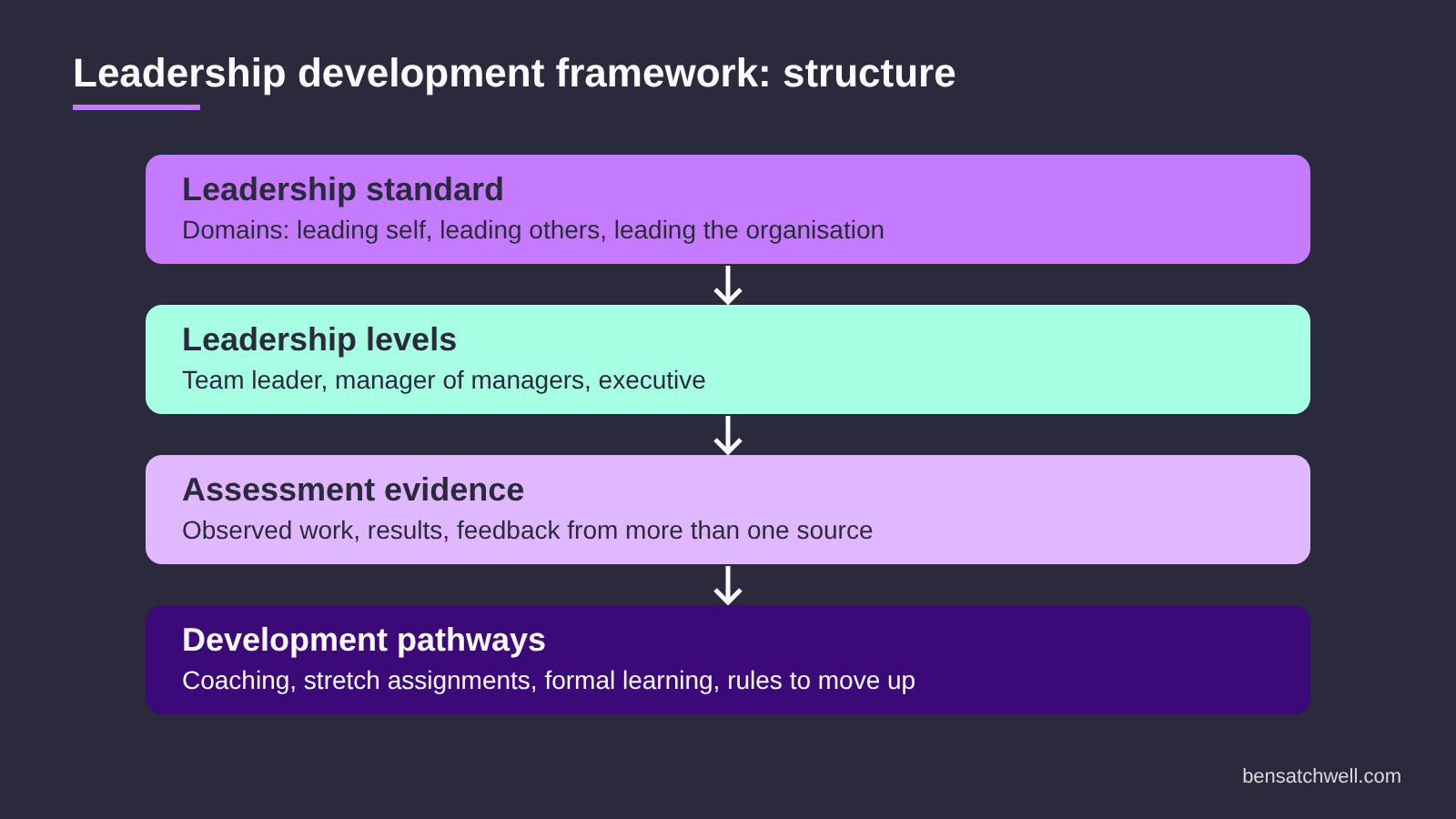
Five components do the work.
- Leadership domains. The groups of competencies that describe leading, such as leading self, leading others and leading the organisation. Keep to three to five domains.
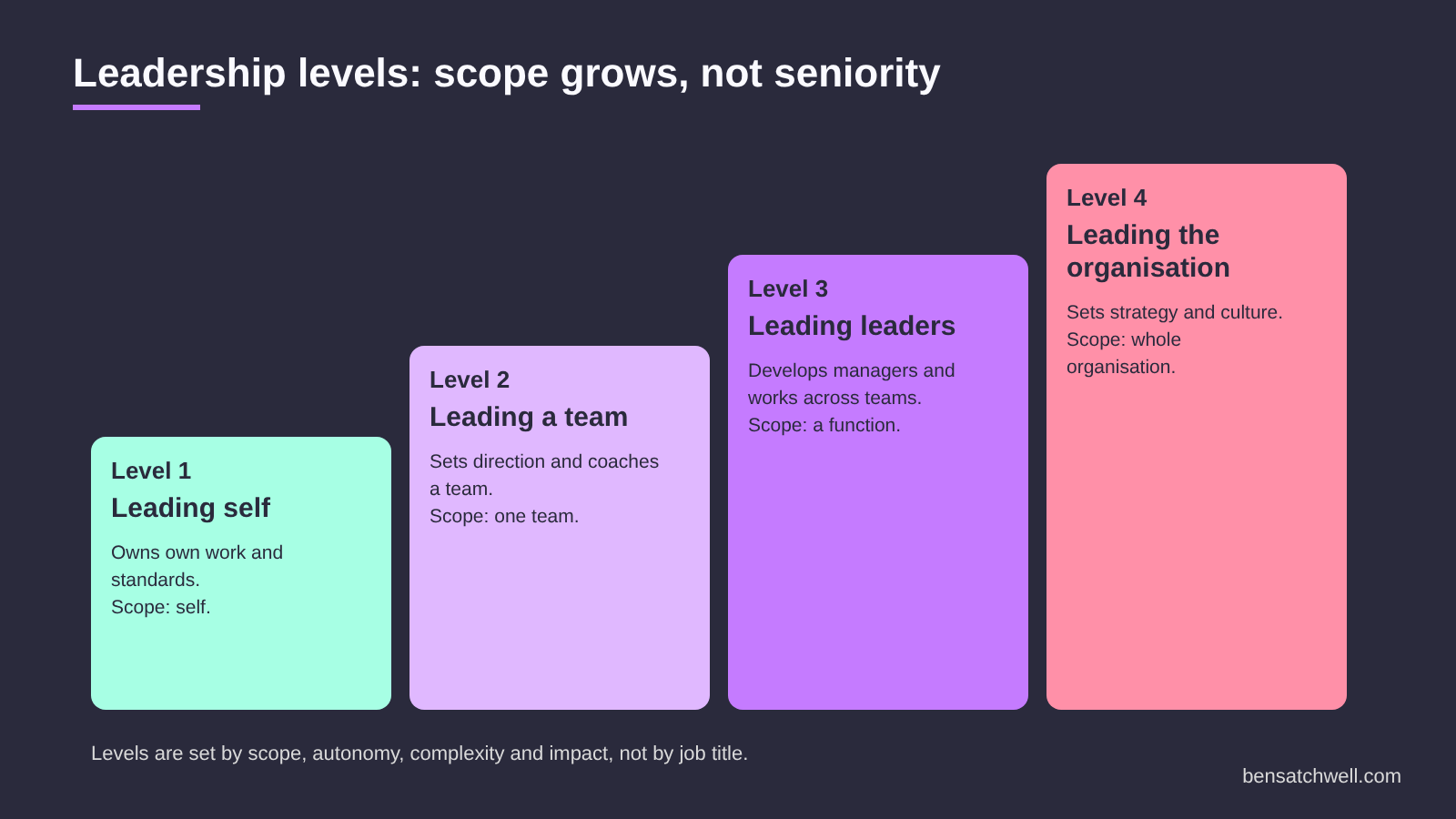
- Leadership levels. The stages of leadership responsibility, such as team leader, manager of managers and executive. These are set by scope, autonomy, complexity and impact, not by seniority or years of service.
- Behavioural indicators. The written statements of what effective leadership looks like at each level. These are what assessment is conducted against.
- Assessment evidence. What counts as proof: observed work, results, feedback from more than one source and structured interviews.
- Development pathways. The experiences, coaching, stretch assignments and formal learning linked to specific gaps, plus the rules for moving up a level.
How does a leadership development framework work in practice?
It runs as a cycle. A leader is profiled against the standard for their level, the gap to the required level is identified, a development plan targets that gap, and the leader is reassessed on evidence. The cycle repeats at promotion or at a set interval.
How many leadership levels should it have?
Four to six is workable, and I explain how to set them in competency framework levels. The NSW Public Sector Capability Framework keeps five capability levels, from Foundational to Highly Advanced, showing a progressive increase in complexity and skill, and its revised version strengthened behaviours related to leadership (NSW Government, revised framework factsheet). Each level should be distinguishable from the one above and below without mentioning job title.
How does it connect to development?
Each gap maps to a development action, and the match matters. A gap in a judgement-based behaviour is rarely closed by information. It is closed by experience with feedback, such as a stretch assignment with a coach. The competency development framework guide covers how gaps become pathways.
Where does capability fit?
Leadership is a good candidate for a capability lens, because leadership capabilities are broad, durable and carry across roles as work changes. If your organisation has adopted capabilities, the same structure applies. I cover it in leadership capability framework.
What a leadership development framework is not
It is easily mistaken for neighbouring things.
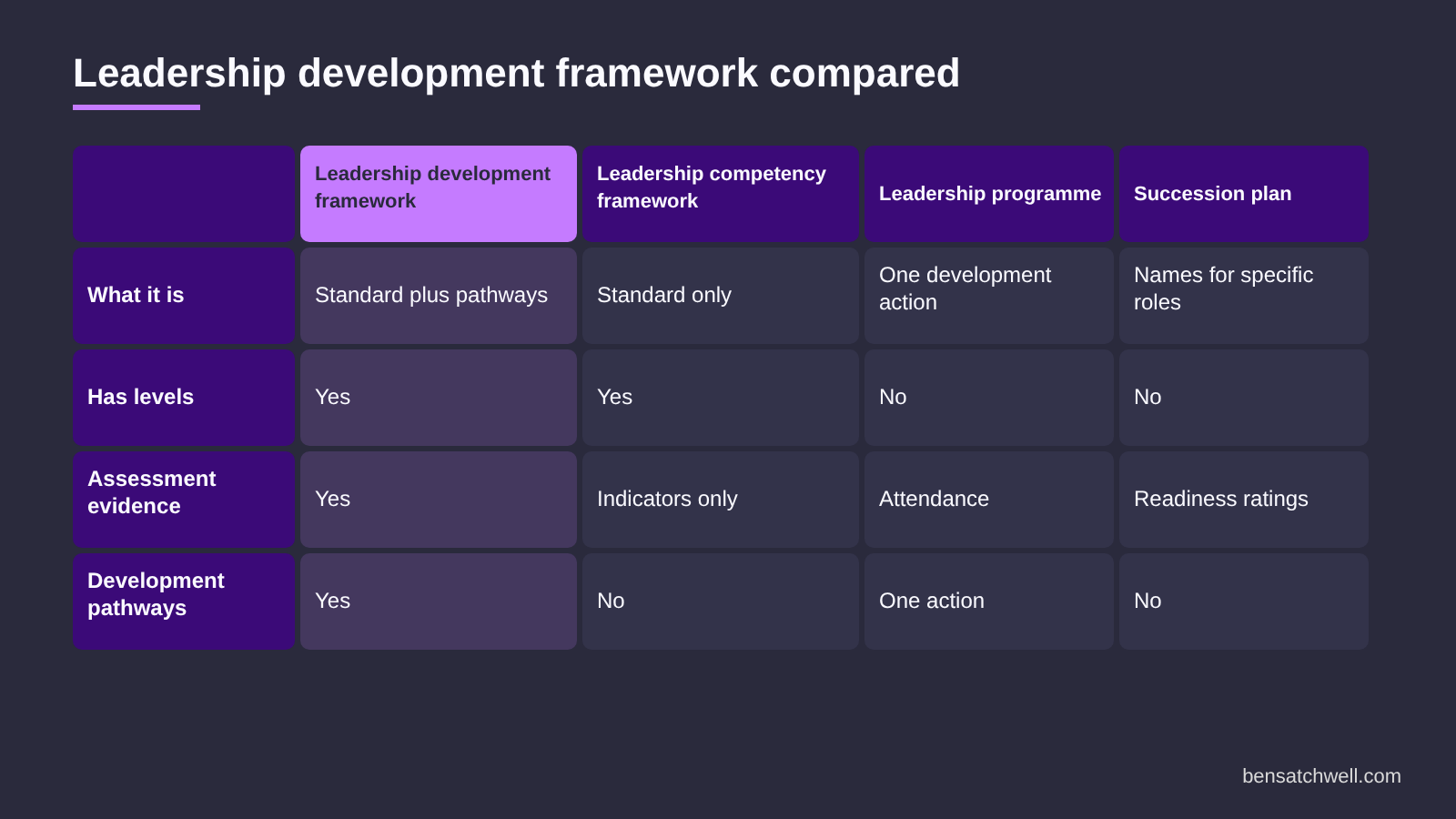
- Not a leadership competency framework. The competency framework defines the standard. The development framework adds levels of responsibility, assessment evidence and pathways.
- Not a leadership programme. A programme is one development action. A framework decides which action suits which gap.
- Not a succession plan. Succession names people for specific roles. The framework supplies the standard those decisions use.
- Not a values statement. Values describe intent. The UK Civil Service Leadership Statement sets out the values and behavioural expectations of its leaders (UK Government, Civil Service Leadership Statement), and a development framework still needs levels and evidence beneath it to be usable.
How do you build a leadership development framework?
1. Decide the purpose and the population
Name the decisions it supports: selection, development, promotion or succession. Name the levels of leadership it covers. A framework built to serve every purpose serves none.
2. Start from an existing standard
Select from published leadership standards and from your own competency framework before writing anything new. Selecting is faster and gives you a common language with the market.
3. Set the domains and the levels
Choose three to five domains and four to six levels. Define each level by scope, autonomy, complexity and impact.
4. Write behavioural indicators
Write two to four observable statements for each competency at each level, in the present tense, with a work example. Vague wording defeats assessment.
5. Define the evidence
Decide what counts as proof of a level and who assesses it. Use more than one source so ratings do not rest on one opinion.
6. Link gaps to development actions
For each domain, list the experiences and supports that close a gap, and who owns them.
7. Set the rules for moving up
State what evidence qualifies someone for the next level, and who decides. Name an owner and a review cycle for the framework.
Where do leadership development frameworks commonly fail?
- A list of qualities. Traits such as integrity and vision are named but not levelled, so nothing can be assessed.
- Levels tied to job title. Level 3 becomes "director", and the scale measures status instead of leadership.
- No link to development. Gaps are identified and then nothing follows.
- Self-rating only. Scores drift upward and the data loses value within a year.
- Too many competencies. A leader cannot work on forty things, and managers stop using the framework.
- Frozen content. The framework is built once and not reviewed as strategy changes.
What are the trade-offs when designing a leadership development framework?
One framework against several. A single framework for all leaders is easier to maintain and compare. Separate frameworks for functions or levels fit better but multiply upkeep. Most organisations do better with one framework and short local additions.
Standard against custom. A published standard is credible and quick. A custom framework reflects your strategy but must be maintained by you.
Precision against shelf life. Detailed indicators are easier to assess and date faster. Write at the level you are prepared to review each year.
Do not build one if no competency framework exists and the leadership population is small. A conversation and a short role profile do the same work at lower cost.
FAQ
What is a leadership development framework?
A leadership development framework is a governing structure that defines the leadership capability required at each leadership level, and the pathways, evidence and decisions used to move people between levels.
What is the difference between a leadership development framework and a leadership competency framework?
A leadership competency framework defines the competencies, levels and indicators of effective leadership. A leadership development framework builds on it by adding assessment evidence and the pathways that develop people toward each level.
What should a leadership development framework include?
Leadership domains, leadership levels, behavioural indicators, assessment evidence and development pathways, plus an owner and a review cycle.
How many levels should a leadership development framework have?
Four to six. Fewer cannot separate real differences in responsibility, and more are hard to describe and assess consistently.
How do you measure whether a leadership development framework is working?
Track whether leaders are assessed on evidence against the written indicators, whether plans target identified gaps, and whether internal appointments to leadership roles are made against the standard. Reassess the same indicators over time to see movement.
Can a capability framework support leadership development?
Yes. Leadership capabilities are broad and durable, so they suit a capability lens, and the same levels, indicators and pathways structure applies.