
Most organisations that invest in leadership development still cannot tell you what their leaders actually need to be capable of. They can describe behaviours. They can point to a competency list. But a unified, organisation-wide structure that defines leadership capability at every level, tied to strategy and applied consistently across roles, is less common than it should be. A leadership capability framework is the answer to that gap, and it is distinct in important ways from the adjacent structures that organisations often confuse it with.
What Is a Leadership Capability Framework?
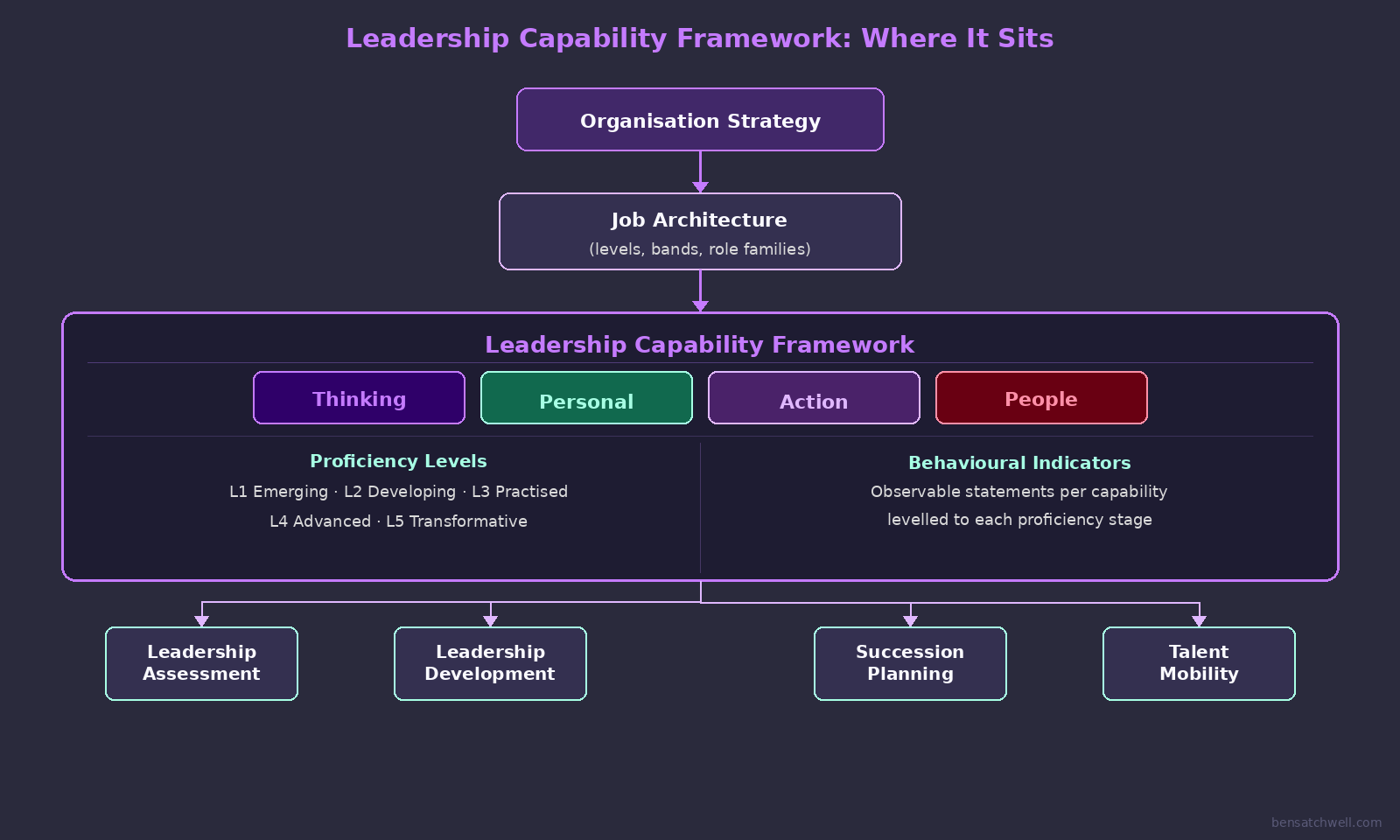
A leadership capability framework is an organisation-wide structure that defines the capabilities leaders at every level need to deliver the organisation's strategy. It organises those capabilities into domains, sets proficiency expectations by level, and provides the observable indicators used to assess and develop leadership across the workforce.
At its core, it defines capability in the human sense: what a person must be able to do, not just what they know or what role they hold. A capability is broad, durable, and person-held. It integrates knowledge, skills, and personal attributes into something transferable across contexts. A leadership capability framework takes that construct and applies it specifically to the work of leading people and organisations.
Why a Leadership Capability Framework Exists
The problem it solves is consistency. Without a shared structure, every leader in an organisation operates against a different implicit standard. HR teams develop leaders using frameworks borrowed from vendors. Senior leaders promote people based on criteria that are never made explicit. The result is a leadership cohort with inconsistent capabilities, no shared language, and no clear development pathway.
A capability framework, as distinct from a development catalogue or a set of leadership principles, creates the common reference point that makes consistent assessment, selection, and development possible. It makes visible what was previously tacit.
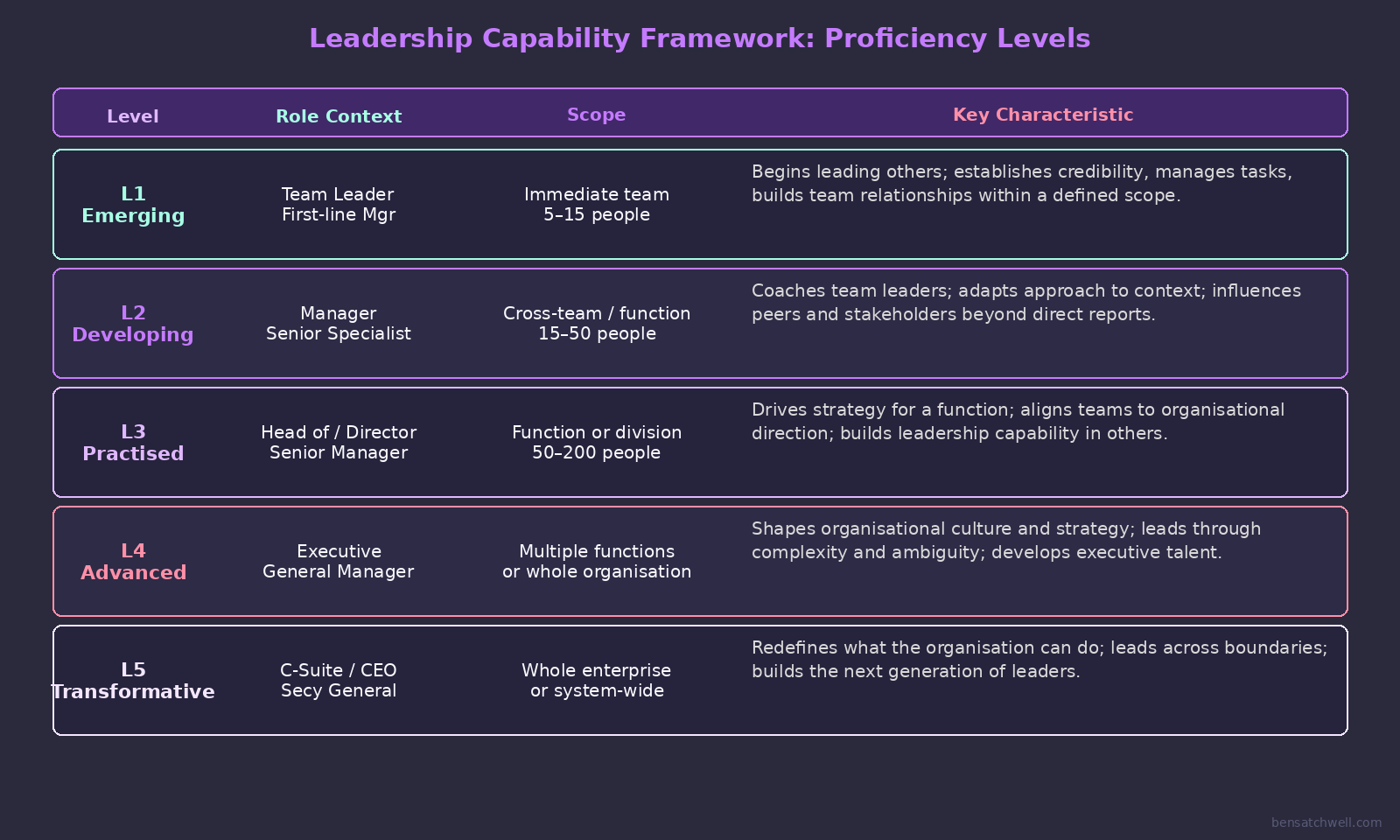
The public sector has led this work in Australia. The Australian Public Service Commission's Leadership Capabilities framework provides a structured framework for APS leaders across four capabilities and four levels of leadership, from new team leader to executive. The framework explicitly defines what leadership capability means at each level: not just what leaders should do, but what they must be able to demonstrate.
How a Leadership Capability Framework Works in Practice
A leadership capability framework organises capabilities into domains. Common domains include Thinking and Strategic, Leading People and Teams, Navigating Complexity and Change, and Delivering Outcomes. The exact domains vary by organisation and strategy, but they are coherent groupings, not a flat list.
Each domain contains three to five defined capabilities. Each capability is then described at a number of proficiency levels, typically four to six, that represent the scope, autonomy, and complexity expected at different points in the leadership pipeline.
For each level, the framework provides behavioural indicators: observable statements describing what the capability looks like in practice. Indicators are the operational unit of assessment. They make it possible to distinguish between someone who holds a capability and someone who does not, based on evidence rather than impression.
The framework is then applied through role profiles that set the expected capability level for each leadership role. Assessors, whether in performance conversations, development centres, or selection processes, use the indicators as the reference point for evaluation.
What a Leadership Capability Framework Is NOT
This is worth being direct about, because conflation is common.
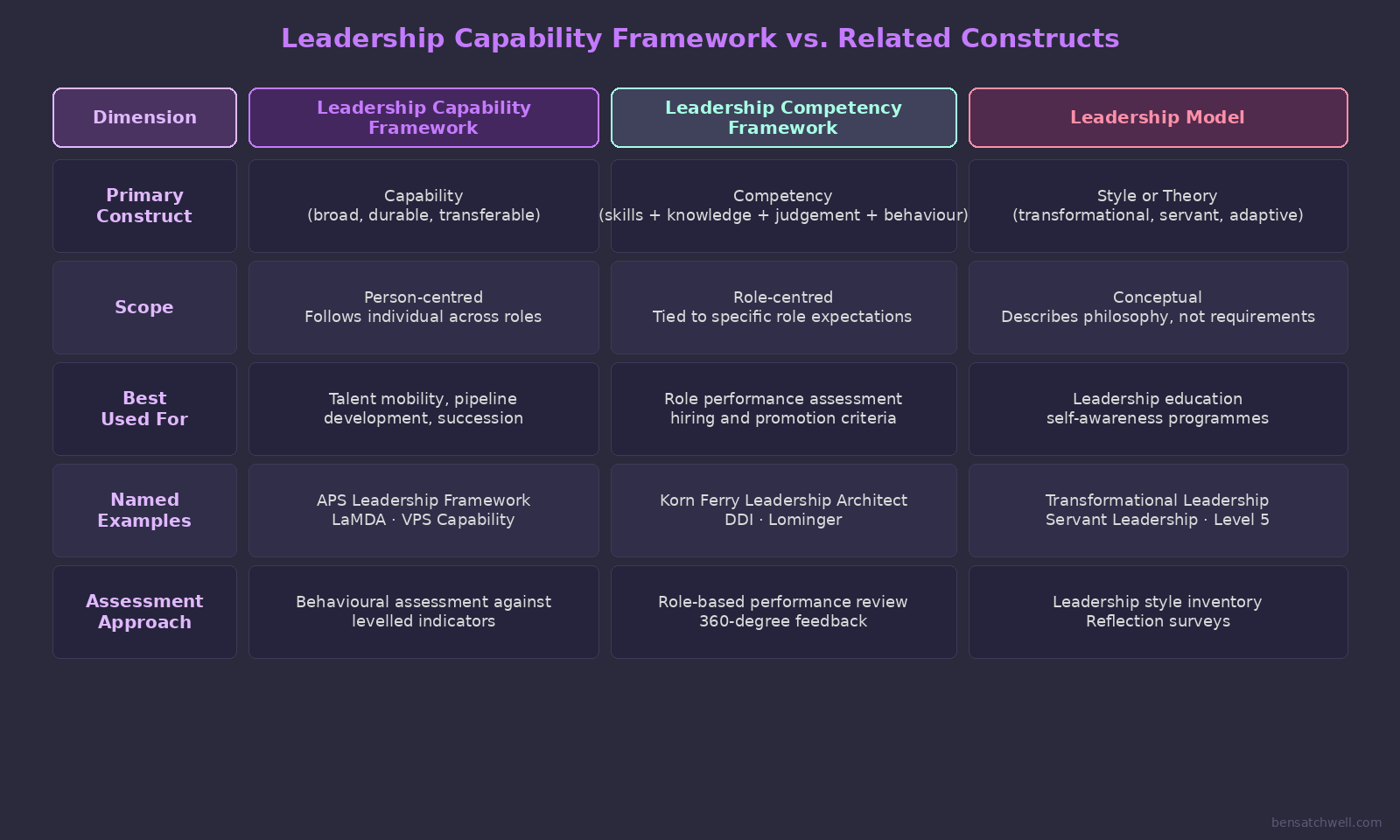
A leadership capability framework is not a competency framework for leaders. A leadership competency framework defines role-specific, performance-expected behaviours: what leaders must do to perform well in their current role. A capability framework defines what leaders must be able to become, broad and durable capacities that carry across roles and contexts. A competency framework is also called a competency model, especially in the United States, and usage varies by region. I explain the differences in this competency model definition.
Both structures have value. They serve different purposes. A competency framework is better suited for performance management. A capability framework is better suited for development, succession, and workforce planning.
A leadership capability framework is also not a set of leadership values or principles. Values describe what the organisation believes in. Capabilities describe what people must be able to do. The two are not substitutes.
And it is not a development programme catalogue. A framework defines the capability requirements. Development programmes are one response to those requirements. They are not the framework itself.
Named Frameworks and Standards
Several well-known frameworks are worth understanding in this space.
The Australian Public Service Leadership Capabilities framework organises APS leader development around four capabilities and four leadership levels. The OECD's guidance on civil service leadership is a useful international reference for how public sector leadership expectations are structured.
The Korn Ferry Leadership Architect is one of the most widely deployed commercial frameworks globally. It organises leadership capabilities into clusters and provides levelled behavioural indicators suitable for assessment and succession planning. Many organisations use it as the basis for a broader capability architecture, though it sits closer to the competency framework end of the spectrum.
The Victorian Public Service (VPS) Capability Framework is a strong Australian example of a full-stack framework that integrates capability domains, proficiency levels, and role-specific expectations within a public sector context.
Common Failure Modes
The three most common ways leadership capability frameworks fail in practice:
- Overcomplication at the design stage. Frameworks that include 40 capabilities across eight domains and six proficiency levels become unusable. Nobody can assess against them effectively. Nobody can remember them. The best frameworks have four to six capabilities per domain and four proficiency levels. Usability is a design requirement, not an afterthought.
- Decoupling from strategy. A framework that is not explicitly tied to the organisation's strategic direction becomes a generic HR artefact. If the organisation's strategy requires leaders to navigate large-scale change, that capability domain must be present and prominent. Frameworks built from commercial templates and installed without customisation frequently miss this.
- Building without deploying. The framework exists in a document, is approved by the executive, and then sits on an intranet page with no role profiles, no assessment tools, and no development pathways. This is the most common failure mode of all, and it comes from treating design as the output rather than the starting point.
Trade-offs and Constraints
A leadership capability framework is most valuable when the organisation is large enough to need shared standards across divisions, when the strategy requires deliberate capability development for succession and talent mobility, and when assessment and selection decisions need to be consistent and defensible.
It is less appropriate when the organisation is small and leaders operate in a single tight context, when the primary need is performance management rather than development (a competency profile, such as a competency profile for mentoring used for structured mentor development, serves better here), or when leadership roles are too diverse to define shared capability requirements meaningfully.
Frequently Asked Questions
What is a leadership capability framework?
A leadership capability framework is an organisation-wide structure that defines the broad, durable capabilities leaders at every level need to deliver strategy. It organises those capabilities into domains, sets proficiency expectations by level, and provides observable indicators for assessment and development.
What is the difference between a leadership capability framework and a leadership competency framework?
A leadership competency framework defines the specific behaviours and skills leaders need to perform well in their current roles. A leadership capability framework defines broader, more durable capacities that carry across roles and contexts. Competency frameworks are better suited for performance management. Capability frameworks are better suited for development, succession, and workforce planning.
How many capabilities should a leadership framework include?
A workable framework typically includes 12 to 25 capabilities organised into four to six domains. Frameworks with 40 or more capabilities are difficult to assess against and rarely used effectively. Fewer, well-defined capabilities are more useful than a comprehensive but unwieldy list.
Who uses a leadership capability framework?
HR and L&D teams use it to design development programmes, assessment tools, and development pathways. Managers use it in performance and development conversations. Selection panels use it to evaluate candidates for leadership roles. Executives use it for succession planning and talent mobility decisions.
How is a leadership capability framework different from a set of leadership values?
Leadership values describe what the organisation believes in. A leadership capability framework defines what leaders must be able to do. The two are complementary but not substitutes for each other.
Can a single leadership capability framework work across all leadership levels?
Yes, and that is one of its core design requirements. The framework must span the full leadership pipeline from team leader to executive, with proficiency levels that define what each capability looks like as scope, complexity, and autonomy increase. A framework that only covers senior leaders leaves the development pipeline unaddressed.