

The project delivery capability framework is the UK Government's description of what it takes to be a project delivery professional, and its name is the first thing worth challenging. It is called a capability framework, but what it describes is roles, competencies and levels. I read it as a useful competency framework with a capability label, and the distinction matters if you plan to copy its design. It sits in the wider capability framework family only loosely, and I will show where.
This article explains what the framework contains, why it exists, how people use it, and what to borrow from it and what to leave. I have checked each factual claim against the published pages. Where those pages do not say something, I say so.
What is the project delivery capability framework?
The project delivery capability framework (PDCF) is a UK Government framework that describes the roles and competencies of project delivery professionals across central government. The Government Projects Academy page says it covers projects, programmes and portfolios, applies at all grades, and gives people a shared vocabulary for job roles, skills and behaviours.
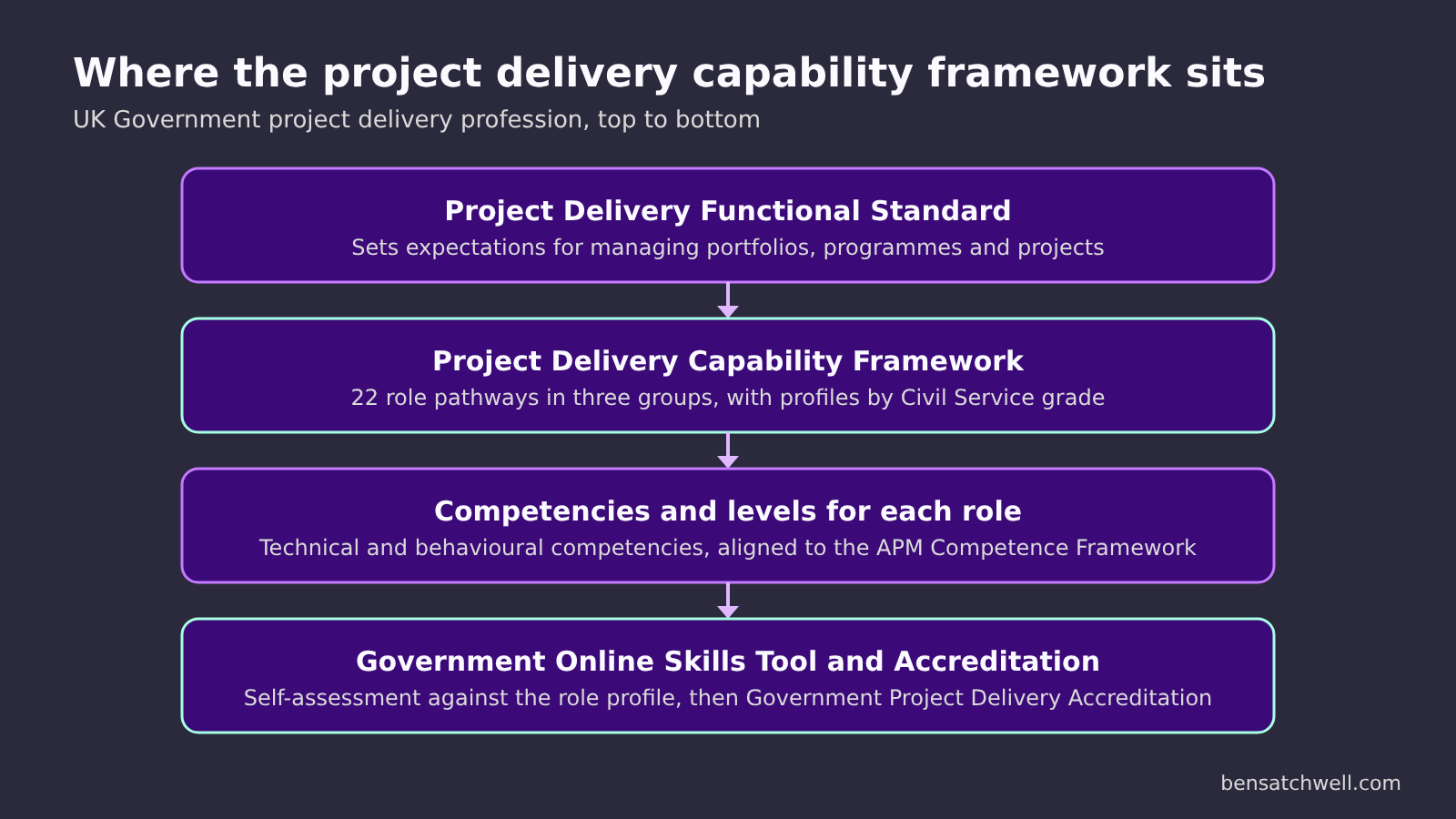
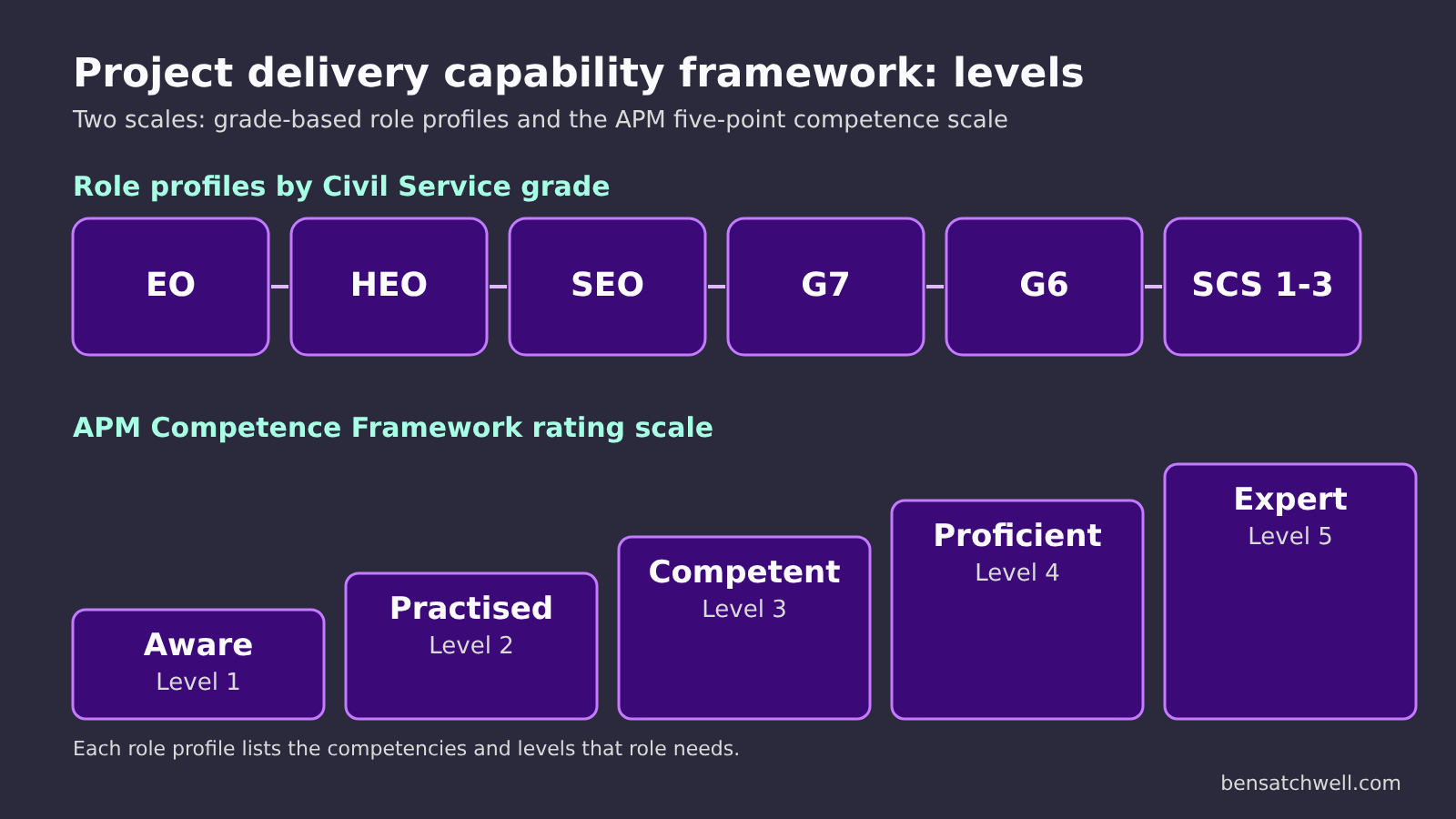
It is organised as 22 role pathways in three groups. Leadership has seven roles, such as Senior Responsible Owner and Programme Director. Project delivery specialists have eleven, such as Planner, Estimator and Assurance Manager. Business analysis and change specialists have four, such as Benefits Manager and Business Analyst. Each pathway has profiles by Civil Service grade, from EO through to the Senior Civil Service.
The earlier version on GOV.UK describes four elements: a career pathway with common job roles, a set of competencies, signposts to development opportunities, and criteria and a process for accreditation. That version was first published on 11 May 2017 by the Infrastructure and Projects Authority and the Cabinet Office. The current GOV.UK publication page shows it as withdrawn on 10 June 2025 and points readers to the Government Projects Academy version, which is marked as beta.
A note on terminology. A competency framework is also called a competency model, especially in the United States. I use competency profile for the competencies and required levels for one role, and competency matrix for the grid of required against current proficiency. Usage varies by region, and I explain the differences in this competency model definition.
Why the project delivery capability framework exists
A profession spread across many departments needs a common description of the work. The Academy page notes that job titles can vary between organisations, and the framework answers that with one set of role names, one set of competencies and one route for career progression.
That is a workforce problem, and it explains the design. A shared structure lets a Project Manager in one department be compared with a Project Manager in another. The Academy page also directs hiring managers to guidance on standardised job titles.
How the project delivery capability framework works in practice
The framework works at the level of the role. A person picks a current or aspired role, reads its profile for their grade, and compares their own competence against it.
Role pathways and grade profiles
Each role has a profile for each grade it exists at. A Senior Responsible Owner profile and a Project Support Officer profile therefore differ in the competencies required and the level of each. I find this the most reusable idea in the framework: the role is the unit, and the grade sets the expectation. It is the same logic as a competency profile in a competency framework.
Technical and behavioural competencies
The Academy page says the framework includes technical and behavioural competencies, and that its competencies align with the Association for Project Management Competence Framework. The APM Competence Framework has 29 outcome-based competences, each with criteria for knowledge and application, and it uses a five-point scale: aware, practised, competent, proficient and expert. The Academy page I read does not name the PDCF's own levels, so I treat the APM scale as the reference point rather than as the PDCF scale.
Self-assessment and accreditation
People assess themselves against the role profile to find strengths and development areas, and they use the results in conversations with their line manager. The Academy page describes the framework as the first step in the Government Project Delivery Accreditation process. The earlier GOV.UK page also refers to the Government Online Skills Tool for self-assessment and to the Project Delivery Functional Standard, which sets expectations for managing portfolios, programmes and projects.
What the project delivery capability framework is not
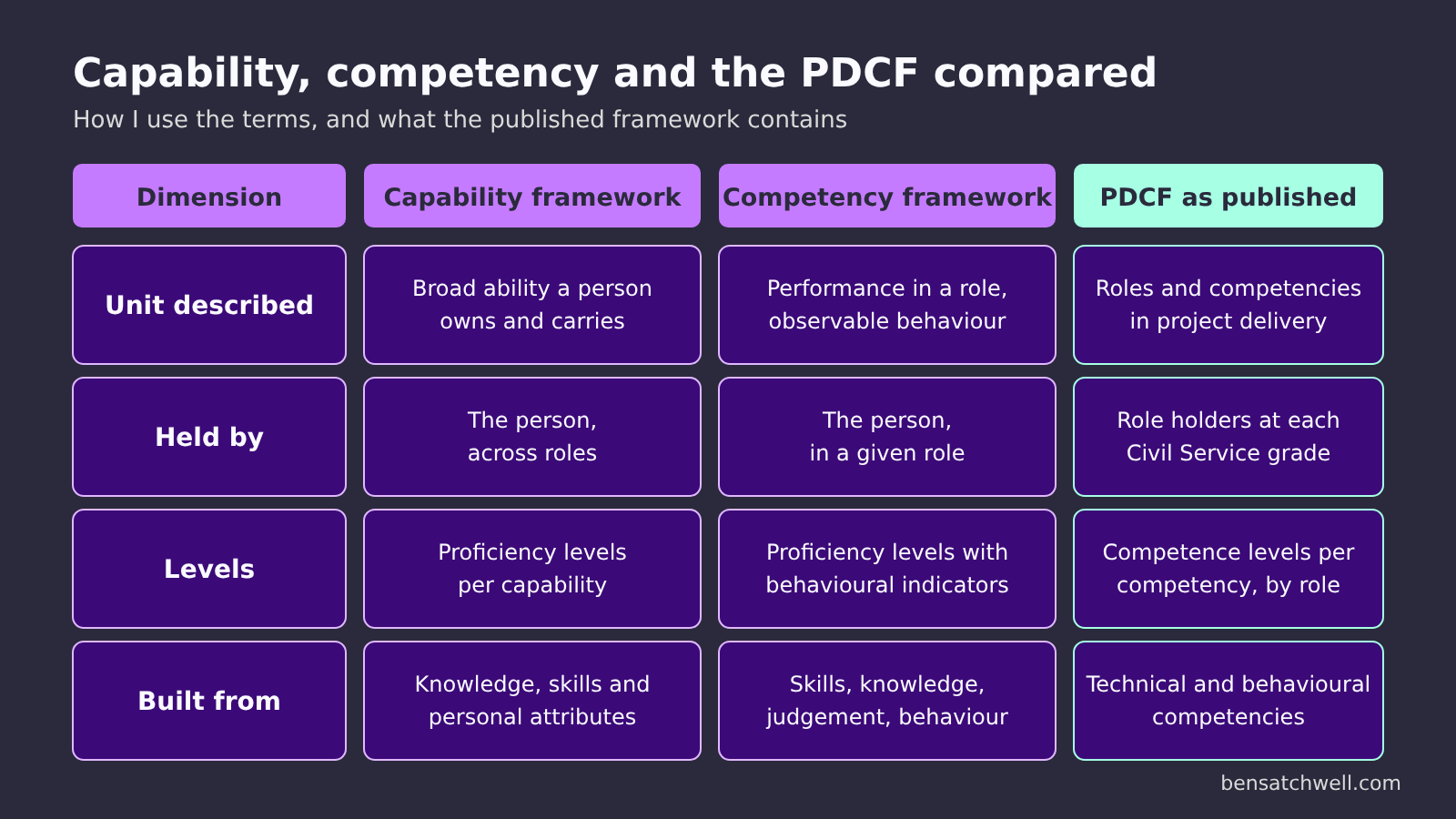
It is not a capability framework in the sense I use the term. A capability is a broad, durable area of ability that a person owns and carries across roles, tasks and contexts. A competency integrates skills, knowledge, judgement and behaviour as applied in a role, at a level of proficiency. The PDCF is built around roles, lists competencies for each role, and sets a required level for each grade. By those definitions it is a competency framework for one profession. I explain how the two constructs fit together in capability and competency framework, and the pillar page on the competency framework covers the structure it follows.
It is also not a whole-of-workforce framework. The Academy page lists the roles it treats as core to project delivery, and says other roles needed to deliver projects are described in other professions' frameworks, such as digital and data, commercial, finance and human resources.
Finally, it is not a performance rating. Self-assessment against a profile shows where someone sits relative to a role. It does not decide pay, promotion or accreditation on its own.
How the project delivery capability framework compares with other public sector frameworks
Public sector frameworks tend to take one of two shapes. Some describe capabilities for everyone in the service. The PSC capability framework and the VPS capability framework are examples of that shape, and the public sector capability frameworks overview compares several. Others describe one profession in depth, with role pathways and technical competencies. The PDCF is the second shape.
The two shapes answer different questions. A whole-of-service framework asks what every public servant should be able to do. A professional framework asks what a Planner or a Programme Director needs at a given grade. A government with both needs both, and the design problem is how they connect. The PDCF's own approach is to point outwards to other professions' frameworks, which keeps each one short but leaves the connection to the reader.
Common failure modes when copying a project delivery capability framework
- Copying the label, not the structure. Calling a role-based competency list a capability framework confuses the people who maintain it and the people who use it.
- Importing the grade structure. The grade profiles fit the Civil Service. Another organisation needs levels defined by scope, autonomy, complexity and impact, not by grade names. My piece on capability framework levels covers how many levels to use and what goes wrong.
- Treating the competency list as the framework. The competencies are one part. Governance, role profiles and the assessment process make the system usable.
- Skipping a source of truth for levels. If the framework does not define its own levels, users borrow another body's scale and the two drift apart.
Trade-offs and constraints
A single-profession framework is precise, and that precision is its strength. It lets a hiring manager write a role description and a candidate see a path. The cost is coverage. Anything outside the profession is left to someone else, and a person who moves from project delivery into policy or commercial work changes frameworks.
The framework is also tied to a status that is still moving. The Academy version is in beta, the older GOV.UK publication is withdrawn, and detail such as level definitions sits in role profiles rather than on one page. If you are using it as a reference, cite the version and date you read.
It suits an organisation that has a defined project profession and a grade structure. It suits an organisation with no grades, or with project work spread across many job families, much less.
Project delivery capability framework FAQ
What is the project delivery capability framework?
It is the UK Government framework that sets out the roles and competencies for project delivery professionals, with 22 role pathways and profiles by Civil Service grade.
Who publishes the project delivery capability framework?
The current version is on the Government Projects Academy site. The earlier GOV.UK publication lists the Infrastructure and Projects Authority, the National Infrastructure and Service Transformation Authority and the Cabinet Office as publishers.
Is the project delivery capability framework a capability framework or a competency framework?
By the definitions I use, it is a competency framework, because it is built around roles and lists competencies with required levels. Its published name uses capability.
What levels does the project delivery capability framework use?
The page I read does not name the levels. Its competencies align with the APM Competence Framework, which uses a five-point scale from aware to expert.
How do people use the project delivery capability framework?
They pick a current or aspired role, assess themselves against its competencies, discuss the results with their line manager and use it as the first step towards Government Project Delivery Accreditation.