

Competency assessment software records which competencies each person holds, at what proficiency level, and reports the gaps against what a role requires. I also call it competency management software, because most products do more than assess. Buyers tend to start with a product demonstration. That is the wrong place to start, because the software stores a competency framework. It does not create one.
If the framework is vague, the software stores vague data faster and produces tidy dashboards from it. This page explains what the tools do, what to check before you buy, and where they fail. It is written for HR and L&D professionals who have to choose or run one.
What is competency assessment software?
Competency assessment software is a system that holds a competency framework, records assessments of people against it, and reports the difference between required and current proficiency. Three things sit inside that definition: the framework itself (definitions, levels and behavioural indicators), the assessment records (who rated whom, when, and on what evidence), and the reporting layer (gap reports, heatmaps and team views).
The category goes by several names: competency management software, skills management software, talent intelligence platform. The labels overlap and vendors use them loosely. What matters is whether the product holds levelled competencies with observable indicators, or only a flat list of skill tags.
A note on terminology. A competency framework is also called a competency model, especially in the United States. I use competency profile for the competencies and required levels for one role, and competency matrix for the grid of required against current proficiency. Usage varies by region, and I explain the differences in this competency model definition.
Why organisations buy competency management software
A framework on a shared drive is hard to keep current and impossible to query. Once an organisation has a few hundred roles and a few thousand people, someone asks questions a spreadsheet answers slowly: how many people hold this competency at level three, which teams have no one at level four, which roles share the same gaps. Software answers those questions in minutes if the underlying data is sound.
The second reason is consistency. When assessments live in separate files, each manager rates against a different reading of the standard. A single system with one set of definitions makes ratings comparable, and comparable ratings are the point of a framework.
How competency assessment software works in practice
Most products follow the same sequence, and each step depends on the one before it.
- Load the framework. Competencies, proficiency levels and behavioural indicators go in as structured data. Role profiles select competencies and set a required level for each.
- Assess people. Self-ratings, manager ratings, multi-rater feedback or evidence submissions record a current level per competency. The method should match the rules in your competency assessment framework.
- Report the gap. Required level minus current level, shown per person, team and role. This is the competency matrix in software form.
- Act on it. Gaps feed development plans, internal mobility, succession and workforce planning, either inside the product or through an export to other HR systems.
What competency assessment software is not
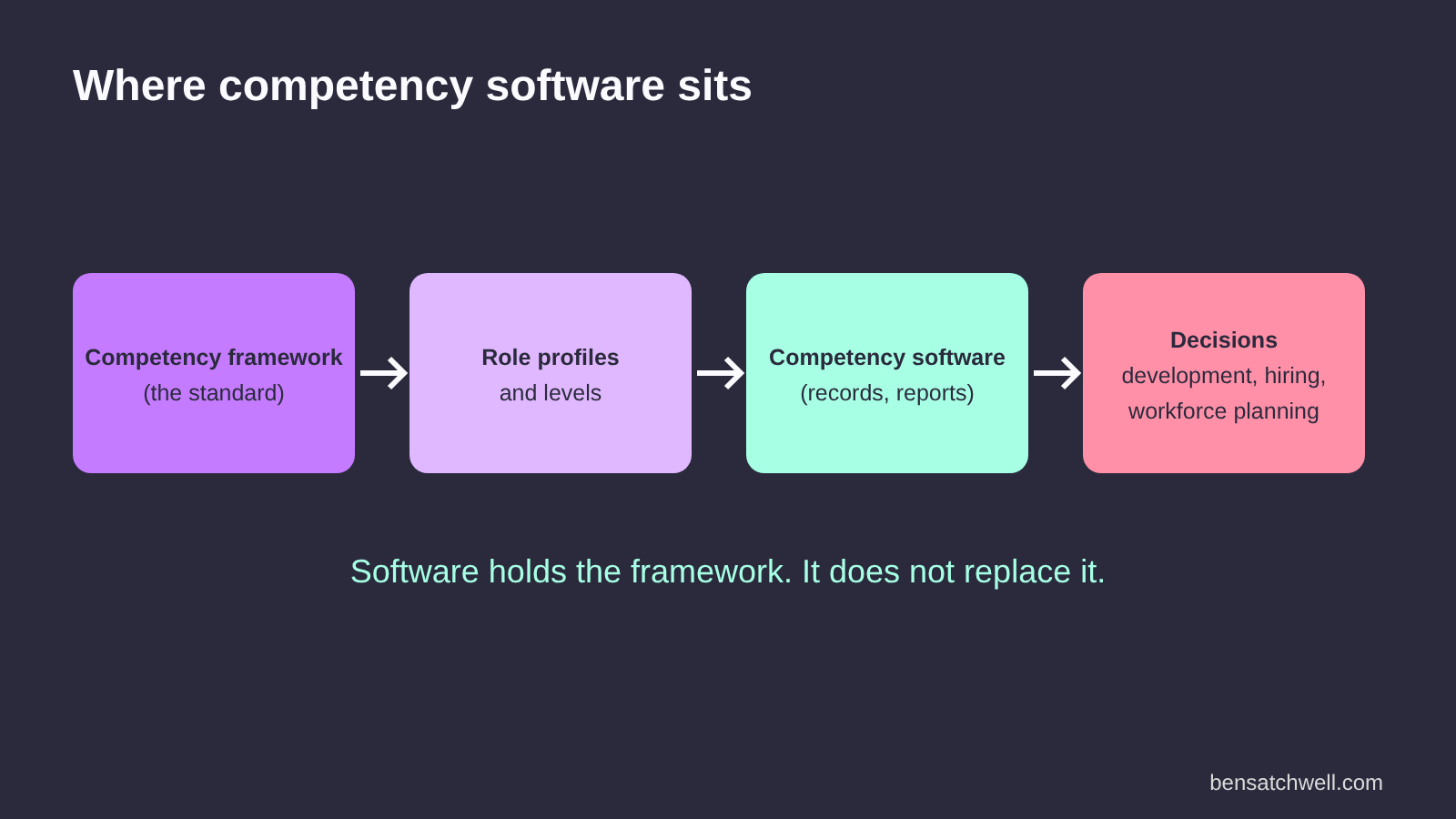
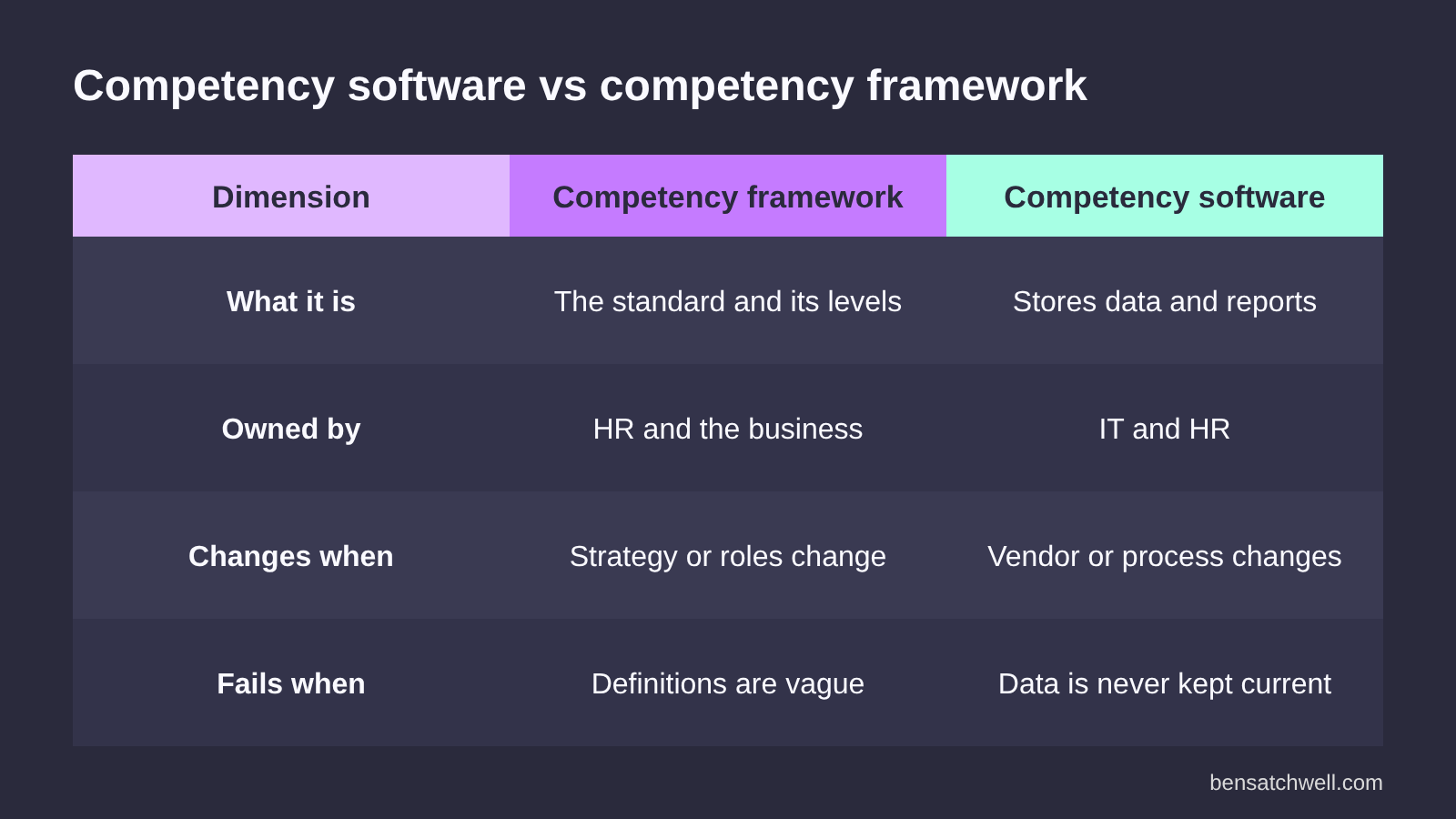
It is not a competency framework. The framework is the standard: what each competency means and what good looks like at each level. The software is the tool that stores and reports against it. Buying software does not design a framework, and a weak framework does not improve because it now has a login screen.
It is also not a performance rating tool, although many products connect to one. Competency ratings describe capability against a standard. Performance ratings describe results in a period. Mixing them in one score makes both unreliable.
Competency management software features to check before buying
Can it hold your framework as you designed it?
Test this with your own framework, not the vendor's sample. Check that it supports your number of proficiency levels, behavioural indicators per level, and the grouping of competencies into domains. Some products force a fixed scale or a flat skill list, which flattens a well-designed framework.
Does it import and export standard data?
You will want your data to move. Published standards show what interoperability can look like. The European Commission publishes ESCO, a multilingual classification that, per its own site, describes 3,039 occupations and 13,939 skills in 28 languages and can be downloaded or accessed through an API. The SFIA Foundation supplies the SFIA 9 skills and responsibilities as a spreadsheet you can import into your own tools, after registration. If a product cannot import a structured framework or export your assessment records in a usable format, you are renting your own data.
How does it treat personal information?
Assessment records are about identifiable people, and they include opinions about them. The Office of the Australian Information Commissioner describes personal information as a broad range of information, or an opinion, that could identify an individual. Manager ratings fit that description. Ask where the data is stored, who can see individual ratings, how long records are kept, and whether employees can see what is held about them.
Who maintains the framework inside the tool?
Frameworks change when roles and strategy change. Check how competency changes are versioned, whether past assessments keep their original definitions, and which role in your organisation is allowed to edit. A competency framework template is a useful baseline to compare against the vendor's data model.
Competency assessment software maturity levels
Organisations use these tools at different depths, and the deeper levels only pay off if the earlier ones are sound.
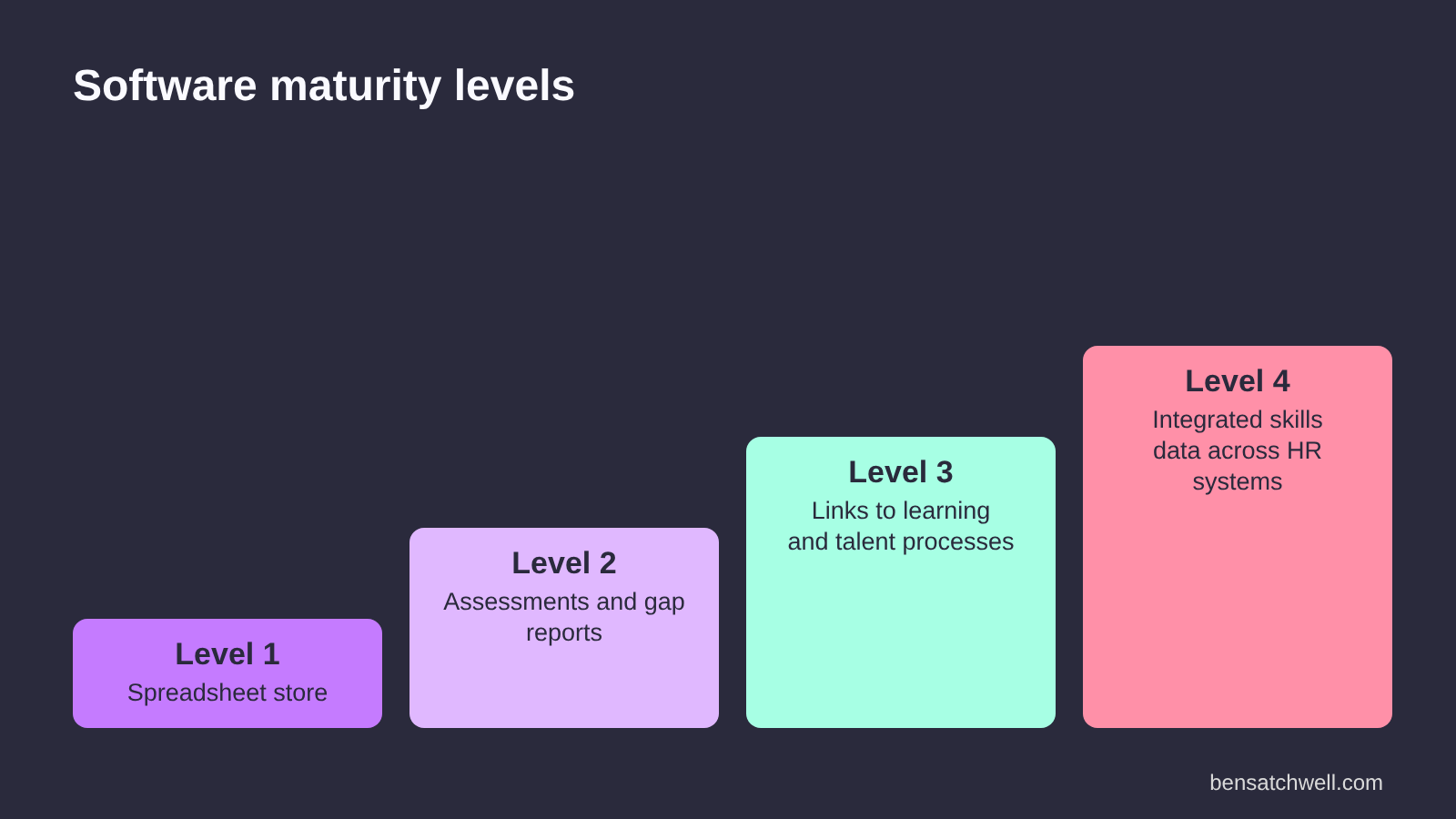
- Level 1, spreadsheet store. The framework and ratings sit in files. Cheap and flexible, but slow to query and hard to keep consistent.
- Level 2, assessments and gap reports. A system runs assessments and produces gap reports by person, team and role.
- Level 3, links to learning and talent processes. Gaps drive development plans, succession and internal mobility decisions.
- Level 4, integrated skills data across HR systems. Competency data flows between the HR information system, learning, recruitment and workforce planning.
Common failure modes of competency management software
- Buying before the framework is stable. The vendor's competency library becomes the framework by default. Nobody owns it and nobody can explain why it says what it says.
- Self-ratings with no calibration. People rate themselves generously or harshly, and the average means nothing. Ratings need evidence or a calibration step.
- Too many competencies per role. A role profile with thirty competencies produces a thirty-row form nobody completes properly.
- Data that is never refreshed. A gap report built on assessments two years old describes a workforce that no longer exists.
- Treating the dashboard as the decision. A heatmap shows where ratings are low. It does not show why, and it does not say what to do.
Trade-offs and constraints
Software earns its cost when you have enough roles and people that manual maintenance has broken down, and when someone owns the framework and the assessment cycle. Below that scale, a well-built spreadsheet with a clear owner often does the job and keeps your options open. Above it, the cost is less the licence than the effort to keep definitions current and ratings credible.
There is also a design trade-off. A tool that makes assessment quick tends to encourage shallow ratings. A tool that demands evidence produces better data and lower completion rates. Decide which you need before you compare products.
Frequently asked questions about competency assessment software
What is competency assessment software?
It is a system that holds a competency framework, records assessments of people against it, and reports the gap between required and current proficiency by person, team and role.
What is the difference between competency assessment software and competency management software?
The labels overlap. Assessment software focuses on rating people against the framework. Management software also covers the framework itself, role profiles, development plans and reporting. Most products sold under either name do both.
Do I need software to run a competency framework?
No. A framework works in documents and spreadsheets. Software becomes useful when the number of roles and people makes manual upkeep and reporting unreliable.
What should a competency framework contain before I load it into software?
Defined competencies, a set number of proficiency levels, observable behavioural indicators at each level, and role profiles that set a required level per competency. Without those, the software has nothing consistent to assess against.
Is competency data personal information?
Yes, in most cases. Ratings and manager opinions that identify an individual are personal information, so storage, access and retention need the same care as other employee records.
How do I compare vendors fairly?
Load the same framework and the same small set of role profiles into each product, run a trial assessment, and compare the gap reports and the exported data. Score the results against the same criteria, not the demonstration scripts.