
A sales manager competency framework defines what effective sales management looks like, level by level, and it is not the same thing as the sales competency framework you use for individual sellers. Most organisations that build a framework for their account executives make one critical error: they assume it also works for the people who manage them. It does not. Managing a sales team requires a distinct set of competencies that have almost nothing to do with selling.
Below I set out the eight core sales manager competencies, a four-level proficiency scale from new frontline manager to sales director, a worked example, and how to assess each competency with evidence rather than revenue alone.
What Is a Sales Manager Competency Framework?
A sales manager competency framework is an organisation-wide system that defines, organises and levels the competencies required to manage sales teams effectively. It describes what good sales management looks like at each proficiency level, expressed as observable behavioural indicators, so that hiring, development, promotion and performance decisions for sales managers are made against the same standard.
It is not a list of desired traits or a summary of job responsibilities. It specifies the competencies (integrations of skill, knowledge, judgement and behaviour), the proficiency levels at which they are held, and the behavioural indicators that allow those levels to be assessed.
A note on terminology. A competency framework is also called a competency model, especially in the United States. I use competency profile for the competencies and required levels for one role, and competency matrix for the grid of required against current proficiency. Usage varies by region, and I explain the differences in this competency model definition.
Why Sales Managers Need Their Own Competency Framework
A top-performing account executive excels because they build relationships, close complex deals and manage their own pipeline. Promoting that person into management without a clear competency standard exposes a common mismatch: selling ability predicts very little about the ability to coach, hire, hold performance conversations, forecast across a team or run a disciplined pipeline review.
This is more than anecdote. In research published in the Quarterly Journal of Economics, Benson, Li and Shue analysed 53,035 sales workers across 214 US firms, 1,531 of whom were promoted into management. The strongest sellers were the most likely to be promoted, yet they became weaker managers: doubling a new manager's pre-promotion sales was associated with a 7.5 per cent decline in the sales performance of each of their subordinates. Collaboration experience was the better predictor of managerial performance.
A sales manager competency framework addresses this by defining a standard for management that is independent of sales history. Some organisations call this a sales management framework. Either way, it is distinct from a sales methodology or sales process framework, which governs how reps sell rather than how they are managed.
Sales Manager Proficiency Levels: From Frontline Manager to Sales Director
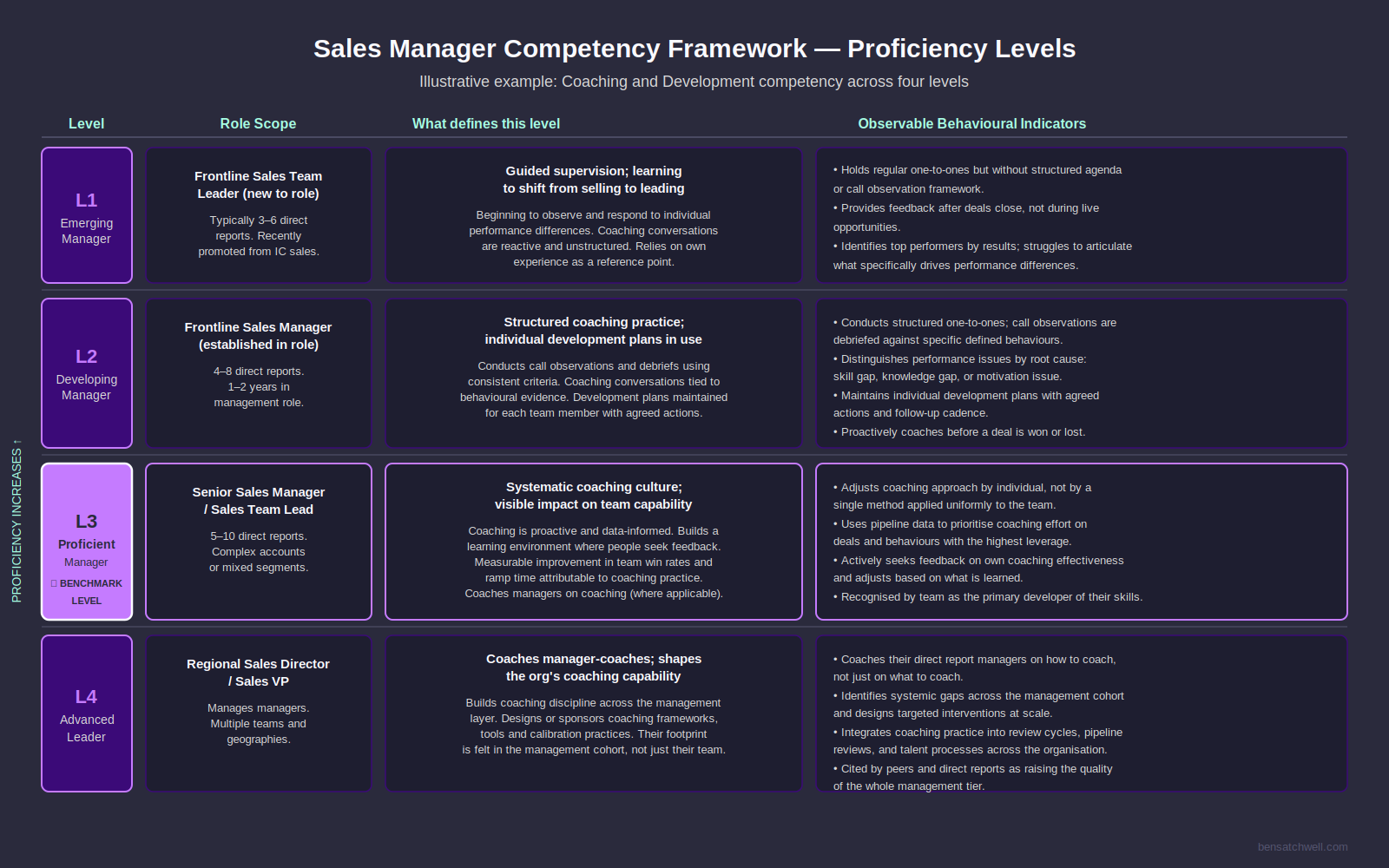
Every competency in the framework is levelled. I recommend four levels for sales management. As with any set of competency framework levels, they are defined by scope, autonomy, complexity and impact, not by job title or tenure.
- L1 Emerging: still shifting from selling to leading. Acts reactively and uses personal sales experience as the reference point. Typical of a team leader new to the role.
- L2 Developing: applies structured routines to one team, such as regular one-to-ones, consistent pipeline inspection and documented development plans. Typical of an established frontline sales manager.
- L3 Proficient: manages proactively using data, adapts to each individual and produces measurable improvement in team capability. The benchmark for a senior sales manager.
- L4 Advanced: manages managers and shapes the system, including operating rhythm, forecasting discipline, hiring standards and coaching practice across teams or regions. Typical of a regional sales director or sales VP.
The role mapping is a typical pattern, not a rule. A frontline manager running a complex enterprise team may need L3 in forecasting long before they manage other managers.
The 8 Core Sales Manager Competencies
These are the sales management competencies I include in almost every sales manager framework. Most lists online call them "sales manager skills", but each integrates skills, knowledge, judgement and behaviour in the context of the role, which makes them competencies. They sit in three domains, plus an optional fourth where managers carry significant cross-functional responsibility:
- Developing talent: sales coaching, and hiring and selection.
- Driving commercial outcomes: pipeline and forecast management, territory and capacity planning, and commercial acumen.
- Managing performance: performance management, and sales team leadership.
- Stakeholder influence (optional): cross-functional influence.
Each competency below has a definition and indicators for L2 to L4. L1 is the same behaviour performed inconsistently or only with support.
1. Sales coaching
Diagnosing the specific behaviours behind each seller's results and improving them through structured observation, feedback and practice, kept separate from deal management.
- L2 Developing: holds structured one-to-ones, debriefs call observations against defined behaviours and keeps a development plan for each rep.
- L3 Proficient: uses pipeline and conversation data to focus coaching where it has most impact, and adapts the approach to each individual.
- L4 Advanced: coaches their managers on how to coach and protects coaching time in the regional operating rhythm.
2. Hiring and selection
Defining what a successful seller looks like for a specific role and selecting against that standard with structured, evidence-based methods rather than instinct or likeability.
- L2 Developing: uses a structured interview guide and scorecard for every vacancy.
- L3 Proficient: designs role-specific work samples, calibrates panel ratings and tracks new hires' ramp-up to refine the profile.
- L4 Advanced: sets hiring standards across teams, builds a candidate bench ahead of need and assesses internal sellers for management potential before promoting them.
3. Pipeline and forecast management
Inspecting the quality and progression of the team's pipeline, and producing an accurate, evidence-based forecast from it.
- L2 Developing: runs regular pipeline reviews that test stage criteria and next steps, and removes stalled deals.
- L3 Proficient: forecasts by deal and category, explains variances and uses conversion data to spot gaps a quarter ahead.
- L4 Advanced: sets the forecasting method across teams, reconciles bottom-up and top-down views and holds managers accountable for accuracy.
4. Territory and capacity planning
Deciding how accounts, territories, quota and headcount are allocated so the team has enough capacity and coverage to reach its number.
- L2 Developing: allocates accounts and leads fairly within a defined territory and flags capacity gaps early.
- L3 Proficient: models coverage against quota, balances territories by potential rather than history and plans hiring around ramp time.
- L4 Advanced: designs territory and quota structures across regions with sales operations and finance.
5. Commercial acumen
Understanding how the business makes money and applying it to pricing, deal structure, discounting and where the team spends its time.
- L2 Developing: applies discount rules consistently and can explain the margin impact of a deal.
- L3 Proficient: shapes deal structures to protect margin and redirects effort toward the segments with the best return.
- L4 Advanced: contributes to go-to-market, pricing and product decisions using customer and pipeline evidence.
6. Performance management
Setting clear expectations, diagnosing the cause of underperformance and acting on it fairly and early, using activity, pipeline and behavioural evidence rather than quota attainment alone.
- L2 Developing: sets clear activity and pipeline expectations and holds documented performance conversations.
- L3 Proficient: separates skill, knowledge, motivation and territory causes of underperformance and responds to each before it reaches formal process.
- L4 Advanced: builds consistent performance standards and calibration across managers.
7. Sales team leadership
Running the team's operating rhythm and sustaining focus through quota cycles, including the quota, incentive and recognition conversations specific to sales.
- L2 Developing: runs a consistent weekly rhythm of team meetings, pipeline reviews and one-to-ones, and explains quota changes clearly.
- L3 Proficient: adapts the rhythm to the sales cycle and retains strong performers through difficult quarters.
- L4 Advanced: builds a management layer that sustains performance across teams without depending on them.
8. Cross-functional influence
Working with marketing, product, customer success, finance and sales operations to remove obstacles for the team and shape the inputs it depends on.
- L2 Developing: escalates issues with clear evidence and keeps working relationships with adjacent teams.
- L3 Proficient: negotiates lead quality and handover agreements with marketing and customer success.
- L4 Advanced: represents the sales view in planning and investment decisions.
Sales Manager Competency Framework Example: A Frontline Manager Profile
A framework becomes useful when it is applied to a role. Here is a worked example of a competency profile for a sales manager, drawn from the framework above. For more on how role profiles relate to their framework, see my article on the management competency profile.
Role boundary: frontline sales manager leading seven mid-market account executives, owning the quarterly team number and forecast, and reporting to a regional sales director.
Target proficiency levels:
- Sales coaching: L3 Proficient
- Pipeline and forecast management: L3 Proficient
- Performance management, sales team leadership, hiring and selection, territory and capacity planning, commercial acumen: L2 Developing
- Cross-functional influence: L1 Emerging
Coaching and forecasting sit one level higher because this team runs multi-stakeholder deals and the manager's forecast rolls straight into the regional number.
Role-specific indicators (excerpt):
- Observes at least two customer calls per rep each month and debriefs them against the team's discovery standard.
- Calls the team forecast by deal every week and explains material movement from the previous call.
- Reviews every deal above a defined value against stage exit criteria before it enters commit.
The regional sales director profile uses the same eight competencies but sets L4 for coaching, forecasting, territory planning and cross-functional influence, and L3 for the rest. Same framework, different profile. That separation keeps assessment consistent across the whole sales leadership population.
How to Assess Sales Manager Competencies
The behavioural indicators, not the competency labels, are the unit of assessment. The most common mistake is to rate sales managers on their team's quota attainment and call it a competency assessment. Attainment is an outcome shaped by territory, market conditions and inherited pipeline, so it cannot tell you which competency is strong or weak. A sound competency assessment framework draws on several sources of evidence:
- Direct observation: sit in on a pipeline review, a one-to-one and a call debrief, and rate what you see against the target-level indicators.
- Work products: compare forecasts with actual results over several quarters, and review development plans and hiring scorecards.
- Multi-rater input: ask direct reports specific questions about coaching and performance conversations.
- Structured interviews and work samples: for hiring or promotion, score behavioural questions and simulations, such as a mock pipeline review, against the indicators. SHRM's guidance on competency-based hiring makes the same point about scoring answers against defined criteria.
- Calibration: compare ratings across managers at the same level so that L3 means the same thing in every region.
For sellers being considered for a first management role, assess the manager competencies before the promotion. Evidence of informal coaching and peer collaboration is a better signal than personal quota history, which is what the Benson, Li and Shue findings suggest.
What a Sales Manager Competency Framework Is Not
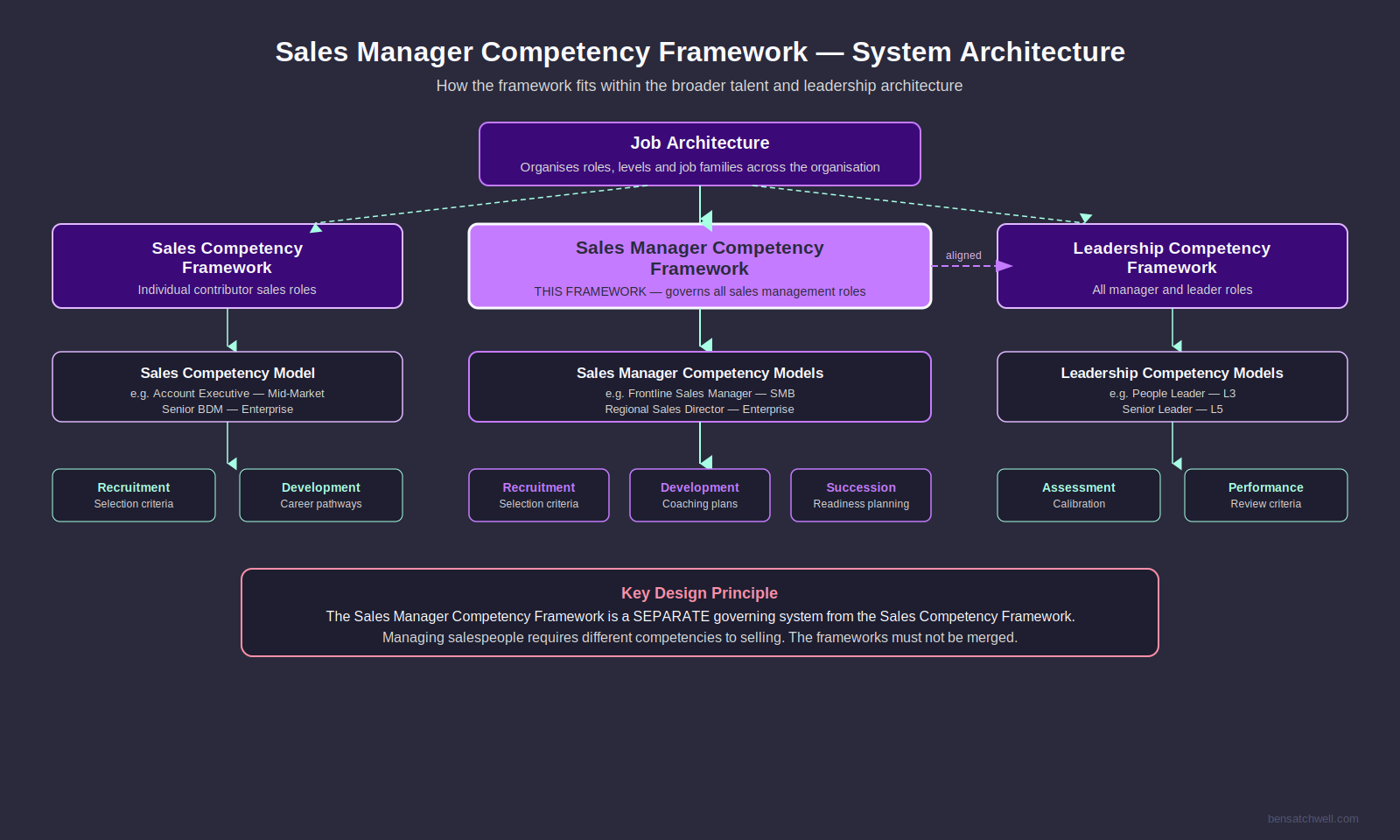
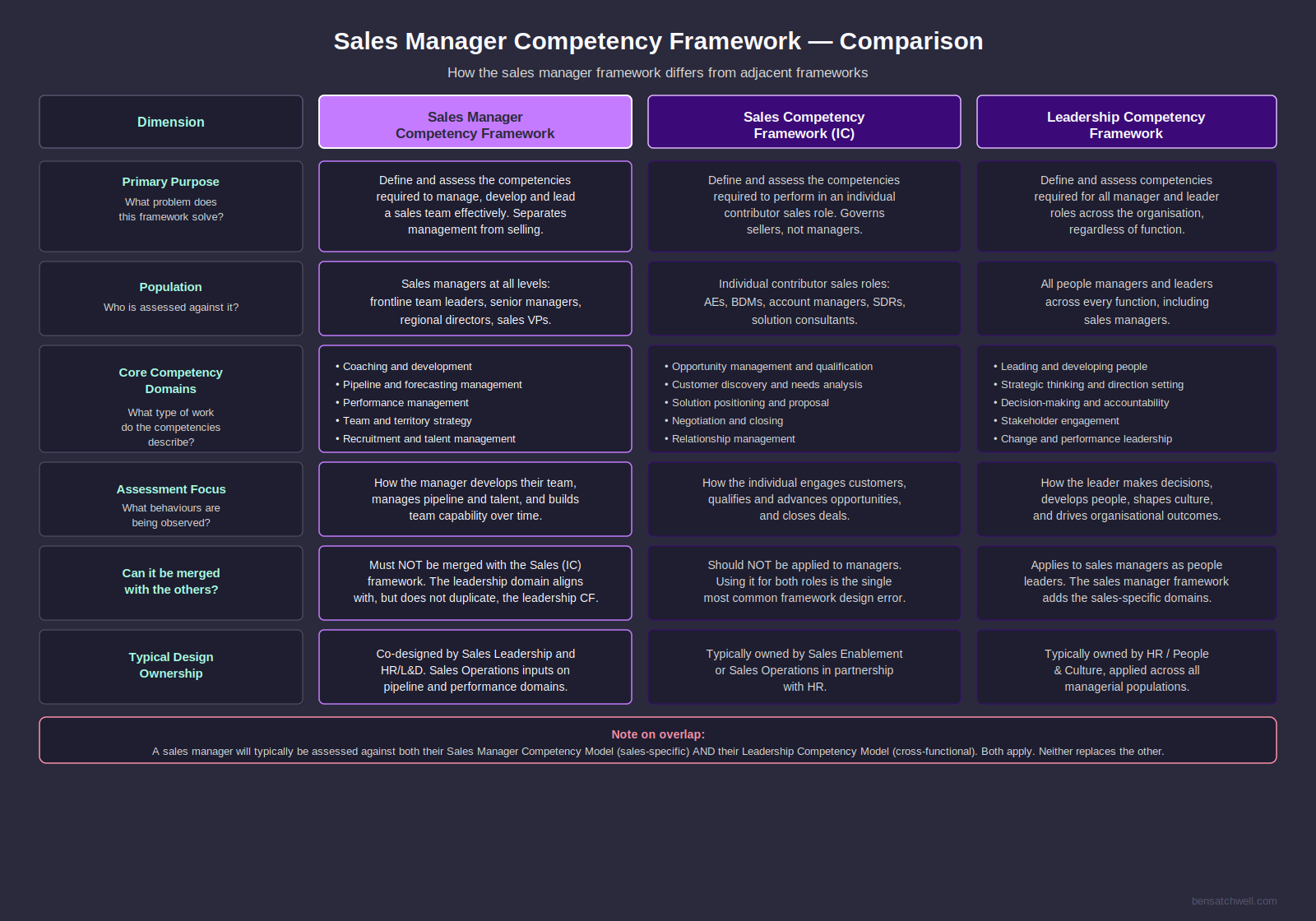
- It is not a sales competency framework. That framework governs individual contributors such as account executives and SDRs, and is applied through a sales competency profile for each selling role. Sellers' competencies centre on selling; a manager's centre on enabling others to sell. Merging them produces a framework that serves neither population.
- It is not a leadership competency framework. A leadership competency framework applies to managers in every function. The sales manager framework aligns with it and adds the commercial competencies it does not capture. Most sales managers are assessed against both.
- It is not a sales methodology. MEDDIC, Challenger or SPIN describe how deals are run. A framework can require managers to coach to your methodology, but the methodology is not the competency.
- It is not a job description or appraisal form. Those describe accountabilities and a review process. The framework is the standard both should follow from.
Named Frameworks and Occupational Standards
No single published standard defines sales manager competencies, but these reference points are worth using.
- Korn Ferry Leadership Architect: a commercial library of 38 competencies in four factors (thought, results, people and self). Many organisations build the leadership layer of a sales manager profile from it, then add sales-specific competencies such as pipeline and forecast management.
- O*NET Sales Managers (11-2022.00): the O*NET occupational profile for sales managers, sponsored by the US Department of Labor, lists tasks such as reviewing operational records to project sales, and skills including monitoring and judgement and decision making.
- OSCA Sales and Marketing Manager (112133): in Australia, the ABS Occupation Standard Classification for Australia, which replaced ANZSCO, lists directing sales strategy and target setting and leading sales teams among the occupation's tasks.
- CIPD: the CIPD factsheet on competence and competency frameworks is sound design guidance, particularly on balancing detail with flexibility.
O*NET and OSCA describe the occupation, not levelled behaviour, so treat them as a check on scope rather than a competency standard.
Common Failure Modes and Trade-offs
The most common failure is having no framework and relying on informal judgement about what good sales management looks like. The next is starting from a generic leadership framework and bolting on a few sales competencies, which leaves it thin on commercial specificity. The opposite happens when HR designs it without commercial leaders: it over-indexes on interpersonal behaviour and under-specifies pipeline rigour. And a framework that does not visibly shape hiring, development and review is a document, not a governing system.
A dedicated framework is worth the effort when the sales management population is large or strategically important. With only a handful of sales managers, a tailored profile built from your leadership framework is usually proportionate. Design at a level of abstraction that survives changes in methodology and tools, and review it at least annually.
Frequently Asked Questions
What are the key competencies of a sales manager?
The core sales manager competencies are sales coaching, hiring and selection, pipeline and forecast management, territory and capacity planning, commercial acumen, performance management, sales team leadership and cross-functional influence. In my experience, coaching and forecasting are where newly promoted managers struggle most.
What is a sales leadership competency profile?
A sales leadership competency profile is the set of competencies and required proficiency levels applied to a sales leadership role, such as frontline sales manager or regional sales director. It is drawn from the sales manager competency framework. Many North American sources call the whole system a competency model.
What is the difference between a sales competency framework and a sales manager competency framework?
A sales competency framework governs individual contributors, the people who sell. A sales manager competency framework governs the people who manage them. The two populations need different competencies, so keep the frameworks separate and connect them through your job architecture.
Can a leadership competency framework cover sales managers?
Partly. It covers the people side of management common to every function, but not commercially specific competencies such as sales coaching or pipeline and forecast management. For a large sales manager population, use a dedicated framework aligned to it.
How many proficiency levels should a sales manager competency framework use?
Four to six is the practical range, and four suits most sales management populations: emerging, developing, proficient and advanced. That spans a newly promoted frontline manager through to a director who manages managers.
Who should own the design of a sales manager competency framework?
HR or L&D usually leads the design, but sales leadership must co-own and endorse it, with sales operations contributing to the pipeline and forecasting competencies. Without commercial ownership, the framework lacks the credibility to be used in real decisions.