
Capability frameworks are foundational workforce infrastructure. They define what people must be able to do in order to perform effectively, independent of specific roles, tasks, or tools. When designed properly, capability frameworks support workforce planning, development, mobility, and organisational change without constant structural rework.
This article provides a clear capability framework definition, explains capability framework structure and levels, distinguishes capability frameworks from skills and competency frameworks, and sets out how they are applied in practice. Usage of these terms varies by region, and I explain how I use them in this competency model definition.
What is a capability framework?
A capability framework is a structured model that defines the capabilities required for effective performance across an organisation, function, or role family. It describes what individuals must be capable of doing, at increasing levels of scope and impact, independent of job titles or task detail.
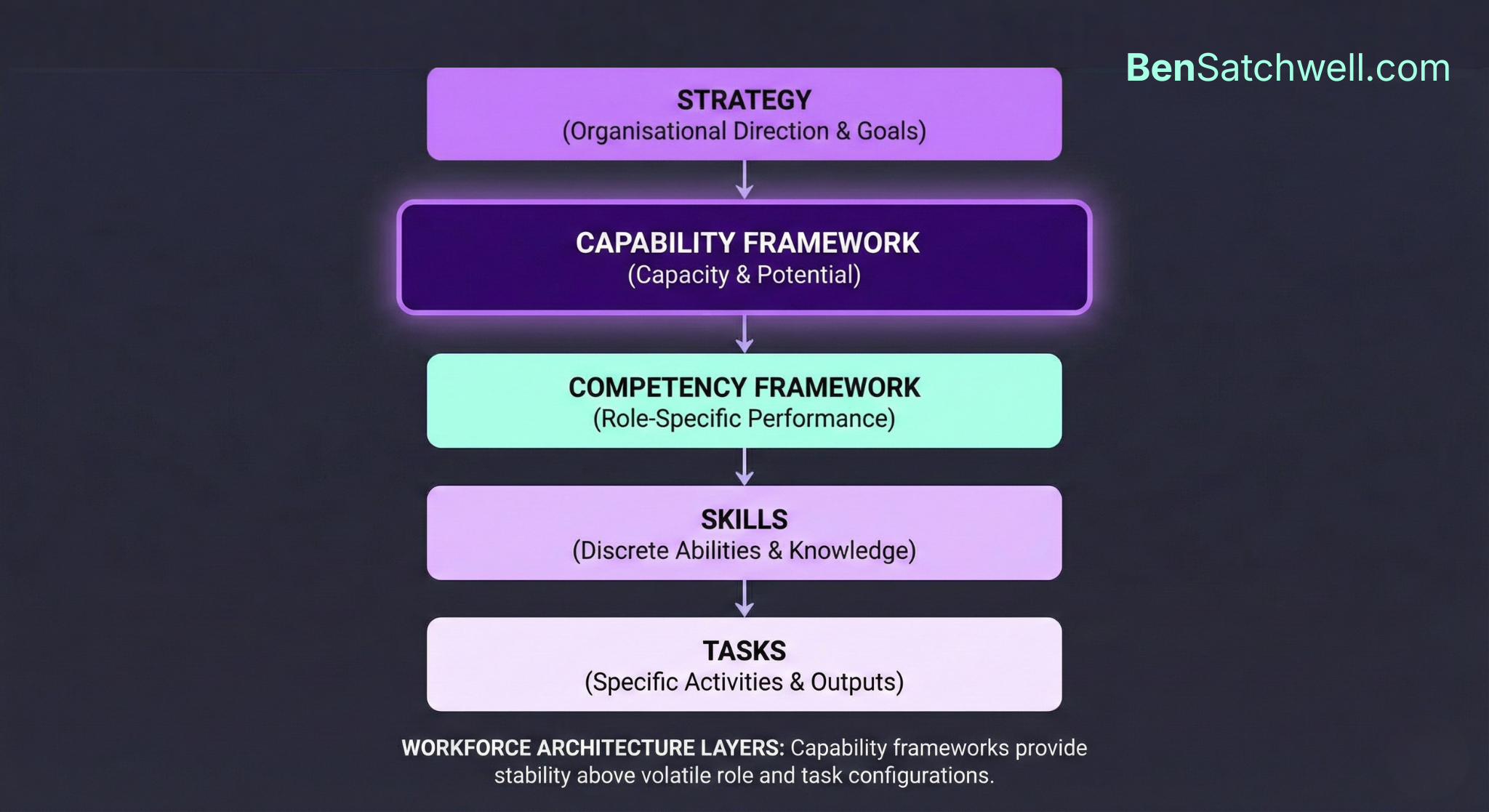
Capability frameworks operate at a level above roles and tasks. They provide durable reference points that remain valid even as operating models, technologies, and processes evolve.
In simple terms:
- Skills describe specific abilities.
- Tasks describe work activities.
- Capabilities describe broad, durable abilities that are transferable across roles and contexts.
Capability frameworks formalise that integration.
Why capability frameworks exist
Most organisations already maintain job descriptions, competency frameworks, and skills libraries. Yet common problems persist:
- Role ambiguity and overlap
- Rapid obsolescence of skills inventories
- Learning disconnected from strategic priorities
- Workforce planning based on headcount rather than people's underlying capability
The structural issue is this: roles and tasks change quickly. Technology, automation, and AI accelerate that change. When workforce architecture is anchored only to roles or tasks, it becomes unstable.
Capability frameworks introduce a stabilising layer. They define potential and durable ability in a way that remains meaningful even when work configuration shifts.
This is why capability frameworks are increasingly important in environments undergoing digital transformation, operating model redesign, or automation adoption.
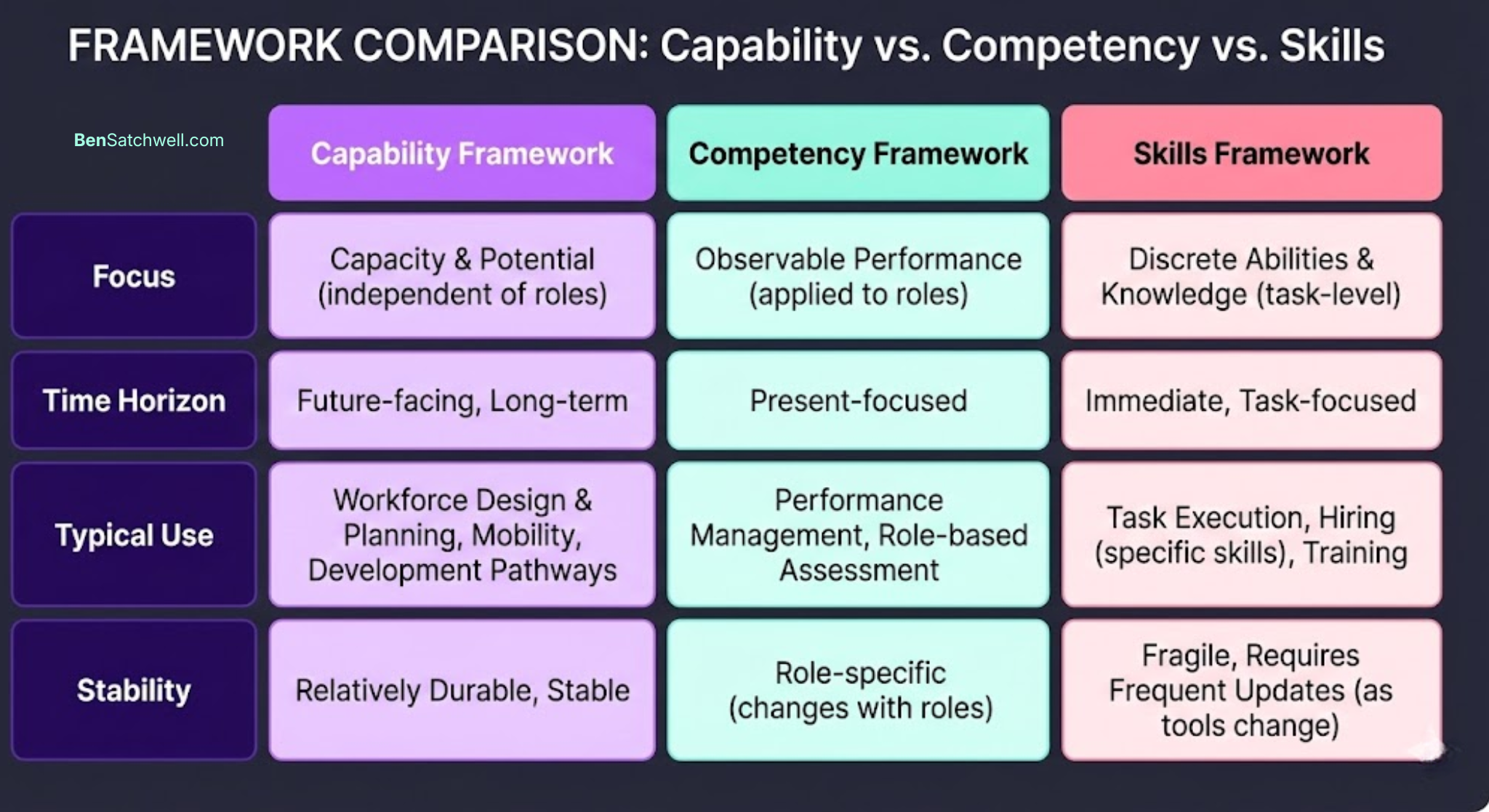
Difference between a capability framework and a competency framework
Capability frameworks and competency frameworks are related but distinct.
| Dimension | Capability Framework | Competency Framework |
|---|---|---|
| Core focus | Potential and durable ability | Observable performance |
| Time orientation | Future-facing | Present-focused |
| Stability | Relatively durable | Role-specific |
| Design question | What must someone be able to do? | How well must they perform? |
| Typical use | Workforce design and development | Performance management |
Capability frameworks define potential and durable ability.
Competency frameworks define performance standards applied to roles.
The confusion between the two often results in frameworks that are overly behavioural and compliance-driven, rather than structurally useful for workforce design.
Both have value. They operate at different layers.
Difference between a capability framework and a skills framework
Skills frameworks catalogue discrete skills.
Capability frameworks define broad, durable, transferable abilities.
A skill can be assessed independently. A capability is a broader, more durable ability that draws on multiple skills and remains relevant as those skills evolve.
For example, strategic thinking is not a single skill. It involves analysis, synthesis, communication, judgement, and decision-making. Treating it as a flat list of skills removes coherence.
Skills frameworks are precise but fragile. They require frequent updating as tools and techniques change. Capability frameworks are less granular but more durable.
This trade-off is intentional.
Core components of a capability framework
Effective capability frameworks share structural characteristics.
1. Capability domains
Logical groupings that organise related capabilities.
2. Capability statements
Outcome-oriented descriptions of what the capability enables.
3. Capability levels
Progressive levels reflecting increasing autonomy, complexity, scope, and impact.
4. Behavioural indicators
Observable signals that demonstrate capability at each level.
5. Scope definition
Clarity about whether the framework applies at enterprise, functional, or role-family level.
If these components are poorly defined, the framework either becomes abstract rhetoric or collapses into a skills inventory.
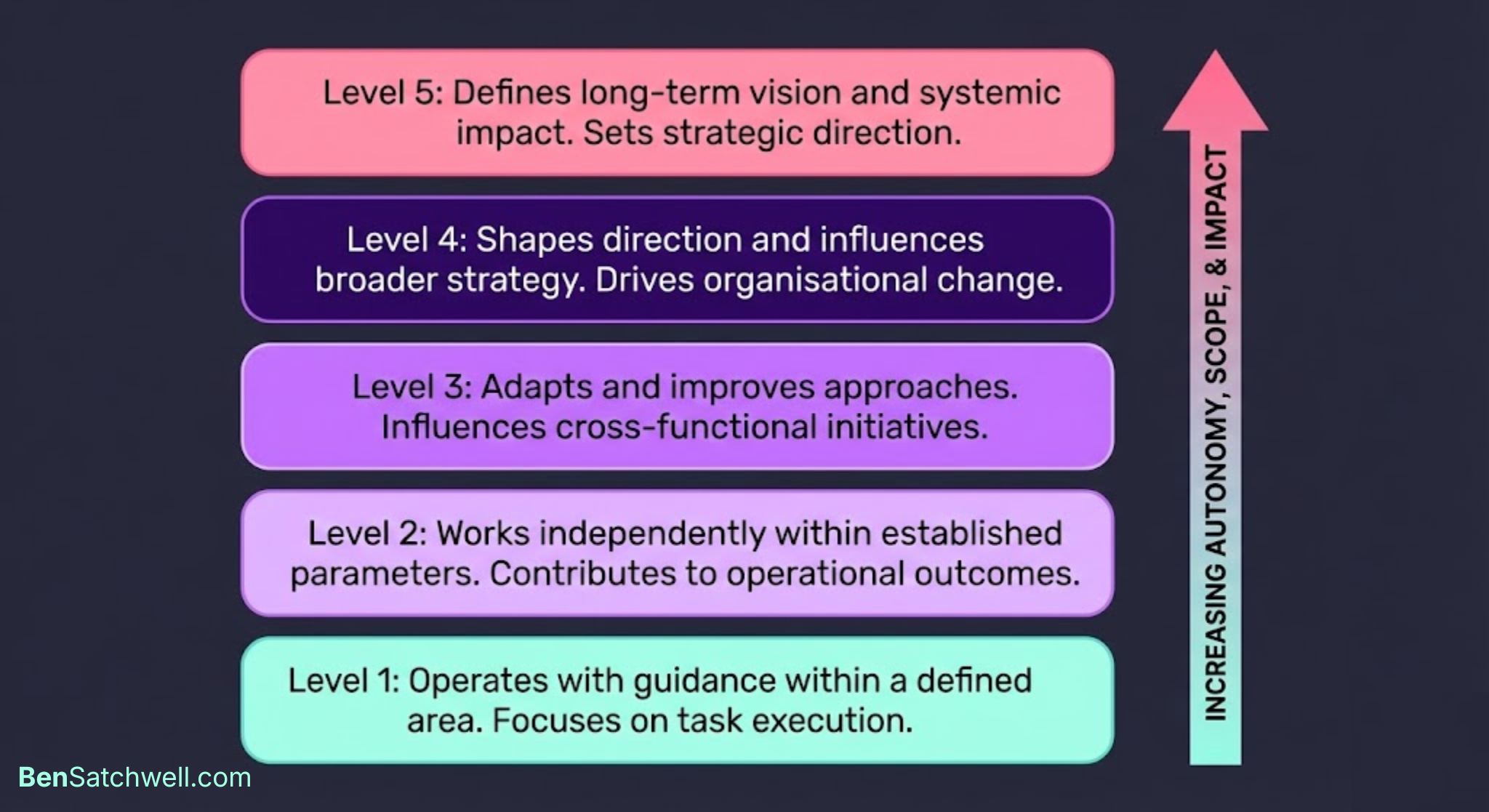
Capability framework levels explained
Capability framework levels describe progression of contribution.
They typically increase across dimensions such as:
- Autonomy
- Complexity of decisions
- Scope of influence
- Strategic impact
A common five-level structure:
- Foundational – operates with guidance, applies established practices
- Applied – operates independently in defined scope
- Proficient – adapts and improves approaches
- Advanced – influences others and shapes direction
- Strategic – defines long-term direction and system impact
The intent is not grading individuals. It is defining meaningful progression of capability.
When levels are well-designed, they support career mobility and workforce transparency.
What makes a core capability framework
A core capability framework defines capabilities required across the organisation, regardless of role.
Examples include:
- Strategic thinking
- Collaboration
- Decision-making
- Change leadership
- Digital literacy
Core frameworks provide coherence. Role-specific frameworks extend them. Digital literacy is a good example: it often sits in the core framework as one capability, which a digital literacy skills framework then expands into assessable skills.
Without a core layer, organisations often create fragmented models that cannot be reconciled across teams.
Types of capability frameworks
Capability frameworks vary by design intent.
Enterprise capability frameworks
Define organisation-wide priorities aligned to strategy.
Leadership capability frameworks
Define capabilities required to lead people and systems.
Manager capability frameworks
Focus on operational leadership and execution.
Employee capability frameworks
Define individual contributor expectations.
Layered design prevents duplication and conceptual drift.
Designing a capability framework: a structured method
Capability frameworks should not be written as abstract lists. A structured design process is required.
Step 1: Define strategic anchors
Identify long-term organisational capabilities required to execute strategy.
Step 2: Identify enduring capability domains
Separate stable capabilities from transient tasks.
Step 3: Draft outcome-oriented capability statements
Avoid task language. Focus on durable ability and impact.
Step 4: Define level progression
Articulate meaningful shifts in autonomy and scope.
Step 5: Validate against real work
Test the framework against existing roles and scenarios.
Step 6: Align with external reference models
Reference recognised frameworks such as SFIA, DigComp, and O*NET to ensure structural integrity.
This process prevents frameworks from becoming aspirational documents disconnected from reality.
Capability frameworks and workforce planning
Capability frameworks enable planning based on people's durable capability rather than headcount.
They allow organisations to:
- Map capability gaps against strategic priorities
- Identify transferable capability across roles
- Design development pathways aligned to need
- Model future workforce scenarios
Without capability clarity, workforce planning reduces to role-count forecasting, which is structurally limited.
Capability frameworks and automation
Automation and AI change tasks rapidly. Capability frameworks provide a way to distinguish between:
- Tasks that can be automated
- Skills that can be augmented
- Capabilities that remain human-centred
When capability, skills, and tasks are layered properly, organisations can evaluate automation impact without destabilising workforce architecture.
Common failure modes
Failure patterns recur across organisations:
- Conflating capability with skills
- Embedding task detail in capability statements
- Writing aspirational but non-operational language
- Designing frameworks without clear progression logic
- Creating overly complex models that cannot be implemented
These failures undermine trust and adoption.
Capability frameworks succeed when they are structurally rigorous and conceptually bounded.
When a capability framework is not appropriate
Capability frameworks are not suitable for:
- Short-term task optimisation
- Highly experimental project environments
- Purely behavioural performance issues
In such cases, task modelling or process redesign is more effective.
Capability frameworks are strategic infrastructure, not operational quick fixes.
Frequently Asked Questions About Capability Frameworks
What is a capability framework?
A capability framework is a structured model defining what individuals must be able to do to perform effectively, independent of specific jobs or tasks.
How does a capability framework differ from a competency framework?
A capability framework defines potential and durable ability. A competency framework defines performance standards applied to roles.
Are capability frameworks the same as skills frameworks?
No. Skills frameworks list discrete skills. Capability frameworks describe broad, durable abilities that are transferable across contexts.
How many capabilities should a framework contain?
Most effective frameworks include between eight and fifteen capabilities, depending on scope and organisational complexity.
How often should a capability framework be updated?
Core capability frameworks should remain relatively stable and reviewed periodically, typically every two to three years, unless strategic shifts require revision.
Can capability frameworks support AI and automation strategies?
Yes. They provide a structural layer for evaluating which tasks and skills are subject to automation while preserving enduring capability requirements.
Final perspective
Capability frameworks are structural infrastructure. They allow organisations to reason about people's potential and durable capability independently of volatile role and task configurations.
When designed with rigour, they support strategy execution, workforce planning, development, and change. When designed poorly, they become another compliance artefact.
The difference lies in clarity of boundaries, disciplined structure, and alignment to real work.