
Most organisations approach competency design backwards. They start with the outputs they want and try to reverse-engineer the competencies that might produce them. What gets left out is the structural logic: the understanding of which components combine to form a competency in the first place. The building blocks competency model exists to fix that.
What Is a Building Blocks Competency Model?
A building blocks competency model is a structured approach to competency design that defines competency as a combination of discrete, separable components: knowledge, skills, and attitudes (commonly abbreviated as KSA), along with additional dimensions such as behaviours, values, and sometimes context or environment. Rather than treating "competency" as a single indivisible concept, this model decomposes it into its constituent parts and defines each part explicitly.
The most widely cited version of this model comes from the US Department of Labor's Competency Model Clearinghouse, which organises competencies across a tiered pyramid from foundational personal effectiveness through industry-wide technical competencies to occupation-specific requirements. Each tier is built on the one below it, which is why the "building blocks" framing is apt.
A note on terminology. A competency framework is also called a competency model, especially in the United States. I use competency profile for the competencies and required levels for one role, and competency matrix for the grid of required against current proficiency. Usage varies by region, and I explain the differences in this competency model definition.
Why the Building Blocks Approach Exists
The problem this model addresses is definitional imprecision. In most organisations, competency frameworks conflate things that should be kept separate. "Communication" becomes a competency, but it is never made clear whether communication refers to a knowledge base (understanding how communication works), a skill (ability to structure and deliver a message), a behaviour (doing it consistently), or an attitude (valuing it as a practice). When these elements are bundled under a single label, assessment becomes unreliable and development planning becomes vague.
The CIPD has long identified this ambiguity as one of the primary reasons competency frameworks underperform in practice. Without a shared language for what makes up a competency, organisations end up measuring proxies rather than the thing itself.
The building blocks model forces clarity by requiring that each competency be traced back to its constituent components. Before you can assess someone's competency, you have to specify whether you are assessing their knowledge of the domain, their demonstrated skill in applying it, or their habitual behaviour around it. These require different assessment approaches, different development strategies, and different standards.
How the Building Blocks Model Works in Practice
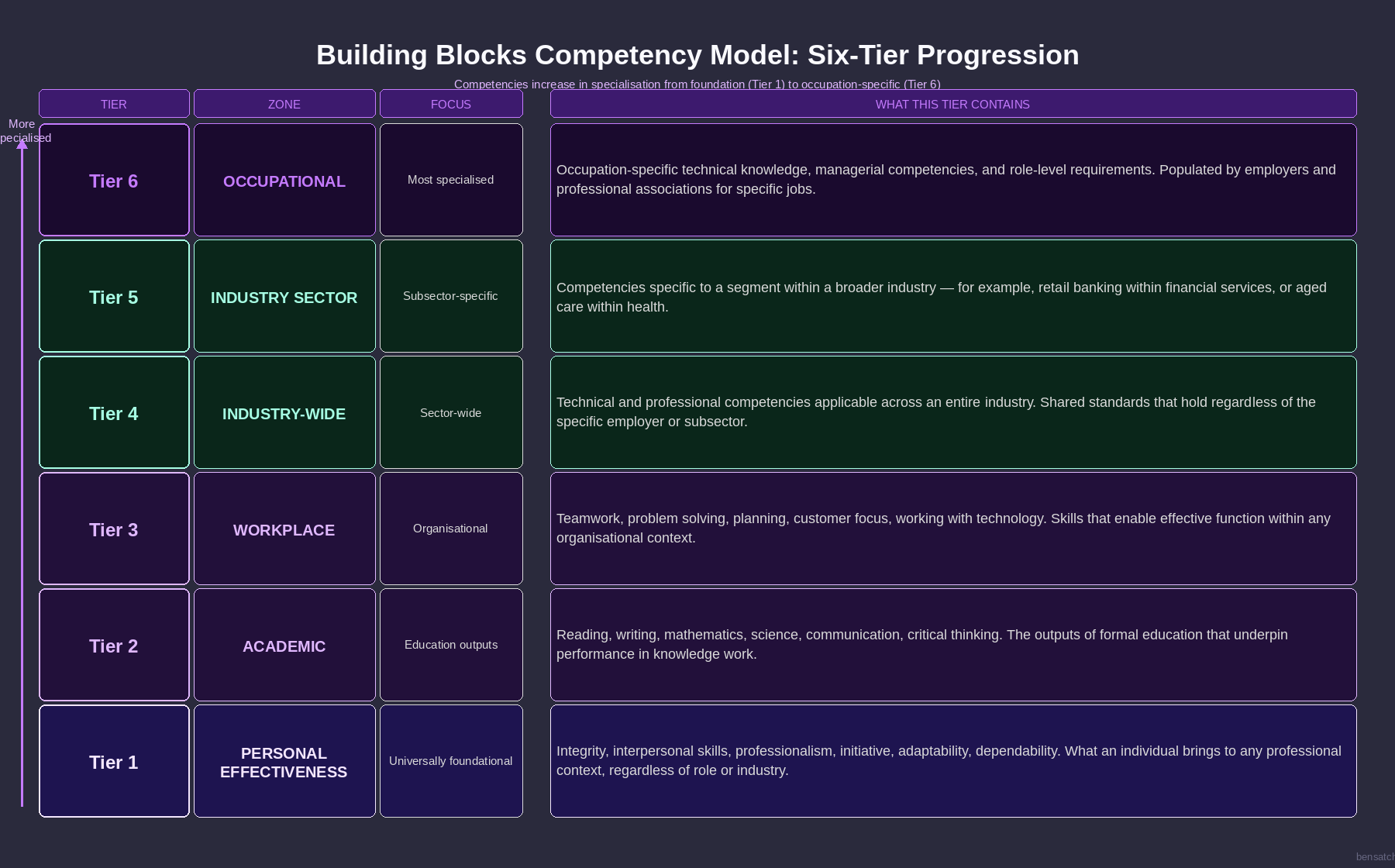
The model operates across multiple tiers, each representing a different layer of specificity. At the base sit foundational competencies that apply across almost any role: personal effectiveness, academic, and workplace competencies such as initiative, integrity, and dependability. As you move up the model, competencies become progressively more specific to an industry, then to a sector, and ultimately to a specific occupation or role.
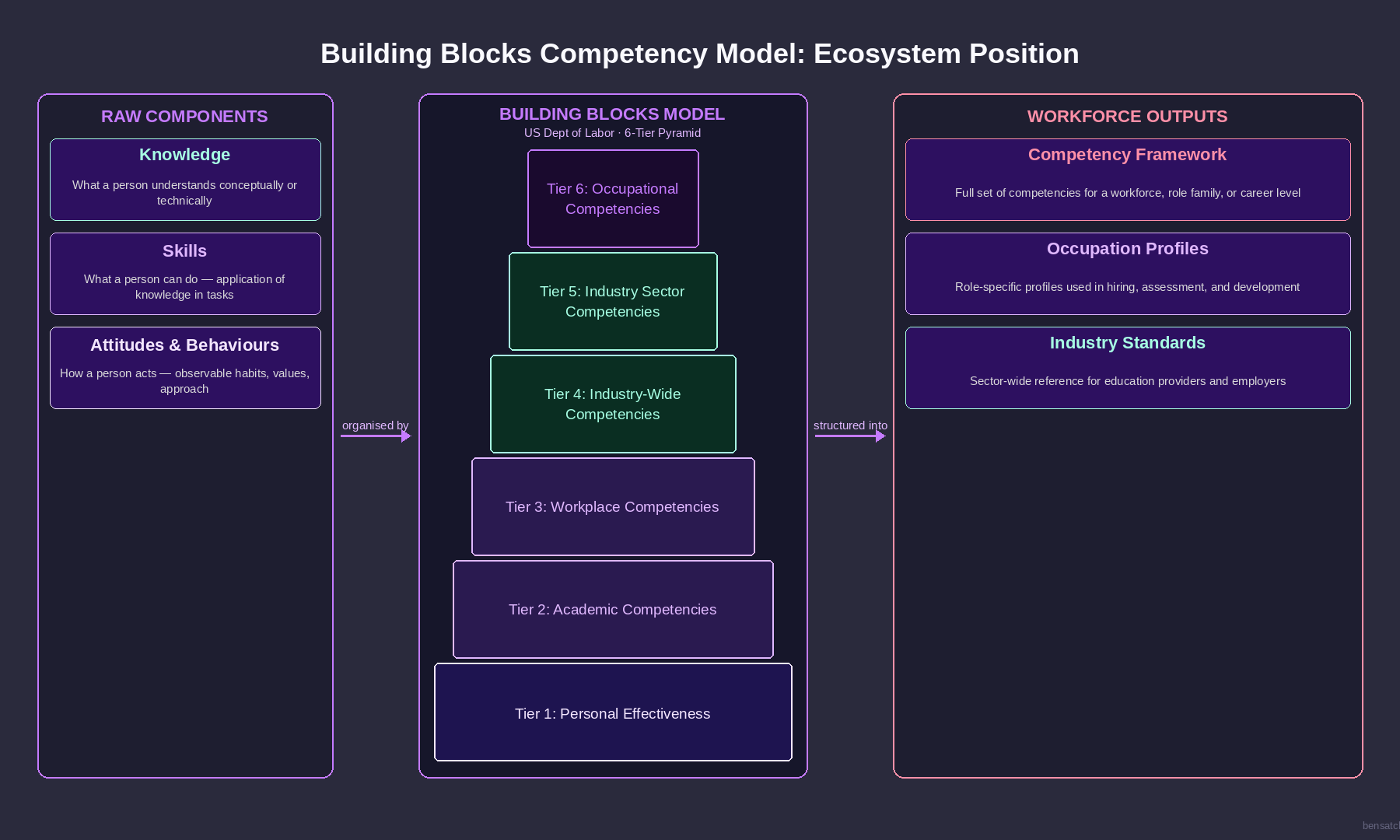
Within each tier, the building blocks principle applies: every competency at every level is decomposed into its KSA components. This is where the micro-design work happens. A single competency such as "data analysis" might require technical knowledge (statistical concepts, analytical tools), a specific skill (structuring and interpreting data sets), and an attitude (curiosity and attention to accuracy). Knowing which of these is underdeveloped tells you exactly what intervention is appropriate.
For teams working on competency profiles at the role level, the building blocks principle applies at the micro level too. The same decomposition logic that organises competencies across an industry can be applied to a single job family or role cluster, making it adaptable to a wide range of organisation types and sizes.
What a Building Blocks Competency Model Is Not
This is worth being explicit about, because the term gets used loosely.
A building blocks competency model is not simply any tiered competency framework. Tiers describe levels of specificity or proficiency, but they do not necessarily decompose competencies into their underlying components. Many frameworks are tiered without being structured around the KSA logic that distinguishes the building blocks approach.
It is also not a skills taxonomy. The distinction between competency and capability matters here. A skills taxonomy catalogues what skills exist and how they relate to each other. A building blocks competency model goes further by specifying the knowledge, skill, and attitudinal dimensions that make up each competency and how these combine to produce observable performance.
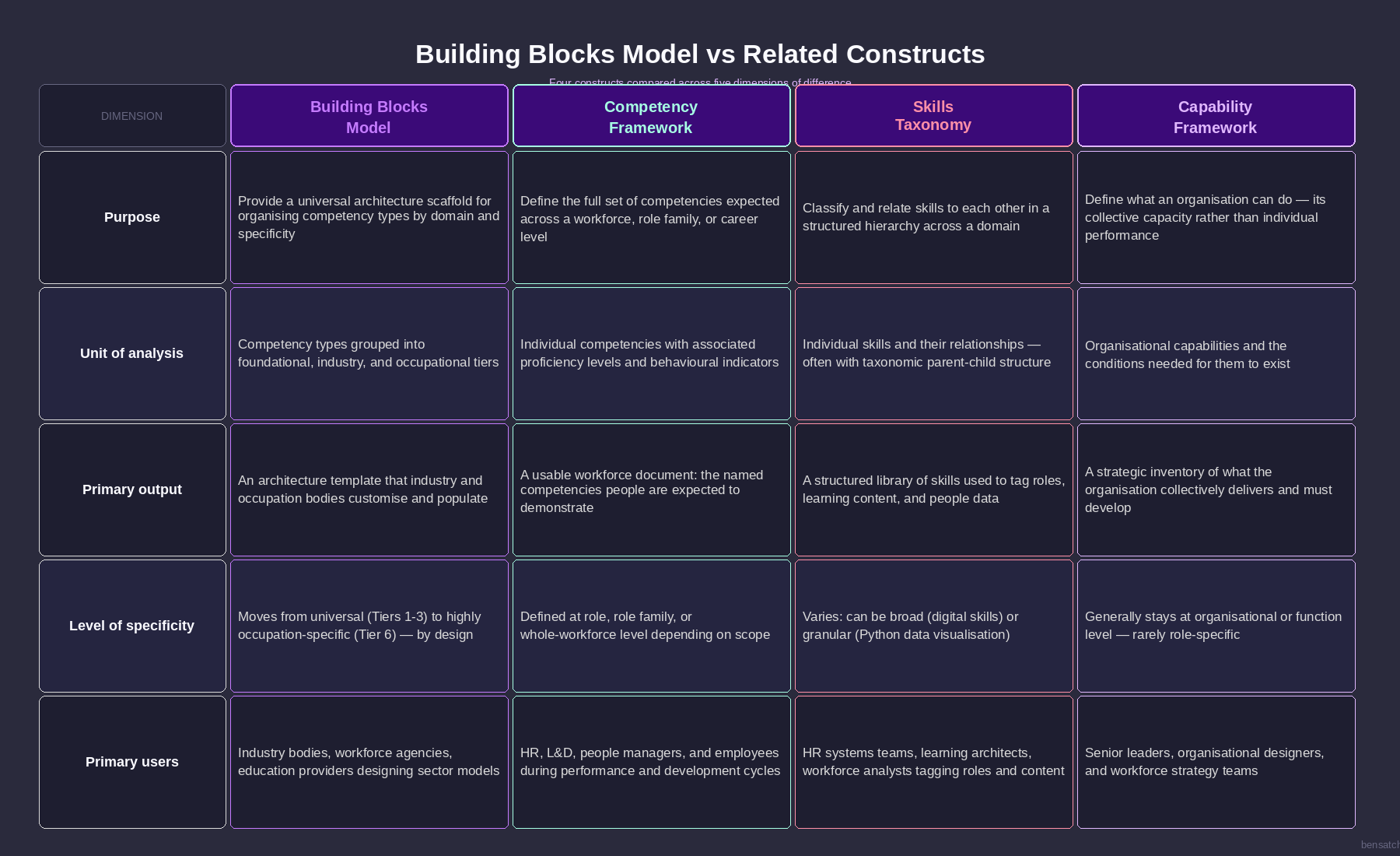
It is not a behavioural framework either. Behavioural frameworks focus on the observable outputs of competency. The building blocks model is interested in the underlying architecture, not just the surface behaviour. A person can exhibit the right behaviour for the wrong reasons, and a model that only measures behaviour misses that distinction.
Named Framework and Standard References
The most systematic treatment of the building blocks model in a workforce context is the US Department of Labor's tiered pyramid, developed to provide a common language for competency design across industries and occupational groups. It organises competencies into nine tiers from personal effectiveness at the base through to occupation-specific requirements at the top. See how the tiers compare with other competency model examples.
Research into KSA integration in vocational competence development supports this layered view. The KSA triad underpins most rigorous approaches to competency assessment, though different frameworks emphasise different dimensions. CIPD frameworks lean toward behaviours and attitudes. SHRM's competency model for HR professionals integrates KSAs with leadership and business acumen dimensions. Korn Ferry's model moves toward potentials and drivers, treating motivation and cognitive agility as foundational rather than derivative.
For HR competency frameworks specifically, the building blocks approach is particularly useful because HR roles span both specialist and generalist demands, and decomposing those demands into their KSA components makes it possible to assess and develop people against a precise, legible standard.
Common Failure Modes
The most frequent failure is doing the decomposition inconsistently. Some competencies in the framework are decomposed into K, S, and A components; others remain as bundled statements. This creates a patchwork model that is hard to assess and harder to use for development planning.
The second failure is conflating the building blocks framework with a job description. Job descriptions list tasks; building blocks competency models specify the underpinning knowledge, skill, and attitude that enable someone to perform those tasks. When organisations use task lists as proxies for competency components, they end up with a behavioural checklist rather than a developmental model.
The third failure is omitting attitudes entirely. Knowledge and skill are easier to assess and therefore more likely to be included. But attitudes such as intellectual curiosity, commitment to accuracy, or willingness to seek feedback are often the determining factor in whether knowledge and skill are applied effectively. A model that leaves them out is incomplete.
Trade-Offs and Constraints
The building blocks approach demands significant upfront investment in design rigour. Decomposing every competency in a framework into its K, S, and A dimensions is time-consuming, and maintaining that decomposition as roles evolve is ongoing work.
It also requires a level of shared language and conceptual precision that many organisations do not yet have. If HR teams and line managers do not share a clear understanding of the difference between a skill and a behaviour, the framework will be interpreted inconsistently regardless of how well it is designed.
For teams designing a competency assessment framework, this has direct implications for assessment design. Each building block calls for a different assessment method: knowledge is typically assessed through structured tests or professional conversation; skill through observed practice or work samples; attitude through structured behaviour-based interviews or 360-degree feedback. Combining these correctly requires both design knowledge and operational commitment.
The model is most valuable when there is genuine intent to use it for development planning, not just for role matching or performance appraisal. If the primary use case is to populate a job advertisement or fill a tick-box in a performance form, the building blocks level of granularity is overkill.
Frequently Asked Questions
What are the building blocks of a competency model?
The core building blocks are knowledge (what someone needs to understand), skills (what they need to be able to do), and attitudes (the dispositions and values that shape how they apply their knowledge and skills). Some models add behaviours and values as additional layers.
How is a building blocks competency model different from a skills framework?
A skills framework catalogues skills and their relationships. A building blocks competency model decomposes each competency into its constituent knowledge, skill, and attitudinal components, specifying not just what skills are needed but what knowledge and disposition support them.
What is the US Department of Labor building blocks model?
The US Department of Labor's building blocks model is a tiered pyramid that organises competencies from personal effectiveness at the base through workplace and academic competencies, industry-wide technical competencies, and occupation-specific competencies at the top. It is used as a national reference point for workforce development in the United States.
Is the building blocks model suitable for all organisations?
It is most suitable for organisations that need to develop people in complex, multi-dimensional roles and have the capacity to design and maintain a rigorous competency architecture. Smaller organisations or those using competencies primarily for recruitment may find simpler frameworks more practical.
Can the building blocks model be used for assessment?
Yes, but it requires matching the assessment method to the specific building block being assessed. Knowledge components call for different methods than skill or attitude components. A single assessment approach applied uniformly across all building blocks will produce unreliable results.