
Most organisations that want better product managers start in the wrong place. They rewrite job descriptions, restructure teams, or benchmark salaries against market data. None of that is wrong, but none of it is the thing. A product management competency framework is the thing. It defines what good looks like at every level before anyone starts making decisions about who has it.
The absence of that definition is more costly than most organisations realise. A systematic review of the product manager role found that PM responsibilities vary dramatically across company types, product contexts, and delivery methodologies. That variation makes the case for internal standards more pressing, not less. If the role itself is contested, the organisation needs its own clear position on what good looks like here.
What Is a Product Management Competency Framework
A product management competency framework is an organisation-wide governing structure that defines the competencies product managers need to be effective at each level of the function. It describes what good performance looks like, not in abstract traits or personality characteristics, but in observable behaviour at defined levels of proficiency.
A competency, precisely defined, is the integration of skills, knowledge, judgement and behaviour applied effectively in the context of a role. It is not a task. It is not a single skill. It is the compound thing: what a product manager actually produces when they bring all of those inputs to bear on real decisions in a real organisation.
The framework wraps around that competency definition with structure. It groups competencies into domains, typically core, functional and leadership. It sets proficiency levels that describe how those competencies should look at each stage of seniority. It writes behavioural indicators that make assessment observable rather than subjective. I cover the full architecture of this in the foundational definition of a competency framework.
A note on terminology. A competency framework is also called a competency model, especially in the United States. I use competency profile for the competencies and required levels for one role, and competency matrix for the grid of required against current proficiency. Usage varies by region, and I explain the differences in this competency model definition.
Why a Product Management Competency Framework Exists
The specific problem this framework solves is ambiguity. Without it, “good product manager” means different things to different people in the same organisation. Hiring managers assess for different qualities. Performance reviews measure inconsistent things. Career conversations produce different advice depending on who is having them. The framework replaces that ambiguity with shared standards.
It also solves a calibration problem. At scale, organisations need to compare product managers across teams, geographies, and product types. Without a common standard, those comparisons are either absent or based on whoever argues most confidently in a calibration meeting. Research on how competencies connect to project and product outcomes demonstrates that defined competency structures are associated with better delivery performance. Not because the framework itself produces outcomes, but because it creates conditions for targeted development and clearer accountability.
The framework is also the precondition for everything else. You cannot run a meaningful performance review, build an honest career pathway, or make a defensible hiring decision without first agreeing what the role requires at each level.
How a Product Management Competency Framework Works in Practice
The framework is built around three competency domains.
Core competencies apply to every product manager in the organisation, regardless of specialism or level. These define what it means to be a PM here: customer focus, data-informed decision-making, cross-functional influence, and commercial awareness.
Functional competencies are specific to the product manager role and its distinct activities: product discovery, roadmap prioritisation, go-to-market coordination, and technical understanding. These are where the product management specialism lives, and where organisations need to do the hardest definitional work.
Leadership competencies apply at senior levels, where scope and accountability shift from shipping product to shaping function. Product vision, portfolio strategy, and team development belong here.

Proficiency Levels
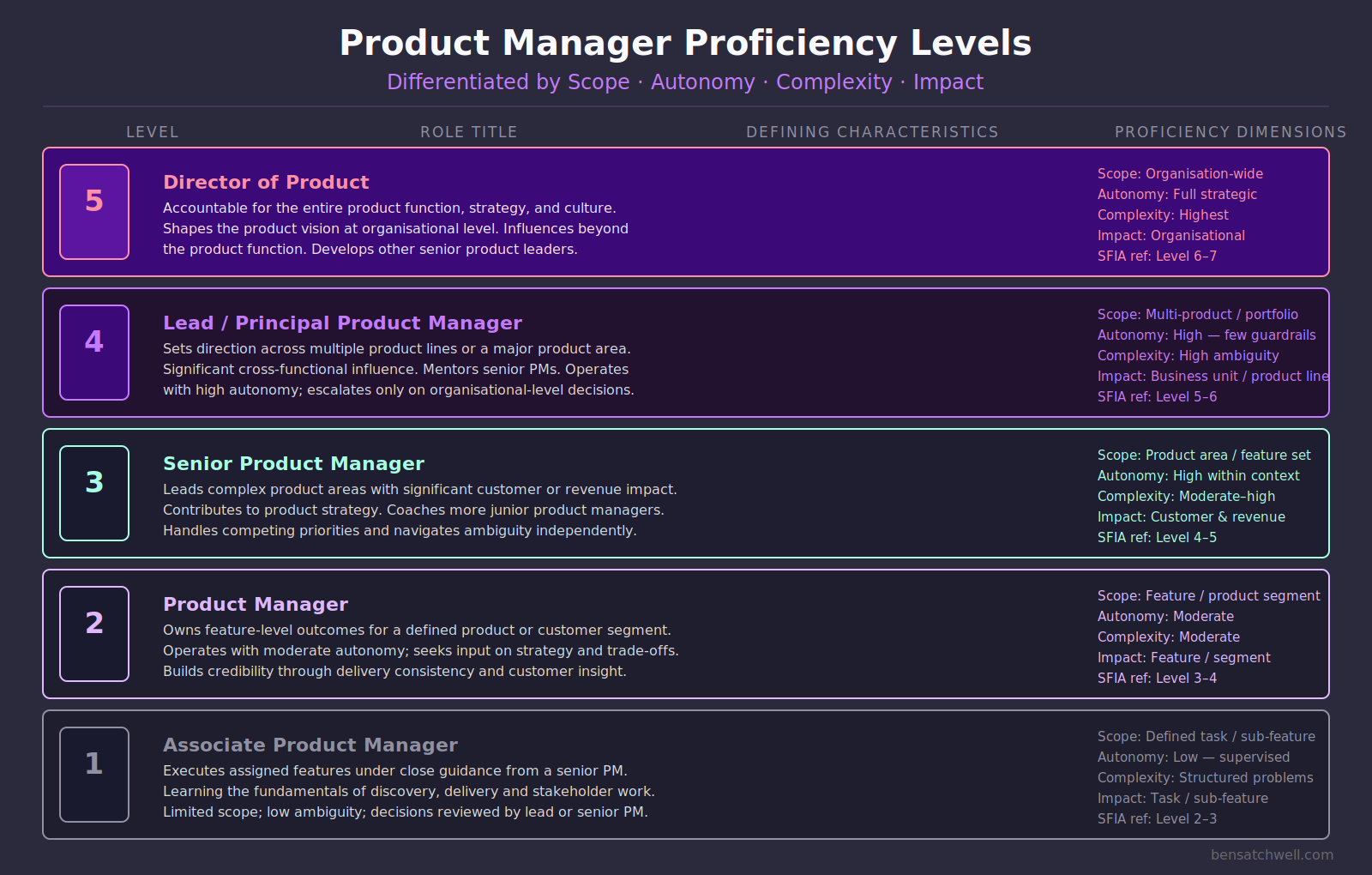
Proficiency levels define how each competency should look at each stage of career development. A well-designed framework uses four to six levels, separated by meaningful differences in scope, autonomy, complexity and impact, not by years of experience or job title alone.
At the entry level, a product manager is focused on execution within a well-defined problem space. At the senior end, they are shaping product strategy and developing the function around them. The levels tell the story of that progression, competency by competency.
Behavioural indicators translate each proficiency level into observable acts. They describe what the competency looks like in action, not what someone knows, but what someone does. That is what makes assessment consistent. For guidance on building this structure, see the full guide to creating a competency framework.
What a Product Management Competency Framework Is NOT
Three things frequently get confused with a product management competency framework, and the confusion matters because it leads organisations to build the wrong thing.
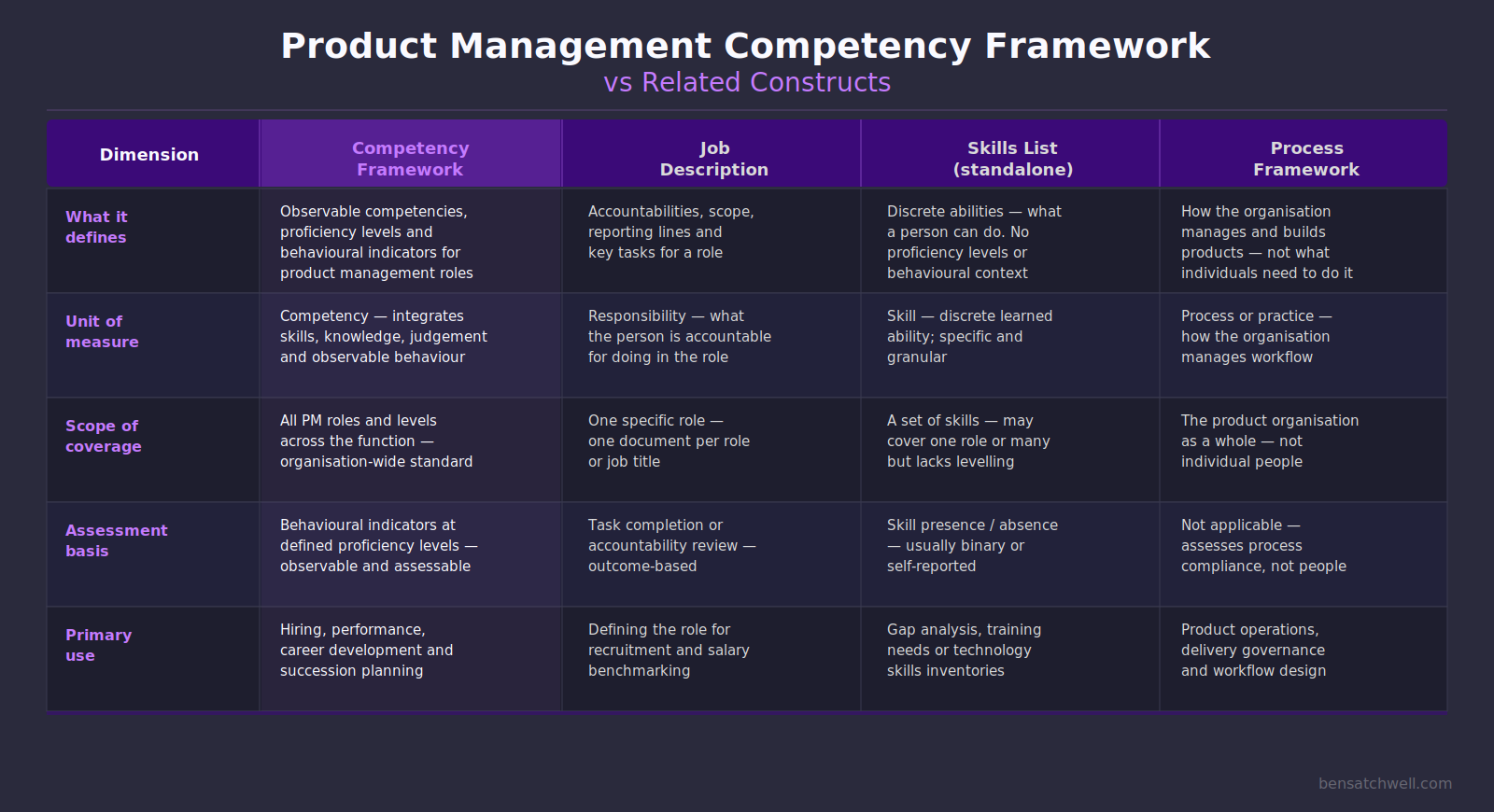
It is not a job description. A job description lists responsibilities. A framework defines how those responsibilities should be executed at each level. A senior PM and a principal PM may have the same responsibilities on paper; the framework describes the difference in expected performance quality and scope between them.
It is not a skills list. Skills are discrete, granular and transient. The specific abilities a person can apply to a task. Competencies integrate skills with knowledge, judgement and behaviour into something more durable and contextually applied. A product manager might have strong SQL skills; whether they have data competency depends on whether they apply that with the right judgement in their actual role. I explore this in more depth when looking at how competency frameworks differ across contexts.
It is not a process framework. A product management process framework describes how work gets done: discovery cycles, prioritisation processes, delivery cadences. A competency framework describes the person doing that work. They are complementary, but not the same thing. A systematic literature review on this distinction found that conflating the two is one of the most common sources of confusion in the field.
It is also worth noting the relationship to capability frameworks. Capabilities are broader, more durable, and owned by the person rather than tied to a role. I cover the relationship between the two in capability and competency frameworks compared.
Referenced Frameworks and Standards
No single external standard governs product management competencies in the way SFIA governs technology skills or CIPD governs HR competencies. That reflects how recently product management has professionalised as a distinct discipline.
Korn Ferry’s leadership competency architecture is sometimes adapted for senior PM roles, particularly at director and VP levels where the leadership dimensions of the role outweigh the technical ones. The Lominger competency library offers a structured starting point for organisations wanting to adapt an existing taxonomy rather than build from scratch. SFIA is relevant for product managers in technology organisations, particularly for technical understanding and digital product design competencies in the functional domain.
Common Failure Modes
Most product management competency frameworks that fail do so for one of four reasons.
Too many competencies. A framework with 30 or more competencies becomes unmanageable. Assessors cannot differentiate between similar definitions. Calibration conversations drift. Twelve to eighteen well-defined competencies is typically more useful than twenty-five half-defined ones.
Generic competencies. Competencies like “communication” or “strategic thinking” without definition are meaningless. They exist in every framework and distinguish no one. The value comes from defining what strategic thinking means in product decisions: roadmap prioritisation under constraint, or navigating competing stakeholder positions on product direction.
Level descriptors that describe titles rather than behaviours. Writing “leads a team” at the senior level and “contributes to a team” at the junior level does not describe competency. It describes reporting structure. Behavioural indicators need to describe observable acts that a manager could assess in a calibration session.
No governance. A framework without active governance is just a document. It needs to connect to hiring criteria, be referenced in performance reviews, and be owned by someone with the authority to maintain and update it as the role and organisation change.
Trade-offs and Constraints
A product management competency framework is worth building when a PM function has reached a size where informal calibration no longer holds, typically from around six to eight product managers, or when there is genuine inconsistency in hiring, performance, or progression decisions.
It is less useful in very small functions where the range of contexts is too narrow to justify a multi-level structure, or where the PM role varies so significantly by product type that a single framework forces false equivalences. A lightweight role profile aligned to a shared competency definition is often more practical in those cases.
The framework also requires maintenance. As product management practice evolves and the organisation’s product context shifts, competency definitions and level descriptors need revisiting. A framework designed for a B2B software context several years ago may not describe what good looks like in the same organisation today.
Frequently Asked Questions
What is a product management competency framework?
A product management competency framework is an organisation-wide governing structure that defines the competencies product managers need at each level of the function. It groups competencies into core, functional and leadership domains, sets proficiency levels, and writes behavioural indicators so performance can be assessed consistently.
How many competencies should a product management framework include?
Most effective frameworks sit between twelve and eighteen competencies. Fewer than ten tends to produce competencies too broad for meaningful assessment. More than twenty-five tends to produce calibration fatigue, where assessors cannot differentiate between similar-looking definitions.
What is the difference between a product management competency framework and a job description?
A job description lists the responsibilities a product manager is accountable for. A competency framework defines how those responsibilities should be executed at each level. A PM and a senior PM may have overlapping responsibilities; the framework is what distinguishes the expected quality and scope of performance between them.
How do competency frameworks connect to career progression for product managers?
The proficiency levels in a competency framework define what the progression from one level to the next looks like in behavioural terms. Career conversations become grounded rather than speculative. A PM who wants to move to the next level has specific behavioural indicators to work toward.
How is a product management competency framework different from a capability framework?
Competencies are role-specific and integrate skills, knowledge, judgement and behaviour in context. Capabilities are broader, more durable, and owned by the person rather than tied to a role. A competency framework defines what good looks like in this PM role at each level. A capability framework identifies the broader human capacities a person carries across roles. They serve different purposes and are built differently.